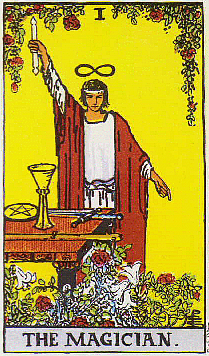
The Magus, Magician, or Juggler, the caster of the dice and mountebank in
the world of vulgar trickery. This is the
colportage interpretation,
and it has the same correspondence with the real symbolical meaning that the
use of the Tarot in fortune-telling has with its mystic construction
according to the secret science of symbolism...
On the table in front of the Magus are the symbols of the four Tarot
suits, signifying the elements of natural life, which lie like counters
before the adept, and he adapts them as he wills. Beneath are roses and
lilies, the
flos campi and
lilium convallium, changed into
garden flowers, to show the culture of aspiration.
ARTHUR EDWARD WAITE,
The Key to the Tarot
Part One
Un débauché de profession est rarement un homme
pitoyable.
DE SADE,
Les Infortunes de la Vertu
1
I was born in 1927, the only child of middle-class parents, both
English, and themselves born in the grotesquely elongated shadow, which
they never rose sufficiently above history to leave, of that monstrous
dwarf Queen Victoria. I was sent to a public school, I wasted two years
doing my national service, I went to Oxford; and there I began to
discover I was not the person I wanted to be.
I had long before made the discovery that I lacked the parents and
ancestors I needed. My father was, through being the right age at the
right time rather than through any great professional talent, a
brigadier; and my mother was the very model of a would-be major general's
wife. That is, she never argued with him and always behaved as if he were
listening in the next room, even when he was thousands of miles away. I
saw very little of my father during the war, and in his long absences I
used to build up a more or less immaculate conception of him, which he
generally — a bad but appropriate pun — shattered within the
first forty-eight hours of his leave.
Like all men not really up to their jobs, he was a stickler for
externals and petty quotidian things; and in lieu of an intellect he had
accumulated an armory of capitalized key words like Discipline and
Tradition and Responsibility. If I ever dared — I seldom did
— to argue with him he would produce one of these totem words and
cosh me with it, as no doubt in similar circumstances he coshed his
subalterns. If one still refused to lie down and die, he lost, or loosed,
his temper. His temper was like a violent red dog, and he always had it
close to hand.
The wishful tradition is that our family came over from France after
the Revocation of the Edict of Nantes — noble Huguenots remotely
allied to Honoré d'Urfe, author of the seventeenth-century bestseller
L'Astrée. Certainly — if one excludes another equally
unsubstantiated link with Tom Durfey, Charles II's scribbling friend
— no other of my ancestors showed any artistic leanings whatever;
generation after generation of captains, clergymen, sailors, squirelings,
with only a uniform lack of distinction and a marked penchant for
gambling, and losing, to characterize them. My grandfather had four sons,
two of whom died in the First World War; the third took an unsavory way
of paying off his atavism (gambling debts) and disappeared to America. He
was never referred to as still existing by my father, a youngest brother
who had all the characteristics that eldest are supposed to possess; and
I have not the least idea whether he is still alive, or even whether I
have unknown cousins on the other side of the Atlantic.
During my last years at school I realized that what was really wrong
with my parents was that they had nothing but a blanket contempt for the
sort of life I wanted to lead. I was "good" at English, I had poems
printed pseudonymously in the school magazine, I thought D. H. Lawrence
the greatest human being of the century; my parents had certainly never
read Lawrence, and had probably never heard of him except in connection
with Lady Chatterley's Lover. There were things, a certain
emotional gentleness in my mother, an occasional euphoric jolliness in my
father, I could have borne more of; but always I liked in them the things
they didn't want to be liked for. By the time I was eighteen and Hitler
was dead they had become mere providers, for whom I had to exhibit a
token gratitude, but for whom I couldn't feel much else.
I led two lives. At school I got a small reputation as a wartime
aesthete and cynic. But I had to join the regiment — Tradition and
Sacrifice pressganged me into that. I insisted, and luckily the
headmaster of my school backed me, that I wanted to go to university
afterwards. I went on leading a double life in the Army, queasily playing
at being Brigadier "Blazer" Urfe's son in public, and nervously reading
Penguin New Writing and poetry pamphlets in private. As soon as I
could, I got myself demobilized.
I went to Oxford in 1948. In my second year at Magdalen, soon after a
long vacation during which I hardly saw them, my father had to fly out to
India. He took my mother with him. Their plane crashed, a high-octane
pyre, in a thunderstorm some forty miles east of Karachi. After the first
shock I felt an almost immediate sense of relief, of freedom. My only
other close relation, my mother's brother, farmed in Rhodesia, so I now
had no family to trammel what I regarded as my real self. I may have been
weak on filial charity, but I was strong on the discipline in vogue.
At least, along with a group of fellow odd men out at Magdalen, I
thought I was strong in the discipline. We formed a small club called Les
Hommes Révoltés, drank very dry sherry, and (as a protest against those
shabby dufflecoated last years of the forties) wore dark gray suits and
black ties for our meetings; we argued about essence and existence and
called a certain kind of inconsequential behavior existentialist. Less
enlightened people would have called it capricious or just plain selfish;
but we didn't realize that the heroes, or anti-heroes, of the French
existentialist novels we read were not supposed to be realistic. We tried
to imitate them, mistaking metaphorical descriptions of complex modes of
feeling for straightforward prescriptions of behavior. We duly felt the
right anguishes. Most of us, true to the eternal dandyism of Oxford,
simply wanted to look different. In our club, we did.
I acquired expensive habits and affected manners. I got a third-class
degree and a first-class illusion that I was a poet. But nothing could
have been less poetic than my pseudo-aristocratic, seeingthrough-all
boredom with life in general and with making a living in particular. I
was too green to know that all cynicism masks a failure to cope —
an impotence, in short; and that to despise all effort is the greatest
effort of all. But I did absorb a small dose of one permanently useful
thing, Oxford's greatest gift to civilized life: Socratic honesty. It
showed me, very intermittently, that it is not enough to revolt against
one's past. One day I was outrageously bitter among some friends about
the Army; back in my own rooms later it suddenly struck me that just
because I said with impunity things that would have apoplexed my dead
father, I was still no less under his influence. The truth was that I was
not a cynic by nature; only by revolt. I had got away from what I hated,
but I hadn't found where I loved, and so I pretended there was nowhere to
love.
Handsomely equipped to fail, I went out into the world. My father
hadn't kept Financial Prudence among his armory of essential words; he
ran a ridiculously large account at Ladbroke's and his mess bills always
reached staggering proportions, because he liked to be popular and in
place of charm had to dispense alcohol. What remained of his money when
the lawyers and taxmen had had their cuts yielded not nearly enough for
me to live on. But every kind of job I looked at — the Foreign
Service, the Civil, the Colonial, the banks, commerce, advertising
— was transpierceable at a glance. I went to several interviews,
and since I didn't feel obliged to show the eager enthusiasm our world
expects from the young executive, I was successful at none.
In the end, like countless generations of Oxford men before me, I
answered an advertisement in the Times Educational Supplement. I
went to the place, a minor public school in East Anglia, I was
interviewed, I was offered the post. I learnt later that there were only
two other applicants, both Redbrick, and term was beginning in three
days.
The mass-produced middle-class boys I had to teach were bad enough; the
claustrophobic little town was a nightmare; but the really intolerable
thing was the common room. It became almost a relief to go into class.
Boredom, the numbing annual predictability of life, hung over the staff
like a cloud. And it was real boredom, not my modish ennui. From it
flowed cant, hypocrisy and the impotent rage of the old who know they
have failed and the young who suspect that they will fail. The senior
masters stood like gallows sermons; with some of them one had a sort of
vertigo, a glimpse of the bottomless pit of human futility... or so I
began to feel during my second term.
I could not spend my life crossing such a Sahara; and the more I felt
it the more I felt also that the smug, petrified school was a toy model
of the entire country and that to quit the one and not the other would be
ridiculous. There was also a girl I was tired of.
My resignation was accepted with resignation. The headmaster briskly
supposed from my vague references to a personal restlessness that I
wanted to go to America or the Dominions.
"I haven't decided yet, Headmaster."
"I think we might have made a good teacher of you, Urfe. And you might
have made something of us, you know. But it's too late now."
"I'm afraid so."
"I don't know if I approve of all this wandering off abroad. My advice
is, don't go. However... vous l'avez voulu, Georges Danton. Vous
l'avez voulu."
The misquotation was typical.
It poured with rain the day I left. But I was filled with excitement, a
strange exuberant sense of taking wing. I didn't know where I was going,
but I knew what I needed. I needed a new land, a new race, a new
language; and, although I couldn't have put it into words then, I needed
a new mystery.
2
I heard that the British Council were recruiting staff, so in early
August I went along to Davies Street and was interviewed by an eager lady
with a culture-ridden mind and a very upperclass voice and vocabulary. It
was frightfully important, she told me, as if in confidence, that "we"
were represented abroad by the right type; but it was an awful bore, all
the posts had to be advertised and the candidates chosen by interview,
and anyway they were having to cut down on overseas personnel —
actually. She came to the point: the only jobs available were teaching
English in foreign schools — or did that sound too ghastly?
I said it did.
In the last week of August, half as a joke, I advertised: the
traditional insertion. I had a number of replies to my curt offer to go
anywhere and do anything. Apart from the pamphlets reminding me that I
was God's, there were three charming letters from cultured and alert
swindlers. And there was one that mentioned unusual and remunerative work
in Tangiers — could I speak Italian? — but my answer went
unanswered.
September loomed: I began to feel desperate. I saw myself cornered,
driven back in despair to the dreaded Educational Supplement and
those endless pale gray lists of endless pale gray jobs. So one morning I
returned to Davies Street.
I asked if they had any teaching jobs in the Mediterranean area, and
the woman with the frightful intensifiers went off to fetch a file. I sat
under a puce and tomato Matthew Smith in the waiting room and began to
see myself in Madrid, in Rome, or Marseilles, or Barcelona... even
Lisbon. It would be different abroad; there would he no common room, and
I would write poetry. She returned. All the good things had gone, she was
terribly afraid. But there were these. She handed me a sheet about a
school in Milan. I shook my head. She approved.
"Well actually then there's only this. We've just advertised it." She
handed me a clipping.
THE LORD BYRON SCHOOL, PHRAXOS
The Lord Byron School, Phraxos, Greece, requires in early October an
assistant master to teach English. Candidates must be single and must have a
degree in English. A knowledge of Modern Greek is not essential. The salary
is worth about £600 per annum, and is fully convertible. Two-year
contract, renewable. Fares paid at the beginning and end of contract.
- "And this."
It was an information sheet that longwindedly amplified the
advertisement. Phraxos was an island in the Aegean about eighty miles
from Athens. The Lord Byron was "one of the most famous boarding schools
in Greece, run on English public-school lines" — whence the name.
It appeared to have every facility a school should have. One had to give
a maximum of five lessons a day.
"The school's terribly well spoken of. And the island's simply
heavenly."
"You've been there?"
She was about thirty, a born spinster, with a lack of sexuality so
total that her smart clothes and too heavy makeup made her pathetic; like
an unsuccessful geisha. She hadn't been there, but everybody said so. I
reread the advertisement.
"Why've they left it so late?"
"Well, we understand they did appoint another man. Not through us. But
there's been some awful mess-up." I looked again at the information
sheet. "We haven't actually recruited for them before. We're only doing
it out of courtesy now, as a matter of fact." She gave me a patient
smile; her front teeth were much too big. I asked, in my best Oxford
voice, if I might take her out to lunch.
When I got home, I filled in the form she had brought to the
restaurant, and went straight out and posted it. That same evening, by a
curious neatness of fate, I met Alison.
3
I suppose I'd had a good deal of sex for my age; at any rate, devoted a
good deal to it. Girls, or a certain kind of girl, liked me; I had a car
— not so common among undergraduates in those days — and I
had some money. I wasn't ugly; and even more important, I had my
loneliness, which, as every cad knows, is a deadly weapon with women. My
"technique" was to make a show of unpredictability, cynicism and
indifference. Then, like a conjurer with his white rabbit, I produced the
solitary heart.
I didn't collect conquests; but by the time I left Oxford I was a dozen
girls away from virginity. I found my sexual success and the apparently
ephemeral nature of love equally pleasing. It was like being good at
golf, but despising the game. One was covered all round, both when one
played and when one didn't. I contrived most of my affaires in the
vacations, away from Oxford, since the new term meant that I could
conveniently leave the scene of the crime. There were sometimes a few
tedious weeks of letters, but I soon put the solitary heart away,
"assumed responsibility with my total being" and showed the
Chesterfieldian mask instead. I became as neat at ending liaisons as at
starting them.
This sounds, and was, calculating, but it was caused less by a true
coldness than by my dandyish belief in the importance of the life style.
I mistook the feeling of relief that dropping a girl always brought for a
love of freedom. Perhaps the one thing in my favor was that I lied very
little; I was always careful to make sure that the current victim knew,
before she took her clothes off, the difference between coupling and
marrying.
But then in S—— things became complicated. I started to
take the daughter of one of the older masters out. She was pretty in a
stock English way, as province-hating as myself, and she seemed rather
passionate, but I belatedly realized she was passionate for a purpose. I
was to marry her. I began to be sick of the way a mere bodily need
threatened to distort my life. There were even one or two evenings when I
felt myself near surrendering to Janet, a fundamentally silly girl I knew
I didn't love and would never love. Our parting scene, an infinitely sour
all-night of nagging and weeping in the car beside the July sea, haunted
me. Fortunately I knew, and she knew I knew, that she was not pregnant. I
came to London with the firm determination to stay away from women for a
while.
The Russell Square flat below the one I had rented had been empty
through most of August. But then one Sunday I heard movements, doors
slammed, and there was music. I passed a couple of uninteresting-looking
girls on the stairs on the Monday; heard them talking, all their short
a's flattened into ugly short a's, as I went on down. They were
Australians. Then came the evening of the day I had lunch with Miss
Spencer-Haigh; a Friday.
About six, there was a knock on the door, and the stockier of the two
girls I had seen was standing there.
"Oh hi. I'm Margaret. From below." I took her outstretched hand. "Gled
to know you. We're heving ourselves a bottle pardy. Like to come
along?"
"Oh. Well actually...
"It'll be noisy up here."
It was the usual thing, an invitation to kill complaint. I hesitated,
then shrugged.
"All right. Thanks."
"Well thet's good. Eight?" She began to go downstairs, but she called
back. "You hev a girl-friend you'd like to bring?"
"Not just now."
"We'll fix you up. Hi."
And she was gone. I wished then that I hadn't accepted.
So I went down when I could tell a lot of people had already arrived,
when the ugly girls — they always arrive first — would, I
hoped, be disposed of. The door was open. I went in through a little hall
and stood in the doorway of the living room, holding my bottle of
Algerian burgundy ready to present. I tried to discover in the crowded
room one of the two girls I had seen before. Loud male Australian voices;
a man in a kilt, and several West Indians. It didn't look my sort of
party, and I was within five seconds of slipping back out. Then someone
arrived and stood in the hall behind me.
It was a girl of about my own age, carrying a heavy suitcase, with a
small rucksack on her shoulders. She was wearing a whitish old creased
mackintosh, and she had the sort of tan that only weeks in hot sun can
give. Her long hair was not quite blonde, but bleached almost to that
color. It looked odd, because the urchin cut was the fashion; girls like
boys, not girls like girls; and there was something German, Danish, about
her — waif-like, yet perversely or immorally so. She kept back from
the open doorway, beckoned me. Her smile was very thin, very insincere,
and very curt.
"Could you find Maggie and ask her to come out?"
"Margaret?"
She nodded. I forced my way through the packed room and eventually
caught sight of Margaret in the kitchen.
"Hi there! You made it."
"Someone wants to see you outside. A girl with a suitcase."
"Oh no!" She turned to a woman behind her. I sensed trouble. She
hesitated, then put down the quart beer bottle she was opening. I
followed her plump shoulders back through the crowd.
"Alison! You said next week."
"I know, Maggie. I spent all my money." Her voice was faintly
Australian. "It doesn't matter. I feel like a party. Is Pete back?"
"No." Her voice dropped, half warning. "But Charlie and Bill are."
"Oh merde." She looked outraged. "I must have a bath."
"Charlie's filled it to cool the beer. It's stecked to the brim."
The girl with the tan sagged. I broke in.
"Use mine. Upstairs."
"Yes? Alison, this is..."
"Nicholas."
"Would you mind? I've just come from Paris." I noticed she had two
voices; one almost Australian, one almost English.
"Of course. I'll take you up."
"I must go and get some things first." As soon as she went into the
room there was a shout.
"Hey, Allie! Where you been, girl?"
Two or three of the Australian men gathered round her. She kissed them
all briefly. In a minute Margaret, one of those fat girls who mother thin
girls, pushed them away. Alison reappeared with the clothes she wanted,
and we went up.
"Oh Jesus," she said. "Australians."
"Where've you been?"
"All over. France. Spain."
We went into the flat.
"I'll just clean the spiders out of the bath. Have a drink. Over
there."
When I came back, she was standing with a glass of Scotch in her hand.
She smiled again, but it was an effort; shut off almost at once. I helped
her take off her mackintosh. She was wearing a French perfume so dark it
was almost carbolic, and her primrose shirt was dirty.
"You live downstairs?"
"Uh huh. Share."
She raised her glass in silent toast. She had very wide-apart gray
eyes, the only innocent things in a corrupt face, as if circumstances,
not nature, had forced her to be hard. To fend for herself, yet to seem
to need defending. And her voice, only very slightly Australian, yet not
English, veered between harshness, faint nasal rancidity, and a strange
salty directness. She was bizarre, a kind of human oxymoron.
"Are you alone? At the party?"
"Yes."
"Would you keep with me this evening?"
"Of course."
"Come back in about twenty minutes?"
"I'll wait."
"I'd rather you came back."
We exchanged wary smiles. I went back to the party.
Margaret came up. I think she'd been waiting. "I've a nice English girl
enxious to meet you, Nicholas."
"I'm afraid your friend's jumped the gun."
She looked round, and pulled me out into the little hall.
"This is difficult to explain. But Alison — well, we're second
cousins, and she's engaged to my brother. A lot of my brother's friends
are here tonight."
"So?"
"She's been very mixed up."
"I still don't understand."
"It's just that I don't want a roughhouse. We hed one once before." I
looked blank. "People grow jealous on other people's behalf?"
"I shan't start anything."
Someone called her from inside. She tried to feel sure of me, but
couldn't, and apparently decided she couldn't do anything about it. "Fair
deal. But please remember. Will you?"
"If you insist."
She gave me a veteran's look, then a nod, not a very happy one, and
went away. I waited for about twenty minutes, near the door, and then I
slipped out and went back up to my own flat. I rang the bell. There was a
long pause, then there was a call behind the door.
"Who is it?"
"Twenty minutes."
The door opened. She had her hair up, and a towel wrapped round her;
very brown shoulders, very brown legs.
"I've been soaking. Boy, it was good." She went quickly back into the
bathroom. I shouted through the door.
"I've been warned off you."
"Maggie?"
"She says she doesn't want a roughhouse."
"Fucking cow. She's my cousin."
"I know."
"Studying sociology. London University." There was a pause. "Thinks she
knows it all."
"She tells me you're engaged."
"Isn't it crazy? You go away and you think people will have changed and
they're just the same."
"What does that mean?"
"Wait a minute."
There was a long pause.
"Here I am." The door opened and she came out into the living room. She
was wearing a very simple white dress, and her hair was down again. She
had no makeup, and looked ten times prettier.
She gave me a little bitten-in grin. "Je vous plais?"
"Very much." Her look was so direct I found it disconcerting. "We go
down?"
"Just one finger?"
I filled her glass again, and with more than one finger. Watching the
whisky fall, she said, "I don't know why I'm frightened. Why am I
frightened?"
"What of?"
She turned away. "I don't know. Maggie. The boys. The dear old
diggers."
"This roughhouse?"
"Oh God. It was so stupid. There was a nice Israeli boy, you see, and
we were just kissing. It was a party. That was all. But Charlie told
Pete, and they just picked a quarrel, and... oh God. You know.
He-men."
Downstairs I lost her for a time. A group formed round her. I went and
got a drink and passed it over someone's shoulder; talk about Cannes,
about Collioure and Valencia. Jazz had started in the back room and I
went into the doorway to watch. Outside the window, past the dark
dancers, were dusk trees, a pale amber sky. I had a sharp sense of
alienation from everyone around me. A girl with spectacles, myopic eyes
in an insipidly pretty face, one of those soulful-intellectual creatures
born to be preyed on and exploited by artistic phonies, smiled coyly from
the other side of the room. She was standing alone and I guessed that she
was the "nice English girl" Margaret had picked for me. Her lipstick was
too red, and she was as familiar as a species of bird. I turned away from
her as from a cliff-edge, and went and sat on the floor by a bookshelf.
There I pretended to read a paperback.
Alison knelt beside me. "I'm sloshed. That whisky. Hey, have some of
this." It was gin. She sat beside me. "Well?" I thought of that
white-faced English girl with the red smudged mouth. At least this girl
was alive; brown, crude, but alive.
"I'm so glad you returned tonight."
"Yes?" She sipped her gin and gave me a small gray look.
"Ever read this?"
"Let's cut corners. To hell with literature. You're clever and I'm
beautiful. Now let's talk about what we really are."
The gray eyes teased; or dared.
"Who's Pete?"
"He's a pilot." She mentioned a famous airline. "We live together. Off
and on. That's all."
"Ah."
"He's doing a conversion course. In the States." She turned and gave me
that incongruously sincere look. "I'm free. And I'm going to stay free."
It wasn't clear whether she was talking about her fiancé or for my
benefit; or whether freedom was her pose or her truth.
"What do you do?"
"Things. Reception mostly."
"Hotels?"
"Anything." She wrinkled her nose. "I've applied for a new job. Air
hostess. That's why I went off polishing French and Spanish these last
weeks."
"Can I take you out tomorrow?"
A heavy Australian came and leant on a door opposite. "Oh Charlie," she
cried across the room. "He's just lent me his bath. It's nothing."
Charlie nodded his head slowly, then pointed an admonitory stubby
finger. He pushed himself off the doorjamb and went unsteadily away.
"Charming."
She turned over her hand and looked at the palm.
"Did you spend two and a half years in a Jap prisoner-of-war camp?"
"No. Why?"
"Charlie did."
"Poor Charlie."
There was a silence.
"Australians are boors, and Englishmen are prigs."
"If you —"
"I make fun of him because he's in love with me and he likes it. But no
one else ever makes fun of him. If I'm around."
There was a silence.
"Sorry."
"That's okay."
"About tomorrow."
"No. About you."
Gradually — I was offended at having been taught a lesson in the
art of not condescending — she made me talk about myself. She did
it by asking blunt questions, and by brushing aside empty answers. I
began to talk about being a brigadier's son, about loneliness, and for
once mostly not to glamorize myself but simply to explain. I discovered
two things about Alison: that behind her bluntness she was an expert
coaxer, a handler of men, a sexual diplomat, and that her attraction lay
as much in her candor as in her having a pretty body, an interesting
face, and knowing it. She had a very un-English ability to suddenly flash
out some truth, some seriousness, some quick surge of interest. I fell
silent. I knew she was watching me. After a moment I looked at her. She
had a shy, thoughtful expression; a new self.
"Alison, I like you."
"I think I like you. You've got a nice mouth."
"You're the first Australian girl I've ever met."
"Poor Pom."
All the lights except one dim one had long ago been put out, and there
were the usual surrendered couples on all available furniture and floor
space. The party had paired off. Maggie seemed to have disappeared, and
Charlie lay fast asleep on the bedroom floor. We danced. We began close,
and became closer. I kissed her hair, and then her neck, and she pressed
my hand, and moved a little closer still.
"Shall we go upstairs?"
"You go first. I'll come in five minutes." She slipped away. I went up.
Ten minutes passed, and then she was in the doorway, a faintly
apprehensive smile on her face. She stood there in her white dress,
small, innocent-corrupt, coarse-fine, an expert novice.
She came in, I shut the door, and we were kissing at once, for a
minute, two minutes, pressed back against the door in the darkness. There
were steps outside, and a sharp double rap. Alison put her hand over my
mouth. Another double rap; and then another. Hesitation, heartbeats. The
footsteps went away.
"Come on," she said. "Come on, come on."
4
It was late the next morning when I woke. She was still asleep, with
her creole-brown back turned to me. I went and made some coffee and took
it into the bedroom. She was awake then, staring at me over the top of
the bedclothes. It was a long expressionless look that rejected my smile
and my greeting and ended and ended abruptly in her turning and pulling
the bedclothes over her head. She began to cry. I sat beside her and
tried rather amateurishly to comfort her, but she kept the sheet pulled
tight over her head; so I gave up patting and making noises and went back
to my coffee. After a while she sat up and asked for a cigarette. And
then if I would lend her a shirt. She wouldn't look me in the eyes. She
pulled on the shirt, went to the bathroom, and brushed me aside with a
shake of her hair when she came and got back into bed again. I sat at the
foot of the bed and watched her drink her coffee.
"What's wrong?"
"I'm a whore. Do you know how many men I've slept with the last two
months?"
"Fifty?"
She didn't smile.
"If I'd slept with fifty I'd just be an honest professional."
"Have some more coffee."
"Half an hour after I first saw you last night I thought, if I was
really vicious I'd get into bed with him."
"Thank you very much."
"I could tell about you from the way you talked."
"Tell what?"
"You're the affaire de peau type. You're already thinking, how
the hell am I going to get rid of this stupid Australian slut."
"That's ridiculous."
"I don't blame you."
A silence.
"I was sloshed," she said. "So tired."
A possibility occurred to me. "Catholic?"
She gave me a long look, then shook her head and shut her eyes.
"I'm sorry. You're nice. You're terribly nice in bed. Only now
what?"
"I'm not used to this."
"I know, I know. I'm impossible."
"It's not a crime. You're just proving you can't marry this chap."
"What I'm proving is that I can't marry."
"That's absurd. Good God, at your age."
"I'm twenty-three. How old are you?"
"Twenty-five."
"Don't you begin to feel things about yourself you know are you? Are
going to be you forever? That's what I feel. I'm going to be a whore
forever."
"Come on."
"I tell you what Pete's doing right now. You know, he writes and tells
me. 'I took a piece out last Friday and we had a wuzzamaroo.'"
"What's that mean?"
"It means 'and you sleep with anyone you like, too." She stared out of
the window. "We lived together, all this spring. You know, we get on,
we're like brother and sister when we're out of bed." She gave me a
slanting look through the cigarette smoke. "You don't know what it's like
waking up with a man you didn't even know this time yesterday. It's
losing something. Not just what all girls lose."
"Or gaining something."
"God, what can we gain. Tell me."
"Experience. Pleasure."
"Did I tell you I love your mouth?"
"Several times."
She stubbed the cigarette out and sat back.
"Do you know why I cried just now? Because I'm going to marry him. As
soon as he comes back, I'm going to marry him. Because he's all I
deserve." She sat leaning back against the wall. The too large shirt, a
small female boy with a swollen, hurt face, staring at me, staring at the
bedcover, in our silence. "I'm a nympho."
"It's just a phase. You're unhappy."
"I'm unhappy when I stop and think. When I wake up and see what I
am."
"Thousands of girls do it."
"I'm not thousands of girls. I'm me." She slipped the shirt over her
head, then retreated under the bedclothes. "What's your real name? Your
surname?"
"Urfe. U, R, F, E."
"Mine's Kelly. Was your dad really a brigadier?"
"Yes. Just."
She gave a timid mock salute, then reached out a brown arm and took my
hand. I sat down beside her.
"Don't you think I'm a tramp?"
Perhaps then, as I was looking at her, so close, I had my choice. I
could have said what I was thinking: Yes, you are a tramp, and even
worse, you exploit your tramphood, and I wish I'd taken your
sister-in-law-to-be's advice. Perhaps if I had been farther away from
her, on the other side of the room, in any situation where I could have
avoided her eyes, I could have been decisively brutal. But those gray,
searching, always candid eyes, by their begging me not to lie, made me
lie.
"I like you. Really very much."
"Come back to bed and hold me. Nothing else. Just hold me."
I got into bed and held her. Then for the first time in my life I made
love to a woman in tears.
She was in tears more than once that first Saturday. She went down to
see Maggie about five and came back with red eyes. Maggie had told her to
get out. Half an hour later Ann, the other girl in the flat, one of those
unfortunate women whose faces fall absolutely flat from nostrils to chin,
came up. Maggie had gone out and wanted Alison to remove all her things.
So we went down and brought them up. I had a talk with Ann. In her quiet,
rather prim way she showed more sympathy for Alison than I was expecting;
Maggie was evidently and aggressively blind to her brother's faults.
For days, afraid of Maggie, who for some reason stood in her mind as a
hated but still potent monolith of solid Australian virtue on the blasted
moor of English decadence, Alison did not go out except at night. I went
and bought food, and we talked and slept and made love and danced and
cooked meals at all hours, sous les toits, as remote from ordinary
time as we were from the dull London world outside the window.
Alison was always female; she never, like so many English girls,
betrayed her gender. She wasn't beautiful, she very often wasn't even
pretty. But she had a fashionably thin boyish figure, she had a
contemporary dress sense, she had a conscious way of walking, and her sum
was extraordinarily more than her parts. I would sit in the car and watch
her walking down the street towards me, pause, cross the road; and she
looked wonderful. But then when she was close, beside me, there so often
seemed to be something rather shallow, something spoilt-child, in her
prettiness. Even close to her, I was always being wrong-footed. She would
be ugly one moment, and then some movement, look, angle of her face, made
ugliness impossible.
When she went out she used to wear a lot of eye shadow, which married
with the sulky way she sometimes held her mouth to give her a
characteristic bruised look; a look that subtly made one want to bruise
her more. Men were always aware of her, in the street, in restaurants, in
pubs; and she knew it. I used to watch them sliding their eyes at her as
she passed. She was one of those rare, even among already pretty, women
that are born with a natural aura of sexuality: always in their lives it
will be the relationships with men, it will be how men react, that
matters. And even the tamest sense it.
There was a simpler Alison, when the mascara was off; she had not been
typical of herself, that first evening; but still always a little
unpredictable, ambiguous. One never knew when the more sophisticated,
bruised-hard persona would reappear. She would give herself violently;
then yawn at the wrongest moment. She would spend all one day clearing up
the flat, cooking, ironing, then pass the next three or four bohemianly
on the floor in front of the fire, reading Lear, women's
magazines, a detective story, Hemingway — not all at the same time,
but bits of all in the same afternoon. She liked doing things, and only
then finding a reason for doing them.
One day she came back with an expensive fountain pen.
"For monsieur."
"But you shouldn't."
"It's okay. I stole it."
"Stole it!"
"I steal everything. Didn't you realize?"
"Everything!"
"I never steal from small shops. Only the big stores. They ask for it.
Don't look so shocked."
"I'm not." But I was. I stood holding the pen gingerly. She grinned.
"It's just a hobby."
"Six months in Holloway wouldn't be so funny."
She had poured herself a whisky. "Sante'. I hate big stores. And
not just capitalists. Pommy capitalists. Two birds with one steal. Oh,
come on, sport, smile." She put the pen in my pocket. "There. Now you're
a cassowary after the crime."
"I need a Scotch."
Holding the bottle, I remembered she had "bought" that as well. I
looked at her. She nodded.
She stood beside me as I poured. "Nicholas, you know why you take
things too seriously? Because you take yourself too seriously." She gave
me an odd little smile, half tender, half mocking, and went away to peel
potatoes. And I knew that in some obscure way I had offended her; and
myself.
One night I heard her say a name in her sleep.
"Who's Michel?" I asked the next morning.
"Someone I want to forget."
But she talked about everything else; about her English-born mother,
genteel but dominating; about her father, a stationmaster who had died of
cancer four years before.
"That's why I've got this crazy between voice. It's Mum and Dad living
out their battles again every time I open my mouth. I suppose it's why I
hate Australia and I love Australia and I couldn't ever be happy there
and yet I'm always feeling homesick. Does that make sense?"
She was always asking me if she made sense.
"I went to see the old family in Wales. Mum's brother. Jesus. Enough to
make the wallabies weep."
But she found me very English, very fascinating. Partly it was because
I was "cultured," a word she often used. Pete had always "honked" at her
if she went to galleries or concerts. She mimicked him: "What's wrong
with the boozer, girl?"
One day she said, "You don't know how nice Pete is. Besides being a
bastard. I always know what he wants, I always know what he thinks, and
what he means when he says anything. And you, I don't know anything. I
offend you and I don't know why. I please you and I don't know why. It's
because you're English. You couldn't ever understand that."
She had finished high school in Australia, and had even had a year
doing languages at Sydney University. But then she had met Pete, and it
"got complicated." She'd had an abortion and come to England.
"Did he make you have the abortion?"
She was sitting on my knees.
"He never knew."
"Never knew!"
"It could have been someone else's. I wasn't sure."
"You poor kid."
"I knew if it was Pete's he wouldn't want it. And if it wasn't his he
wouldn't have it. So."
"Weren't you —"
"I didn't want a baby. It would have got in the way." But she added
more gently, "Yes, I was."
"And still?"
A silence, a small shrug.
"Sometimes."
I couldn't see her face. We sat in silence, close and warm, both aware
that we were close and aware that we were embarrassed by the implications
of this talk about children. In our age it is not sex that raises its
ugly head, but love.
One evening we went to see Carne's old film Quai des Brumes. She
was crying when we came out and she began to cry again when we were in
bed. She sensed my disapproval.
"You're not me. You can't feel like I feel."
"I can feel."
"No you can't. You just choose not to feel or something, and
everything's fine."
"It's not fine. It's just not so bad."
"That film made me feel what I feel about everything. There isn't any
meaning. You try and try to be happy and then something chance happens
and it's all gone. It's because we don't believe in a life after
death."
"Not don't. Can't."
"Every time you go out and I'm not with you I think you may die. I
think about dying every day. Every time I have you, I think this is one
in the eye for death. You know, you've got a lot of money and the shops
are going to shut in an hour. It's sick, but you've got to spend. Does
that make sense?"
"Of course. The bomb."
She lay smoking.
"It's not the bomb. It's us."
She didn't fall for the solitary heart; she had a nose for emotional
blackmail. She thought it must be nice to be totally alone in the world,
to have no family ties. When I was going on one day in the car about not
having any close friends — using my favorite metaphor: the cage of
glass between me and the rest of the world — she just laughed. "You
like it," she said. "You say you're isolated, boyo, but you really think
you're different." She broke my hurt silence by saying, too late, "You
are different."
"And isolated."
She shrugged. "Marry someone. Marry me."
She said it as if she had suggested I try an aspirin for a headache. I
kept my eyes on the road.
"You're going to marry Pete."
"And you wouldn't marry me because I'm a whore and a colonial."
"I wish you wouldn't use that word."
"And you wish I wouldn't use that word."
Always we edged away from the brink of the future. We talked about a
future, about living in a cottage, where I should write, about buying a
jeep and crossing Australia. "When we're in Alice Springs..." became a
sort of joke — in never-never land.
One day drifted and melted into another. I knew the affaire was like no
other I had been through. Apart from anything else it was so much happier
physically. Out of bed I felt I was teaching her, anglicizing her accent,
polishing off her roughnesses, her provincialisms; in bed she did the
teaching. We knew this reciprocity without being able, perhaps because we
were both single children, to analyze it. We both had something to give
and to gain... and at the same time a physical common ground, the same
appetites, the same tastes, the same freedom from inhibition. She was
teaching me other things, besides the art of love; but that is how I
thought of it at the time.
I remember one day when we were standing in one of the rooms at the
Tate. Alison was leaning slightly against me, holding my hand, looking in
her childish sweet-sucking way at a Renoir. I suddenly had a feeling that
we were one body, one person, even there; that if she had disappeared it
would have been as if I had lost half of myself. A terrible deathlike
feeling, which anyone less cerebral and self-absorbed than I was then
would have realized was simply love. I thought it was desire. I drove her
straight home and tore her clothes off.
Another day, in Jermyn Street, we ran into Billy Whyte, an Old Etonian
I had known quite well at Magdalen; he'd been one of the Hommes Révoltés.
He was pleasant enough, not in the least snobbish — Etonians very
seldom are — but he carried with him, perhaps in spite of himself,
an unsloughable air of high caste, of constant contact with the nicest
best people, of impeccable upper-class taste in facial expression,
clothes, vocabulary. We went off to an oyster bar; he'd just heard the
first Colchesters of the season were in. Alison said very little, but I
was embarrassed by her, by her accent, by the difference between her and
one or two debs who were sitting near us. She left us for a moment when
Billy poured the last of the Muscadet.
"Nice girl, dear boy."
"Oh..." I shrugged. "You know."
"Most attractive."
"Cheaper than central heating."
"I'm sure."
But I knew what he was thinking.
Alison was very silent after we left him. We were driving up to
Hampstead to see a film. I glanced at her sullen face.
"What's wrong?"
"Sometimes you sound so mean, you upper-class Poms."
"I'm not upper-class. I'm middle-class."
"Upper, middle — God, who cares."
I drove some way before she spoke again.
"You treated me as if I didn't really belong to you."
"Don't be silly."
"As if I'm a bloody abo."
"Rubbish."
"In case my pants fell down or something."
"It's so difficult to explain."
"Not to me, sport. Not to me."
One day she said, "I've got to go for my interview tomorrow."
"Do you want to go?"
"Do you want me to go?"
"It doesn't mean anything. You haven't got to make up your mind."
"It'll do me good if I get accepted. Just to know I'm accepted."
She changed the subject; and I could have refused to change the
subject. But I didn't.
Then, the very next day, I too had a letter about an interview.
Alison's took place — she thought she had done well. Three days
later she got a letter saying that she had been accepted for training, to
start in October.
I had my interview, with a board of urbane culture-organizers. She met
me outside and we went and had an awkward meal, like two strangers, in an
Italian restaurant. She had a gray, tired face, and her cheeks looked
baggy. I asked her what she'd been doing while I was away.
"Writing a letter."
"To them?"
"Yes."
"Saying?"
"What do you think I said?"
"You accepted."
There was a difficult pause. I knew what she wanted me to say, but I
couldn't say it. I felt as a sleepwalker must feel when he wakes up at
the end of the roof parapet. I wasn't ready for marriage, for settling
down. I wasn't psychologically close enough to her; something I couldn't
define, obscure, monstrous, lay between us, and this obscure monstrous
thing emanated from her, not from me.
"Some of their flights go via Athens. If you're in Greece we can meet.
Maybe you'll be in London. Anyway."
We began to plan how we would live if I didn't get the job in
Greece.
But I did. A letter came, saying my name had been selected to be
forwarded to the School Board in Athens. This was "virtually a
formality." I should be expected in Greece about the beginning of
October.
I showed Alison the letter as soon as I had climbed the stairs back to
the flat, and watched her read it. I was looking for regret, but I
couldn't see it. She kissed me.
"I told you."
"I know."
"Let's celebrate. Let's go out in the country."
I let her carry me away. She wouldn't take it seriously, and I was too
much of a coward to stop and think why I was secretly hurt by her
refusing to take it seriously. So we went out into the country, and when
we came back we went to see a film and later went dancing in Soho; and
still she wouldn't take it seriously. But then, late, after love, we
couldn't sleep, and we had to take it seriously.
"Alison, what am I going to do tomorrow?"
"You're going to accept."
"Do you want me to accept?"
"Not all over again."
We were lying on our backs, and I could see her eyes were open.
Somewhere down below little leaves in front of a lamppost cast nervous
shadows across our ceiling.
"If I say what I feel about you, will you..."
"I know what you feel."
And it was there: an accusing silence.
I reached out and touched her bare stomach. She pushed my hand away,
but held it. "You feel, I feel, what's the good. It's what we feel. What
you feel is what I feel. I'm a woman."
I was frightened; and calculated my answer.
"Would you marry me if I asked you?"
"You can't say it like that."
"I'd marry you tomorrow if I thought you really needed me. Or wanted
me."
"Oh Nicko, Nicko." Rain lashed the windowpanes. She beat my hand on the
bed between us. There was a long silence.
"I've just got to get out of this country."
She didn't answer; more silence, and then she spoke.
"Pete's coming back to London next week."
"What will he do?"
"Don't worry. He knows."
"How do you know he knows?"
"I wrote to him."
"Has he answered?"
She breathed out. "No strings."
"Do you want to go back to him?"
She turned on her elbow and made me turn my head, so that our faces
were very close together.
"Ask me to marry you."
"Will you marry me?"
"No." She turned away.
"Why did you do that?"
"To get it over. I'm going to be an air hostess, and you're going to
Greece. You're free."
"And you're free."
"If it makes you happier — I'm free."
The rain came in sudden great swathes across the treetops and hit the
windows and the roof; like spring rain, out of season. The bedroom air
seemed full of unspoken words, unformulated guilts, a vicious silence,
like the moments before a bridge collapses. We lay side by side,
untouching, effigies on a bed turned tomb; sickeningly afraid to say what
we really thought. In the end she spoke, in a voice that tried to be
normal, but sounded harsh.
"I don't want to hurt you and the more I... want you, the more I shall.
And I don't want you to hurt me and the more you don't want me the more
you will." She got out of bed for a moment. When she came back she said,
"We've decided?"
"I suppose."
We said no more. Soon, too soon, I thought, she went to sleep.
In the morning she was determinedly gay. I telephoned the Council. I
went to receive Miss Spencer-Haigh's congratulations and briefings, and
took her out for a second and — I prayed — last lunch.
5
What Alison was not to know — since I hardly realized it myself
— was that I had been deceiving her with another woman during the
latter part of September. The woman was Greece. Even if I had failed the
board I should have gone there. I never studied Greek at school, and my
knowledge of modern Greece began and ended with Byron's death at
Missolonghi. Yet it needed only the seed of the idea of Greece, that
morning in the British Council. It was as if someone had hit on a
brilliant solution when all seemed lost. Greece — why hadn't I
thought of it before? It sounded so good: "I'm going to Greece." I
knew no one — this was long before the new Medes, the tourists,
invaded — who had been there. I got hold of all the books I could
find on the country. It astounded me how little I knew about it. I read
and read; and I was like a medieval king, I had fallen in love with the
picture long before I saw the reality.
It seemed almost a secondary thing, by the time I left, that I wanted
to escape from England. I thought of Alison only in terms of my going to
Greece. When I loved her, I thought of being there with her; when I
didn't, then I was there without her. She had no chance.
I received a cable from the School Board confirming my appointment, and
then by post a contract to sign and a courteous letter in atrocious
English from my new headmaster. Miss Spencer-Haigh produced the name and
address in Northumberland of a man who had been at the school the year
before. He hadn't been appointed by the British Council, so she could
tell me nothing about him. I wrote a letter, but that was unanswered. Ten
days remained before I was due to go.
Things became very difficult with Alison. I had to give up the flat in
Russell Square and we spent three frustrating days looking for somewhere
for her to live. Eventually we found a large studio-room off Baker
Street. The move, packing things, upset us both. I didn't have to go
until October 8th, but Alison started work on the 1st, and the need to
get up early, to introduce order into our life, was too much for us. We
had two dreadful rows. The first one she started, and stoked, and built
up to a whitehot outpouring of contempt for men, and me in particular. I
was a snob, a prig, a twopenny-halfpenny Don Juan — and so on. The
next day — she had been icily mute at breakfast — when I went
in the evening to meet her, she was not there. I waited an hour, then I
went home. She wasn't there, either. I telephoned: no air-hostess
trainees had been kept late. I waited, getting angrier and angrier, until
eleven o'clock, and then she came in. She went to the bathroom, took her
coat off, put on the milk she always had before bed, and said not a
word.
"Where the hell have you been?"
"I'm not going to answer any questions."
She stood over the stove in the kitchen recess. She had insisted on a
cheap room. I loathed the cooking-sleeping-everything in one room; the
shared bathroom; the having to hiss and whisper.
"I know where you've been."
"I'm not interested."
"You've been with Pete."
"All right. I've been with Pete." She gave me a furious dark look.
"So?"
"You could have waited till Thursday."
"Why should I?"
Then I lost my temper. I dragged up everything I could remember that
might hurt her. She didn't say anything, but undressed and got into bed,
and lay with her face turned to the wall. She began to cry. In the
silence I kept remembering, with intense relief, that I should soon be
free of all this. It was not that I believed my own vicious accusations;
but I still hated her for having made me make them. In the end I sat
beside her and watched the tears trickle out of her swollen eyes.
"I waited hours for you."
"I went to the cinema. I haven't seen Pete."
"Why lie about it?"
"Because you can't trust me. As if I'd do that."
"This is such a lousy way to end."
"I could have killed myself tonight. If I'd had the courage. I'd have
thrown myself under the train. I stood there and thought of doing it."
"I'll get you a whisky." I came back with it and gave it to her. "I
wish to God you'd live with someone. Isn't there another air hostess
who'd —"
"I'm never going to live with another woman again."
"Are you going back to Pete?"
She gave me an angry look.
"Are you trying to tell me I shouldn't?"
"No."
She sank back and stared at the wall.
"I'd be back with him now... if I could stand the idea." For the first
time she gave a faint smile. The whisky was beginning to work. "It's like
those Hogarth pictures. Love a la mode. Five weeks later."
"Are we friends again?"
"We can't ever be friends again."
"If it hadn't been you, I'd have walked out this evening."
"If it hadn't been you I wouldn't have come back."
She held out her glass for more whisky. I kissed her wrist, and went
and got the bottle.
"You know what I thought today?" She said it across the room.
"No."
"If I killed myself, you'd be pleased. You'd be able to go round
saying, she killed herself because of me. I think that would always keep
me from suicide. Not letting some lousy slit like you get the credit."
"That's not fair."
"Then I thought I could do it if I wrote a note first explaining why I
did it." She eyed me, still hostile. "Look in my handbag. The shorthand
pad." I got it out. "Look at the back."
There were two pages scrawled in her big handwriting.
"When did you write this?"
"Read it."
I don't want to live any more, it said. I spend most of my
life not wanting to live. The only place I am happy is here where we're
being taught, and I have to think of something else, or reading books, or
in the cinema. Or in bed. I'm only happy when I forget I exist. When just
my eyes or my ears or my skin exist. I can't remember having been happy
for two or three years. Since the abortion. All I can remember is forcing
myself sometimes to look happy so if I catch sight of my face in the
mirror I might kid myself for a moment I really am happy.
There were two more sentences heavily crossed out. I looked up into her
gray eyes, still watching me.
"You can't mean this."
"I wrote it today in coffee-time. If I'd known how to quietly kill
myself in the canteen I'd have done it."
"It's... well, hysterical."
"I feel hysterical." It was almost a shout.
"And histrionic. You wrote it for me to see."
There was a long pause. She kept her eyes shut.
"Not just for you to see."
And then she cried again, but this time, in my arms. I tried to reason
with her. I made promises; I would postpone the journey to Greece, I
would turn down the job — a hundred things that I didn't mean and
she knew I didn't mean, but finally took as a placebo.
In the morning I persuaded her to ring up and say that she wasn't well,
and we spent the day out in the country.
The next morning, my last but two, came a postcard with a
Northumberland postmark. It was from Mitford, the man who had been on
Phraxos, to say that he would be in London for a few days, if I wanted to
meet him.
I rang him up on the Wednesday at the Army and Navy Club and asked him
out to lunch. He was two or three years older than myself, tanned, with
blue staring eyes in a narrow head. He had a dark young-officer
moustache, which he kept on touching, and he wore a dark-blue blazer,
with a regimental tie. He reeked mufti; and almost at once we started a
guerrilla war of prestige and anti-prestige. He had been parachuted into
Greece during the German Occupation, and he was very glib with his Xan's
and his Paddy's and the Christian names of all the other well-known
condottieri of the time. He had tried hard to acquire the triune
personality of the philhellenic in fashion — gentleman, scholar,
thug — but he spoke with a secondhand accent and the clipped,
sparse prepsehoolisms of a Viscount Montgomery. He was dogmatic,
unbrooking, lost off the battlefield. I managed to keep my end up, over
pink gins; I told him my war had consisted of two years' ardent longing
for demobilization. It was absurd. I wanted information from him, not
antipathy; so in the end I made an effort, confessed I was a Regular Army
officer's son and asked him what the island looked like.
He nodded at the food-stand on the bar. "There's the island." He
pointed with his cigarette. "That's what the locals call it." He said
some word in Greek. "The Pasty. Shape, old boy. Central ridge. Here's
your school and your village in this corner. All the rest of this north
side and the entire south side deserted. That's the lie of the land."
"The school?"
"Best in Greece, actually."
"Discipline?" He stiffened his hand karate fashion.
"Teaching problems?"
"Usual stuff." He preened his moustache in the mirror behind the bar;
mentioned the names of two or three books.
I asked him about life outside the school.
"Isn't any. Island's damn beautiful, if you like that sort of thing.
Birds and the bees, all that caper."
"There's a village, isn't there?"
He smiled grimly. "Old boy, your Greek village isn't like an English
village. Masters' wives. Half a dozen officials. Odd pater and mater on a
visit." He raised his neck, as if his shirt collar was too tight. It was
a tic; made him feel authoritative. "A few villas. But they're all
boarded up for ten months of the year."
"You're not exactly selling the place to me."
"It's remote. Let's face it, bloody remote. And you'd find the people
in the villas pretty damn dull, I can tell you. There's one that you
might say isn't, but I don't suppose you'll meet him."
"Oh?"
"Actually, we had a row and I told him pretty effing quick what I
thought of him."
"What was it all about?"
"Bastard collaborated during the war. That was really at the root of
it." He exhaled smoke. "No — you'll have to put up with the other
beaks if you want chat."
"They speak English?"
"Most of 'em speak Frog. There's the Greek chap who teaches English
with you. Cocky little bastard. Gave him a black eye one day."
"You've really prepared the ground for me."
He laughed. "Got to keep 'em down, you know." He felt his mask had
slipped a little. "Your peasant, especially your Cretan peasant, salt of
the earth. Wonderful chaps. Believe me. I know."
I asked him why he'd left. He became incoherent.
"Writing a book, actually. Wartime experiences and all that. See my
publisher."
There was something forlorn about him; I could imagine him briskly
dashing about like a destructive Boy Scout, blowing up bridges and
wearing picturesque offbeat uniforms; but he had to live in this dull new
welfare world, like a stranded archosaur. He went hurriedly on.
"You'll piss blood for England. It'll be worse for you. With no Greek.
And you'll drink. Everyone does. You have to." He talked about
retsina and aretsinato, raki and ouzo —
and then about women. "The girls in Athens are strictly O.O.B. Unless you
want the pox."
"No talent on the island?"
"Nix, old boy. Women are about the ugliest in the Aegean. And anyway
— village honor. Makes that caper highly dangerous. Shouldn't
advise it. Discovered that somewhere else once." He gave me a curt grin,
with the appropriate hooded look in his eyes; T. E. Lawrence run totally
to seed.
I drove him back towards his club. It was a bronchial midafternoon,
already darkening, the people, the traffic, everything fish-gray. I asked
him why he hadn't stayed in the Army.
"Too damn orthodox, old boy. 'Specially in peacetime."
I guessed he had been rejected for a permanent commission; there was
something obscurely wild and unstable about him under the officer's-mess
mannerisms.
We came to where he wanted to be dropped off.
"Think I'll do?"
His look was doubtful. "Treat 'em tough. It's the only way. Never let
'em get you down. They did the chap before me, you know. Never met him,
but apparently he went bonkers. Couldn't control the boys."
He got out of the car.
"Well, all the best, old man." He grinned. "And listen." He had his
hand on the doorhandle. "Beware of the waiting room."
He closed the door at once, as if he had rehearsed that moment. I
opened it quickly and leaned out to call after him. "The what?"
He turned, but only to give a sharp wave. The Trafalgar Square crowd
swallowed him up. I couldn't get the smile on his face out of my mind. It
secreted an omission; something he'd saved up, a mysterious last word.
Waiting room, waiting room, waiting room; it went round in my head all
that evening.
6
I picked up Alison and we went to the garage that was going to sell the
car for me. I'd offered it to her some time before, but she had
refused.
"If I had it I'd always think of you."
"Then have it."
"I don't want to think of you. And I couldn't stand anyone else sitting
where you are."
"Will you take whatever I get for it? It won't be much."
"My wages?"
"Don't be silly."
"I don't want anything."
But I knew she wanted a scooter. I could leave a check with Towards
a scooter on a card, and I thought she would take that, when I had
gone.
It was curious how quiet that last evening was; as if I had already
left, and we were two ghosts talking to each other. We arranged what we
should do in the morning. She didn't want to come and see me off at
Victoria; we would have breakfast as usual, she would go, it was cleanest
and simplest that way. We arranged our future. As soon as she could she
would try to get herself to Athens. If that was impossible, I might fly
back to England at Christmas. We might meet halfway somewhere —
Rome, Germany.
"Alice Springs," she said.
In the night we lay awake, knowing each other awake, yet afraid to
talk. I felt her hand feel out for mine. We lay for a while without
talking. Then she spoke.
"If I said I'd wait?" I was silent. "I think I could wait. That's what
I mean."
"I know."
"You're always saying 'I know.' But it doesn't answer anything."
"I know." She pinched my hand. "Suppose I say, yes, wait, in a year's
time I shall know. All the time you'll be waiting, waiting."
"I wouldn't mind."
"But it's mad. It's like putting a girl in a convent till you're ready
to marry her. And then deciding you don't want to marry her. We have to
be free. We haven't got a choice."
"Don't get upset. Please don't get upset."
"We've got to see how things go."
There was a silence.
"I was thinking of coming back here tomorrow night. That's all."
"I'll write. Every day."
"Yes."
"It's a sort of test, really. We'll see how mucil we miss each
other."
"I know what it's like when people go away. It's agony for a week, then
painful for a week, then you begin to forget, and then it seems as if it
never happened, it happened to someone else, and you start shrugging. You
say, dingo it's life, that's the way things are. Stupid things like that.
As if you haven't really lost something forever."
"I shan't forget. I shan't ever forget."
"You will. And I will."
"We've got to go on living. However sad it is."
After a long time she said, "I don't think you know what sadness
is."
We overslept in the morning. I had deliberately set the alarm late, to
make a rush, not to leave time for tears. Alison ate her breakfast
standing up. We talked about absurd things: cutting the milk order, where
I would be at lunchtime, where a library ticket I had lost might be. And
then she put down her coffeecup and we were standing at the door. I saw
her face, as if it was still not too late, all a bad dream, her gray eyes
searching mine, her small puffy cheeks. There were tears forming in her
eyes, and she opened her mouth to say something. But then she leant
forward, desperately, clumsily, kissed me so swiftly that I hardly felt
her mouth, and was gone. Her camel-hair coat disappeared down the stairs.
She didn't look back. I went to the window, and saw her walking fast
across the street, the pale coat, the straw-colored hair almost the same
color as the coat, a movement of her hand to her handbag, her blowing her
nose; not once did she look back. She broke into a sort of run. I opened
the window and leant out and watched until she disappeared around the
corner at the end of the street into Marylebone Road. And not even then,
at the very end, did she look back.
I turned to the room, washed up the breakfast things, made the bed;
then I sat at the table and wrote out a check for fifty pounds, and a
little note.
Alison darling, please believe that if it was to be anyone, it would
have been you; that I've really been far sadder than I could show, if we
were not both to go mad. Please wear the earrings. Please take this money
and buy a scooter and go where we used to go — or do what you want
with it. Please look after yourself. Oh God, if only I was worth waiting
for...
Nicholas
It was supposed to sound spontaneous, but I had been composing it on
and off for days. I put the check and the note in an envelope, and set it
on the mantelpiece with the little box containing the pair of jet
earrings we had seen in a closed antique-shop one day. Then I shaved, and
went out to get a taxi.
The thing I felt most clearly, when the first corner was turned, was
that I had escaped. Obscurer, but no less strong, was the feeling that
she loved me more than I loved her, and that consequently I had in some
indefinable way won. So on top of the excitement of the voyage into the
unknown, the taking wing again, I had an agreeable feeling of emotional
triumph. A dry feeling; but I liked things dry. I went towards Victoria
as a hungry man goes towards a good dinner after a couple of glasses of
Manzanilla. I began to sing, and it was not a brave attempt to hide my
grief but a revoltingly unclouded desire to sing.
7
Five days later I was standing on Hymettus, looking down over the great
complex of Athens-Piraeus, cities and suburbs, houses split like a
miffion dice over the Attic plain. South stretched the pure blue
late-summer sea, pale pumice-colored islands, and beyond them the serene
mountains of the Peloponnesus stood away over the horizon in a
magnificent arrested flow of land and water. Serene, superb, majestic: I
tried for adjectives less used, but anything else seemed slick and
underweight. I could see for eighty miles, and all pure, all noble,
luminous, immense, all as it always had been.
It was like a journey into space. I was standing on Mars, knee-deep in
thyme, under a sky that seemed never to have known dust or cloud. I
looked down at my pale London hands. Even they seemed changed,
nauseatingly alien, things I should long ago have disowned.
When that ultimate Mediterranean light fell on the world around me, I
could see it was supremely beautiful; but when it touched me, I felt it
was hostile. It seemed to corrode, not cleanse. It was like being at the
beginning of an interrogation under arc lights; already I could see the
table with straps through the open doorway, already my old self began to
know that it wouldn't be able to hold out. It was partly the terror, the
stripping-to-essentials, of love; because I fell head over heels, totally
and forever in love with the Greek landscape from the moment I arrived.
But with the love came a contradictory, almost irritating, feeling of
impotence and inferiority, as if Greece were a woman so sensually
provocative that I must fall physically and desperately in love with her,
and at the same time so calmly aristocratic that I should never be able
to approach her.
None of the books I had read explained this sinister-fascinating, this
Circe-like quality of Greece; the quality that makes it unique. In
England we live in a very muted, calm, domesticated relationship with
what remains of our natural landscape and its soft northern light; in
Greece landscape and light are so beautiful, so all-present, so intense,
so wild, that the relationship is immediately love-hatred, one of
passion. It took me many months to understand this, and many years to
accept it.
Later that day I was standing at the window of a room in the luxury
hotel to which the bored young man who received me at the British Council
had directed me. I had just written a letter to Alison, but already she
seemed far away, not in distance, not in time, but in some dimension for
which there is no name. Reality, perhaps. I looked down over Constitution
Square, the central meeting-place of Athens, over knots of strolling
people, white shirts, dark glasses, bare brown arms. A sibilant murmur
rose from the crowds sitting at the café tables. It was as hot as a hot
English July day, and the sky was still perfectly clear. By craning out
and looking east I could see Hymettus, where I had stood that morning,
its whole sunset-facing slope an intense soft violet-pink, like a
cyclamen. In the other direction, over the clutter of roofs, lay the
massive black silhouette of the Acropolis. It was too real, too exactly
as imagined, to be true. But I felt as gladly and expectantly
disorientated, as happily and alertly alone, as Alice in Wonderland.
Phraxos lay eight dazzling hours in a small steamer south of Athens,
about six miles off the mainland of the Peloponnesus and in the center of
a landscape as memorable as itself: to the north and west, a great flexed
arm of mountains, in whose crook the island stood; to the east a distant
gently peaked archipelago; to the south the soft blue desert of the
Aegean stretching away to Crete. Phraxos was beautiful. There was no
other adjective; it was not just pretty, picturesque, charming — it
was simply and effortlessly beautiful. It took my breath away when I
first saw it, floating under Venus like a majestic black whale in an
amethyst evening sea, and it still takes my breath away when I shut my
eyes now and remember it. Its beauty was rare even in the Aegean, because
its hills were covered with pine trees, Mediterranean pines as light as
greenfinch feathers. Nine-tenths of the island was uninhabited and
uncultivated: nothing but pines, coves, Silence, sea. Herded into one
corner, the northwest, lay a spectacular agglomeration of snow-white
houses around a couple of small harbors.
But there were two eyesores, visible long before we landed. One was an
obese Greek-Edwardian hotel near the larger of the two harbors, as at
home on Phraxos as a hansom cab in a Doric temple. The other, equally at
odds with the landscape, stood on the outskirts of the village and
dwarfed the cottages around it: a dauntingly long building several
stories high and reminiscent, in spite of its ornate Corinthan facade, of
a factory — a likeness more than just visually apt, as I was to
discover.
But the Lord Byron School, the Hotel Philadelphia and the village
apart, the body of the island, all thirty square miles of it, was virgin.
There were some silvery olive orchards and a few patches of terrace
cultivation on the steep slopes of the north coast, but the rest was
primeval pine forest. There were no antiquities. The ancient Greeks never
much liked the taste of cistern water.
This lack of open water meant also that there were no wild animals and
few birds on the island. Its distinguishing characteristic, away from the
village, was silence. Out on the hills one might pass a goatherd and his
winter (in summer there was no grazing) flock of bronzebelled goats, or a
bowed peasant woman carrying a huge faggot, or a resin-gatherer; but one
very rarely did. It was the world before the machine, almost before man,
and what small events happened, the passage of a shrike, the discovery of
a new path, a glimpse of a distant caique far below, took on an
unaccountable significance, as if they were isolated, framed, magnified
by solitude. It was the least eerie, the most un-Nordic solitude in the
world. Fear had never touched the island. If it was haunted, it was by
nymphs, not monsters.
I was forced to go frequently for walks to escape the claustrophobic
ambience of the Lord Byron School. To begin with, there was something
pleasantly absurd about teaching in a boarding school (run on supposedly
Eton-Harrow lines) only a look north from where Clytemnestra killed
Agamemnon. Certainly the masters, victims of a country with only two
universities, were academically of a far higher standard than Mitford had
suggested, and in themselves the boys were no better and no worse than
boys the world over. But they were ruthlessly pragmatic about English.
They cared nothing for literature, and everything for science. If I tried
to do their eponym's poetry with them, they yawned; if I did the English
names for the parts of a car, I had trouble getting them out of the class
at lesson's end; and often they would bring me American scientific
textbooks full of terms that were just as much Greek to me as the
expectant faces waiting for a simple paraphrase.
Both boys and masters loathed the island, and regarded it as a sort of
self-imposed penal settlement where one came to work, work, work. I had
imagined something far sleepier than an English school, and instead it
was far tougher. The crowning irony of all was that this obsessive
industry, this molelike blindness to their natural environment, was what
was considered to be so typically English about the school. Perhaps to
Greeks, made blasé by living among the most beautiful landscapes in the
world, there was nothing discordant in being cooped up in such a system;
but it drove me mad with irritation.
One or two of the masters spoke some English, and several French, but I
found little in common with them. The only one I could tolerate was
Demetriades, the other teacher of English, and that was solely because he
spoke and understood the language so much better than anyone else. With
him I could rise out of Basic.
He took me round the village kapheneia and tavernas, and I got a
taste for Greek food and Greek folk music. But there was always something
mournful about the place in daylight. There were so many villas boarded
up; there were so few people in the alley streets; one had always to go
to the same two better-class tavernas for a meal, and one met the same
old faces, a stale Levantine provincial society that belonged more to the
world of the Ottoman Empire, Balzac in a fez, than to the 1950's. I had
to agree with Mitford. It was desperately dull. I tried one or two of the
fishermen's wineshops. They were jollier, but I felt they felt I was
slumming; and my Greek never began to cope with the island dialect they
spoke.
I made inquiries about the man Mitford had had a row with, but no one
seemed to have heard of either him or it; or, for that matter, of the
"waiting room." Mitford had evidently spent a lot of time in the village;
and made himself unpopular with other masters besides Demetriades; there
was a heavy aftermath of anglophobia, aggravated by the political
situation at that time, which I had to suffer.
Soon I took to the hills. None of the other masters ever stirred an
inch farther than they needed to, and the boys were not allowed beyond
the chevaux de frise of the high-walled school grounds except on
Sundays, and then only for the half-mile along the coast road to the
village. The hills were always intoxicatingly clean and light and remote.
With no company but my own boredom, I began for the first time in my life
to look at nature, and to regret that I knew its Ianguage as little as I
knew Greek. I became aware of stones, birds, flowers, land, in a new way,
and the walking, swimming, the magnificent climate, the absence of all
traffic — ground or air, for there wasn't a single car on the
island, there being no roads outside the village, and airplanes passed
over not once a month — these things made me feel healthier than I
had ever felt before. I began to get some sort of harmony between body
and mind; or so it seemed. It was an illusion.
There had been a letter from Alison waiting for me when I arrived at
the school. It was very brief. She must have written it at work the day I
left London.
I love you, you can't understand what that means because you've
never loved anyone yourself. It's what I've been trying to make you see
this last week. All I want to say is that one day, when you do fall in
love, remember today. Remember I kissed you and walked out of the room.
Remember I walked all the way down the street and never once looked back.
I knew you were watching. Remember I did all this and I love you. If you
forget everything else about me, please remember this. I walked down that
street and I never looked back and I love you. I love you. I love you so
much that I shall hate you forever for today.
Another letter came from her the next day. It contained nothing but my
check torn in two and a scribble on the back of one half: No
thanks. And two days later there was a third letter, full of
enthusiasm for some film she had been to see, almost a chatty letter. But
at the end she wrote: Forget the first letter I sent you. I was so
upset. It's all over now. I won't be old-fashioned again.
Of course I wrote back, if not every day, two or three times a week;
long letters full of self-excuse and self-justification until one day she
wrote Please don't go on so about you and me. Tell me about things,
about the island, the school. I know what you are. So be what you are.
When you write about things I can think I'm with you, seeing them with
you. And don't be offended. Forgiving's forgetting.
Imperceptibly information took the place of emotion in our letters. She
wrote to me about her work, a girl she had become friendly with, about
minor domestic things, films, books. I wrote about the school and the
island, as she asked. One day there was a photo of her in her uniform.
She'd had her hair cut short and it was tucked back under her
fore-and-aft cap. She was smiling, but the uniform and the smile combined
gave her an insincere, professional look; she had become, the photo
sharply warned me, a stranger, someone not the someone I liked to
remember; the private, the uniquely my, Alison. And then the letters
became once-weekly. The physical ache I had felt for her during the first
weeks seemed to disappear; there were still times when I knew I wanted
her very much, and would have given anything to have her in bed beside
me. But they were moments of sexual frustration, not regretted love. One
day I thought: if I wasn't on this island I should be dropping this girl.
The writing of the letters had become as often as not more of a chore
than a pleasure, and I didn't hurry back to my room after dinner to write
them — I scribbled them off hurriedly in class and got a boy to run
down to the gate at the last minute to give them to the school
postman.
At half-term I went with Demetriades to Athens. He wanted to take me to
his favorite brothel, in a suburb. He assured me the girls were clean. I
hesitated, then — isn't it a poet's, to say nothing of a cynic's,
moral duty to be immoral? — I went. When we came out of it, it was
raining, and the shadowing wet leaves on the lower branches of a
eucalyptus, caught under a light in the entrance, made me remember our
bedroom in Russell Square. But Alison and London were gone, dead,
exorcized; I had cut them away from my life. I decided I would write a
letter to Alison that night, to say that I didn't want to hear from her
again. I was too drunk by the time we got back to the hotel, and I don't
know what I would have said. Perhaps, that I had proved beyond doubt that
I was not worth waiting for; perhaps that she bored me; perhaps that I
was lonelier than ever — and wanted to stay that way. As it was, I
sent her a postcard telling her nothing; and on the last day I went back
to the brothel alone. But the Lebanese nymphet I coveted was taken and I
didn't fancy the others.
December came, and we were still writing letters. I knew she was hiding
things from me. Her life, as she described it, was too simple and manless
to be true. When the final letter came, I was not surprised. What I
hadn't expected was how bitter I should feel, and how betrayed. It was
less a sexual jealousy of the man than an envy of Alison; moments of
tenderness and togetherness, moments when the otherness of the other
disappeared flooded back through my mind for days afterwards, like
sequences from some cheap romantic film that I certainly didn't want to
remember, but did; and there was the read and reread letter; and that
such things could be ended so, by two hundred stale, worn words.
DEAR NICHOLAS,
I can't go on any more. I'm so terribly terribly sorry if this hurts
you. Please believe that I'm sorry, please don't be angry with me for
knowing you will be hurt. I can see you saying, I'm not hurt.
I got so terribly lonely and depressed. I haven't told you how much, I
can't tell you how much. Those first days I kept up such a brave front at
work, and then at home I collapsed.
I'm sleeping with Pete again when he's in London. It started two weeks
ago. Please please believe me that I wouldn't be if I thought... you
know. I know you know. I don't feel about him as I used to do, and don't
begin to feel about him as I felt about you, you can't be jealous.
It's just that he's so uncomplicated, he stops me thinking, he stops me
being lonely, I've sunk back into all the old Australians-in-London thing
again. We may marry. I don't know.
It's terrible. I still want to write to you, and you to me. I keep on
remembering.
Goodbye.
ALISON
You will be different for me. Always. That very first letter I wrote
the day you left. If you could only understand.
I wrote a letter in reply to say that I had been expecting her letter,
that she was perfectly free. But I tore it up. I realized that if
anything might hurt her, silence would. I wanted to hurt her.
8
I was hopelessly unhappy in those last few days before the Christmas
holidays. I began to loathe the school irrationally; the way it worked
and the way it was planted, blind and prisonlike, in the heart of the
divine landscape. When Alison's letters stopped, I was also increasingly
isolated in a more conventional way. The outer world, England, London,
became absurdly and sometimes terrifyingly unreal. The two or three
Oxford friends I had kept up a spasmodic correspondence with sank beneath
the horizon. I used to hear the B.B.C. Overseas Service from time to
time, but the news broadcasts seemed to come from the moon, and concerned
situations and a society I no longer belonged to, while the newspapers
from England became more and more like their own One hundred years ago
today features. The whole island seemed to feel this exile from
contemporary reality. The harbor quays were always crowded for hours
before the daily boat from Athens appeared on the northeastern horizon;
even though people knew that it would stop for only a few minutes, that
probably not five passengers would get off, or five get on, they had to
watch. It was as if we were all convicts still hoping faintly for a
reprieve.
Yet the island was so beautiful. Near Christmas the weather became wild
and cold. Enormous seas of pounding Antwerp blue roared on the shingle of
the school beaches. The mountains on the mainland took snow, and
magnificent white shoulders out of Hokusai stood west and north across
the angry water. The hills became even barer, even more silent. I often
started off on a walk out of sheer boredom, but there were always new
solitudes, new places. Yet in the end this unflawed natural world became
intimidating. I seemed to have no place in it, I could not use it and I
was not made for it. I was a townsman; and I was rootless. I rejected my
own age, yet could not sink back into an older. So I ended like Sciron, a
mid-air man.
The Christmas holidays came. I went off to travel around the
Peloponnesus. I had to be alone, to give myself a snatch of life away
from the school. If Alison had been free, I would have flown back to
England to meet her. I had thoughts of resigning; but then that seemed a
retreat, another failure, and I told myself that things would be better
once spring began. So I had Christmas alone in Sparta and I saw the New
Year in alone in Pyrgos. I had a day in Athens before I caught the boat
back to Phraxos, and visited the brothel again.
I thought very little about Alison, but I felt about her; that is, I
tried to erase her, and failed. I had days when I thought I could stay
celibate for the rest of my life — monastic days; and days when I
ached for a conversable girl. The island women were of Albanian stock,
dour and sallow-faced, and about as seducible as a Free Church
congregation. Much more tempting were some of the boys, possessors of an
olive grace and a sharp individuality that made them very different from
their stereotyped English private school equivalents — those
uniformed pink termites out of the Arnold mould. I had Gidelike moments,
but they were not reciprocated, because nowhere is pederasty more
abominated than in bourgeois Greece; there at least Arnold would have
felt thoroughly at home. Besides, I wasn't queer; I simply understood
(nailing a lie in my own education) how being queer might have its
consolations. It was not only the solitude — it was Greece. It made
conventional English notions of what was moral and immoral ridiculous;
whether or not I did the socially unforgivable seemed in itself merely a
matter of appetite, like smoking or not smoking a new brand of cigarette
— as trivial as that, from a moral point of view. Goodness and
beauty may be separable in the north, but not in Greece. Between skin and
skin there is only light.
And there was my poetry. I had begun to write poems about the island,
about Greece, that seemed to me philosophically profound and technically
exciting. I dreamt more and more of literary success. I spent hours
staring at the wall of my room, imagining reviews, letters written to me
by celebrated fellow poets, fame and praise and still more fame. I did
not at that time know Emily Dickinson's great definition, her
Publication is not the business of poets; being a poet is all,
being known as a poet is nothing. The onanistic literary picture of
myself I caressed up out of reality began to dominate my life. The school
became a convenient scapegoat — how could one compose flawless
verse if one was surrounded by futile routine?
But then, one bleak March Sunday, the scales dropped from my eyes. I
read the Greek poems and saw them for what they were; undergraduate
pieces, without rhythm, without structure, their banalities of perception
clumsily concealed under an impasto of lush rhetoric. In horror I turned
to other poems I had written — at Oxford, in S——. They
were no better; even worse. The truth rushed down on me like a burying
avalanche. I was not a poet.
I felt no consolation in this knowledge, but only a red anger that
evolution could allow such sensitivity and such inadequacy to co-exist in
the same mind. In one ego, my ego, screaming like a hare caught in a gin.
Taking all the poems I had ever written, page by slow page, I tore each
one into tiny fragments, till my fingers ached and the basket
overflowed.
Then I went for a walk in the hills, even though it was very cold and
began to pour with rain. The whole world had finally declared itself
against me. Here was something I could not shrug off, an absolute
condemnation. One aspect of even my worst experiences had always been
that they were fuel, ore; finally utilizable, not all waste and
suffering. Poetry had always seemed something I could turn to in need; an
emergency exit, a life buoy, as well as a justification. Now I was in the
sea, and the life buoy had sunk, like lead. It was an effort not to cry
tears of self-pity. My face set into a stiff fierce mask, like that of an
acroterion. I walked for hours and I was in hell.
One kind of person is engaged in society without realizing it; another
kind engages in society by controlling it. The one is a gear, a cog, and
the other an engineer, a driver. But a person who has opted out has only
his ability to express his disengagement between his existence and
nothingness. Not cogito, but scribo, pingo, ergo sum. For
days after I felt myself filled with nothingness; with something more
than the old physical and social loneliness — a metaphysical sense
of being marooned. It was something almost tangible, like cancer or
tuberculosis.
Then one day not a week later it was tangible. I woke up one morning
and found I had two small sores. I had been half expecting them. In late
February I had gone to Athens, and paid another visit to the house in
Kephisia. I knew I had taken a risk. At the time it hadn't seemed to
matter.
For a day I was too shocked to act. There were two doctors in the
village: one active, who had the school in his practice, and one, a
taciturn old Rumanian, who though semi-retired still took a few patients.
The school doctor was in and out of the common room continually. I
couldn't go to him. So I went to see Dr. Patarescu.
He looked at the sores, and then at me, and shrugged.
"Félicitations," he said.
"C'est..."
"On va voir ça à Athènes. Je vous donnerai une adresse. C'est bien à
Athènes que vous l'avez attrape, oui?" I nodded. "Les poules
la-bas. Infectes. Seulement les fous qui s'y laissent prendre."
He had an old yellow face and pince-nez; a malicious smile. My
questions amused him. The chances were I could be cured; I was not
contagious but I must have no sex; he could have treated me if he had the
right drug, benzathine penicillin, but he could not get it. He had heard
one could get it at a certain private clinic in Athens, but I would have
to pay through the nose; it would be eight weeks before we could be sure
it had worked. He answered all my questions drily; all he could offer was
the ancient arsenic and bismuth treatment, and I must in any case have a
laboratory test first. He had long ago been drained of all sympathy for
humanity, and he watched me with tortoise eyes as I put down the fee.
I stood in his doorway, still foolishly trying for his sympathy.
"Je suis maudit."
He shrugged, and showed me out, totally indifferent, a mere notifier of
what is.
It was too horrible. There was still a week to the end of term, and I
thought of leaving at once and going back to England. Yet I couldn't bear
the idea of London, and there was a sort of anonymity in Greece, if not
on the island. I didn't really trust Dr. Patarescu; one or two of the
older masters were his cronies and I knew they often saw him for whist. I
searched every smile, every word spoken to me, for a reference to what
had happened; and I thought that the very next day I saw in various eyes
a certain dry amusement. One morning during break the headmaster said,
"Cheer up, kyrios Urfe, or we shall say the beauties of Greece
have made you sad." I thought this was a direct reference; and the smiles
that greeted the remark seemed to me to be more than it merited. Within
three days of seeing the doctor I decided that everyone knew about my
disease; even the boys. Every time they whispered I heard the word
"syphilis."
Suddenly, in that same terrible week, the Greek spring was with us. In
only two days, it seemed, the earth was covered with anemones, orchids,
asphodels, wild gladioli; for once there were birds everywhere, on
migration. Undulating lines of storks croaked overhead, the sky was blue,
pure, the boys sang, and even the sternest masters smiled. The world
around me took wing, and I was stuck to the ground; a Catullus without
talent forced to inhabit a land that was Lesbia without mercy. I had
hideous nights, in one of which I wrote a long letter to Alison, trying
to explain what had happened to me, how I remembered what she had said in
her letter in the canteen, how now I could believe her; how I loathed
myself. Even then I managed to sound resentful, for my leaving her began
to seem like the last and the worst of my bad gambles. I might have been
married to her; at least I should have had a companion in the desert. I
did not post the letter, but again and again, night after night, I
thought of suicide. It seemed to me that death had marked my family down,
right back to those two uncles I had never known, one killed at Ypres and
the other at Passchendaele; then my parents. All violent, pointless
deaths, lost gambles. I was worse off than even Alison was; she hated
life, I hated myself. I had created nothing, I belonged to nothingness,
to the néant, and it seemed to me that my own death was the only thing
left that I could create; and still, even then, I thought it might accuse
everyone who had ever known me. It would validate all my cynicism, it
would prove all my solitary selfishness; it would stand, and be
remembered, as a final dark victory.
The day before term ended I felt the balance tip. I knew what to do.
The gatekeeper at the school had an old twelve-bore, which he had once
offered to lend me if I wanted to go shooting in the hills. I went to him
and asked him to let me have it. He was delighted and loaded my pocket
with cartridges; the pine forests were full of birds.
I walked up a galley behind the school, climbed to a small saddle, and
went into the trees. I was soon in shadow. To the north, across the
water, the golden mainland still lay in the sun. The air was very light,
warm, the sky of an intense luminous blue. A long way away, above me, I
could hear the bells of a flock of goats being brought back to the
village for the night. I walked for some time. It was like looking for a
place to relieve oneself in; I had to be sure I couldn't be observed. At
last I found a rocky hollow.
I put a cartridge in the gun, and sat on the ground, against the stem
of a pine tree. All around me blue grape-hyacinths pushed through the
pine needles. I reversed the gun and looked down the barrel, into the
black o of my nonexistence. I calculated the angle at which I
should have to hold my head. I held the barrel against my right eye,
turned my head so that the shot would mash like black lightning through
the brain and blast the back wall of my skull off. I reached for the
trigger — this was all testing, all rehearsing — and found it
difficult to reach. In straining forward, I thought I might have to twist
my head at the last moment and botch the job, so I searched around and
found a dead branch that I could fit between the guard and the trigger. I
took the cartridge out and fitted the stick in, and then sat with the gun
between my knees, the soles of my shoes on the stick, the right barrel an
inch from my eye. There was a click as the hammer fell. It was simple. I
reloaded the cartridge.
From the hills behind came the solitary voice of a girl. She must have
been bringing down the goats, and she was singing wildly, at the limit of
her uninhibited voice, without any recognizable melody, in Turkish-Moslem
intervals. It sounded disembodied, of place, not person. I remembered
having heard a similar voice, perhaps this same girl's, singing one day
on the hill behind the school. It had drifted down into the classroom,
and the boys had begun to giggle. But now it seemed intensely mysterious,
welling out of a solitude and suffering that made mine trivial and
absurd. It held me under a spell. I sat with the gun across my knees,
unable to move while the sound floated down through the evening air. I
don't know how long she sang for, but the sky darkened, the sea paled to
a nacreous gray. Over the mountains there were pinkish bars of high cloud
in the still strong light from the set sun. All the land and the sea held
light, as if light was warmth, and did not fade as soon as the source was
removed. But the voice dwindled towards the village; then died into
silence.
I raised the gun again until the barrel was pointing at me. The stick
projected, waiting for my feet to jerk down. The air was very silent.
Many miles away I heard the siren of the Athens boat, approaching the
island. But it was like something outside a vacuum. Death was now.
I did nothing. I waited. The afterglow, the palest yellow, then a
luminous pale green, then a limpid stained-glass blue, held in the sky
over the sea of mountains to the west. I waited, I waited, I heard the
siren closer, I waited for the will, the black moment, to come to raise
my feet and kick down, and I could not. All the time I felt I was being
watched, that I was not alone, that I was putting on an act for the
benefit of someone, that this action could be done only if it was
spontaneous, pure, isolated — and moral. Because more and more it
crept through my mind with the chill spring night that I was trying to
commit not a moral action, but a fundamentally aesthetic one; to do
something that would end my life sensationally, significantly,
consistently. It was a Mercutio death I was looking for, not a real one.
A death to be remembered, not the true death of a true suicide, the death
obliterate.
And the voice; the light; the sky.
It began to grow dark, the siren of the receding Athens boat sounded,
and I still sat smoking, with the gun by my side. I re-evaluated myself.
I saw that I was from now on, forever, contemptible. I had been, and
remained, intensely depressed, but I had also been, and always would be,
intensely false; in existentialist terms, unauthentic. I knew I would
never kill myself, I knew I would always want to go on living with
myself, however hollow I became, however diseased.
I raised the gun and fired it blindly into the sky. The crash shook me.
There was an echo, some falling twigs. Then the heavy well of silence.
"Did you shoot anything?" asked the old man at the gate.
"One shot," I said. "I missed."
9
Years later I saw the gabbia at Piacenza; a harsh black canary
cage strung high up the side of the towering campanile, in which
prisoners were left to starve to death and rot in full view of the town
below. And looking up at it I remembered that winter in Greece, that
gabbia I had constructed for myself out of light, solitude and
selfdelusions. To write poetry and to commit suicide, apparently so
contradictory, had really been the same, attempts at escape. And my
feelings, at the end of that wretched term, were those of a man who knows
he is in a cage, exposed to the jeers of all his old ambitions until he
dies.
But I went to Athens, to the address the village doctor gave me. I was
given a Kahn test and Dr. Patarescu's diagnosis was confirmed. The ten
days' treatment was very expensive; most of the drugs had been smuggled
into Greece, or stolen, and I was at the receiving end of a Third Man
network. The smooth young American-trained doctor told me not to worry;
the prognosis was excellent. At the end of the Easter holidays, when I
returned to the island, I found a card from Alison. It was a garishly
colored thing with a kangaroo on it balloonsaying "Thought I'd forgot?"
My twenty-sixth birthday had taken place while I was in Athens. The
postmark was Amsterdam. There was no message. It was simply signed
Alison. I threw it into the wastepaper basket. But that evening, I
took it out again.
To get through the anxious wait for the secondary stage not to develop,
I began quietly to rape the island. I swam and swam, I walked and walked,
I went out every day. The weather rapidly became hot, and during the heat
of the afternoon the school slept. Then I used to take off into the pine
forest. I always went over the central crest to the south side of the
island if I could, away from the village and the school. There, was
absolute solitude: three hidden cottages at one small bay, a few tiny
chapels lost among the green downward sea of pines and deserted except on
their saint's days, and one almost invisible villa, which was in any case
empty. The rest was sublimely peaceful, as potential as a clean canvas, a
site for myths. It was as if the island was split into dark and light; so
that the teaching timetable, which made it difficult to go far except at
weekends or by getting up very early (school began at half-past seven)
became as irksome as a short tether.
I did not think about the future. In spite of what the doctor at the
clinic had said I felt certain that the cure would fail. The pattern of
destiny seemed pretty clear: down and down, and down.
But then the mysteries began.
Part Two
Irrités de ce premier crime, les monstres ne s'en tinrent pas là;
ils l'étendirent ensuite nue, à plat ventre sur une grande table, ils
allumèrent des cierges, ils placèrent l'image de notre sauveur à sa tête
et osèrent consommer sur les reins de cette malheureuse le plus
redoutable de nos mystères.
DE SADE, Les Infortunes de la Vertu
10
This was the first event.
It was a Sunday in late May, blue as a bird's wing, fresh, hot, in mint
condition. I climbed up the goatpaths to the island's ridge-back, from
where the green froth of the pine tops rolled southwards two miles down
to the coast. The sea was a pure veronica blue, stretching like a silk
carpet across to the shadowy wall of mountains on the mainland to the
west. These mountains reverberated away south, fifty or sixty miles right
down to the horizon, under the totally uncontaminated sky. It was a blue
world, vast and stupendously manless, and as always when I stood on the
central ridge of the island and saw it, I forgot most of my troubles. I
walked along the central ridge, westwards, between the two great views
north and south. Lizards flashed up the pine trunks like living emerald
necklaces. There were thyme and rosemary and other herbs, and bushes with
flowers like dandelions dipped in sky, a wild, lambent blue.
After a while I came to a place where the ridge fell away south in a
small near-precipitous bluff. I always used to sit on the brink there to
smoke a cigarette and survey the immense expanse of sea and mountains.
Almost as soon as I sat down, that Sunday, I saw that something in the
view had changed. Below me, halfway along the south coast of the island,
there was the bay with the three small cottages. From this bay the coast
ran on westwards in a series of low headlands and hidden coves.
Immediately to the west of the bay with the cottages the ground rose
steeply into a little cliff that ran inland some hundreds of yards, a
crumbled and creviced reddish wall; as if it was some fortification for
the solitary villa that lay on the headland beyond. All I knew of this
villa was that it belonged to a presumably well-to-do Athenian, who used
it only in high summer. Because of an intervening rise in the pine
forest, one could see no more than the flat roof of the place from the
central ridge.
But now a thin wisp of pale smoke curled up from the roof. It was no
longer deserted. My first feeling was one of resentment, a Crusoelike
resentment, since the solitude of the south side of the island must now
be spoilt and I had come to feel possessive about it. It was my secret
province and no one else's — I permitted the poor fishermen in the
three cottages — no one else risen beyond peasanthood had any right
to it. For all that I was curious, and I chose a path that I knew led
down to a cove the other side of Bourani, the name of the headland the
villa stood on.
The sea and a strip of bleached stones finally shone through the pines.
I came to the edge of them. It was a large open cove, a stretch of
shingle, the sea as clear as glass, walled by two headlands. On the left
and steeper, the eastward one, Bourani, lay the villa hidden in the
trees, which grew more thickly there than anywhere else on the island. It
was a beach I had been to before two or three times, and it gave, like
many of the island beaches, the lovely illusion that one was the very
first man that had ever stood on it, that had ever had eyes, that had
ever existed, the very first man. There was no sign of anyone from the
villa. I installed myself at the more open westward end of the beach, I
swam, I ate my lunch of bread, olives and zouzoukakia, fragrant
cold meatballs, and I saw no one.
Sometime in the early afternoon I walked down the burning shingle to
the villa end of the cove. There was a minute white chapel set back among
the trees. Through a crack in the door I saw an overturned chair, an
empty candlestand, and a row of naively painted ikons on a small screen.
A tarnished paper-gilt cross was pinned on the door. On the back of it
someone had scrawled Agios Demetrios — Saint James. I went
back to the beach. It ended in a fall of rocks which mounted rather
forbiddingly into dense scrub and trees. For the first time I noticed
some barbed wire, twenty or thirty feet from the foot of this slope; the
fence turned up into the trees, isolating the headland. An old woman
could have got through the rusty strands without difficulty, but it was
the first barbed wire I had seen on the island, and I didn't like it. It
insulted the solitude.
I was staring up at the hot, heavy slope of trees, when I had the
sensation that I was not alone. I was being looked at. I searched the
trees in front of me. There was nothing. I walked a little nearer the
rocks above which the wire fence ran through the scrub.
A shock. Something gleamed behind the first rock. It was a blue rubber
foot-fin. Just beyond it, partially in the thin clear shadow of another
rock, was the other fin, and a towel. I looked round again. I moved the
towel with my foot. A book had been left beneath. I recognized it at once
by the cover design: one of the commonest paperback anthologies of modern
English verse, which I had myself in my room back at the school. It was
so unexpected that I remained staring stupidly down with the idea that it
was in fact my own copy, stolen. I picked it up to see.
It was not mine. The owner had not written his or her name inside, but
there were several little slips of plain white paper, neatly cut. The
first one I turned to marked a page where four lines had been underscored
in red ink; from "Little Gidding."
We shall not cease from exploration
And the end of all our exploring
Will be to arrive where we started
And know the place for the first time.
The last three lines had an additional mark vertically beside them. I
looked up to the dense bank of trees again before I turned to the next
little slip of paper. That, and all the other slips, were at pages where
there were images or references concerning islands or the sea. There must
have been about a dozen of them. Later, that night, I rediscovered a few
passages in my own copy.
Each in his little bed conceived of islands
...
Where love was innocent, being far from cities.
Those two lines from Auden had been marked, and the two intervening
ones not. There were several from Ezra Pound.
Come, or the stellar tide will slip away.
Eastward avoid the hour of its decline,
Now! for the needle trembles in my soul!
And this one —
Yet must thou sail after knowledge
Knowing less than drugged beasts. phthengometha thasson.
The sun beat down on my back. The sun-wind, the breeze that blows
almost every summer day in the Aegean, sent little waves curling like
lazy whips along the shingle. Nothing appeared, everything waited. For
the second time that day I felt like Robinson Crusoe.
I put the book back beneath the towel, and faced the hill in a rather
self-conscious way, convinced by now that I was indeed being watched. I
bent down and picked up the towel and the book and put them on top of the
rock with the fins, where they would be easier to find if someone came
looking for them. Not out of kindness, but to justify my curiosity to the
hidden eyes. The towel had a trace of feminine perfume on it; suntan
oil.
I went back to where my own clothes were and watched out of the corner
of my eye along the beach. After a time I withdrew to the shade of the
pine trees behind the beach. The white spot on the rock gleamed in the
sun. I lay back and went to sleep. It can't have been for long. But when
I woke up and looked down the beach, the things had gone. The girl, for
I'd decided it was a girl, had done her retrieving unseen. I dressed and
walked down to the place.
The normal path back to the school was from the middle of the bay. At
this end I could see another small path that led up away from the beach
where the wire turned. It was steep, and the undergrowth inside the fence
was too dense to see through. Small pink heads of wild gladioli flopped
out of the shadows, and some warbler in the thicket of the bushes reeled
out a resonant, stuttering song. It must have been singing only a few
feet from me, with a sobbing intensity, like a nightingale, but much more
brokenly. A warning or a luring bird? I couldn't decide, though it was
difficult not to think of it as meaningful. It scolded, fluted,
screeched, jugjugged, entranced.
Suddenly, a clear bell sounded from some way beyond the undergrowth.
The bird stopped singing, and I climbed on. The bell sounded again, three
times. It was evidently calling people to some meal, English tea, or
perhaps a child was playing with it. After a while the ground leveled out
on the back of the headland, and the trees thinned a little, though the
undergrowth kept on as thickly as ever.
Then there was a gate, chained and painted. But the paint was peeling,
the chain rusty, and a well-worn way had been forced through the wire by
the right-hand gatepost. A wide, grassy track led along the headland,
seawards and slightly downhill, but it curved between the trees and
revealed nothing of the house. I listened for a minute, but there was no
sound of voices. Down the hill the bird began to sing again.
Then I saw it. I went through the gap. It was two or three trees in,
rusty, barely legible, roughly nailed high up the trunk of a pine, in the
sort of position one sees Trespassers will be prosecuted notices
in England. But this notice said, in dull red letters on a white
background, SALLE D'ATTENTE. It looked as if years ago it had been taken
from some French railway station; some ancient student joke. Enamel had
come off and cancerous patches of rusty metal showed through. At one end
were what looked like several old bullet holes. It was Mitford's warning:
Beware of the waiting room.
I stood on the grassy track, in two minds whether to go on to the
house, caught between curiosity and fear of being snubbed. I guessed
immediately that this was the villa of the collaborationist he had
quarreled with; but I had pictured a shifty, rat-faced Greek Laval rather
than someone cultured enough to read, or have guests who could read,
Eliot and Auden in the original. I stood so long that I became impatient
with my indecision, and forced myself to turn away. I went back through
the gap and followed the track up towards the central ridge. It soon
petered out into a goatpath, but one that had been recently used, because
there were overturned stones that showed earth-red among the sun-bleached
grays. When I reached the central ridge, I looked back. From that
particular point the house was invisible, but I knew where it lay. The
sea and the mountains floated in the steady evening sunshine. It was all
peace, elements and void, golden air and mute blue distances, like a
Claude; and as I wound down the steep schoolward paths, the northern side
of the island seemed oppressed and banal in comparison.
11
The next morning after breakfast I crossed over to Demetriades's table.
He had been in the village the previous evening and I hadn't bothered to
wait up until he returned. Demetriades was small, very plump, frog-faced,
a corfiot with a pathological dislike of sunshine and the rural. He
grumbled incessantly about the "disgusting" provincial life we had to
lead on the island. In Athens he lived by night, indulging in his two
hobbies, whoring and eating. He spent all his money on these two pursuits
and on his clothes, and he ought to have looked sallow and oily and
corrupt, but he was always pink and immaculate. His hero in history was
Casanova. He lacked the Boswellian charm, to say nothing of the genius,
of the Italian, but he was in his alternately gay and lugubrious way
better company than Mitford had suggested. And at least he was not a
hypocrite. He had the charm of all people who believe implicitly in
themselves, that of integration.
I took him out into the garden. His nickname was Méli — honey
— for which he was a glutton.
"Méli, what do you know about the man over at Bourani?"
"You've met him?"
"No."
"Ai!" He shouted petulantly at a boy who was carving a word on
an almond tree. The Casanova persona was confined strictly to his private
life; in class he was a martinet.
"You don't know his name?"
"Conchis." He pronounced the ch hard — the ch of
loch.
"Mitford said he had a row with him. A quarrel with him."
"He was telling lies. He was always telling lies."
"Maybe. But he must have met him."
"Po po." Po po is Greek for "Tell that to the marines."
"That man never sees anyone. Never. Ask the other professors."
"But why?"
"Ech..." He shrugged. "Many old stories. I don't know them."
"Come on."
"It is not interesting."
We walked down a cobbled path. Méli disliked silence, and in a moment
he began to tell me what he knew about Conchis.
"He worked for the Germans in the war. He never comes to the village.
The villagers would kill him with stones. So would I, if I saw him."
I grinned. "Why?"
"Because he is rich and he lives on a desert island like this when he
could be in Paris..." he waved his pink right hand in rapid small
circles, a favorite gesture. It was his own deepest ambition — an
apartment overlooking the Seine, containing a room with no windows and
various other peculiar features.
"Does he speak English?"
"I suppose. But why are you so interested?"
"I'm not. I just saw the house."
The bell for second school rang through the orchards and paths against
the high white walls of the school grounds. On the way back to class I
invited Méli to have dinner with me in the village the next day.
The leading estiatoras of the village, a great walrus of a man
called Sarantopoulos, knew more about Conchis. He came and had a glass of
wine with us while we ate the meal he'd cooked. It was true that Conchis
was a recluse and never came to the village, but that he had been a
collaborationist was a lie. He had been made mayor by the Germans during
the Occupation, and had in fact done his best for the villagers. If he
was not popular now, it was because he ordered most of his provisions
from Athens. He launched out on a long story. The island dialect was
difficult, even for Greeks, and I couldn't understand a word. He leant
earnestly across the table. Demetriades looked bored and nodded
complacently at the pauses.
"What's he say, Méli?"
"Nothing. A war story. Nothing at all."
Sarantopoulos suddenly looked past us. He said something to
Demetriades, and stood up. I turned. In the door stood a tall,
mournful-looking islander. He went to a table in the far corner, the
islanders' corner, of the long bare room. I saw Sarantopoulos put his
hand on the man's shoulder. The man stared at us doubtfully, then gave in
and allowed himself to be led to our table.
"He is the agoyatis of Mr. Conchis."
"The how much?"
"He has a donkey. He takes the mail and the food to Bourani."
"What's his name?" His name was Hermes. I had become far too used to
hearing not conspicuously brilliant boys called Socrates and Aristotle,
and to addressing the ill-favored old woman who did my room out as
Aphrodite, to smile. The donkey driver sat down and rather grudgingly
accepted a small tumbler of retsina. He fingered his
koumbologi, his amber patience beads. He had a bad eye, fixed,
with a sinister pallor. From him Méli, who was much more interested in
eating his lobster, extracted a little information.
What did Mr. Conchis do? He lived alone — yes, alone — with
a housekeeper, and he cultivated his garden, quite literally, it seemed.
He read. He had many books. He had a piano. He spoke many languages. The
agoyatis did not know which — all, he thought. Where did he
go in winter? Sometimes he went to Athens, and to other countries. Which?
The man did not know. He knew nothing about Mitford visiting Bourani. No
one ever visited.
"Ask him if he thinks I might visit Mr. Conchis."
No; it was impossible.
Our curiosity was perfectly natural, in Greece — it was his
reserve that was strange. He might have been picked for his sullenness.
He stood up to go.
"Are you sure he hasn't got a harem of pretty girls hidden there?" said
Méli. The agoyatis raised his blue chin and eyebrows in a silent
no, then turned contemptuously away.
"What a villager!" Having muttered the worst insult in the Greek
language at his back, Méli touched my wrist moistly. "My dear fellow, did
I ever tell you about the way two men and two ladies I once met on
Mykonos made love?"
"Yes. But never mind."
I felt oddly disappointed. And it was not only because it was the third
time I had heard precisely how that acrobatic quartet achieved
congress.
Back at the school I picked up, during the rest of the week, a little
more. Only two of the masters had been at the school before the war. They
had both met Conchis once or twice then, but not since the school had
restarted in 1949. One said he was a retired musician. The other had
found him a very cynical man, an atheist. But they both agreed that
Conchis was a man who cherished his privacy. In the war the Germans had
forced him to live in the village. They had one day captured some
andarte — resistance fighters — from the mainland and
ordered him to execute them. He had refused and had been put before a
firing squad with a number of the villagers. But by a miracle he had not
been killed outright, and was saved. This was evidently the story
Sarantopoulos had told us. In the opinion of many of the villagers, and
naturally of all those who'd had relatives massacred in the German
reprisal, he should have done what they ordered. But that was all past.
He had been wrong, but to the honor of Greece. However, he had never set
foot in the village again.
Then I discovered something small, but anomalous. I asked several
people besides Demetriades, who had been at the school only a year,
whether Leverrier, Mitford's predecessor, or Mitford himself had ever
spoken about meeting Conchis. The answer was always no —
understandably enough, it seemed, in Leverrier's case, because he was
very reserved, "too serious" as one master put it, tapping his head. It
so happened that the last person I asked, over coffee in his room, was
the biology master. Karazoglou said in his aromatic broken French that he
was sure Leverrier had never been there, as he would have told him. He'd
known Leverrier rather better than the other masters; they had shared a
common interest in botany. He rummaged about in a chest of drawers, and
then produced a box of sheets of paper with dried flowers that Leverrier
had collected and mounted. There were lengthy notes in an admirably clear
handwriting and a highly technical vocabulary, and here and there
professional-looking sketches in India ink and watercolor. As I sorted
uninterestedly through the box I dropped one of the pages of dried
flowers, to which was attached a sheet of paper with additional notes.
This sheet slipped from the clip that was holding it. On the back was the
beginning of a letter, which had been crossed out, but was still legible.
It was dated June 6, 1951, two years before. Dear Mr. Conchis, I am
much afraid that since the extraordinary... and then it stopped.
I didn't say anything to Karazoglou, who had noticed nothing; but I
then and there decided to visit Mr. Conchis.
I cannot say why I became so suddenly so curious about him. Partly it
was for lack of anything else to be curious about, the usual island
obsession with trivialities; partly it was that one cryptic phrase from
Mitford and the discovery about Leverrier; partly, perhaps mostly, a
peculiar feeling that I had a sort of right to visit. My two predecessors
had both met this unmeetable man, and not wanted to talk about it; in
some way I felt I had a turn coming, too.
I did one other thing that week. I wrote a letter to Alison. I sent it
inside an envelope addressed to Ann in the flat below in Russell Square,
asking her to post it on to wherever Alison was living. I said almost
nothing in the letter; only that I'd thought about her once or twice,
that I had discovered what the "waiting room" meant; and that she was to
write back only if she really wanted to, I'd quite understand if she
didn't.
I knew that on the island one was driven back into the past. There was
so much space, so much silence, so few meetings that one too easily saw
out of the present and then the past seemed ten times closer than it was.
It was likely that Alison hadn't given me a thought for weeks, and that
she had had half a dozen more affaires. So I posted the letter rather as
one throws a message in a bottle into the sea. Not as a joke, perhaps,
but almost; yet with a kind of ashamed hope.
12
The absence of the usually unfailing sun-wind made the next Saturday
oppressively hot. The cicadas had begun. They racketed in a ragged
chorus, never quite finding a common beat, rasping one's nerves, but
finally so familiar that when one day they stopped in a rare shower of
rain, the silence was like an explosion. They completely changed the
character of the pine forest. Now it was live and multitudinous, an
audible, invisible hive of energy, with all its pure solitude gone, for
besides the tzitzikia the air throbbed, whined, hummed with
carmine-winged grasshoppers, locusts, huge hornets, bees, midges, bots
and ten thousand other anonymous insects. In some places there were
nagging clouds of black flies, so that I climbed through the trees like a
new Orestes, cursing and slapping.
I came to the ridge again. The sea was a pearly turquoise, the far
mountains ash-blue in the windless heat. I could see the shimmering green
crown of pine trees around Bourani. It was about noon when I came through
the trees out onto the shingle of the beach with the chapel. It was
deserted. I searched among the rocks, but there was nothing, and I didn't
feel watched. I had a swim, then lunch, black bread and ochra and fried
squid. A long way south a plump caique thudded past towing a line of six
little lamp-boats, like a mallard with ducklings. Its bow wave made a
thin dark miraging ripple on the creamy blue surface of the sea, and that
was all that remained of civilization when the boats had disappeared
behind the western headland. There was the infinitesimal lap of the
transparent blue water on the stones, the waiting trees, the myriad
dynamos of the insects, and the enormous landscape of silence. I dozed
under the thin shade of a pine, in the agelessness, the absolute
dissociation of wild Greece.
The sun moved, came on me, and made me erotic. I thought of Alison, of
sex things we had done together. I wished she was beside me, naked. We
would have made love against the pine needles, then swum, then made love
again. I was filled with a dry sadness, a mixture of remembering and
knowing; remembering what was and what might have been and knowing it was
all past, at the same time knowing, or beginning to know, that other
things were happily past — at least some of my illusions about
myself, and then the syphilis, for there were no signs that it was going
to come back. I felt physically very well. What was going to become of my
life I didn't know; but lying there that day by the sea it didn't seem to
matter much. To be was enough. I felt myself in suspension, waiting
without fear for some impulse to drive me on. I turned on my stomach and
made love to the memory of Alison, like an animal, without guilt or
shame, a mere machine for sensation spreadeagled on the earth. Then I ran
across the burning stones into the sea.
I climbed the path by the wire and the undergrowth, passed round the
peeling gate, the mysterious sign, and stood in the grassy track. It ran
level, curved and dipped a little, emerged from the trees. The house,
dazzlingly white where the afternoon sun touched it, stood with its
shadowed back to me. It had been built on the seaward side of a small
cottage that had evidently existed before it. It was square, with a flat
roof and a colonnade of slender arches running round the south and east
sides. Above the colonnade was a terrace. I could see the open French
windows of a first-floor room giving access to it. To the east and back
of the house there were lines of swordplants and small clumps of bushes
with vivid scarlet and yellow flowers. In front, southwards and seawards,
there was a stretch of gravel and then the ground fell away abruptly down
to the sea. At both corners of the gravel stood palm trees, in neat
whitewashed rings of stones. The pines had been thinned to clear the
view.
The house abashed me. It was too reminiscent of the Côte d'Azur, too
un-Greek. It stood, white and opulent, like Swiss snow, and made me feel
sticky-palmed and uncouth.
I walked up the small flight of steps to the red-tiled side-colonnade.
There was a closed door with an iron knocker cast in the shape of a
dolphin. The windows beside it were heavily shuttered. I knocked on the
door; the knocks barked sharply over stone floors. But no one came. The
house and I stood silently in a sea of insect sound. Along the colonnade
to the corner of the southern front of the house; there the colonnade was
wider and the arches more open. Standing in the deep shade, I looked out
over the treetops and the sea to the languishing ash-lilac mountains.
Surprise at the beauty of the view seen through the slender arches, and a
déjà vu feeling of having stood in the same place before;
something in that particular proportion of the arches, something in that
particular contrast of shade and burning landscape outside — I
couldn't say.
There were two old cane chairs in the middle of the colonnade, and a
table covered in a blue and white folk-weave cloth, on which were two
cups and saucers and two large plates covered in muslin. By the wall
stood a rattan couch with cushions; and hanging from a bracket by the
open French windows was a small brightly polished bell with a faded
maroon tassel hanging from the clapper.
I noticed the twoness of the tea table, and stood by the corner,
embarrassed, aware of a trite English desire to sneak away. Then, without
warning, a figure appeared in the doorway.
It was Conchis.
13
Before anything else, I knew I was expected. He saw me without
surprise, with a small smile, almost a grimace, on his face.
He was nearly completely bald, brown as old leather, short and spare, a
man whose age was impossible to tell; perhaps sixty, perhaps seventy;
dressed in a navy-blue shirt, knee-length shorts, and a pair of
salt-stained gymshoes. The most striking thing about him was the
intensity of his eyes; very dark brown, staring, with a simian
penetration emphasized by the remarkably clear whites; eyes that seemed
not quite human.
He raised his left hand briefly in a kind of silent salutation, then
strode to the corner of the colonnade, leaving me with my formed words
unspoken, and called back to the cottage.
"Maria!"
I heard a faint wail of answer.
"You..." I began, as he turned.
But he raised his left hand again, this time to silence me; took my arm
and led me to the edge of the colonnade. He had an authority, an abrupt
decisiveness, that caught me off-balance. He surveyed the landscape, then
me. The sweet saffronlike smell of some flowers that grew below, at the
edge of the gravel, wafted up into the shade.
"I chose well?"
His English sounded perfect.
"Wonderfully. But you must let me—"
Once again his arm, brown and corded, swept silencingly towards the sea
and the mountains and the south, as if I might not have properly
appreciated it. I looked sideways at him. He was obviously a man who
rarely smiled. There was something masklike, emotionpurged, about his
face. Deep furrows ran from beside his nose to the corners of his mouth;
they suggested experience, command, impatience with fools. He was
slightly mad, no doubt harmlessly so, but mad. I had an idea that he
thought I was someone else. He kept his apelike eyes on me. The silence
and the stare were alarming, and faintly comic, as if he was trying to
hypnotize a bird.
Suddenly he gave a curious little rapid shake of the head; quizzical,
rhetorical, not expecting an answer. Then he changed, as if what had
happened between us till then was a joke, a charade, that had been
rehearsed and gone according to plan, but could now be ended. And I was
completely off-balance again. He wasn't mad after all. He even smiled,
and the ape eyes became almost squirrel eyes.
He turned back to the table. "Let us have tea."
"I only came for a glass of water. This is..."
"You came here to meet me. Please. Life is short."
I sat down. The second place was mine. An old woman appeared, in black,
a black gray with age, her face as lined as an Indian squaw's. She was
incongruously carrying a tray with an elegant silver teapot, a kettle, a
bowl of sugar, a saucer with sliced lemon.
"This is my housekeeper. Maria."
He spoke to her in very precise Greek, and I heard my own name and the
name of the school. The old woman bobbed at me, her eyes on the ground,
unsmiling, and then unloaded her tray. Conchis plucked the muslin away
from one of the plates with the quick aplomb of a conjurer. I saw
cucumber sandwiches. He poured the tea, and indicated the lemon.
"How do you know who I am, Mr. Conchis?"
"Anglicize my name. I prefer the ch soft." He sipped his tea.
"If you interrogate Hermes, Zeus will know."
"I'm afraid my colleague was tactless."
"You no doubt found out all about me."
"I found out very little. But that makes this even kinder of you."
He looked out to sea. "There is a poem of the Tang dynasty." He sounded
the precious little glottal stop. "Here at the frontier, there are
falling leaves. Although my neighbors are all barbarians, and you, you
are a thousand miles away, there are always two cups on my table."
I smiled. "Always?"
"I saw you last Sunday."
"They were your things down there?"
He bowed his head. "And I also saw you this afternoon."
"I hope I haven't kept you from your beach."
"Not at all. My private beach is down there." He pointed over the
gravel. "But I always like a beach to myself. And I presume the same of
you. Now. Eat the sandwiches."
He poured me more tea. It had huge torn leaves and a tarry China
fragrance. On the other plate were kourabièdes, conical
buttercakes rolled in icing sugar. I'd forgotten what a delicious meal
tea could be; and sitting there I felt invaded by the envy of the man who
lives in an institution, and has to put up with the institution meals and
institution everything else, for the rich private life of the
established. I remembered having tea with one of my tutors, an old
bachelor don at Magdalen; and the same envy for his rooms, his books, his
calm, precise, ticking peace.
I bit into my first kourabiè, and gave an appreciative nod.
"You are not the first English person to have admired Maria's
cooking."
"Mitford?" His eyes fixed me sharply again. "I met him in London."
He poured more tea. "How did you like Captain Mitford?"
"Not my type."
"He told you about me?"
"Not at all. That is..." his eyes flicked at me. "He just said you'd
had a row."
"Captain Mitford made me ashamed to have English blood."
Till then I had felt I was beginning to get his measure; first of all,
his English, though excellent, was somehow not contemporary, more that of
someone who hadn't been in England for many years; and then his whole
appearance was foreign. He had a bizarre family resemblance to Picasso;
saurian as well as simian, decades of living in the sun, the
quintessential Mediterranean man, who had discarded everything that lay
between him and his vitality. A monkey-glander, essence of queen bees;
and intense by choice and exercise as much as by nature. He was plainly
not a dandy about clothes; but there are other sorts of narcissism.
"I didn't realize you were English."
"I spent the first nineteen years of my life in England. Now I have
Greek nationality and my mother's name. My mother was Greek."
"You go back to England?"
"Never." He jumped swiftly on. "Do you like my house? I designed and
built it myself."
I looked around. "I envy you."
"And I envy you."
"Not much to envy."
"You have the one thing that matters. You have all your discoveries
before you." His face was without the offensively avuncular smile that
usually accompanies such trite statements; and something intent about the
look he gave me made it clear he did not think it trite; that it did not
carry its usual meaning. He stood up. "Well. Now I will leave you for a
few minutes. Then we shall have a look round." I stood up with him, but
he gestured me down again. "Finish the cakes. Maria will be honored.
Please."
He walked into the sunlight at the edge of the colonnade, stretched his
arms and fingers, and with another gesture to me to help myself passed
back inside the room. From where I was sitting I could see one end of a
cretonne-covered sofa, a table with a bowl of milky flowers on it. The
wall behind was covered by bookshelves, from the ceiling to the floor. I
stole another kourabiè. The sun was beginning to float down on the
mountains, and the sea glittered lazily at the foot of their ashy, opaque
shadows. Then there was an unannounced shock of antique sound, a rapid
arpeggio, far too real to come from a radio or record. I stood up,
wondering what new surprise I was being presented with.
There was a moment's silence, perhaps to leave me guessing. Then came
the quiet plangent sound of a harpsichord. I hesitated, then decided that
two could play the independence game, and sat down again. He played
quickly, and then tranquilly; once or twice he stopped and retook a
phrase. The old woman came and silently cleared away, without once
looking at me, even when I pointed at the few cakes left and praised them
in my stilted Greek; the hermit master evidently liked silent servants.
The music came clearly out of the room, and flowed around me and out
through the colonnade into the light. He broke off, repeated a passage,
and then stopped as abruptly as he had begun. A door closed, there was a
silence. Five minutes passed, then ten. The sun crept towards me over the
red tiles.
I felt I ought to have gone in earlier; that now I had put him in a
huff. But he appeared in the doorway, speaking.
"I have not driven you away."
"Not at all. It was Bach?"
"Telemann."
"You play very well."
"Once, I could play. Never mind. Come." His jerkiness was
pathological; as if he wanted to get rid not only of me, but of time
itself.
I stood up. "I hope I shall hear you play again."
He made a little bow, refusing the invitation to invite. "I hope you
will."
"One gets so starved of music here."
"Only of music?" He went on before I could answer. "Come now. Prospero
will show you his domaine."
As we went down the steps to the gravel I said, "Prospero had a
daughter."
"Prospero had many things." He turned a look on me. "And not all young
and beautiful, Mr. Urfe."
"You live alone here?"
"What some would call alone. What others would not."
He stared ahead as he said it; whether to mystify me once more or
because there was no more to be said to a stranger, I couldn't tell.
He walked rapidly on, alertly, incessantly pointing things out. He
showed me around his little vegetable-garden terrace: his cucumbers, his
almonds, his loquats, his pistachios. From the far edge of the terrace I
could see down to where I had been lying only an hour or two before.
"Moutsa."
"I haven't heard it called that before."
"Albanian." He tapped his nose. "Snout. Because of the cliff over
there."
"Not very poetic for such a lovely beach."
"The Albanians were pirates. Not poets. Their word for this cape was
Bourani. Two hundred years ago it was their slang word for gourd. Also
for skull." He moved away. "Death and water."
As I walked behind him, I said, "I wondered about the sign by the gate.
Salle d'attente."
"The German soldiers put it there. They requisitioned Bourani during
the war."
"But why that?"
"I think they had been stationed in Paris. They found it dull being
garrisoned here." He turned and saw me smile. "Precisely. One must be
grateful for the smallest grain of humor from the Germans. I should not
like the responsibility of destroying such a rare plant."
"Do you know Germany?"
"It is not possible to know Germany. Only to endure it."
"Bach? Isn't he reasonably endurable?"
He stopped. "I do not judge countries by their geniuses. I judge them
by their racial characteristics. The ancient Greeks could laugh at
themselves. The Romans could not. That is why France is a civilized
society and Spain is not. That is why I forgive the Jews and the
Anglo-Saxons their countless vices. And why I should thank God, if I
believed in God, that I have no German blood."
It seemed odd that a man so penetrated by dryness should hold such
views. But we had come to an arbor of bougainvillea and morning-glory at
the end of the kitchen-garden terrace, set back and obliquely. He
gestured me in. In the shadows, in front of an outcrop of rock, stood a
pedestal. On it was a bronze manikin with a grotesquely enormous erect
phallus. Its hands were flung up as well, as if to frighten children; and
on its face it had a manic-satyric grin. It was only eighteen inches or
so high, yet it emitted a distinct primitive terror.
"You know what it is?" He was standing close behind me.
"Pan?"
"A Priapus. In classical times every garden and orchard had one. To
frighten away thieves and bring fertility. It should be made of pear
wood."
"Where did you find it?"
"I had it made. Come." He said "come" as Greeks prod their donkeys; as
if, it later struck me, I was a potential employee who had to be shown
briefly around the works.
We went back towards the house. A narrow path zigzagged steeply down
from in front of the colonnade to the shore. There was a small cove
there, not fifty yards across at its cuffed mouth. He had built a
miniature jetty, and a small green and rose-pink boat, an open island
boat with an engine fitted, was tied up alongside. At one end of the
beach I could see a small cave, drums of kerosene. And there was a little
pump-house, with a pipe running back up the cliff.
"Would you like to swim?"
We were standing on the jetty.
"I left my trunks at the house."
"A costume is not necessary." His eyes were those of a chess-player who
has made a good move. I remembered a joke of Demetriades's about English
bottoms; and the Priapus. Perhaps this was the explanation; Conchis was
simply an old queer.
"I don't think I will."
"As you please."
We moved back to the strip of shingle and sat on a large balk of timber
that had been dragged up away from the water.
I lit a cigarette and looked at him; tried to determine him. I was in
something not unlike a mild state of shock. It was not only the fact that
this man who spoke English so fluently, who was seemingly cultured,
cosmopolitan, had come to "my" desert island, had sprung almost overnight
from the barren earth, like some weird plant. It was not even that his
manner was so strange. But I knew that there must really be some mystery
about the previous year, some deliberate and inexplicable suppression on
Mitford's part. Second meanings hung in the air; ambiguities,
unexpectednesses.
"How did you first come to this place, Mr. Conchis?"
"Will you forgive me if I ask you not to ask me questions?"
"Of course."
"Good."
And that was that; I bit my lip. If anyone else had been there I should
have had to laugh.
Shadows began to fall across the water from the pines on the bluff to
our right, and there was peace, absolute peace over the world, the
insects stilled, and the water like a mirror. He sat in silence, sitting
with his hands on his knees, apparently engaged in deep-breathing
exercises. Not only his age but everything about him was difficult to
tell. Outwardly he seemed to have very little interest in me, yet he
watched me; even when he was looking away, he watched me; and he waited.
Right from the beginning I had this: he was indifferent to me, yet he
watched and he waited. So we sat there in the silence as if we knew each
other well and had no need merely to talk; and as a matter of fact it
seemed in a way to suit the stillness of the day. It was an unnatural,
but not an embarrassing, silence.
Suddenly he moved. His eyes had flicked up to the top of the small
cliff to our left. I looked around. There was nothing. I glanced back at
him.
"Something there?"
"Nothing."
Silence.
I watched his profiled face. Was he mad? Was he making fun of me? But
he stared expressionlessly out to sea. I tried to make conversation
again.
"I gather you've met both my predecessors."
His head turned on me with a snakelike swiftness, accusingly, but he
said nothing. I prompted. "Leverrier?"
"Who told you this?"
For some reason he was terrified about what we might have said of him
behind his back. I explained about the sheet of notepaper, and he relaxed
a little.
"He was not happy here. On Phraxos."
"So Mitford told me."
"Mitford?" Again the accusing stare.
"I suppose he heard gossip at the school."
He searched my eyes, then nodded, but not very convincedly. I smiled at
him, and he gave me the trace of a wary smile back. We were playing
obscure psychological chess again. I apparently had the advantage, but I
didn't know why.
Unexpectedly, from the invisible house above, came the sound of the
bell. It rang twice; then after a moment, three times; then twice again.
It clearly had a meaning, and it gave a voice to the peculiar state of
tension that seemed to pervade both the place and its owner, and which
clashed so oddly with the enormous peace of the landscape. Conchis stood
at once.
"I must go. And you have a long walk."
We set off back up the cliff hill. Halfway up, where the steep path
broadened, there was a small cast-iron seat. Conchis, who had set a
quickish pace, sat down gratefully on it. He was breathing hard; so was
I. He patted his heart. I put on a look of concern, but he shrugged.
"When you grow old. The annunciation in reverse." He grimaced. "Not to
be."
We sat in silence and got our breaths back. I watched the yellowing sky
through the delicate fenestrations in the pines. The sky in the west was
hazy. A few evening wisps of cloud were curled high, tranced over the
stillness of the world.
Then out of the blue he said quietly, "Are you elect?"
"Elect?"
"Do you feel chosen by anything?"
"Chosen?"
"John Leverrier felt chosen by God."
"I don't believe in God. And I certainly don't feel chosen."
"I think you may be."
I smiled dubiously. "Thank you."
"It is not meant as a compliment. Hazard makes you elect. You cannot
elect yourself."
"I'm afraid you have me out of my depth."
He put his hand momentarily on my shoulder, as if to reassure me; to
say it did not matter. Then he stood and climbed the rest of the hill. At
last we were on the gravel by the side colonnade. He stopped.
"So."
"Thank you very much indeed." I tried to get him to return my smile, to
confess that he had been pulling my leg; but his masklike face was
drained of humor.
"I make two requests of you. One is that you tell no one over there
that you have met me. This is because of certain events that happened
during the war."
"I've heard about that."
"What have you heard?"
"The story."
"There are many versions of the story. But never mind now. For them I
am a recluse. No one ever sees me. You understand?"
"Of course. I shan't tell anyone."
I knew what the next request would be: not to visit him again.
"My second request is that you come here next weekend. And stay
Saturday and Sunday nights. That is, if you do not mind the walking back
early on Monday morning."
"Thank you. Thank you very much. I'd love to."
"I think we have many things to discover."
"'We shall not cease from exploration'?"
"You read that in the book on the beach?"
"Didn't you leave it for me to read?"
He looked down. "Well. Yes. It was left. And you read it."
"I had a feeling someone was watching me. It was you?"
His dark brown eyes burnt up into mine; he took a long moment to reply.
The faintest ghost of a smile.
"Do you feel that you are being watched now?"
And once again his eyes flicked past my shoulders, as if he could see
something some way inside the trees. I looked round. The pines were
empty. I looked back at him; a joke? He was still smiling, a small dry
smile.
"Am I?"
"I merely wondered, Mr. Urfe." He held out his hand. "If for some
reason you cannot come, leave a message at Sarantopoulos's for Hermes. It
will get here the next day."
"I've enjoyed meeting you very much."
"Good. I am delighted. Till Saturday."
After fifty yards I turned and looked back. He was still standing
there, master of his domaine. I waved and he raised both his arms in an
outlandish hieratic gesture, one foot slightly advanced, as if in some
kind of primitive blessing. When I looked back again, just before the
trees hid the house, he had disappeared.
Whatever else he was he was not like anyone else I had ever met.
Something more than mere loneliness, mere senile fantasies and quirks,
burnt in his striking eyes, in that abrupt, probing then dropping
conversation, in those sudden oblique looks at nothing. But I certainly
didn't think, as I went into the trees, that I should have the apparent
answer within another hundred yards.
14
Long before I came up to the gate out of Bourani, I saw something
whitish lying in the gap. At first I thought it was a handkerchief, but
when I stooped to pick it up I saw it was a cream-colored glove; and of
all gloves, an elbow-length woman's glove. Inside the wrist was a
yellowish label, with the words Mireille, gantière embroidered
on it in blue silk. The label, like the glove, seemed unreasonably old,
something from the bottom of a long-stored trunk. I smelt it, and there
it was, that same scent as on the towel the week before — musky,
old-fashioned like sandalwood. When Conchis had said that he'd been down
on Moutsa the week before, it had been this one fact, the sweet womanish
perfume, that had puzzled me.
Now I began to understand why he might not want unexpected visits, or
gossip. Why he should want to risk his secret with me, perhaps, next
week, let me know it, I couldn't imagine; what the lady was doing out in
Ascot gloves, I couldn't imagine; and who she was, I couldn't imagine.
She might be a mistress, but she might equally well be a daughter, a
wife, a sister — perhaps someone weakminded, perhaps someone
elderly. It flashed through my mind that it was someone who was allowed
out in the grounds of Bourani and down at Moutsa only on pain of keeping
herself concealed. She would have seen me the week before; and this time,
have heard my arrival and tried to catch a glimpse of me — that
explained the old man's quick looks past me, and perhaps some of his
nervous strangeness. He knew she was "out"; it explained the second place
at the tea table, and the mysterious bell.
I turned around, half expecting to hear a giggle, a rather inane
giggle; and then as I looked at the thick shadowy scrub near the gate,
and remembered the grim reference to Prospero, a more sinister
explanation came to me. Not weakmindedness, but some terrible
disfigurement. Not all young and beautiful, Mr. Urfe. I felt,
for the first time on the island, a small cold shiver of solitary-place
fear.
The sun was getting low and night comes with near tropical speed in
Greece. I didn't want to have to negotiate the steep northside paths in
darkness. So I hung the glove neatly over the center of the top bar of
the gate and went on quickly. Half an hour later the charming hypothesis
occurred to me that Conchis was a transvestite. After a while I began,
for the first time in months, to sing.
I told no one, not even Méli, about my visit to Conchis, but I spent
many hours conjecturing about the mysterious third person in the house. I
decided that a weakminded wife was the most likely answer; it would
explain the seclusion, the taciturn servants.
I tried to make up my mind about Conchis too. I was far from sure that
he was not just a homosexual; that would explain Mitford's inadequate
warning, though not very flatteringly to me. The old man's nervous
intensity, that jerking from one place to another, one subject to
another, his jaunty walk, the gnomic answers and mystifications, the
weird flinging-up of his arms when I left — all his mannerisms
suggested, were calculated to suggest, that he wanted to seem younger and
more vital than he was.
There remained the peculiar business of the poetry book, which he must
have had ready to puzzle me. I had been swimming a long time that first
Sunday, far out in the bay, and he could easily have slipped the things
onto the Bourani end of the beach while I was in the water. But it seemed
an oddly devious means of introduction. Then what did my "being elect"
mean — our "having much to discover"? In itself it could mean
nothing; in regard to him it could mean only that he was mad. And
Some would say I lived alone: I remembered the scarcely
concealed contempt with which he had said that.
I found a large-scale map of the island in the school library. The
boundaries of the Bourani estate were marked. I saw it was bigger,
especially to the east, than I had realized: six or seven hectares, some
fifteen acres. Again and again I thought of it, perched on its lonely
promontory, during the weary hours of plodding through Eckersley's
purgatorial English Course. I enjoyed conversation classes, I enjoyed
doing more advanced work with what was known as the Philologic Sixth, a
small group of eighteen-year-old duds who were doing languages only
because they were hopeless at science, but the endless business of
"drilling" the beginners bored me into stone. What am I doing? I am
raising my arm. What is he doing? He is raising his arm. What are they
doing? They are raising their arms. Have they raised their arms? They
have raised their arms.
It was like being a champion at tennis, and condemned to play with
rabbits, as well as having always to get their wretched balls out of the
net for them. I would look out of the window at the blue sky and the
cypresses and the sea, and pray for the day's end, when I could retire to
the masters' wing, lie back on my bed and sip an ouzo. Bourani
seemed greenly remote from all that; so far, and yet so near; its small
mysteries, which grew smaller as the week passed, no more than an added
tang in its other promise of civilized pleasure.
15
This time he was waiting for me at the table. I dumped my dufflebag by
the wall and he called for Maria to bring the tea. He was much less
eccentric, perhaps because he had transparently determined to pump me. We
talked about the school, about Oxford, my family, about teaching English
to foreigners, about why I had come to Greece. Though he kept asking
questions, I still felt that he had no real interest in what I was
saying. What interested him was something else, some specificness I
exhibited, some category I filled. I was not interesting in myself, but
only as an example. I tried once or twice to reverse our roles, but he
again made it clear that he did not want to talk about himself. I said
nothing about the glove.
Only once did he seem really surprised. He had asked me about my
unusual name.
"French. My ancestors were Huguenots."
"Ah."
"There's a writer called Honoré d'Urfé —"
He gave me a swift look. "He is an ancestor of yours?"
"It's just a family tradition. No one's ever traced it. As far as I
know." Poor old d'Urfé; I had used him before to suggest centuries of
high culture lay in my blood. Conchis's smile was genuinely warm, almost
radiant, and I smiled back. "That makes a difference?"
"It is amusing."
"It's probably all rubbish."
"No, no, I believe it. And have you read L'Astree?"
"For my pains. Terrible bore."
"Oui, un peu fade. Mais pas tout a fait sans charmes."
Impeccable accent; he could not stop smiling. "So you speak French."
"Not very well."
"I have a direct link with le grand siècle at my table."
"Hardly direct."
But I didn't mind his thinking it; his sudden flattering benignity. He
stood up.
"Now. In your honor. Today I will play Rameau."
He led the way into the room, which ran the whole width of the house.
Books lined three walls. At one end there was a green-glazed tile stove
under a mantelpiece on which stood two bronzes, one a modern one. Above
them was a life-size reproduction of a Modigliani, a fine portrait of a
somber woman in black against a glaucous green background.
He sat me in an armchair, sorted through some scores, found the one he
wanted; began to play, short, chirrupy little pieces, then some
elaborately ornamented courantes and passacaglias. I didn't much like
them, but I realized he played with some mastery. He might be pretentious
in other ways, but he was not posing at the keyboard. He stopped
abruptly, in midpiece, as if a light had fused; pretention began
again.
"Voilà."
"Very nice." I determined to stamp out the French flu before it spread.
"I've been admiring that." I nodded at the reproduction.
"Yes?" We went and stood in front of it. "My mother."
For a moment I thought he was joking.
"Your mother?"
"In name. In reality, it is his mother. It was always his mother." I
looked at the woman's eyes; they hadn't the usual fishlike pallor of
Modigliani eyes. They stared, they watched, they were simian. I also
looked at the painted surface. With a delayed shock I realized I was not
looking at a reproduction.
"Good Lord. It must be worth a fortune."
"No doubt." He spoke without looking at me. "You must not think that
because I live simply here I am poor. I am very rich." He said it as if
"very rich" was a nationality; as perhaps it is. I stared at the picture
again. I think it was the first time I had seen a really valuable modern
picture hanging in a private house. "It cost me... nothing. And that was
charity. I should like to say that I recognized his genius. But I did
not. No one did. Not even the clever Mr. Zborowski."
"You knew him?"
"Modigliani? I met him. Many times. I knew Max Jacob, who was a friend
of his. That was in the last year of his life. He was quite famous by
then. One of the sights of Montparnasse."
I stole a look at Conchis as he gazed up at the picture; he had, by no
other logic than that of cultural snobbery, gained a whole new dimension
of social respectability for me, and I began to feel much less sure of
his eccentricity and his phoniness, of my own superiority in the matter
of what life was really about.
"You must wish you bought more from him."
"I did."
"You still own them?"
"Of course. Only a bankrupt would sell beautiful paintings. They are in
my other houses." I stored away that plural; one day I would mimic it to
someone.
"Where are your... other houses?"
"Do you like this?" He touched the bronze of a young man beneath the
Modigliani. "This is a maquette by Rodin. My other houses. Well. In
France. In the Lebanon. In America. I have business interests all over
the world." He turned to the other characteristically skeletal bronze.
"And this is by the Italian sculptor Giacometti."
I looked at it, then at him. "I'm staggered. Here on Phraxos."
"Why not?"
"Thieves?"
"If you have many valuable paintings, as I have — I will show you
two more upstairs later — you make a decision. You treat them as
what they are — squares of painted canvas. Or you treat them as you
would treat gold ingots. You put bars on your windows, you lie awake at
night worrying. There." He indicated the bronzes. "If you want, steal
them. I shall tell the police, but you may get away with them. The only
thing you will not do is make me worry."
"They're safe from me."
"And on Greek islands, no thieves. But I do not like everyone to know
they are here."
"Of course."
"This picture is interesting. It was omitted from the only
catalogue raisonné of his work I have seen. You see also it is
not signed. However — it would not be difficult to authenticate. I
will show you. Take the corner."
He moved the Rodin to one side and we lifted the frame down. He tilted
it for me to see. On the back were the first few lines of a sketch for
another painting, then scrawled across the lower half of the untreated
canvas were some illegible words with numbers beside them, added up at
the bottom, by the stretcher.
"Debts. That one there." Toto. "Toto was the Algerian he
bought his hashish from." He pointed: Zbo. "Zborowski."
I stared down at those careless, drunken scrawls; felt the immediacy of
the man, and the terrible but necessary alienation of genius from
ordinariness. A man who would touch you for ten francs; and go home and
paint what would one day be worth ten million. Conchis watched me.
"This is the side the museums never show."
"Poor devil."
"He would say the same of us. With much more reason."
I helped him put the frame back.
Then he made me look at the windows. They were rather small and narrow,
arched, each one with a center pillar and a capital of carved marble.
"These come from Monemvasia. I found them built into a cottage. So I
bought the cottage."
"Like an American."
He did not smile. "They are Venetian. Of the fifteenth century." He
turned to the bookshelves and pulled down an art book. "Here." I looked
over his shoulder and saw Fra Angelico's famous Annunciation;
and at once knew why the colonnade outside had seemed so familiar. There
was even the same white-edged floor of red tiles.
"Now what else can I show you? My harpsichord is very rare. It is one
of the original Pleyels. Not in fashion. But very beautiful." He stroked
its shining black top, as if it were a cat. There was a music stand on
the far side, by the wall. It seemed an unnecessary thing to have with a
harpsichord.
"You play some other instrument, Mr. Conchis?"
He looked at it, shook his head. "No. It has sentimental value." But he
sounded quite unsentimental.
He looked at his watch. "Now, I must leave you for some time. I have
letters to write. You will find newspapers and magazines over there. Or
books — take what you want. You will excuse me? Your room is
upstairs... if you wish?"
"No, this is fine. Thank you."
He went; and I stared again at the Modigliani, caressed the Rodin,
surveyed the room. I felt rather like a man who has knocked on a cottage
door and found himself in a palace; vaguely foolish. I took a pile of the
French and American magazines that lay on a table in the corner and went
out under the colonnade. After a while I did something else I hadn't done
for several months. I began to rough out a poem.
From this skull-rock strange golden roots throw
Ikons and incidents; the man in the mask
Manipulates. I am the fool that falls
And never learns to wait and watch,
Icarus eternally damned, the dupe of time...
He suggested we look over the rest of the house.
A door led into a bare, ugly hall. There was a dining room, which he
said he never used, on the north side of the house, and another room
which resembled nothing so much as a secondhand-book shop; a chaos of
books — shelves of books, stacks of books, piles of magazines and
newspapers, and one large and evidently newly arrived parcel that lay
unopened on a desk by the window.
He turned to me with a pair of calipers in his hand.
"I am interested in anthropology. May I measure your skull?" He took my
permission for granted, and I bent my head. As he gently pinched my head,
he said, "You like books?"
He seemed to have forgotten, but perhaps he hadn't, that I had read
English at Oxford.
"Of course."
"What do you read?" He wrote down my measurements in a little
notebook.
"Oh... novels mainly. Poetry. And criticism."
"I have not a single novel here."
"No?"
"The novel is no longer an art form."
I grinned.
"Why do you smile?"
"It was a sort of joke when I was at Oxford. If you didn't know what to
say at a party, you used to ask a question like that."
"Like what?"
"'Do you think the novel is exhausted as an art form?' No serious
answer was expected."
"I see. It was not serious."
"Not at all." I looked at the notebook. "Are my measurements
interesting?"
"No." He dismissed that. "Well — I am serious. The novel is dead.
As dead as alchemy." He cut out with his hands, with the calipers,
dismissing that as well. "I realized that one day before the war. Do you
know what I did? I burnt every novel I possessed. Dickens. Cervantes.
Dostoievsky. Flaubert. All the great and all the small. I even burnt
something I wrote myself when I was too young to know better. I burnt
them out there. It took me all day. The sky took their smoke, the earth
their ashes. It was a fumigation. I have been happier and healthier ever
since." I remembered my own small destroying and thought, grand gestures
are splendid — if you can afford them. He picked up a book and
slapped the dust off it. "Why should I struggle through hundreds of pages
of fabrication to reach half a dozen very little truths?"
"For fun?"
"Fun!" He pounced on the word. "Words are for truth. For facts. Not
fiction."
"I see."
"For this." A life of Franklin Roosevelt. "This." A French paperback on
astrophysics. "This. Look at this." It was an old pamphlet — An
Alarme for Sinners, Containing the Last Words of the Murderer Robert
Foulkes, 1679. "There, take that and read it over the weekend. See
if it is not more real than all the historical novels you have ever
read."
His bedroom extended almost the seaward width of the house, like the
music room below. At one end was a bed — a double bed, I noticed
— and a huge wardrobe; at the other, a closed door led through into
what must have been a very small room, a dressing room perhaps. Near that
door stood a strange-looking table, the top of which he lifted. It was (I
had to be told) a clavichord. The center of the room was fitted out as a
kind of sitting room and study. There was another tiled stove, and a desk
littered with the papers he must have been working on, and two armchairs
upholstered in pale brown to match a chaise longue. In one corner there
was a triangular cabinet full of pale blue and green Isnik ware. Flooded
with evening light, it was altogether a more homely room than the one
downstairs, and by contrast pleasantly free of books.
But its tone was really set by its two paintings: both nudes, girls in
sunlit interiors, pinks, reds, greens, honeys, ambers; all light, warmth,
glowing like yellow fires with life, humanity, domesticity, sexuality,
Mediterraneity.
"You know him?" I shook my head. "Bonnard. He painted them both five or
six years before he died." I stood in front of them. He said, behind me,
"These, I paid for."
"They were worth it."
"Sunlight. A naked girl. A chair. A towel, a bidet. A tiled floor. A
little dog. And he gives the whole of existence a reason."
I stared at the one on the left, not the one he had inventoried. It
showed a girl by a sunlit window with her back turned, apparently drying
her loins and watching herself in the mirror at the same time. I was
remembering Alison, Alison wandering about the flat naked, singing, like
a child. It was an unforgettable painting; it set a dense golden halo of
light round the most trivial of moments, so that the moment, and all such
moments, could never be completely trivial again.
Conchis moved out on the terrace, and I followed him. By the westward
of the two French doors stood a small Moorish ivory-inlaid table. It
carried a bowl of flowers set, as if votively, before a photograph.
It was a large picture in an old-fashioned silver frame, with the
photographer's name stamped floridly in gold across the bottom corner
— a London address. A girl in an Edwardian dress stood by a vase of
roses on an improbable Corinthian pedestal, while painted foliage drooped
sentimentally across the background. It was one of those old photographs
whose dark chocolate shadows are balanced by the creamy richness of the
light surfaces; of a period when women had bosoms, not breasts. The young
girl in the picture had a massed pile of light hair, and a sharp waist,
and that plump softness of skin and slightly heavy Gibson-girl
handsomeness of feature that the age so much admired.
Conchis had stopped and saw me give it a lingering glance. "She was
once my fiancée."
I looked again. "You never married her?"
"She died."
The girl looked absurdly historical, standing by her pompous vase in
front of the faded, painted grove.
"She looks English."
"Yes." He paused, surveying her. "Yes, she was English."
I looked at him. "What was your English name, Mr. Conchis?"
He smiled one of his rare smiles; like a monkey's paw flashing out of a
cage. "I have forgotten."
"You never married at all?"
He remained looking down at the photograph, then slowly shook his
head.
"Come."
A table stood in the southeast corner of the parapeted L-shaped
terrace. It was already laid with a cloth, presumably for dinner. We
looked over the trees at the breathtaking view, the vast dome of light
over land and sea. The mountains of the Peloponnesus had turned a
violet-blue, and Venus hung in the pale green sky like a white lamp, with
the steady soft brilliance of gaslight. The photo stood in the doorway,
placed rather in the way children put dolls in a window to let them look
out.
He sat against the parapet with his back to the view.
"You have a girl. You are engaged?" In my turn I shook my head. "You
must find life here very frustrating."
"I was warned." Some embarrassing proposition haunted the air.
"You have no girl. You have no family. You have no friends here. You
are very alone."
"Loneliness has its advantages." I looked at him. "Hasn't it?"
"I am lonely here. Not elsewhere." He added, "And not even here."
I looked out to sea. "Well there is a girl, but..."
"But?"
"I can't explain."
"Is she English?"
I thought of the Bonnard; that was the reality; such moments; not what
one could tell. I smiled at him.
"May I ask you what you asked me last week? No questions?"
"Of course."
We sat in silence then, that same peculiar silence he had imposed on
the beach the Saturday before. At last he turned to the sea and spoke
again.
"Greece is like a mirror. It makes you suffer. Then you learn."
"To live alone?"
"To live. With things as they are. A Swiss came to live here —
many years ago now — in an isolated ruined cottage at the far end
of the island. Over there, under Aquila. A man of my age now. He had
spent all his life assembling watches and reading about Greece. He had
even taught himself classical Greek. He repaired the cottage himself,
cleared the cisterns, and made some terraces. His passion became —
you cannot guess — goats. He kept one, then two. Then a small flock
of them. They slept in the same room as he did. Always exquisite. Always
combed and brushed, since he was Swiss. He used to call here sometimes in
spring and we would have the utmost difficulty in keeping his seraglio
out of the house. He learnt to make excellent cheeses — they
fetched good prices in Athens. But he was absolutely alone. No one ever
wrote to him. Visited him. Totally alone. And I believe the happiest man
I have ever met."
"What happened to him?"
"He died in 1937. A stroke. They did not discover him till a fortnight
later. By then all his goats were dead too. It was winter, so you see the
door was fastened."
His eyes on mine, Conchis grimaced, as if he found death a joker. His
skin clung very close to his skull. Only the eyes lived. I had the
strange impression that he wanted me to believe he was death; that at any
moment the leathery old skin and the eyes would fall, and I should find
myself the guest of a skeleton.
Later we went back indoors. There were three other rooms on the north
side of the first floor. One room he showed me only a glimpse of, a
lumber room. I saw crates piled high, and some furniture with dustcovers
on. Then there was a bathroom, and beside the bathroom, a small bedroom.
The bed was made, and I saw my dufflebag lying on it. I had fully
expected one locked room, the woman-of-the-glove's room. Then I thought
that she lived in the cottage — Maria looked after her, perhaps; or
perhaps this room that was to be mine for the weekend was normally
hers.
He handed me the seventeenth-century pamphlet, which I had left on a
table on the landing.
"I usually have an aperitif downstairs in about half an hour. I will
see you then?"
"Of course."
"I must tell you something."
"Yes?"
"You have heard some disagreeable things about me?"
"I only know one story about you and that seems very much to your
credit."
"The execution?"
"I told you last week."
"I have a feeling that you have heard something else. From Captain
Mitford?"
"Absolutely nothing. I assure you."
He was standing in the doorway, giving me his intensest look. He seemed
to gather strength; to decide that the mystery must be cleared up; then
spoke.
"I am psychic."
The house seemed full of silence; and suddenly everything that had
happened earlier led to this.
"I'm afraid I'm not psychic. At all."
We seemed drowned in dusk; two men staring at each other. I could hear
a clock ticking in his room.
"That is unimportant." He moved away. "In half an hour?"
"Of course. But why did you tell me that?"
He turned to a small table by the door, and struck a match to light the
oil lamp, and then carefully adjusted it. In the doorway he stopped a
moment.
"In half an hour?" he said again.
Then he went down the passage and across the landing into his room. I
heard his door shut. The house was very still. I had a sensation that I
couldn't define; except that it was new.
16
The bed was a cheap iron one. Besides a second table, a carpet, and an
armchair, there was only an old, locked cassone, of a kind to
be found in every cottage on the island. It was the least likely
millionaire's spare room imaginable. The walls were bare except for a
photograph of a number of village men standing in front of a house
— the house. I could make out a younger Conchis in the center,
wearing a straw hat and shorts, and there was one woman, a peasant woman,
though not Maria, because she was Maria's age in the photo and it was
plainly twenty or thirty years old. I held up the lamp and turned the
picture round to see if there was anything written on the back. But the
only thing there was a fragile gecko, which clung splayfooted to the wall
and watched me with cloudy eyes. Geckos like seldom-used rooms.
On the table by the head of the bed there was a flat shell to serve as
an ashtray, and three books; a collection of ghost stories, an old Bible
and a large thin volume entitled The Beauties of Nature. The
ghost stories purported to be true, "authenticated by at least two
reliable witnesses." The list of contents — Borley
Rectory, The Isle of Man Polecat, No. 18 Dennington
Road, The Man with the Limp — reminded me of being
ill at boarding school. I opened The Beauties of Nature. The
nature was all female, and the beauty all pectoral. There were long shots
of breasts, shots of breasts of every material from every angle, and
against all sorts of background, closer and closer, until the final
picture was of nothing but breast, with one dark and much larger than
natural nipple staring from the center of the glossy page. It was much
too obsessive to be erotic.
I picked up the lamp and went into the bathroom. It was well fitted
out, with a formidable medicine chest. I looked for some sign of a
woman's occupation, and found none. There was running water, but it was
cold and salt; for men only.
I went back to my room and lay on the bed. The sky in the open window
was a pale night blue and one or two first faint northerly stars blinked
over the trees. Outside, the crickets chirped monotonously, with a
Webern-like inconsistency yet precision of rhythm. I heard small noises
from the cottage below my window, and I could smell cooking. In the house
was a great stillness.
I was increasingly baffled by Conchis. At times he was so Germanically
dogmatic that I wanted to laugh, to behave in the traditionally
xenophobic, continentals-despising way of my race; at times, rather
against my will, he impressed me, and not only as a rich man with some
enviable works of art in his house. And now he quite definitely
frightened me. It was the kind of illogical fear of the supernatural that
in others made me sneer; but all along I had felt that I was invited not
out of hospitality, but for some other reason. He wanted to use me in
some way. I now discounted homosexuality; he had had his chances and
ignored them. Beside, the Bonnards, the fiancée, the book of breasts, all
discounted it.
Something much more bizarre was afoot. Are you elect... Even here
I am not alone... I am psychic... it all pointed to spiritualism,
to table tapping. Perhaps the lady of the glove was a medium of some
kind. Certainly Conchis hadn't got the petty-bourgeois gentility and the
woolly vocabulary I associated with séance holders; but he was equally
certainly not a normal man.
I lit a cigarette, and after a while I smiled. In that small bare room,
it seemed not to matter, even if I was a shade scared. The truth was that
I was full of a sort of green stir. Conchis was no more than the chance
agent, the event that had come at the right time; just as in the old
days, I might, after a celibate term at Oxford, have met a girl and begun
an affaire with her; I had begun something exciting with him. It seemed
linked in a way with my wanting to see Alison again. I wanted to live
again.
The house was as quiet as death, as the inside of a skull; but the year
was 1953, I was an atheist and an absolute nonbeliever in spiritualism,
ghosts and all that mumbo-jumbo. I lay there waiting for the half-hour to
pass; and the silence of the house was still, that day, much more a
silence of peace than one of fear.
17
When I went downstairs, the music room was lamplit but empty. There was
a tray on the table in front of the stove with a bottle of ouzo, a
jug of water, glasses and a bowl of fat blue-black Amphissa olives. I
poured out some ouzo and added enough water to make it go milkily
opaque. Then, glass in hand, I began a tour of the bookshelves. The books
were methodically arranged. There were two entire sections of medical
works, mostly in French, and many — they hardly seemed to go with
spiritualism — on psychiatry, and another two of scientific books
of all kinds; several shelves of philosophical works, and also a fair
number of botanical and ornithological books, mostly in English and
German; but the great majority of all the rest were autobiographies and
biographies. There must have been thousands of them. They appeared to
have been collected without any method: Wordsworth, Mae West,
Saint-Simon, geniuses, criminals, saints, nonentities. The collection had
the eclectic impersonality of a public library.
Behind the harpsichord and under the window there was a low glass
cabinet which contained two or three classical pieces. There was a rhyton
in the form of a human head, a black-figure kylix on one side, a small
red-figure amphora on the other. On top of the cabinet were also three
objects: a photo, an eighteenth-century clock and a white-enameled
snuffbox. I went behind the music stool to look at the Greek pottery. The
painting on the flat inner bowl of the kylix gave me a shock. It involved
two satyrs and a woman and was very obscene indeed. Nor were the
paintings on the amphora of a kind any museum would dare put on
display.
Then I looked closer at the clock. It was mounted in ormolu with an
enameled face. In the middle was a rosy little naked cupid; the shaft of
the one short hand came through his loins, and the rounded tip at its end
made it very clear what it was meant to be. There were no hours marked
round the dial, and the whole of the right-hand half was blacked out,
with the word Sleep in white upon it. On the other half,
enameled in white, were written in neat black script the following faded
but still legible words: at six, Exhaustion; at eight,
Enchantment; at ten, Erection; at twelve,
Ecstasy. The cupid smiled; the clock was not going and his
manhood hung permanently askew at eight. I opened the innocent white
snuffbox. Beneath the lid was enacted, in Boucheresque eighteenth-century
terms, exactly the same scene as some ancient Greek had painted in the
kylix two thousand years before.
It was between these two objets that Conchis had chosen,
whether with perversion, with humor, or with simple bad taste, I couldn't
decide, to place another photo of the Edwardian girl, his dead
fiancée.
She looked out of the oval silver frame with alert, smiling eyes. Her
splendidly white skin and fine neck were shown off by a square
décolletage, messy swathes of lace tied over her bosom by what seemed a
white shoelace. By one armpit was a floppy black bow. She looked very
young, as if she was wearing her first evening dress; and in this photo
she looked less heavy featured; rather piquant, a touch of mischief,
almost as if she rather enjoyed being queen of a cabinet of curiosa.
A door closed upstairs, and I turned away. The eyes of the Modigliani
seemed to glare at me severely, so I sneaked out under the colonnade,
where a minute later Conchis joined me. He had changed into a pair of
pale trousers and a dark cotton coat. He stood silhouetted in the soft
light that flowed out of the room and silently toasted me. The mountains
were just visible, dusky and black, like waves of charcoal, the sky
beyond still not quite drained of afterglow. But overhead — I was
standing on the steps down to the gravel — the stars were out. They
sparkled less fierily than they do in England; tranquilly, as if they
were immersed in limpid oil.
"Thank you for the bedside books."
"If you see anything more interesting on the shelves, take it up.
Please."
There was a strange call from the dark trees to the east of the house.
I had heard it in the evenings at the school, and at first thought it
made by some moronic village boy. It was very high pitched, repeated at
regular intervals. Kew. Kew. Kew. Like a melancholy
transmigrated bus conductor.
"There is my friend," said Conchis. For an absurd and alarming moment I
thought he must mean the woman of the glove. I saw her flitting through
the island trees in her Ascot gloves, forever searching for Kew. The call
came again, eery and stupid, from the night behind us. Conchis counted
five slowly, and the call came as he raised his hand. Then five again,
and again it came.
"What is it?"
"Otus scops. The scops owl. It is very small. Not twenty
centimeters. Like this."
"I saw you had some books on birds."
"Ornithology interests me."
"And you have studied medicine."
"I studied medicine. Many years ago."
"And never practiced?"
"Only on myself."
Far out to sea to the west I saw the bright lights of the Athens boat.
On Saturday nights it went on south down to Kythera. But instead of
relating Bourani to the ordinary world, the distant ship seemed only to
emphasize its hiddenness, its secrecy. I took the plunge.
"What did you mean by saying that you were psychic?"
"What did you think I meant?"
"Spiritualism?"
"Infantilism."
"That's what I think."
"Of course."
I could just make out his face in the light from the doorway. He could
see more of mine, because I had swung round and sat against a column.
"You haven't really answered my question."
"Your first reaction is the characteristic one of your
contrasuggestible century: to disbelieve, to disprove. I see this very
clearly underneath your politeness. You are like a porcupine. When that
animal has its spines erect, it cannot eat. If you do not eat, you will
starve. And your prickles will die with the rest of your body."
I swilled the last of the ouzo round in my glass. "Isn't it
your century too?"
"I have lived a great deal in other centuries."
"In literature."
"In reality."
The owl called again, at monotonously regular intervals. I stared out
into the darkness of the pines.
"Reincarnation?"
"Is rubbish."
"Then..." I shrugged.
"I cannot escape my human life span. So there is only one way I could
have lived in other centuries."
I was silent. "I give up."
"Not give up. Look up. What do you see?"
"Stars. Space."
"And what else? That you know are there. Though they are not
visible."
"Other worlds?"
I turned to look at him. He sat, a black shadow. I felt a chill run
down my spine. Not at the supernatural, but at the now proven realization
that I was with a madman. He took the thought out of my mind.
"I am mad?"
"Mistaken."
"No. Neither mad nor mistaken."
"You... travel to other worlds?"
"Yes. I travel to other worlds."
I put the glass down and pulled out a cigarette; lit it before
speaking.
"In the flesh?"
"If you can tell me where the flesh ends and the mind begins, I will
answer that."
"You um... you have some evidence of this?"
"Ample evidence." He allowed a moment to pass. "For those with the
intelligence to see it."
"This is what you meant by election and being psychic?"
"In part."
I was silent. I was thinking that I must make up my mind what course of
action to take. I sensed a sort of inherent hostility to him in myself,
which rose from beyond anything that had passed between us; a
subconscious resistance of water against oil.
I decided to pursue a course of polite scepticism.
"You do this... traveling by, I don't know, something like
telepathy?"
But before he could answer there was a soft slap of footsteps round the
colonnade. Maria stood and bobbed.
"Sas efcharistoume, Maria. Dinner is served," said
Conchis.
We stood and went in to the music room. As we put our glasses on the
tray he said, "There are things that words cannot explain."
I looked down. "At Oxford we are taught to assume that if words can't
explain, nothing else is likely to."
"Very well." He smiled. "May I call you Nicholas now?"
"Of course. Please."
He poured a drop of ouzo into our glasses. We raised and clinked
them.
"Eis 'ygeia sas, Nicholas."
"Sygeia."
But I had a strong suspicion even then that he was drinking to
something other than my health.
The table in the corner of the terrace glittered, an unexpectedly
opulent island of glass and silver in the darkness. It was lit by one
tall lamp with a dark shade; the light flowed downwards, concentrated on
the white cloth, and was then reflected up, lighting our faces strangely,
Caravaggio fashion, against the surrounding darkness.
The meal was excellent. We ate small fish cooked in wine, a delicious
chicken, herb-flavored cheese and a honey-and-curd flan made, according
to Conchis, from a medieval Turkish recipe. The wine we drank had a trace
of resin, as if the vineyard had merely been beside a pine forest, and
was nothing like the harsh turpentine-tasting rotgut I sometimes drank in
the village. We ate largely in silence. He evidently preferred this. If
we talked, it was of the food. He ate slowly, and very little, but I left
Maria nothing to take away.
When we had finished, Maria brought Turkish coffee in a brass pot and
took the lamp, which was beginning to attract too many insects. She
replaced it by a single candle. The flame rose untrembling in the still
air; now and again a persistent insect would fly around, in, around and
away. I lit my cigarette, and sat like Conchis, half-turned towards the
sea and the south. He did not want to talk, and I was content to wait.
Suddenly there were footsteps below on the gravel. They were going away
from the house towards the sea. At first I took them for Maria's, though
it seemed strange that she should be going down to the beach at that
time. But a second later I knew that they could not, or could no more
plausibly than the glove, be hers.
They were light, rapid, quiet steps, as if the person was trying to
make as little noise as possible. They might even have belonged to a
child. I was sitting away from the parapet, and could see nothing below.
I glanced at Conchis. He was staring out into the darkness as if the
sound was perfectly normal. I shifted unobtrusively, to crane a look over
the parapet. But the steps had passed away into silence. With alarming
speed a large moth dashed at the candle, repeatedly and frantically, as
if attached to it by elastic cord. Conchis leant forward and snuffed the
flame.
"You do not mind sitting in darkness?"
"Not at all."
It occurred to me that it might after all have really been a child,
from one of the cottages at the bay to the east; someone who had come to
help Maria. I was just about to ask when Conchis spoke.
"I should tell you how I came here."
"It must have been a marvelous site to find."
"Of course. But I am not talking of architecture." He sat staring out
to sea, his face like a death mask, emotionless. "I came to Phraxos
looking for a house to rent. A house for a summer. I did not like the
village. I do not like coasts that face north. On my last day I had a
boatman take me round the island. For pleasure. By chance he landed me
for a swim at Moutsa down there. By chance he said there was an old
cottage up here. By chance I came up. The cottage was crumbled walls. A
litter of stones choked with thorn-ivy. It was very hot. About four
o'clock on the afternoon of April the eighteenth, 1929."
He paused, as if the memory of that year had stopped him; and to
prepare me for a new facet of himself; a new shift.
"There were many more trees then. One could not see the sea. I stood in
the little clearing round the ruined walls. I had immediately the
sensation that I was expected. Something had been waiting there all my
life. I stood there, and I knew who waited, who expected. It was myself.
I was here and this house was here, you and I and this evening were here,
and they had always been here, like reflections of my own coming. It was
like a dream. I had been walking towards a closed door, and by a sudden
magic its impenetrable wood became glass, through which I saw myself
coming from the other direction, the future. I speak in analogies. You
understand?"
I nodded, cautious, not concerned with understanding; because
underlying everything he did I had come to detect an air of stage
management, of the planned and rehearsed. He did not tell me of his
coming to Bourani as a man tells something that chances to occur to him,
but far more as a dramatist tells an anecdote where the play requires. He
went on.
"I knew at once that I must live here. I could not go beyond. It was
only here that my past would merge into my future. So I stayed. I am here
tonight. And you are here tonight."
In the darkness he was looking sideways at me. I said nothing for a
moment; there had seemed to be some special emphasis on the last
sentence.
"Is this also what you meant by being psychic?"
"It is what I mean by being fortunate. There comes a time in each life
like a point of fulcrum. At that time you must accept yourself. It is not
any more what you will become. It is what you are and always will be. You
are too young to know this. You are still becoming. Not being."
"Perhaps."
"Not perhaps. For certain."
"What happens if one doesn't recognize the... point of fulcrum?" But I
was thinking, I have had it already — the silence in the trees, the
siren of the Athens boat, the black mouth of the shotgun barrels.
"You will be like the many. Only the few recognize this moment. And act
on it."
"The elect?"
"The elect. The chosen by hazard." I heard his chair creak. "Look over
there. The lamp fishermen." Away at the far feet of the mountains there
was a thin dust of ruby lights in the deepest shadows. I didn't know
whether he meant simply, look; or that the lamps were in some way
symbolic of the elect.
"You're very tantalizing sometimes, Mr. Conchis."
"I am prepared to be less so."
"I wish you would be."
He was silent again.
"Suppose that what I might tell you should mean more to your life than
the mere listening?"
"I hope it would."
Another pause.
"I do not want politeness. Politeness always conceals a refusal to face
other kinds of reality. I am going to say something about you that may
shock you. I know something about you that you do not know yourself." He
paused, again as if to let me prepare myself. "You too are psychic,
Nicholas. You are sure you are not. I know that."
"Well, I'm not. Really." I waited, then said, "But I'd certainly like
to know what makes you think I am."
"I have been shown."
"When?"
"I prefer not to say."
"But you must. I don't even know what you really mean by the word. If
you merely mean some sort of intuitive intelligence, then I hope I am
psychic. But I thought you meant something else."
Again silence, as if he wanted me to hear the sharpness in my own
voice. "You are treating this as if I have accused you of some crime. Of
some weakness."
"I'm sorry. Look, Mr. Conchis, I just know that I am not
psychic. I've never had a psychical experience in my life." I added,
naïvely, "Anyway, I'm an atheist."
His voice was gentle and dry. "If a person is intelligent, then of
course he is either an agnostic or an atheist. Just as he is a physical
coward. They are automatic definitions of high intelligence. But I am not
talking about God. I am talking about science." I said nothing. His voice
became much drier. "Very well. I accept that you believe that you are..."
he mimicked my emphasis ". . . not psychic."
"You can't refuse to tell me what you promised now."
"I wanted only to warn you."
"You have."
"Excuse me for one minute."
He disappeared into his bedroom. I got up and went to the corner of the
parapet, from where I could see in three directions. All around the house
lay the silent pine trees, dim in the starlight. Absolute peace. High and
very far to the north I could just hear a plane, only the third or fourth
I had heard at night since coming to the island. I thought of an Alison
on it, moving down the aisle with a trolley of drinks. Like the ship the
faint drone accentuated, rather than diminished, the remoteness of
Bourani. I had an acute sense of the absence of Alison, of the probably
permanent loss of her; I could imagine her beside me, her hand in mine;
and she was human warmth, normality, standard to go by. I had always seen
myself as potentially a sort of protector of her; and for the first time,
that evening at Bourani, I saw that perhaps she had been, or could have
been, a protector of me.
A few seconds later Conchis returned. He went to the parapet, and
breathed deeply. The sky and the sea and the stars, half the universe,
stretched out before us. I could still just hear the plane. I lit a
cigarette, as Alison, at such a moment, would have lit a cigarette.
18
"I think we should be more comfortable in the lounging chairs."
I helped him pull the two long wicker chairs from the far end of the
terrace. Then we both put our feet up and lay back, so that we looked
into the stars. And at once I could smell it on the tied-on headcushion
— that same elusive, old-fashioned perfume of the towel, of the
glove. I was sure it did not belong to Conchis or old Maria. I should
have smelt it by then. There was a woman, and she often used this
chair.
"It will take me a long time to define what I mean. It will take me the
story of my life."
"I've spent the last seven months among people who can speak only the
most rudimentary English."
"My French is better than my English now. But no matter.
Comprendre, c'est tout."
"'Only connect.'"
"Who said that?"
"An English novelist."
"He should not have said it. Fiction is the worst form of
connection."
I smiled in the darkness. There was silence. The stars gave signals. He
began.
"I told you my father was English. But his business, importing tobacco
and currants, lay mainly in the Levant. One of his competitors was a
Greek living in London. In 1892 this Greek had tragic news. His eldest
brother and his wife had been killed in an earthquake over the mountains
there on the other side of the Peloponnesus. Three children survived. The
two youngest, two boys, were sent out to South America, to a third
brother. And the eldest child, a girl of seventeen, was brought to London
to keep house for her uncle, my father's competitor. He had long been a
widower. She had the prettiness that is characteristic of Greek women who
have some Italian blood. My father met her. He was much older, but quite
good-looking, I suppose, and he spoke some demotic Greek. There were
business interests which could be profitably merged. In short, they
married, and I exist.
"The first thing I remember clearly is my mother's singing. She always
sang, whether she was happy or sad. She could sing classical music quite
well, and play the piano, but it was the Greek folk tunes I remember
best. Those she always sang when she was sad. I remember her telling me
— much later in life — of that standing on a distant hillside
and seeing the ochre dust float slowly up into the azure sky. When the
news about her parents came, she was filled with a black hatred of
Greece. She wanted to leave it then, never to return. Like so many
Greeks. And like so many Greeks she never accepted her exile. That is the
cost of being born in the most beautiful and the most cruel country in
the world.
"My mother sang — and music was the most important thing in my
life, from as far back as I can remember. I was something of a child
prodigy. I gave my first concert at the age of nine, and people were very
kind. But I was a bad pupil at all the other subjects at school. I was
not stupid, but I was very lazy. I knew only one obligation: to play the
piano well. Duty largely consists of pretending that the trivial is
critical. And I was never accomplished at that.
"I was fortunate, I had a very remarkable music teacher — Charles
Victor Bruneau. He had many of the traditional faults of his kind. Vain
of his methods and vain of his pupils. A sarcastic agony if one was not
talented, and a painstaking angel if one was. But he was a very learned
man musicologically. In those days that meant he was rarissima
avis. Most executants then wanted only to express themselves. And
so they developed accomplishments like enormous velocity and great skill
at expressive rubato. No one today plays like that. Or could play like
it, even if they wanted to. The Rosenthals and Godowskys are gone
forever. But Bruneau was far in advance of his time and there are still
many Haydn and Mozart sonatas I can hear only as he played them.
"However, his most remarkable acquirement — I speak of before
1914 — was the then almost unknown one of being as good a
harpsichordist as a pianist. I first came under him at a period in his
life when he was abandoning the piano. You know the harpsichord requires
a very different finger technique from the piano. It is not easy to
change. He dreamed of a school of harpsichord players who were trained as
early as possible as pure harpsichordists. And not, as he used to say,
des pianistes en costume de bal masqué.
"When I was fifteen, I had what we would call today a nervous
breakdown. Bruneau had been driving me too hard. I never had the least
interest in games. I was a day boy, I had permission to concentrate on
music. I never made any real friends at school. Perhaps because I was
taken for a Jew. But the doctor said that when I recovered I would have
to practice less and go out more often. I made a face. My father came
back one day with an expensive book on birds. I could hardly tell the
commonest birds apart, had never thought of doing so. But my father's was
an inspired guess. Lying in bed, looking at the stiff poses in the
pictures, I began to want to see the living reality — and the only
reality to begin with for me was the singing that I heard through my
sickroom window. I came to birds through sound. Suddenly even the
chirping of sparrows seemed mysterious. And the singing of birds I had
heard a thousand times, thrushes, blackbirds in our garden, I heard as if
I had never heard them before. Later in my life — ça sera pour
un autre jour — birds led me into a very unusual
experience.
"You see the child I was. Lazy, lonely, yes, very lonely. What is that
word? A sissy. Talented in music, and in nothing else. And I was an only
child, spoilt by my parents. As I entered my fourth luster, it became
evident that I was not going to fulfill my early promise. Bruneau saw it
first, and then I did. Though we tacitly agreed not to tell my parents,
it was difficult for me to accept. Sixteen is a bad age at which to know
one will never be a genius. But by then I was in love.
"I first saw Lily when she was fourteen, and I was a year older, soon
after my breakdown. We lived in St. John's Wood. In one of those small
white mansions for successful merchants. You know them? A semi-circular
drive. A portico. At the back was a long garden, at the end of it a
little orchard, some six or seven overgrown apple and pear trees.
Unkempt, but very green. Ombreux. I had a private 'house'
under a lime tree. One day — June, a noble blue day, burning,
clear, as they are here in Greece — I was reading a life of Chopin.
I remember that exactly. You know at my age you recall the first twenty
years far better than the second — or the third. I was reading and
no doubt seeing myself as Chopin, and I had my new book on birds beside
me. It is 1910.
"Suddenly I hear a noise on the other side of the brick wall which
separates the garden of the next house from ours. This house is empty, so
I am surprised. And then... a head appears. Cautiously. Like a mouse. It
is the head of a young girl. I am half hidden in my bower, I am the last
thing she sees, so I have time to examine her. Her head is in sunshine, a
mass of pale blonde hair that falls behind her and out of sight. The sun
is to the south, so that it is caught in her hair, in a cloud of light. I
see her shadowed face, her dark eyes and her small half-opened
inquisitive mouth. She is grave, timid, yet determined to be daring. She
sees me. She stares at me for a moment in her shocked haze of light. She
seems more erect, like a bird. I stand up in the entrance of my bower,
still in shadow. We do not speak or smile. All the unspoken mysteries of
puberty tremble in the air. I do not know why I cannot speak... and then
a voice called. Li-ly! Li-ly!
"The spell was broken. And all my past was broken, too. Do you know
that image from Seferis — 'The broken pomegranate is full of
stars'? It was like that. She disappeared, I sat down again, but to read
was impossible. I went to the wall near the house, and heard a man's
voice, and silver female voices that faded through a door.
"I was in a morbid state. But that first meeting, that mysterious...
how shall I say, message from her light, from her light to my shadow,
haunted me for weeks.
"Her parents moved into the house next door. I met Lily face to face.
And there was some bridge between us. It was not all my imagination, this
something came from her as well as from me — a joint umbilical
cord, something we dared not speak of, of course, yet which we both knew
was there.
"She was very like me in many ordinary ways. She too had few friends in
London. And the final touch to this faiiy story was that she too was
musical. Not very strikingly gifted, but musical. Her father was a
peculiar man, Irish, with private means, and with a passion for music. He
played the flute very well. Of course he had to meet Bruneau, who
sometimes came to our house, and through Bruneau he met Dolmetsch, who
interested him in the recorder. Another forgotten instrument in those
days. I remember so well Lily playing her first solo on a flat-sounding
descant recorder made by Dolmetsch and bought for her by her father.
"Our two families grew very close. I accompanied Lily, we sometimes
played duets, sometimes her father would join us, sometimes the two
mothers would sing. We discovered a whole new continent of music. The
Fitzwilliam Virginal Book, Arbeau, Frescobaldi, Froberger — in
those years people suddenly realized that there had been music before
1700."
He paused. I wanted to light a cigarette, but more than that I wanted
not to distract him, his reaching back. So I held the cigarette between
my fingers, and waited.
"Lily. She had, yes, I suppose a Botticelli beauty, long fair hair,
gray-violet eyes. But that makes her sound too pale, too Pre-Raphaelite.
She had something that is gone from the world, from the female world. A
sweetness without sentimentality, a limpidity without naïvety. She was so
easy to hurt, to tease. And when she teased, it was like a caress. I make
her sound too colorless to you. Of course, in those days, what we young
men looked for was not so much the body as the soul. Lily was a very
pretty girl. But it was her soul that was sans pareil.
"No obstacles except those of propriety were ever put between us. I
said just now that we were very alike in interests and tastes. But we
were opposites in temperament. Lily was always so very selfcontrolled,
patient, helping. I was temperamental. Moody. And very selfish. I never
saw her hurt anyone or anything. But if I wanted something I wanted it at
once. Lily used to disgust me with myself. I used to think of my Greek
blood as 'dark' blood. Almost Negro blood.
"And then too I soon began to love her physically. Whereas she loved
me, or treated me, more as a brother. Of course we knew we were going to
marry; we promised ourselves to each other when she was only sixteen. But
I was hardly ever allowed to kiss her. You cannot imagine this. To be so
close to a girl and yet so rarely be able to caress her. My desires were
very innocent. I had all the usual notions of the time about the nobility
of chastity. But I was not completely English.
"There was o Pappous — my grandfather — really
my mother's uncle. He had become a naturalized Englishman, but he never
carried his anglophilia to the point of being puritan, or even
respectable. He was not, I think, a very wicked old man. What I knew of
him corrupted me far less than the false ideas I conceived. I always
spoke with him in Greek, and as you perhaps realize Greek is a naturally
sensual and uneuphemistic language. I surreptitiously read certain books
I found on his shelves. I saw La Vie Parisienne. I came one
day on a folder full of tinted engravings. And so I began to have erotic
daydreams. The demure Lily in her straw hat, a hat I could describe to
you now, still, as well as if I had it here in front of me, the crown
swathed in a pale tulle the color of a summer haze... in a long-sleeved,
high-necked, pink-and-white striped blouse... a dark blue hobble skirt,
beside whom I walked across Regent's Park in the spring of 1914. The
entranced girl I stood behind in the gallery at Covent Garden in June,
nearly fainting in the heat — such a summer, that year — to
hear Chaliapin in Prince Igor... Lily — she became in my
mind at night the abandoned young prostitute. I thought I Æwas very
abnormal to have created this second Lily from the real one. I was
bitterly ashamed again of my Greek blood. Yet possessed by it. I blamed
everything on that, and my mother suffered, poor woman. My father's
family had already humiliated her enough, without her own son joining
in.
"I was ashamed then. I am proud now to have Greek and Italian and
English blood and even some Celtic blood. One of my father's grandmothers
was a Scotswoman. I am European. That is all that matters to me. But in
1914 I wanted to be purely English so as to be able to offer myself
untainted to Lily.
"You know, of course, that something far more monstrous than my
adolescent Arabian Night was being imagined in the young mind of
twentieth-century Europe. I was just eighteen. The war began. They were
unreal, the first days of that war. So much peace and plenty, for so long
a time. Unconsciously, in the Jungian collective id, perhaps
everyone wanted a change, a purge. A holocaust. But it appeared to us
unpolitical citizens a matter of pride, of purely military pride.
Something which the Regular Army and His Majesty's invincible Navy would
settle. There was no conscription, no feeling, in my world, of necessity
to volunteer. It never crossed my mind that I might one day have to
fight. Moltke, Bülow, Foch, Haig, French — the names meant nothing.
But then came the somber coup d'archet of Mons and Le Cateau.
That was totally new. The efficiency of the Germans, the horror stories
about the Prussian Guards, the Belgian outrages, the black shock of the
casualty lists. Kitchener. The Million Army. And then in September the
battle of the Marne — that was no longer cricket. Eight hundred
thousand — imagine them drawn up down there on the sea —
eight hundred thousand candles all blown out in one gigantic breath.
"December came. The 'flappers' and the 'nuts' had disappeared. My
father told me one evening that neither he nor my mother would think the
worse of me if I did not go. I had started at the Royal College of Music,
and the atmosphere there was at first hostile to volunteering. The war
had nothing to do with art or artists. I remember my parents and Lily's
discussing the war. They agreed it was inhuman. But my father's
conversation with me became strained. He became a special constable, a
member of the local emergency committee. Then the son of his head clerk
was killed in action. He told us that one silent dinner-time, and left my
mother and me alone immediately afterwards. Nothing was said, but
everything was plain. One day soon afterwards, Lily and I stood and
watched a contingent of troops marching through the streets on their way
to Victoria. It was wet after rain, the pavements shining. They were
going to France, and someone beside us said they were volunteers. I
watched their singing faces in the yellow of the gaslamps. The cheering
people around us. The smell of wet serge. They were drunk, marchers and
watchers, exalted out of themselves, their faces set in the rictus of
certainty. Medieval in their certainty. I had not then heard the famous
phrase. But this was le consentement frémissant a la
guerre.
"They are mad, I said to Lily. She did not seem to hear me. But when
they had gone she turned and said, If I was going to die tomorrow I
should be mad. It stunned me. We went home in silence. And all the way
she hummed, I now — but could not then — believe without
malice, a song of the day."
He paused, then half sung it:
We shall miss you, we shall kiss you,
But we think you ought to go.
"I felt like a small boy beside her. Once again I blamed my miserable
Greek blood. It had made me a coward as well as a lecher. I see, when I
look back, that indeed it had. Because I was less a true coward, a
calculating coward, than someone so innocent, or so Greek, that he could
not see what the war had to do with him. Social responsibility has never
been a Greek characteristic.
"When we reached our houses, Lily kissed my cheek and ran in. I
understood. She could not apologize, but she could still pity. I spent a
night and a day and a second night in agony. The next day I saw Lily and
told her I was going to volunteer. All the blood left her cheeks. Then
she burst into tears and threw herself into my arms. So did my mother
when I told her. But hers was a purer grief.
"I was passed fit, accepted. I was a hero. Lily's father presented me
with an old pistol he had. My father opened champagne. And then when I
got to my room, and sat on my bed with the pistol in my hands, I cried.
Not from fear — for the sheer nobility of what I was doing. I had
never felt public-spirited before. And I also thought that I had
conquered that Greek half of me. I was fully English at last.
"I was pushed into the 13th London Rifles — Princess Louise's
Kensington Regiment. There I became two people — one who watched
and one who tried to forget that the other watched. We were trained less
to kill than to be killed. Taught to advance at two-pace intervals
— against guns that fired two hundred and fifty bullets a minute.
The Germans and the French did the same. No doubt we should have objected
if we had ever seriously thought about action. But the current myth at
that time maintained that the volunteers were to be used only for guard
and communication duties. The regulars and reservists were the fighting
troops. Besides, every week we were told that because of its enormous
cost the war could not last another month."
I heard him move in his chair. In the silence that followed I waited
for him to continue. But he said nothing. The stars shimmered in their
dustless glittering clouds; the terrace was like a stage beneath them.
"A glass of brandy?"
"I hope you're not going to stop."
"Let us have some brandy."
He stood up and lit the candle. Then he disappeared.
I lay in my chair and stared up at the stars. 1914 and 1953 were eons
apart; 1914 was on a planet circling one of the furthest faintest stars.
The vast stretch, the pace of time.
Then they came again, those footsteps. This time, they approached. It
was the same rapid walk. But it was much too warm for rapid walking.
Someone wanted to reach the house urgently, and without being seen. I got
quickly to the parapet.
I was just in time to glimpse a pale shape at the far end of the house
move up the steps and under the colonnade. I could not see well, my eyes
had been dazzled, after the darkness, by the candle. But it was not
Maria; a whiteness, a flowing whiteness, a long coat or a dressing gown
— I had only a second's sight, but I knew it was a woman and I knew
it was not an old woman. I suspected, too, that I had been meant to see
her. Because if one wanted to get into the house unheard, one wouldn't
cross the gravel, but approach the house from the rear, or the far
side.
There was a sound from the bedroom and Conchis appeared in the lamplit
doorway, carrying a tray with a bottle and two glasses. I waited till he
had set it by the candle.
"You know someone has just come in downstairs."
He betrayed not the least surprise. He uncorked the bottle and
carefully poured the brandy. "A man or a woman?"
"A woman."
"Ah." He handed me my brandy. "This is made at the monastery of
Arkadion in Crete." He snuffed the candle and went back to his chair. I
remained standing.
"You did say you lived alone."
"I said that I liked to give the islanders the impression that I lived
alone."
The dryness in his voice made me feel that I was being very naïve. The
woman was simply his mistress, whom for some reason he did not want me to
meet; or perhaps who did not want to meet me. I went and sat down on the
lounging chair.
"I'm being tactless. Forgive me."
"Not tactless. Perhaps a little lacking in imagination."
"I thought perhaps I was meant to notice what obviously I'm not meant
to notice."
"Noticing is not a matter of choice, Nicholas. But explaining is."
"Of course."
"Patience."
"I'm sorry."
"Do you like the brandy?"
"Very much."
"It always reminds me of Armagnac. Now. Shall I continue?"
As he began to speak again I smelt the night air, I felt the hard
concrete under my feet, I touched a piece of chalk in my pocket. But a
strong feeling persisted, when I swung my feet off the ground and lay
back, that something was trying to slip between me and reality.
19
"I found myself in France a little more than six weeks after I
enlisted. I had no aptitude with the rifle. I could not even bayonet an
effigy of Kaiser Bill convincingly. But I was considered 'sharp' and they
also discovered that I could run quite fast. So I was selected as company
runner.
"My training company commander was a Regular Army officer of thirty or
so. His name was Captain Montague. He had broken his leg sometime before
and so had been unfit for active service till then. A kind of
phosphorescent pale elegance about his face. A delicate, gallant
moustache. He was one of the most supremely stupid men I have ever met.
He taught me a great deal.
"Before our training was finished, he received an urgent posting to
France. That same day he told me, as if he were giving me a magnificent
present, that he thought he could pull strings and have me posted with
him. Only a man as blank as he would have failed to see the hollowness of
my enthusiasm. But unfortunately he had grown fond of me.
"He had a brain capable of only one idea at a time. With him it was the
offensive a outrance — the headlong attack. Foch's great
contribution to the human race. 'The force of the shock is the mass,' he
used to say — 'the force of the mass is the impulsion and the force
of the impulsion is the morale. High morale, high impulsion, high shock
— victory!' Thump on the table — 'Victory!' He made us all
learn it by heart. At bayonet drill. Vic-tor-ree! Poor fool.
"I spent a last two days with my parents and Lily. She and I swore
undying love. The idea of heroic sacrifice had contaminated her, as it
had contaminated my father. My mother said nothing, except an old Greek
proverb: A dead man cannot be brave. I remembered that later.
"We went straight to the front. One of the company commanders had died
of pneumonia, and it was his place Montague had to take. This was early
in 1915. It sleeted and rained incessantly. We spent long hours in
stationary trains in railway sidings, in gray towns under grayer skies.
One knew the troops who had been in action. The ones who sang their way
to death, the new recruits, were the dupes of the romance of war. But the
others were dupes of the reality of war, of the ultimate
Totentanz. Like those sad old men and women who haunt every
casino, they knew the wheel must always win in the end. But they could
not force themselves to leave.
"We spent a few days on maneuvers. And then one day Montague addressed
the company. We were going into battle, a new sort of battle, one in
which victory was certain. One that was going to bring us to Berlin in a
month. The night of the next day we entrained. The train stopped
somewhere in the middle of a flat plain and we marched eastwards. Dikes
and willows in the darkness. Endless drizzle. It crept down the columns
that the place we were to attack was a village called Neuve Chapelle. And
that the Germans were to receive something revolutionary. A giant gun. A
mass attack by the new airplanes.
"After a while we turned into a field, thick with mud, and were marched
up to some farm buildings. Two hours' rest before taking up position for
the attack. No one can have slept. It was very cold, and fires were
forbidden. My real self began to appear, I began to be afraid. But I told
myself that if I was ever to be really frightened, I should have known it
before then. This is what I had willed to execute. That is how war
corrupts us. It plays on our pride in our own free will.
"Before dawn we filed forward slowly, many stops, to the assault
positions. I overheard Montague talking with a staff officer. The entire
First Army, Haig's, was engaged, with the Second in support. And there
seemed to me a safety, a kind of warmth in such numbers. But then we
entered the trenches. The terrible trenches, with their stench of the
urinal. And then the first shells fell near us. I was so innocent that in
spite of our so-called training, of all the propaganda, I had never
really been able to believe that someone might want to kill me. We were
told to halt and stand against the walls. The shells hissed, whined,
crashed. Then silence. Then a splatter of falling clods. And shivering, I
awoke from my long sleep.
"I think the first thing I saw was the isolation of each. It is not the
state of war that isolates. It is well known, it brings people together.
But the battlefield — that is something different. Because that is
when the real enemy, death, appears. I no longer saw any warmth in
numbers. I saw only Thanatos in them, my death. And just as much in my
own comrades, in Montague, as in the invisible Germans.
"The madness of it, Nicholas. Standing in holes in the ground,
thousands of men, English, Scots, Indians, French, Germans, one March
morning — and what for? If there is a hell, then it is that. Not
flames, not pitchforks. But a place without the possibility of reason,
like Neuve Chapelle that day.
"A reluctant light began to spread over the eastern sky. The drizzle
stopped. A trill of song from somewhere outside the trench. I recognized
a hedge sparrow, the last voice from the other world. We moved forward
again some way and into the assault trenches — the Rifle Brigade
was to form the second wave of the attack. The German trenches were less
than two hundred yards ahead, with our front trench only a hundred yards
from theirs. Montague looked at his watch. He raised his hand. There was
complete silence. His hand fell. For some ten seconds nothing happened.
Then, from far behind us, there was a gigantic drum-roll, a thousand
tympani. A pause. And then the whole world ahead exploded. Everyone
ducked. A shaking of earth, sky, mind, all. You cannot imagine what the
first few minutes of that bombardment were like. It was the first massive
artillery barrage of the war, the heaviest ever delivered.
"A runner came from the front trenches, down the communicating trench.
His face and uniform were streaked with red. Montague asked if he was
hit. He said everyone in the front trenches was splashed with blood from
the German trenches. They were so close. If only they could have stopped
to think how close .
"After half an hour the barrage was moving over the village. Montague,
at the periscope, cried, 'They're up!' And then — 'The Boches are
done for!' He leapt onto the parapet and waved to all of us around him to
look over the edge of the trench. A hundred yards ahead a long line of
men trotted slowly across the scarred earth towards some shattered trees
and broken walls. A few isolated shots. A man fell. Then stood up and ran
on. He had simply tripped. The men about me began to shout as the line
reached the first houses and a cheer came back. A red light soared up,
and then we in our turn advanced. It was difficult to walk. And as we
went forward, fear was driven out by horror. Not a shot was fired at us.
But the ground became increasingly hideous. Nameless things, pink, white,
red, mud-bespattered, still with rags of gray or khaki. We crossed our
own front trench and traversed the no-man's-land. When we came to the
German trenches there was nothing to see. Everything had been buried or
blown out of them. There we halted for a moment, lying down in the
craters, almost in peace. To the north the firing was very intense. The
Cameronians had been caught on the wire. In twenty minutes they lost
every officer except one. And four-fifths of their men were killed.
"Figures appeared between the wrecked cottages ahead, their hands high.
Some of them being held up by friends. They were the first prisoners.
Many of them were yellow with lyddite. Yellow men out of the white
curtain of light. One walked straight towards me, lurching, with his head
tilted, as if in a dream, and fell straight into a deep crater. A moment
later he reappeared, crawling up over the edge, then slowly standing.
Lurching forward again. Other prisoners came weeping. One vomited blood
in front of us, and collapsed.
"Then we were running towards the village. We came into what must have
been once a street. Desolation. Rubble, fragments of plastered wall,
broken rafters, the yellow splashes of lyddite everywhere. The drizzle
that had started again gleaming on the stones. On the skin of corpses.
Many Germans had been caught in the houses. In one minute I saw a summary
of the whole butcher's shop of war. The blood, the gaping holes, the bone
sticking out of flesh, the stench of burst intestines — I am
telling you this only because the effect on me, a boy who had never seen
even a peacefully dead body before that day, was one I should never have
predicted. It was not nausea and terror. I saw several men being sick,
but I was not. It was an intense new conviction. Nothing could justify
this. It was a thousand times better that England should be a Prussian
colony. One reads that such scenes give the green soldier nothing but a
mad lust to kill in his turn. But I had exactly the contrary feeling. I
had a mad lust not to be killed."
He stood up.
"I have a test for you."
"A test?"
He went into his bedroom, returned almost at once with the oil lamp
that had been on the table when we had dinner. In the white pool of light
he put what he had brought. I saw a die, a shaker, a saucer, and a
pillbox. I looked up at him on the other side of the table, at his severe
eyes on mine.
"I am going to explain to you why we went to war. Why mankind always
goes to war. It is not social or political. It is not countries that go
to war, but men. It is like salt. Once one has been to war, one has salt
for the rest of one's life. Do you understand?"
"Of course."
"So in my perfect republic it would be simple. There would be a test
for all young people at the age of twenty-one. They would go to a
hospital where they would throw a die. One of the six numbers would mean
death. If they threw that they would be painlessly killed. No mess. No
bestial cruelty. No destruction of innocent onlookers. But one clinical
throw of the die."
"Certainly an improvement on war."
"You think so?"
"Obviously."
"You are sure?"
"Of course."
"You said you never saw action in the last war?"
"No."
He took the pillbox, and shook out, of all things, six large molars;
yellowish, two or three with old fillings.
"These were issued to certain German troops during the last war, for
use if they were interrogated." He placed one of the teeth on the saucer,
then with a small downward jab of the shaker crushed it; it was brittle,
like a liqueur chocolate. But the odor of the colorless liquid was of
bitter almonds, acrid and terrifying. He hastily removed the saucer at
arm's length to the far corner of the terrace; then returned.
"Suicide pills?"
"Precisely. Hydrocyanic acid." He picked up the die, and showed me six
sides.
I smiled. "You want me to throw?"
"I offer you an entire war in one second."
"Supposing I don't want it?"
"Think. In a minute from now you could be saying, I risked death. I
threw for life, and I won life. It is a very wonderful feeling. To have
survived."
"Wouldn't a corpse be rather embarrassing for you?" I was still
smiling, but it was wearing thin.
"Not at all. I could easily prove it was suicide." He stared at me, and
his eyes went through me like a trident through a fish. With ninety-nine
persons out of a hundred, I would have known it was a bluff; but he was
different, and a nervousness had hold of me before I could resist it.
"Russian roulette."
"But less fallible. These pills work within a few seconds."
"I don't want to play."
"Then you are a coward, my friend." He leant back and watched me.
"I thought you believed brave men were fools."
"Because they persist in rolling the die again and again. But a young
man who will not risk his life even once is both a fool and a coward."
And he had me. It was absurd, but I could not let my bluff be
called.
I reached for the shaker.
"Wait." He leant forward, and put his hand on my wrist; then placed a
tooth by my side. "I am not playing at make-believe. You must swear to me
that if the number is six you will take the pill." His face was totally
serious. I felt myself wanting to swallow.
"I swear."
"By all that is most sacred to you."
I hesitated, shrugged, and said, "By all that is most sacred to me."
He held out the die and I put it in the shaker. I shook it loosely and
quickly and threw the die. It ran over the cloth, hit the brass base of
the lamp, rebounded, wavered, fell.
It was a six.
Conchis was absolutely motionless, watching me. I knew at once that I
was never, never going to pick up the pill. I could not look at him.
Perhaps fifteen seconds passed. Then I smiled, looked at him and shook my
head.
He reached out again, his eyes still on me, took the tooth beside me,
put it in his mouth and bit it and swallowed the liquid. I went red.
Still watching me, he reached out, and put the die in the shaker, and
threw it. It was a six. Then again. And again it was a six. He spat out
the empty shell of the tooth.
"What you have just decided is precisely what I decided that morning
forty years ago at Neuve Chapelle. You have behaved exactly as any
intelligent human being should behave. I congratulate you."
"But what you said? The perfect republic?"
"All perfect republics are perfect nonsense. The craving to risk death
is our last great perversion. We come from night, we go into night. Why
live in night?"
"But the die was loaded."
"Patriotism, propaganda, professional honor, esprit de corps
— what are all those things? Cogged dice. There is just one small
difference, Nicholas. On the other table these are real." He put the
remaining teeth back in the box. "Not just ratafia in colored
plastic."
He turned out the lamp.
20
"The middle six hours of that day we passed in waiting. The Germans
hardly shelled us at all. They had been bombarded to their knees. The
obvious thing would have been to attack at once. But it takes a very
brilliant general, a Napoleon, to see the obvious.
"About three o'clock the Ghurkas came alongside us and we were told an
attack on the Aubers Ridge was to be launched. We were to be the first
line. Just before half-past three we fixed bayonets. I was beside Captain
Montague, as usual. I think he knew only one thing about himself. That he
was fearless, ready to swallow the acid. He kept looking along the lines
of men beside him. He scorned the use of a periscope, and stood and poked
his head over the parapet. The Germans still seemed stunned.
"We began to walk forward. Montague and the sergeant major called
incessantly, keeping us in line. We had to cross a cratered ploughfield
to a hedge of poplars, and then, across another small field, lay our
objective, a bridge. I suppose we had gone about half the distance we had
to cover, and then we broke into a trot and some of the men began to
shout. The Germans seemed to stop firing altogether. Montague called
triumphantly. 'On, lads! Victoree!'
"They were the last words he ever spoke. It was a trap. Five or six
machine guns scythed us like grass. Montague spun round and fell at my
feet. He lay on his back, staring up at me, one eye gone. I collapsed
beside him. The air was nothing but bullets. I pressed my face right into
the mud, I was urinating, certain that at any moment I should be killed.
Someone came beside me. It was the sergeant major. Some of the men were
firing back, but blindly. In despair. The sergeant major, I do not know
why, began dragging Montague's corpse backwards. Feebly, I tried to help.
We slipped down into a small crater. The back of Montague's head had been
blown away, but his face still wore an idiot's grin, as if he were
laughing in his sleep, mouth wide open. A face I have never forgotten.
The last smile of a stage of evolution.
"The firing stopped. Then, like a flock of frightened sheep, everyone
who survived began to run back towards the village. I as well. I had lost
even the will to be a coward. Many were shot in the back as they ran, and
I was one of the few who reached the trench we had started from unhurt
— alive, even. We were no sooner there than the shelling began. Our
own shells. Owing to the bad weather conditions, the artillery were
shooting blind. Or perhaps still according to some plan established days
before. Such irony is not a by-product of war. But typical of it.
"A wounded lieutenant was now in command. He crouched beside me, with a
great gash across his cheek. His eyes burned dully. He was no longer a
nice upright young Englishman, but a neolithic man. Cornered,
uncomprehending, in a sullen rage. Perhaps we all looked like that. The
longer one survived the more unreal it was.
"More troops came up with us, and a colonel came round. Aubers Ridge
must be captured. We had to have the bridge by nightfall. But I had
meanwhile had time to think.
"I saw that this cataclysm must be an expiation for some barbarous
crime of civilization, some terrible human lie. What the lie was, I had
too little knowledge of history or science to know then. I know now it
was our believing that we were fulfilling some end, serving some plan
— that all would come out well in the end, because there was some
great plan over all. Instead of the reality. There is no plan. All is
hazard. And the only thing that will preserve us is ourselves."
He was silent; I could just make out his face, his staring to sea, as
if Neuve Chapelle was out there, gray mud and hell, visible.
"We attacked again. I should have liked simply to disobey orders and
stay in the trench. But of course cowards were treated as deserters, and
shot. So I clambered up with the rest when the order came. A sergeant
shouted at us to run. Exactly the same thing happened as earlier that
afternoon. There was a little firing from the Germans, just enough to
bait the trap. But I knew that there were half a dozen eyes watching down
their machine guns. My one hope was that they would be truly German. That
is, methodical, and not open fire until the same point as before.
"We came to within fifty yards of that point. Two or three bullets
richocheted close by. I clasped my heart, dropped my rifle, staggered.
Just in front of me I had seen a large shell-crater, an old one. I
stumbled, fell and rolled over the edge of it. I heard the cry 'Keep on!'
I lay with my feet in a pool of water, and waited. A few seconds later
there was the violent unleashing of death I had expected. Someone leapt
in the other side of the shell-hole. He must have been a Catholic,
because he was gabbling Ave's. Then there was another scuffle
and I heard him go in a falling of bits of mud. I drew my feet out of the
water. But I did not open my eyes until the firing had stopped.
"I was not alone in that shell hole. Half in, half out of the water
opposite me was a grayish mass. A German corpse, long dead, half eaten by
rats. Its stomach gaped, and it lay like a woman with a stillborn child
beside it. And it smelt... it smelt as you can imagine.
"I stayed in that crater all night. I accustomed myself to the mephitic
stench. It grew cold, and I thought I had a fever. But I made up my mind
not to move until the battle was over. I was without shame. I even hoped
the Germans would overrun our positions and so allow me to give myself up
as a prisoner.
"Fever. But what I thought was fever was the fire of existence, the
passion to exist. I know that now. A delirium vivens. I do not
mean to defend myself. All deliria are more or less antisocial, and I
speak clinically, not philosophically. But I possessed that night an
almost total recall of physical sensations. And these recalls, of even
the simplest and least sublime things, a glass of water, the smell of
frying bacon, seemed to me to surpass or at least equal the memories of
the greatest art, the noblest music, even my tenderest moments with Lily.
I experienced the very opposite of what the German and French
metaphysicians of our century have assured us is the truth: that all that
is other is hostile to the individual. To me all that is other seemed
exquisite. Even that corpse, even the squealing rats. To be able to
experience, never mind that it was cold and hunger and nausea, was a
miracle. Try to imagine that one day you discover you have a sixth, a
till then unimagined new sense — something not comprehended in
feeling, seeing, the conventional five. But a far profounder sense, the
source from which all others spring. The word 'being' no longer passive
and descriptive, but active... almost imperative.
"Before the night was ended I knew that I had had what religious people
would call a conversion. A light in heaven indeed shone on me, for there
were constant star shells. But I had no sense of God. Only of having
leapt a lifetime in one night."
He was silent for a moment. I wished there was someone beside me, an
Alison, some friend, who could savor and share the living darkness, the
stars, the terraces, the voice. But they would have had to pass through
all those last months with me. I had the comforting sense that this
terrace, this strange story-telling and meeting, was my reward. The
passion to exist: I forgave myself my failure to die.
"I am trying to describe to you what happened to me, what I was. Not
what I should have been. Not the rights and wrongs of conscientious
objection. I beg you to remember that.
"Before dawn there was another German bombardment. They attacked at
first light, their generals having made exactly the same mistake as ours
the day before. They suffered even heavier casualties. They got past my
crater and to the trenches we had attacked from, but they were driven
back again almost at once. All I knew of this was the noise. And the foot
of a German soldier. He used my shoulder for a support while he was
firing.
"Night fell again. There was war to the south, but our sector was
quiet. The battle was over. Our casualties were some thirteen thousand
killed — thirteen thousand minds, memories, loves, sensations,
worlds, universes — because the human mind is more a universe than
the universe itself — and all for a few hundred yards of useless
mud.
"At midnight I crawled back to the village on my stomach. I was afraid
I might be shot by a startled sentry. But the place was manned by
corpses, and I was in the middle of a desert of the dead. I found my way
down a communication trench. There, too, only silence and corpses. Then a
little further on I heard English voices ahead, and called out. It was a
party of stretcher-bearers, passing round for a final ascertaining that
only the dead remained. I said I had been knocked out by a shell
blast.
"They did not doubt my story. Stranger things had happened. From them I
learnt where what was left of my battalion was. I had no plan, nothing
but the instinct of a child to return to its home. But as the Spanish
say, a drowning man soon learns to swim. I knew I must be officially
dead. That if I ran away, at least no one would be running after me. By
dawn I was ten miles behind the lines. I had a little money and French
had always been the lingua franca of my home. I found peasants who
sheltered and fed me that next day. The next night I marched again, over
the fields, always westward, across the Artois towards Boulogne.
"A week later, traveling always like this, like the émigrés
in the 1790's, I arrived there. It was full of soldiers, and of military
police, and I was near despair. Of course it was impossible to board a
returning troop-ship without papers. I thought of presenting myself at
the docks and saying that my pocket had been picked... but I lacked the
impudence to carry it off. Then one day fate was kind to me. She gave me
an opportunity to pick pockets myself. I met a soldier from the Rifle
Brigade who was very drunk, and I made him drunker. I caught the leave
ship while he, poor man, was still snoring in a room above an
estaminet near the station.
"And then my real troubles began. But I have talked enough."
21
There was silence. The crickets chirped. Some night bird, high
overhead, croaked primevally in the stars.
"What happened when you got home?"
"It is late."
"But —"
"Tomorrow."
He lit the lamp. As he straightened up from adjusting the wick, he
stared at me.
"You are not ashamed to be the guest of a traitor to his country?"
"I don't think you were a traitor to the human race."
We moved towards his bedroom windows.
"The human race is unimportant. It is the self that must not be
betrayed."
"I suppose one could say that Hitler didn't betray his self."
He turned.
"You are right. He did not. But millions of Germans did betray their
selves. That was the tragedy. Not that one man had the courage to be
evil. But that millions had not the courage to be good."
He led the way through to my room, and lit the lamp there for me.
"Good night, Nicholas."
"Good night. And..."
But his hand was up, silencing me and what he must have guessed were to
be my thanks. Then he was gone.
When I came back from the bathroom, I looked at my watch. It was a
quarter to one. I undressed and turned out the lamp, then stood a moment
by the open window. There was a vague smell of drains in the still air,
of a cesspool somewhere. I got into bed, and lay thinking about
Conchis.
He seemed a more human person, a much more human person, than he had
before; yet there was a kind of professionalism, an air of having
rehearsed the narrative, or at any rate, of having told it before —
to Leverrier and Mitford? — that took away a little from the
frankness and impact of the confession. I knew that I must be getting
close to his real purpose in inviting me. For some reason he wanted me to
hear these things, to be impressed by them. They were not casual
reminiscings. That was why the good night had followed so abruptly on the
end of the story-telling; he had wanted to create a feeling of
to-be-continued; to leave me in doubt about him, speculating.
And then there were the footsteps, a whole tangle of unrelated ikons
and incidents, the photo on the curiosa cabinet, oblique looks, Alison,
the little girl called Lily with her head in sunlight...
I was about to go to sleep.
At first hallucinatorily faint, impossible to pinpoint, it began. I
thought it must be coming through the walls from a gramophone in
Conchis's bedroom. I sat up, put my ear to the wall, listened. And then I
leapt out of bed and went to the window. It was coming from outside, from
somewhere far to the north, well up in the hills a mile or more away.
There was no light, no sound except the crickets nearby. Only, beyond,
this faintest sound of men, a lot of men, singing. I thought —
fishermen. But why should they be in the hills? Then shepherds —
but shepherds are solitaries.
It grew imperceptibly clearer, as if on a gust of wind — but
there was no wind — swelling, then fading away. I thought for an
incredible moment that I caught something familiar in the sound —
but it couldn't be. And it sank away, almost to complete silence.
And then — unimaginable the strangeness of it, the shock of it
— the sound swelled again and I knew beyond doubt what was being
sung up there. It was "Tipperary." Whether it was the distance, whether
the record, because it must have been a record, had been deliberately
slowed — there seemed to be some tonal distortion as well — I
couldn't tell, but the song came with a dreamlike slowness, almost as if
it was being sung out of the stars and had had to cross all that night
and space to reach me.
I went to the door of my room and opened it. I had some idea that the
record player must be in Conchis's room. Somehow he had had the sound
relayed to a speaker, or speakers, in the hills — perhaps that was
what was in the little room, relaying equipment, a generator. But there
was absolute silence in the house. I closed the door and leant back
against it. The voices and the song washed dimly down out of the night,
through the pine forest, over the house and out to sea. Suddenly the
humor, the absurd, tender, touching incongruity of the whole thing, made
me smile. I realized that it must be some elaborate joke of Conchis's,
mounted for my exclusive benefit. There was no need to rush about trying
to discover how it was done. I should find that out in the morning.
Meanwhile, I was to enjoy it. I went back to the window.
The voices had become very dim, barely audible; but something else had
grown penetratingly strong. It was the cesspool smell I had noticed
earlier. Now it was an atrocious stench that infested the windless air, a
nauseating compound of decomposing flesh and excrement, so revolting that
I had to hold my nose and breathe through my mouth.
Below my room there was a narrow passage between the cottage and the
house. I craned down, trying to see what it was, because the source of
the smell seemed so close. It was clear to me that the smell was
connected with the singing. I remembered that corpse in the shell
hole.
The sound faded, went completely. After a few minutes, the smell too
was fainter. I stood another ten or fifteen minutes, straining eyes and
ears for the faintest sound or movement. But there was none. And there
was no sound inside the house. No creeping up the stairs, no doors gently
closed, nothing. The crickets chirped, the stars pulsed, the experience
was wiped clean. I sniffed at the window. The foul odor still lingered,
but under the normal antiseptic smell of the pines and the sea, not over
it.
Soon it was as if I had imagined everything. I lay awake for at least
another hour. Nothing more happened; and no hypothesis made sense.
I had entered the domaine.
22
Someone was knocking at the door. Through the shadowy air of the open
window, the burning sky. A fly crawled across the wall above the bed. I
looked at my watch. It was half-past ten. I went to the door, and heard
the slap of Maria's slippers going downstairs.
In the glaring light, the racket of cicadas, the events of the night
seemed in some way fictional; as if I must have been slightly drugged.
But my mind didn't seem fuzzled; I felt fit and clearheaded. I dressed
and shaved and went down to breakfast under the colonnade. The taciturn
Maria appeared with coffee.
"O kyrios?" I asked.
"Ephage. Eine epano." Has eaten; is upstairs. Like the
villagers, with foreigners she made no attempt to speak more
comprehensibly, but uttered her usual fast slur of vowel sounds.
I had my breakfast and carried the tray back along the side colonnade
and down the steps to the open door of her cottage. The front room was
fitted out as a kitchen. With its old calendars, its lurid cardboard
ikons, its bunches of herbs and shallots and its bluepainted meatsafe
hanging from the ceiling, it was like any other cottage living-kitchen of
Phraxos. Only the utensils were rather more ambitious, and the stove
larger. I went in and put the tray on the table.
Maria appeared out of the back room; I glimpsed a large brass bed, more
ikons, photographs. A shadow of a smile creased her mouth; but it was
circumstantial, not genuine. It would have been difficult enough in
English to ask questions without appearing to be prying; in my Greek it
was impossible. I hesitated a moment, then saw her face, as blank as the
door behind her, and gave up.
I went through the passage between house and cottage to the vegetable
garden. On the western side of the house a shuttered window corresponded
to the door at the end of Conchis's bedroom. It appeared as if there was
something more than a cupboard there. Then I looked up at the
north-facing back of the house, at my own room. It was easy to hide
behind the rear wall of the cottage, but the ground was hard and bare;
showed nothing. I strolled on into the arbor. The little Priapus threw up
his arms at me, jeering his pagan smile at my English face.
No entry.
Ten minutes later I was down on the private beach. The water, blue and
green glass, was for a moment cold, then deliciously cool; I swam out
between the steep rocks to the open sea. After a hundred yards or so I
could see behind me the whole cliffed extent of the headland, and the
house. I could even see Conchis, who was sitting where we had sat on the
terrace the night before, apparently reading. After a while he stood up,
and I waved. He raised both his arms in his peculiar hieratic way, a way
in which I knew now that there was something deliberately, not
fortuitously, symbolic. The dark figure on the raised white terrace;
legate of the sun facing the sun; the most ancient royal power. He
appeared, wished to appear, to survey, to bless, to command;
dominus and domaine. And once again I thought of Prospero;
even if he had not said it first, I should have thought of it then. I
dived, but the salt stung my eyes and I surfaced. Conchis had turned away
— to talk with Ariel, who put records on; or with Caliban, who
carried a bucket of rotting entrails; or perhaps with... but I turned on
my back. It was ridiculous to build so much on the sound of quick
footsteps, the merest glimpse of a white shape.
When I got back to the beach ten minutes later he was sitting on the
balk. As I came out of the water he stood and said, "We will take the
boat and go to Petrocaravi." Petrocaravi, the "ship of stone," was a
deserted islet half a mile off the tip of Phraxos. He was dressed in
swimming shorts and a garish red-and-white water-polo player's cap, and
in his hand he had the blue rubber flippers and a pair of underwater
masks and snorkels. I followed his brown old back over the hot stones.
"Petrocaravi is very interesting underwater. You will see."
"I find Bourani very interesting above water." I had come up beside
him. "I heard voices in the night."
"Voices?" But he showed no surprise.
"The record. I've never had an experience quite like it. An
extraordinary idea." He didn't answer, but stepped down into the boat and
opened the engine housing. I untied the painter from itcolors iron ring
in the concrete, then squatted on the jetty and watched him fiddle inside
the hatch. "I suppose you have speakers in the trees."
"I heard nothing."
I teased the painter through my hand, and smiled. "But you know I heard
something."
He looked up at me. "Because you tell me so."
"You're not saying, how extraordinary, voices, what voices. That would
be the normal reaction, wouldn't it?" He gestured rather curtly to me to
get aboard. I stepped down and sat on the thwart opposite to him. "I only
wanted to thank you for organizing a unique experience for me."
"I organized nothing."
"I find it hard to believe that."
We remained staring at each other. The red-and-white skullcap above the
monkey eyes gave him the air of a performing chimpanzee. And there stood
the sun, the sea, the boat, so many unambiguous things, around us. I
still smiled; but he wouldn't smile back. It was as if I had committed a
faux pas by referring to the singing. He stooped to fit the starting
handle.
"Here, let me do that." I took the handle. "The last thing I want to do
is to offend you. I won't mention it again."
I bent to turn the handle. Suddenly his hand was on my shoulder. "I am
not offended, Nicholas. I do not ask you to believe. All I ask you is to
pretend to believe. Just pretend to believe. It will be easier."
It was strange. By that one gesture and a small shift in expression and
tone of voice, he resolved the tension between us. I knew on the one hand
that he was playing some kind of trick on me; a trick like the one with
the loaded die. On the other, I felt that he had after all taken a sort
of liking for me. I thought, as I heaved at the engine, if he wants me to
seem his dupe, I'll seem his dupe; but not be his dupe.
We headed out of the cove. It was difficult to talk with the engine
going, and I stared down through fifty or sixty feet of water to patches
of pale rock starred black with sea urchins. On Conchis's left side were
two puckered scars. They were both back and front, obviously bullet
wounds; and there was another old wound high on his right arm. I guessed
that they came from the execution during the second War. Sitting there
steering he looked ascetic, Ghandi-like; but as we approached
Petrocaravi, he stood up and steered the tiller expertly against his dark
thigh. Years of sunlight had tanned him to the same mahogany brown as the
island fishermen.
The rocks were gigantic boulders of conglomerate, monstrous in their
barren strangeness, much larger now we were close to them than I had ever
realized from the island. We anchored about fifty yards away. He handed
me a mask and snorkel. At that time they were unobtainable in Greece, and
I had never used them before.
I followed the slow, pausing thresh of his feet over a petrified
landscape of immense blocks of stone, among which drifted and hovered
shoals of fish. There were flat fish, silvered, aldermanic; slim, darting
fish; Bosch-like fish that peered foully out of crevices; minute poised
fish of electric blue, fluttering red-and-black fish, slinking
azure-and-green fish. He showed me an underwater grotto, a light-shafted
nave of pale blue shadows, where the large wrasse floated as if in a
trance. On the far side of the islet the rocks plunged precipitously away
into a mesmeric blind dark blue. Conchis raised his head above the
surface.
"I am going back to fetch the boat. Stay here."
I swam on. A shoal of several hundred golden-gray fish followed me. I
turned, they turned. I swam on, they followed, truly Greek in their
obsessive curiosity. Then I lay over a great slab of rock which warmed
the water almost to bath heat. The shadow of the boat fell across it.
Conchis led me a little way to a deep fissure between two boulders, and
there suspended a piece of white cloth on the end of a line. I hung like
a bird in the water overhead, watching for the octopus he was trying to
entice. Soon a sinuous tentacle slipped out and groped the bait, then
other swift tentacles, and he began skillfully to coax the octopus up; I
had tried this myself and knew it was not nearly as simple as the village
boys made it seem. The octopus came reluctantly but inevitably,
slow-whirling, flesh of drowned sailors, its suckered arms stretching,
reaching, searching. Conchis suddenly gaffed it into the boat, slashed
its sac with a knife, turned it inside out in a moment. I levered myself
aboard.
"I have caught a thousand in this place. Tonight another will move into
that same hole. And he will let himself be caught as easily."
"Poor thing."
"You notice reality is not necessary. Even the octopus prefers the
ideal." A piece of old white sheeting, from which he had torn his "bait,"
lay beside him. I remembered it was Sunday morning; the time for sermons
and parables. He looked up from the puddle of sepia.
"Well, how do you like the world below?"
"Fantastic. Like a dream."
"Like humanity. But in the vocabulary of millions of years ago." He
threw the octopus under the thwart. "Do you think that has a life after
death?"
I looked down at the viscid mess and up to meet his dry smile. The
red-and-white skullcap had tilted slightly. Now he looked like Picasso
imitating Ghandi imitating a buccaneer. He let in the clutch lever and we
moved forward. I thought of the Maine, of Neuve Chapelle; and shook my
head. He nodded, and raised the white sheeting. His even teeth gleamed
falsely, vividly in the intense sunlight. Stupidity is lethal, he
implied; and look at me, I have survived.
23
We had lunch, a simple Greek meal of goat's-milk cheese and greenpepper
salad with eggs, under the colonnade. The cicadas rasped in the
surrounding pines, the heat hammered down outside the cool arches. All
the time we talked of the undersea world. For him it was like a gigantic
acrostic, an alchemist's shop where each object had a mysterious value,
an inner history that had to be deduced, unraveled, guessed at. He made
natural history sound and feel like something central and poetic; not an
activity for Scout masters and a butt for Punch jokes.
The meal ended, and he stood up. He was going upstairs for his siesta.
We would meet again at tea.
"What will you do?"
I opened the old copy of Time magazine I had beside me.
Carefully inside lay his seventeenth-century pamphlet.
"You have not read it yet?" He seemed surprised.
"I intend to now."
"Good. It is rare."
He raised his hand and went in. I crossed the gravel and started idly
off through the trees to the east. The ground rose slightly then dipped;
after a hundred yards or so a shallow outcrop of rocks hid the house.
Before me lay a deep gulley choked with oleanders and thorny scrub, which
descended precipitously down to the private beach. I sat back against a
pine trunk and became lost in the pamphlet. It contained the posthumous
confessions and letters and prayers of a Robert Foulkes, vicar of Stanton
Lacy in Shropshire. Although a scholar, and married with two sons, in
1677 he had got a young girl with child, and then murdered the child; for
which he was condemned to death.
He wrote the fine muscular pre-Dryden English of the mid-seventeenth
century. He had mounted to the top of impiety, even though he
had known that the minister is the people's Looking-glass.
Crush the cockatrice he groaned from his death cell. I am
dead in law — but of the girl he denied that he had
attempted to vitiate her at Nine years old; for upon the
word of a dying man, both her Eyes did see, and her Hands did act in all
that was done.
The pamphlet was some forty pages long, and it took me half an hour to
read. I skipped the prayers, but it was as Conchis had said, far more
real than any historical novel — more moving, more evocative, more
human. I lay back and stared up through the intricate branches into the
sky. It seemed strange, to have that old pamphlet by me, that tiny piece
of a long-past England that had found its way to this Greek island, these
pine trees, this pagan earth. I closed my eyes and watched the sheets of
warm color that came as I relaxed or increased the tension of the lids.
Then I slept.
When I woke, I looked at my watch without raising my head. Forty
minutes had passed. After a few minutes more of dozing I sat up.
He was there, standing in the dark ink-green shadow under a dense carob
tree seventy or eighty yards away on the other side of the gulley, at the
same level as myself. I leapt to my feet, not knowing whether to call
out, to applaud, to be frightened, to laugh, too astounded to do anything
but stand and stare. The man was costumed completely in black, in a
high-crowned hat, a cloak, a kind of skirted dress, black stockings. He
had long hair, a square collar of white lace at the neck, and two white
bands. Black shoes with pewter buckles. He stood there in the shadows,
posed, a Rembrandt, disturbingly authentic and yet enormously out of
place — a heavy, solemn man with a reddish face. Robert Foulkes.
I looked round, half expecting to see Conchis somewhere behind me. But
there was no one. I looked back at the figure, which had not moved, which
continued to stare at me from the shade through the sunlight over the
gulley. And then another figure appeared from behind the carob. It was a
whitefaced girl of about fourteen or fifteen, in a long dark brown dress.
I could make out a sort of closefitting purple cap on the back of her
head. Her hair was long. She came beside him, and she also stared at me.
She was much shorter than he was, barely to his ribs. We must have stood,
the three of us, staring at each other for nearly half a minute. Then I
raised my arm, with a smile on my face. There was no response. I moved
ten yards or so forward, out into the sunlight, as far as I could, to the
edge of the gulley.
"Good day," I called in Greek. "What are you doing?" And then again:
"Ti kanete?"
But they made not the least reply. They stood and stared at me —
the man with a vague anger, it seemed, the girl expressionlessly. A flaw
of the sun-wind blew a brown banner, some part of the back of her dress,
out sideways. I thought, it's Henry James. The old man's discovered that
the screw could take another turn. And then, his breathtaking impudence.
I remembered the conversation about the novel. Words are for facts.
Not fiction.
I looked around again, towards the house; Conchis must declare himself
now. But he did not. There was myself, with an increasingly foolish smile
on my face — and there were the two of them in their green shadow.
The girl moved a little closer to the man, who put his hand ponderously,
patriarchally, on her shoulder. They seemed to be waiting for me to do
something. Words were no use. I had to get close to them. I looked up the
gulley. It was uncrossable for at least a hundred yards, but then my side
appeared to slope more easily to the gulley floor. Making a gesture of
explanation, I started up the hill. I looked back again and again at the
silent pair under the tree. They turned and watched me until a shoulder
on their side of the small ravine hid them from view. I broke into a
run.
The gulley was finally crossable, though it was a tough scramble up the
far side through some disagreeably sharp-thorned bushes. Once through
them I was able to run again. The carob came into sight below. There was
nothing there. In a few seconds — it had been perhaps a minute in
all since I had lost sight of them — I was standing under the tree,
on an unrevealing carpet of shriveled seedpods. I looked across to where
I had slept. The small gray and red-edged squares of the pamphlet and
Time lay on the pale carpet of needles. I went well beyond the
carob until I came to strands of wire running through the trees, at the
edge of the inland bluff, the eastern limit of Bourani. The three
cottages lay innocently below among their little orchard of olives. In a
kind of panic I walked back to the carob and along the east side of the
gulley to the top of the cliff that overlooked the private beach. There
was more scrub there, but not enough for anyone to hide, unless they lay
flat. And I could not imagine that choleric-looking man lying down flat,
in hiding.
Then from the house I heard the bell. It rang three times. I looked at
my watch — teatime. The bell rang again; quick, quick, slow, and I
realized it was sounding the syllables of my name. I shouted —
"Coming!" My voice echoed, lonely, ridiculous. I began to walk back.
I ought, I suppose, to have felt frightened. But I wasn't. Apart from
anything else I was too intrigued and too bewildered. Both the man and
the wheyfaced girl had looked remarkably English; and whatever
nationality they really were, I knew they didn't live on the island. So I
had to presume that they had been specially brought; had been standing
by, hiding somewhere, waiting for me to read the Foulkes pamphlet. I had
made it easy by falling asleep, and at the edge of the gulley. But that
had been pure chance. And how could Conchis have such people standing by?
And where had they disappeared to?
For a few moments I had let my mind plunge into darkness, into a world
where the experience of all my life was disproved and ghosts existed. But
there was something far too unalloyedly physical about all these
supposedly "psychic" experiences. Besides, "apparitions" obviously carry
least conviction in bright daylight. It was almost as if I was intended
to see that they were not really super-natural; and there was Conchis's
cryptic, doubt-sowing advice that it would be easier if I pretended to
believe. Why easier? More amusing, more polite, perhaps; but "easier"
suggested that I had to pass through some ordeal.
I stood there in the trees, absolutely at a loss; and then smiled. I
had somehow landed myself in the center of an extraordinary old man's
fantasies. That was clear. Why he should hold them, why he should so
strangely realize them, and above all, why he should have chosen me to be
his solitary audience of one, remained a total mystery. But I knew I had
become involved in something too uniquely bizarre to miss, or to spoil,
through lack of patience or humor.
I picked up Time and the pamphlet. Then, as I looked back at
the dark, inscrutable carob tree, I did feel a faint touch of fear. But
it was a fear of the inexplicable, the unknown; not of the
supernatural.
As I walked across the gravel to the colonnade, where I could see
Conchis was already sitting, his back to me, I decided on a course of
action — or rather, of reaction.
He turned. "A good siesta?"
"Yes thank you."
"You have read the pamphlet?"
"You're right. it is more fascinating than any historical
novel." He kept a face impeccably proof to my ironic undertone. "Thank
you very much." I put the pamphlet on the table.
Calmly, in my silence, he began to pour me tea.
He had already had his own and he went away to play the harpsichord for
twenty minutes. As I listened to him I thought. The incidents seemed
designed to deceive all the senses. Last night's had covered smell and
hearing; this afternoon's, and that glimpsed figure of yesterday, sight.
Taste seemed irrelevant — but touch... how on earth could he expect
me even to pretend to believe that what I might touch was "psychic"? And
then what on earth — appropriately, on earth — had these
tricks to do with "traveling to other worlds"? Only one thing was clear;
his anxiety about how much I might have heard from Mitford and Leverrier
was now explained. He had practiced his strange illusionisms on them; and
sworn them to secrecy.
When he came out he took me off to water his vegetables. The water had
to be drawn up out of one of a battery of long-necked cisterns behind the
cottage, and when we had done that and fed the plants we sat on a seat by
the Priapus arbor, with the unusual smell, in summer Greece, of verdant
wet earth all around us. He did his deep-breathing exercises; evidently,
like so much else in his life, ritual; then smiled at me and jumped back
twenty-four hours.
"Now tell me about this girl." It was a command, not a question, or
rather a refusal to believe I could refuse again.
"There's nothing really to tell."
"She turned you down."
"No. Or not at the beginning. I turned her down."
"And now you wish... ?"
"It's all over. It's all too late."
"You sound like Adonis. Have you been gored?"
There was a silence. I took the step; something that had nagged me ever
since I had discovered he was a doctor; and also to shock his old man's
mocking of my young man's fatalism.
"As a matter of fact I have." He looked sharply at me. "By syphilis. I
managed to get it early this year in Athens." Still he observed me. "It's
all right. I think I'm cured."
"Who diagnosed it?"
"The man in the village. Patarescu."
"Tell me the symptoms."
"The clinic in Athens confirmed his diagnosis."
"No doubt." His voice was dry, so dry that my mind leapt to what he
hinted at. "Now tell me the symptoms."
In the end he got them out of me; in every detail.
"As I thought. You had soft sore."
"Soft sore?"
"Chancroid. Ulcus molle. A very common disease in the
Mediterranean. Unpleasant, but harmless. The best cure is frequent soap
and water."
"Then why the hell..."
He rubbed his thumb and forefinger together in the ubiquitous Greek
gesture for money, for money and corruption; I suddenly felt like
Candide.
"Have you paid?"
"Yes. For this special penicillin."
"You can do nothing."
"I can damn well sue the clinic."
"You have no proof that you did not have syphilis."
"You mean Patarescu —"
"I mean nothing. He acted with perfect medical correctness. A test is
always advisable." It was almost as if he were on their side. He shrugged
gently: what was, was.
"He could have warned me."
"Perhaps he thought it more important to warn you against venery than
venality."
I hit my thigh with my clenched fist. "Christ."
We fell silent. In me battled a flood of relief at being reprieved and
anger at such vile deception. At last Conchis spoke again.
"Even if it had been syphilis — why could you not return to this
girl you love?"
"Really — it's too complicated."
"Then it is usual. Not unusual."
Slowly, disconnectedly, prompted by him, I told him a bit about Alison;
remembering his frankness the night before, produced some of my own. Once
again I felt no real sympathy coming from him; simply his obsessive and
inexplicable curiosity. I told him I had recently written a letter.
"And if she does not answer?"
I shrugged. "She doesn't."
"You think of her, you want to see her — you must write again." I
smiled then, briefly, at his energy. "You are leaving it to hazard. We no
more have to leave everything to hazard than we have to drown in the
sea." He shook my shoulder. "Swim!"
"It's not swimming. It's knowing in which direction to swim."
"Towards the girl. She sees through you, you say, she understands you.
That is good."
I was silent. A primrose and black butterfly, a swallowtail, hovered
over the bougainvillea around the Priapus arbor, found no honey, and
glided away through the trees. I scuffed the gravel. "I suppose I don't
know what love is, really. If it isn't all sex. And I don't even really
care a damn any more, anyway."
"My dear young man, you are a disaster. So defeated. So
pessimistic."
"I was rather ambitious once. I ought to have been blind as well. Then
perhaps I wouldn't feel defeated." I looked at him. "It's not all me.
It's in the age. In all my generation. We all feel the same."
"In the greatest age of enlightenment in the history of this earth?
When we have destroyed more darkness in this last fifty years than in the
last five million?"
"As at Neuve Chapelle? Hiroshima?"
"But you and I! We live, we are this wonderful age. We are not
destroyed. We did not even destroy."
"No man is an island."
"Pah. Rubbish. Every one of us is an island. If it were not so we
should go mad at once. Between these islands are ships, airplanes,
telephones, television — what you will. But they remain islands.
Islands that can sink or disappear forever. You are an island that has
not sunk. You cannot be such a pessimist. It is not possible."
"It seems possible."
"Come with me." He stood up, as if time was vital. "Come. I will show
you the innermost secret of life. Come." He walked quickly round to the
colonnade. I followed him upstairs. There he pushed me out onto the
terrace.
"Go and sit at the table. With your back to the sun."
In a minute he appeared, carrying something heavy draped in a white
towel. He put it carefully on the center of the table. Then he paused,
made sure I was looking, before gravely he removed the cloth. It was a
stone head, whether of a man or a woman it was difficult to say. The nose
had been broken short. The hair was done in a fillet, with two
side-pieces. But the power of the fragment was in the face. It was set in
a triumphant smile, a smile that would have been smug if it had not been
so full of the purest metaphysical good humor. The eyes were faintly
Oriental, long, and as I saw, for Conchis put a hand over the mouth, also
smiling. The mouth was beautifully modeled, timelessly intelligent and
timelessly amused.
"That is the truth. Not the hammer and sickle. Not the stars and
stripes. Not the cross. Not the sun. Not gold. Not yin and yang. But the
smile."
"It's Cycladic, isn't it?"
"Never mind what it is. Look at it. Look into its eyes."
He was right. The little sunlit thing had some numen — or not so
much a divinity, as a having known divinity — in it; of being
ultimately certain. But as I looked, I began to feel something else.
"There's something implacable in that smile."
"Implacable?" He came behind my chair and looked down over my head. "It
is the truth. Truth is implacable. But the nature and meaning of this
truth is not."
"Tell me where it came from."
"From Didyma in Asia Minor."
"How old is it?"
"The sixth or seventh century before Christ."
He sat on the parapet, his arms folded.
"I wonder if it would have that smile if it knew of Belsen."
"Because they died, we know we still live. Because a star explodes and
a thousand worlds like ours die, we know this world is. That is the
smile: that what might not be, is." A long silence. Then he said, "When I
die, I shall have this by my bedside. It is the last face I want to
see."
The little head watched our watching; bland, certain, and almost
maliciously inscrutable. It flashed on me that it was also the smile that
Conchis sometimes wore; as if he sat before the head and practiced it. At
the same time I realized exactly what I disliked about it. It was above
all the smile of dramatic irony, of those who have privileged
information. I looked back up at Conchis's face; and knew I was right.
24
A starry darkness over the house, the forest, the sea; the dinner
cleared away, the lamp extinguished. I lay back in the long chair. He let
the night silently envelop and possess us; time fall away; then began to
draw me back down the decades.
"April, 1915. I returned without trouble to England. I did not know
what I should do. Except that I had in some way to justify myself. At
nineteen one is not content simply to do things. They have to be
justified as well. My mother fainted when she saw me. For the first and
last time in my life I saw my father in tears. Until that moment of
confrontation I had determined that I would tell the truth. That I could
not deceive them. Yet before them, I could not do anything but deceive.
Perhaps it was pure cowardice, it is not for me to say. But there are
some truths too cruel, before the faces one has to announce them to, to
be told. So I said that I had been lucky in a draw for leave, and that
now Montague was dead I was to rejoin my original battalion. A madness to
deceive. Not economically, but with the utmost luxury. I invented a new
battle of Neuve Chapelle, as if the original had not been bad enough. I
even told them I had been recommended for a commission. At first fortune
was on my side. Two days after I returned, official notification came
that I was missing, believed killed in action. Such mistakes occurred
frequently enough for my parents to suspect nothing. The letter was
joyously torn up.
"And Lily. Perhaps that waiting before the knowledge came that I was
safe had made her see more clearly her real feelings for me. Whatever it
was, I could no longer complain that she treated me more like a brother
than a lover. You know, Nicholas, that whatever miseries the Great War
brought it destroyed a great deal that was unhealthy between the sexes.
For the first time for a century women discovered that man wanted
something more human from them than a nunlike chastity, a bien
pensant idealism. I do not mean that Lily suddenly lost all
reserve. Or gave herself to me. But she gave as much to me as she could.
The time I spent alone with her... those hours allowed me to gather
strength to go on with my deception. At the same time as they made it
more terrible. Again and again I was possessed by a desire to tell her
all, and before justice caught up with me. Every time I returned home I
expected to find the police waiting. My father outraged. And worst of
all, Lily's eyes on mine. But when I was with her I refused to talk about
the war. She misinterpreted my nervousness. It touched her deeply and
brought out all her gentleness. Her warmth. I sucked on her love like a
leech. A very sensual leech. She had become a very beautiful young
woman.
"One day we went for a walk in woods to the north of London —
near Barnet, I think, I no longer recall the name, except that they were
in those days very pretty and lonely woods for a place so near London.
"We lay on the ground and kissed. Perhaps you smile. That we only lay
on the ground and kissed. You young people can lend your bodies now, play
with them, give them as we could not. But remember that you have paid a
price: that of a world rich in mystery and delicate emotion. It is not
only species of animal that die out. But whole species of feeling. And if
you are wise you will never pity the past for what it did not know. But
pity yourself for what it did.
"That afternoon Lily said she wanted to marry me. To marry by special
license, and if necessary without her parents' permission, so that before
I went away again we should have become one in body as we were in —
dare I say spirit? — at any rate, in mind. I longed to sleep with
her, I longed to be joined to her. But always my dreadful secret lay
between us. Like the sword between Tristan and Isolde. So I had to
assume, among the flowers, the innocent birds and silent trees, an even
falser nobility. How could I refuse her except by saying my death was so
probable that I could not allow such a sacrifice? She argued. She cried.
She took my faltering, my tortured refusals for something far finer than
they really were. At the end of the afternoon, before we left the wood,
and with a solemnity and sincerity, a complete dedication of herself that
I cannot describe to you because such unconditional promising is another
extinct mystery... she said, Whatever happens I shall never marry anyone
but you."
He stopped speaking for a moment, like a man walking who comes to a
brink; perhaps it was an artful pause, but it made the stars, the night
seem to wait, as if story, narration, history lay imbricated in the
nature of things; and the cosmos was for the story, not the story for the
cosmos.
"My fortnight's supposed leave drew to an end. I had no plan, or rather
a hundred plans, which is worse than having none at all. There were
moments when I considered returning to France. But then I saw ghastly
yellow figures staggering like drunkards out of the wall of smoke... I
saw the war and the world and why I was in it. I tried to be blind, but I
could not.
"I put on my uniform and let my father and mother and Lily see me off
at Victoria. They believed I had to report to a camp near Dover. The
train was full of soldiers. I once again felt the great current of war,
the European deathwish, pulling me along. When the train stopped at some
town in Kent I got off. For two or three days I stayed there in a
commercial travelers' hotel. I was hopeless. And purposeless. One could
not escape the war. It was all one saw, all one heard. In the end I went
back to London to the one person in England where I thought there might
be refuge. To my grandfather's — my great-uncle in fact. I knew he
was Greek, that he loved me because I was my mother's child, and that a
Greek will put family above every other consideration. He listened to me.
Then he stood up and came to me. I knew what he was going to do. He
struck me hard, very hard, so hard that I still feel it, across the face.
Then he said, That is what I think.
"I knew very well that when he said that he tacitly meant 'in spite of
whatever help I shall give you.' He was furious with me, he poured every
insult in the Greek language over my head. But he hid me. Perhaps because
I said that even if I returned I should now be shot. The next day he went
to see my mother. I think that he may have given her the choice. Of doing
her duty as a citizen or as a mother. She came to see me, with a lack of
spoken reproach that was worse to me than o Pappous's anger. I
knew what she would suffer when my father heard the truth. She and o
Pappous came to a decision. I would have to be smuggled out of
England to our family in the Argentine. Fortunately o Pappous
had both the money and the necessary relations in the shipping world.
The arrangements were made. A date was fixed.
"I lived in his house for three weeks, unable to go out, in such an
agony of self-disgust and fear that many times I wanted to give myself
up. Above all it was the thought of Lily that tortured me. I had promised
to write every day. And of course I could not. What other people thought
of me, I did not care. But I was desperate to convince her that I was
sane and the world was mad. It may have something to do with
intelligence, but I am certain it has nothing to do with knowledge
— I mean that there are people who have an instinctive yet perfect
moral judgment, who can perform the most complex ethical calculations as
Indian peasants can sometimes perform astounding mathematical
calculations. In a matter of seconds. Lily was such a person. And I
craved her sanction.
"One evening I could stand it no longer. I slipped out of my hiding
place and went to St. John's Wood. It was an evening when I knew Lily
went after dinner to a weekly patriotic sewing and knitting circle. In a
nearby parish hall. I waited in the road I knew she must take. It was a
warm May dusk. I was fortunate. She came alone. Suddenly I stepped out
into her path from the gateway where I had been waiting. She went white
with shock. She knew something terrible had happened, by my face. As soon
as I saw her my love for her overwhelmed me — and what I had
planned to say. I cannot remember now what I said. I can remember only
walking beside her in the dusk towards Regent's Park, because we both
wanted darkness and to be alone. She would not argue, she would not say
anything, she would not look at me for a long time. We found ourselves by
that gloomy canal that runs through the north part of the park. On a
seat. She began to ask me questions, almost practical questions, about
what I was intending to do. Then she began to cry. I was not allowed to
comfort her. I had deceived her. That was the unforgivable. Not that I
had deserted. But that I had deceived. For a time she stared away from
me, down the black canal. Then she put her hand on mine and stopped me
talking. Finally she put her arms round me, and still without words. And
I felt myself all that was bad in Europe in the arms of all that was
good.
"But there was so much misunderstanding between us. It was not that
even then I believed myself to have been wrong to run away. But it is
possible, even normal, to feel right in front of history and very wrong
in front of those one loves. And as for Lily, after a while she began to
talk, and I realized that she understood nothing of what I had said about
the war. That she saw herself not as I so much wanted, as my angel of
forgiveness, but as my angel of salvation. She begged me to go back. She
thought I would be spiritually dead until I did. Again and again she used
the word 'resurrected.' And again and again, on my side, I wanted to know
what would happen to us. And finally she said, this was her judgment,
that the price of her love was that I should return to the front —
not for her, but for myself. To find my true self again. And that the
reality of her love was as it had been in the wood: she should never
marry anyone else, whatever happened.
"In the end we were silent. You will have understood. Love is the
mystery between two people, not the identity. We were at the opposite
poles of humanity. Lily was humanity bound to duty, unable to choose,
suffering, at the mercy of social ideals. Humanity both crucified and
marching towards the cross. And I was free, I was Peter three times to
renounce — determined to survive, whatever the cost. I still see
her face. Her face staring, staring into the darkness as if she was
trying to gaze herself into another world. It was as if we were locked in
a torture chamber. Still in love, yet chained to opposite walls, facing
each other for eternity and for eternity unable to touch.
"Of course, as men always will, I tried to extract some hope from her.
That she would wait for me, not judge me too quickly... such things. But
she stopped me with a look. A look I shall never forget, because it was
almost one of hatred, and hatred in her face was like spite in the Virgin
Mary's. It reversed the entire order of nature.
"I walked back beside her, in silence. I said goodbye to her under a
streetlamp. By a garden full of lilac trees. We did not touch. Not a
single word. Two young faces, suddenly old, facing each other. The moment
that endures when all the other noises, objects, all that dull street,
have sunk into dust and oblivion. Two white faces. The scent of lilac.
And bottomless darkness."
He paused. There was no emotion in his voice; but I was thinking of
Alison, of that last look she had given me.
"And that is all. Four days later I spent a very disagreeable twelve
hours crouched in the bilges of a Greek cargo boat in Liverpool
docks."
There was a silence.
"And did you ever see her again?"
A bat squeaked over our heads.
"She died."
I had to prompt him.
"Soon after?"
"In the early hours of February the nineteenth, 1916." I tried to see
the expression on his face, but it was too dark. "There was a typhoid
epidemic. She was working in a hospital."
"Poor girl."
"All past. All under the sea."
"You make it seem present."
"I do not wish to make you sad."
"The scent of lilac."
"Old man's sentiment. Forgive me."
There was a silence between us. He was staring into the night. The bat
flitted so low that I saw its silhouette for a brief moment against the
Milky Way.
"Is this why you never married?"
"The dead live."
The blackness of the trees. I listened for footsteps, but none came. A
suspension.
"How do they live?"
And yet again he let the silence come, as if the silence would answer
my questions better than he could himself; but just when I had decided he
would not answer, he spoke.
"By love."
It was as if he said it not to me, but equally to everything around us;
as if she stood listening, in the dark shadows by the doors; as if the
telling of his past had reminded him of some great principle he was
seeing freshly again. I found myself touched, and touched to silence.
Some time later, he stood up.
"You must leave early in the morning?"
"At six, I'm afraid."
"I should like you to come next week."
"If you invite me nothing could keep me away."
"I shall not see you in the morning. But Maria will have some breakfast
ready."
"I shall never forget this weekend."
He moved towards the doors to his room.
"Good. I am glad." But his gladness now sounded merely polite. His
peremptoriness had regained command.
"There are so many things I'd like to ask you. Would have liked to ask
you."
He stood at the doors for me to pass, smiled. "The most important
questions in life can never be answered by anyone except oneself."
"I think you know what I mean."
"But I am trying to show you what I mean."
He led me through to my room, where he lit the lamp. He stood in the
doorway and held out his hand.
"I do not want my life discussed over there."
"Of course not."
"I shall see you next Saturday?"
"You will indeed."
He reached out and gripped my shoulder, as if I needed encouragement,
gave me one last piercing stare, then left me alone. I went to the
bathroom, closed my door, turned the lamp out. But I didn't undress. I
stood by the window and waited.
25
For at least twenty minutes there was no sound. Conchis went to the
bathroom and back to his room. Then there was silence. It went on so long
that I undressed and started to give in to the sleep I could feel coming
on me. But the silence was broken. His door opened and closed, quietly,
but not secretively, and I heard him going down the stairs. A minute, two
minutes passed; then I sat up and swung out of bed.
It was music again, but from downstairs, the harpsichord. It echoed,
percussive but dim, through the stone house. For a few moments I felt
disappointment. It seemed merely that Conchis was sleepless, or sad, and
playing to himself. But then there was a sound that sent me swiftly to
the door. I cautiously opened it. The downstairs door must also have been
open, because I could hear the clatter of the harpsichord mechanism. But
the thing that sent a shiver up my back was the thin, haunted piping of a
recorder. I knew it was not on a gramophone; someone was playing it. The
music stopped and went on in a brisker six-eight rhythm. The recorder
piped solemnly along, made a mistake, then another; though the player was
evidently quite skilled, and executed professional-sounding trills and
ornaments.
I went out naked onto the landing and looked over the banisters. There
was a faint radiance on the floor outside the music room. I was probably
meant to listen, not to go down; but this was too much. I pulled on a
sweater and trousers and crept down the stairs in my rubber-soled
beachshoes. The recorder stopped and I heard the rustle of paper being
turned — the music stand. The harpsichord began a long lute-stop
passage, a new movement, as gentle as rain, the sounds stealing through
the house, mysterious, remote-sounding harmonies. The recorder came in
with an adagiolike slowness and gravity, momentarily wobbled off-key,
then recovered. I tiptoed to the open door of the music room, but there
something held me back — an odd childlike feeling, of misbehaving
after bedtime. The door was wide open, but it opened towards the
harpsichord, and the edge of one of the bookshelves blocked the view
through the crack.
The music came to an end. A chair shifted, my heart raced, Conchis
spoke a single indistinguishable word in a low voice. I flattened myself
against the wall. There was a rustle. Someone was standing at the door of
the music room.
It was a slim girl of about my own height, in her early twenties. In
one hand she held a recorder, in the other a small crimson fluebrush for
it. She was wearing a wide-collared, blue-and-white-striped dress that
left her arms bare. There was a bracelet above one elbow, and the skirt
came down narrow-bottomed almost to her ankles. She had a ravishingly
pretty face, but completely untanned, without any makeup, and her hair,
her outline, the upright way she held herself, everything about her was
of forty years before.
I knew I was supposed to be looking at Lily. It was unmistakably the
same girl as in the photographs; especially that on the cabinet of
curiosa. The Botticelli face; gray-violet eyes. The eyes especially were
beautiful; very large, their ovals faintly twisted, a cool doe's eyes,
almond eyes, giving a natural mystery to a face otherwise so regular that
it risked perfection. Perfectly beautiful faces are always boring.
She saw me at once. I stood rooted to the stone floor. For a moment she
seemed as surprised as I was. Then she looked swiftly, secretly with her
large eyes back to where Conchis must have been sitting at the
harpsichord, and then again at me. She raised the fluebrush to her lips,
shook it, forbidding me to move, to say anything, and she smiled. It was
like some genre picture — The Secret. The Admonition. But her smile
was strange — as if she was sharing a secret with me, that this was
an illusion that we must both keep up. There was something about her
mouth, calm and amused, that was at the same time enigmatic and
debunking; pretending and admitting the pretense. She flashed another
look back at Conchis, then leant forward and lightly pushed my arm with
the tip of the brush, as if to say, Go away.
The whole business can't have taken more than five seconds. The door
was closed, and I was standing in darkness and an eddy of sandalwood. I
think if it had been a ghost, if the girl had been transparent
and headless, I might have been less astonished. She had so clearly
implied that of course it was all a charade, but that Conchis must not
know it was; that she was in fancy dress for him, nom, not for me.
I went swiftly down the hall to the front door, and eased its bolts
open. Then I padded out onto the colonnade. I looked through one of the
narrow arched windows and immediately saw Conchis. He had begun to play
again. I moved to look for the girl. I was sure that no one could have
had time to cross the gravel. But she was not there. I moved round behind
his back, until I had seen every part of the room. And she was not there.
I thought she might be under the front part of the colonnade, and peered
cautiously round the corner. It was empty. The music went on. I stood,
undecided. She must have run through the opposite end of the colonnade
and round the back of the house. Ducking under the windows and stealing
past the open doors, I stared out across the vegetable terrace, then
walked around it. I felt sure she must have escaped this way. But there
was no sign of anybody. I waited out there for several minutes, and then
Conchis stopped playing. Soon the lamp went out and he disappeared. I
went back and sat in the darkness on one of the chairs under the
colonnade. There was a deep silence. Only the crickets cheeped, like
drops of water striking the bottom of a gigantic well. Conjectures flew
through my head. The people I had seen, the sounds I had heard, and that
vile smell, had been real, not supernatural; what was not real was the
absence of any visible machinery — no secret rooms, nowhere to
disappear — or of any motive. And this new dimension, this
suggestion that the "apparitions" were mounted for Conchis as well as
myself, was the most baffling of all.
I sat in the darkness, half hoping that someone, I hoped "Lily," would
appear and explain. I felt once again like a child, like a child who
walks into a room and is aware that everyone there knows something about
him that he does not. I also felt deceived by Conchis's sadness. The
dead live by love; and they could evidently also live by
impersonation.
But I waited most for whoever had acted Lily. I had to know the owner
of that young, intelligent, amused, dazzlingly pretty North European
face. I wanted to know what she was doing on Phraxos, where she came
from, the reality behind all the mystery.
I waited nearly an hour, and nothing happened. No one came, I heard no
sounds. In the end I crept back up to my room. But I had a poor night's
sleep. When Maria knocked on the door at half-past five I woke as if I
had a hangover.
Yet I enjoyed the walk back to the school. I enjoyed the cool air, the
delicate pink sky that turned primrose, then blue, the still-sleeping
gray and incorporeal sea, the long slopes of silent pines. In a sense I
reentered reality as I walked. The events of the weekend seemed to
recede, to become locked away, as if I had dreamt them; and yet as I
walked I had the strangest feeling, compounded of the early hour, the
absolute solitude, and what had happened, of having entered a myth; a
knowledge of what it was like physically, moment by moment, to have been
young and ancient, a Ulysses on his way to meet Circe, a Theseus on his
journey to Crete, an Oedipus still searching for his destiny. I could not
describe it. It was not in the least a literary feeling, but an intensely
mysterious present and concrete feeling of excitement, of being in a
situation where anything still might happen. As if the world had
suddenly, during those last three days, changed from being the discovered
to the still undiscovered.
26
There was a letter for me. The Sunday boat had brought it.
DEAR NICHOLAS,
I thought you were dead. I'm on my own again. More or less. I've
been trying to decide whether I want to see you again — the point
is, I could. I come through Athens now. I mean I haven't decided whether
you aren't such a pig that it's crazy to get involved with you again. I
can't forget you, even when I'm with much nicer boys than you'll ever be.
Nicko, I'm a little bit drunk and I shall probably tear this up
anyway.
Well, I may send a telegram if I can work a few days off at
Athens. If I go on like this you won't want to meet me. You probably
don't now as it is. When I got your letter I knew you'd just written it
because you were bored out there. lsn't it awful I still have to get
boozed to write to you. It's raining, I've got the fire on it's so bloody
cold. It's dusk, it's gray it's so bloody miserable. The wallpaper's
muave or is it mauve hell with green plums. You'd be sick all down
it.
A.
Write care of Ann.
Her letter came at the wrongest time. I realized that I didn't want to
share Bourani with anyone. After the first knowledge of the place, and
still after the first meeting with Conchis, even as late as the Foulkes
incident, I had wanted to talk about it — and to Alison. Now it
seemed fortunate that I hadn't, just as it seemed, though still
obscurely, fortunate that I hadn't lost my head in other ways when I
wrote to her.
One doesn't fall in love in five seconds; but five seconds can set one
dreaming of falling in love, especially in a community as unrelievedly
masculine as that of the Lord Byron School. The more I thought of that
midnight face, the more intelligent and charming it became; and it seemed
too to have had a breeding, a fastidiousness, a delicacy, that attracted
me as fatally as the local fishermen's lamps attracted fish on moonless
nights. I reminded myself that if Conchis was rich enough to own
Modiglianis and Bonnards, he was rich enough to pick the very best in
mistresses. I had to presume some sort of sexual relationship between the
girl and him — to do otherwise would have been naïve; but for all
that there had been something much more daughterly, affectionately
protective, than sexual in her glance back at him.
I must have read Alison's letter a dozen times that Monday, trying to
decide what to do about it. I knew it had to be answered, but I came to
the conclusion that the longer I left it, the better. To stop its silent
nagging I pushed it away in the bottom drawer of my desk; went to bed,
thought about Bourani, drifted into various romantic-sexual fantasies
with that enigmatic figure; and failed entirely, in spite of my
tiredness, to go to sleep. The crime of syphilis had made me ban sex from
my mind for weeks; now I was not guilty — half an hour with a
textbook Conchis had given me to look at had convinced me his diagnosis
was right — the libido rose strong. I began to think erotically of
Alison again; of the dirty-weekend pleasures of having her in some Athens
hotel bedroom; of birds in the hand being worth more than birds in the
bush; and with better motives, of her loneliness, her perpetual mixed-up
loneliness. The one sentence that had pleased me in her unfastidious and
not very delicate letter was the last of all — that simple
Write care of Ann. Which denied the gaucheness, the lingering
resentment, in all the rest.
I got out of bed and sat in my pajama trousers and wrote a letter,
quite a long letter, which I tore up at the first rereading. The second
attempt was much shorter and hit off, I thought, the right balance
between regretful practicality and yet sufficient affection and desire
for her still to want to climb into bed if I got half a chance.
I said I was rather tied up at the school over most weekends; though
the half-term holiday was the weekend after next and I might just be in
Athens then — but I couldn't be sure. But if I was, it would be fun
to see her.
As soon as I could I got Méli on his own. I had decided that I had to
have a confidant at the school. One did not have to attend school meals
with the boys over the weekend if one was off duty, and the only master
who might have noticed I had been away was Méli himself, but as it
happened he'd been in Athens. We sat after lunch on Monday in his room;
or rather he sat chubbily at his desk, living up to his nickname,
spooning Hymettus honey out of a jar and telling me of the flesh and
fleshpots he had bought himself in Athens; and I lay on his bed, only
half listening.
"And you, Nicholas, you had a nice weekend?"
"I met Mr. Conchis."
"You... no, you are joking."
"You are not to tell the others."
He raised his hands in protest. "Of course, but how... I can't believe
it."
I gave him a very expurgated version of the visit the week before, and
made Conchis and Bourani as dull as possible.
"He sounds as stupid as I thought. No girls?"
"Not a sign. Not even little boys."
"Nor even a goat?"
I threw a box of matches at him. Half by desipience, half by
proclivity, he had come to live in a world where the only significant
leisure activities were coupling and consuming. His batrachian lips
pursed into a smile, and he dug again into the honey.
"He's asked me over next week again. As a matter of fact, Méli, I
wondered, if I do two preps for you... would you do my noon to six on
Sunday?" Sunday duty was easy work. It meant only that one had to stay
inside the school and stroll through the grounds a couple of times.
"Well. Yes. I will see." He sucked the spoon.
"And tell me what to tell the others, if they ask. I want them to think
I'm going somewhere else."
He thought a minute, waved the spoon, then said, "Tell them you are
going to Hydra."
Hydra was a stop on the way to Athens, though one didn't have to catch
the Athens boat to go there, as there were often caïques doing the run.
It had an embryonic artistic colony of sorts; the kind of place I might
plausibly choose to go to. "Okay. And you won't tell anyone?"
He crossed himself. "I am as silent as the... the what is it?"
"Where you ought to be, Méli. The bloody grave."
I went to the village several times that week, to see if there were any
strange faces about. There was no sign of the three people I was looking
for, although there were a few strange faces: three or four wives with
young children sent out to grass from Athens, and one or two old couples,
dehydrated rentiers, who doddered in and out of the mournful
lounges of the Hotel Philadelphia.
One evening I felt restless and walked down to the harbor. It was about
eleven at night and the place, with its catalpas and its old black
cannons of 1821, was almost deserted. After a Turkish coffee and a nip of
brandy in a kapheneion I started to walk back. Some way past
the hotel, still on the few hundred yards of concrete "promenade," I saw
a very tall elderly man standing and bending in the middle of the road,
apparently looking for something. He looked up as I approached — he
was really remarkably tall and strikingly well dressed for Phraxos;
evidently one of the summer visitors. He wore a pale fawn suit, a white
gardenia in his buttonhole, an oldfashioned white Panama hat with a black
band, and he had a small goatee beard. He was holding by its middle a
cane with a meerschaum handle, and he looked gravely distressed, as well
as naturally grave.
I asked in Greek if he had lost anything.
"Ah pardon.. . est-ce que vous parlez francais,
monsieur?"
I said, yes, I spoke some French.
It seemed he had just lost the ferrule of his stick. He had heard it
drop off and roll away. I struck a few matches and searched round, and
after a little while found the small brass end.
"Ah, très bien. Mille mercis, monsieur."
He produced a pocketbook and I thought for a moment he was going to tip
me. His face was as gloomy as an El Greco; insufferably bored, decades of
boredom, and probably, I decided, insufferably boring. He didn't tip me,
but placed the ferrule carefully inside the wallet, and then politely
asked me who I was, and, fulsomely, where I had learnt such excellent
French. We exchanged a few sentences. He himself was here for only a day
or two. He wasn't French, he said, but Belgian. He found Phraxos
pittoresque, mais mains belle que Délos.
After a few moments more of this platitudinous chat we bowed and went
our ways. He expressed a hope that we might meet again during the
remaining two days of his stay and have a longer conversation. But I took
very good care that we didn't.
At last Saturday came. I had done the two extra duties during the week
to clear my Sunday, and was thoroughly exhausted with the school. As soon
as the morning lessons were over and I had snatched a quick lunch I
headed towards the village with my bag. Yes I told the old man at the
gate — a sure method of propagating the lie — I was off to
Hydra for the weekend. As soon as I was out of sight of the school I cut
up through the cottages and round the back of the school onto the path to
Bourani. But I didn't go straight there.
I had speculated endlessly during the week about Conchis, and as
futilely as endlessly. I thought I could discern two elements in his
"game" — one didactic, the other aesthetic. But whether his
cunningly mounted fantasies hid ultimately a wisdom or a lunacy I could
not decide. On the whole I suspected the latter. Mania made more sense
than reason.
I had wondered more and more during the week about the little group of
cottages at Agia Varvara, the bay east of Bourani. It was a wide sweep of
shingle with a huge row of athanatos, or agaves, whose bizarre
twelve-foot candelabra of flowers stood facing the sea. I lay on a
thyme-covered slope above the bay, having come quietly through the trees,
and watched the cottages below for any sign of unusual life. But a woman
in black was the only person I saw. Now I examined it, it seemed an
unlikely place for Conchis's "assistants" to live. It was so open, so
easy to watch. After a while I wound my way down to the cottages. A child
in a doorway saw me coming through the olives and called, and then the
entire populalion of the tiny hamlet appeared — four women and half
a dozen children, unmistakably islanders. With the usual peasant
hospitality they offered me a little saucer of quince jam and a
thimbleful of raki as well as the glass of cistern water I
requested. Their men were all away far to the south, fishing. I said I
was going to see o kyrios Conchis, and their surprise seemed
perfectly genuine. Did he ever visit them? Their heads all went back
swiftly together, as if the idea was unheard of. I had to listen to the
story of the execution again — at least the oldest woman launched
out into a welter of words among which I heard "mayor" and "Germans"; and
the children raised their arms like guns.
Maria, then? They saw her, of course? But no, they never saw her. She
is not a Phraxiot, one of them said.
Then the music, the songs in the night? They looked at one another.
What songs? I was not surprised, very probably they went to bed and woke
with the sun.
"And you," asked the grandmother, "are you a relation of his?" They
evidently thought of him as a foreigner.
I said I was a friend. He has no friends here, said the old woman, and
with a faint hostility in her voice she added, bad men bring bad luck. I
said he had guests — a young girl with fair hair, a tall man, a
younger girl so high. They had seen them? They had not. Only the
grandmother had even been inside Bourani; and that was long before the
war. Then they had their way and asked me the usual series of childish
but charmingly eager questions about myself, about London, about
England.
I got free in the end, after being presented with a sprig of basil, and
walked inland along the bluff until I could climb onto the ridge that led
to Bourani. For some time three of the barefoot children accompanied me
along the seldom-used path. We topped a rocky crest among the pines, and
the distant flat roof of the house came into sight over the sea of trees
ahead. The children stopped, as if the house was a sign that they should
go no further. I turned after a while and they were still wistfully
standing there. I waved, but they made no gesture in return.
27
I went with him and sat in his music room and listened to him play the
D minor English suite. All through tea I had waited for some indication
on his part that he knew I had seen the girl — as he must have
known, for it was obvious that the nocturnal concert had been given to
announce her presence. But I intended to follow the same course of action
as I had over the earlier incident: to say nothing until he gave me an
opening. Not the slightest chink had appeared in our conversation.
Conchis seemed to me, no expert, to play as if there was no barrier
between him and the music; no need to "interpret," to please an audience,
to satisfy some inner vanity. He played as I suppose Bach himself would
have played — I think at a rather slower tempo than most modern
pianists and harpsichordists, though with no loss of rhythm or shape. I
sat in the cool, shuttered room and watched the slightly bowed bald head
behind the shining black harpsichord. I heard the driving onwardness of
Bach, the endless progressions. It was the first time I had heard him
play great music, and I was moved as I had been by the Bonnards; moved in
a different way, but still moved. The mystery of the old man dwindled,
and his humanity rose uppermost. It came to me as I listened that I
didn't want to be anywhere else in the world at that moment, that what I
was feeling at that moment justified all I had been through, because all
I had been through was my being there. Conchis had spoken of meeting his
future, of feeling his life balanced on a fulcrum, when he first came to
Bourani. I was experiencing what he meant; a new self-acceptance, a sense
that I had to be this mind and this body, its vices and its virtues, and
that I had no other chance or choice. It was an awareness of a new kind
of potentiality, one very different from my old sense of the word, which
had been based on the illusions of ambition. The mess of my life, the
selfishnesses and false turnings and the treacheries, all these things
could fall into place, they could become a source
of construction rather than a source of chaos, and precisely because I
had no other choice. It was certainly not a moment of new moral resolve,
or anything like it; I suppose our accepting what we are must always
inhibit our being what we ought to be; for all that, it felt like a step
forward — and upward.
He had finished, was watching me.
"You make words seem shabby things."
"Bach does."
"And you."
He grimaced, but I could see he was not unpleased, though he tried to
hide it by marching me off to give his vegetables their evening
watering.
An hour later I was in the little bedroom again. I saw that I had new
books by my bedside. There was first a very thin volume in French, a
bound pamphlet, anonymous and privately printed, Paris, 1932; it was
entitled De la communication intermondiale. I guessed the
author easily enough. Then there was a folio: Wild Life in
Scandinavia. As with The Beauties of Nature of the week
before, the "wild life" turned out to be all female — various
Nordic-looking women lying, standing, running, embracing among the fir
forests and fjords. There were lesbian nuances I didn't much like;
perhaps because I was beginning to take against the facet in Conchis's
polyhedral character that obviously enjoyed "curious" objects and
literature. Of course I was not — at least I told myself I was not
— a puritan. I was too young to know that the having to tell myself
gave the game away; and that to be uninhibited about one's own sexual
activities is not the same as being unshockable. I was English; ergo,
puritan. I went twice through the pictures; they clashed unpleasantly
with the still-echoing Bach.
Finally there was another book in French — a sumptuously produced
limited edition: Le Masque Français au Dix-huitième Siècle.
This had a little white marker in. Remembering the anthology on the
beach, I turned to the page, where there was a passage bracketed. It
read:
Aux visiteurs qui pénétraient dans l'enceinte des murs altiers de
Saint-Martin s'offrait la vue délectable des bergers et bergères qui, sur
les verts gazons et parmi las bosquets, dansaient et chantaient entourés
de leurs blancs troupeaux. Ils n'étaient pas toujours habillés des
costumes de l'époque. Quelquefois us étaient vêtus à la romaine ou à la
grecque, at ainsi réalisait-on des odes de Théocrite, des bucoliques de
Virgile. On parlait même d'évocations plus scandaleuses, de charmantes
nymphes qui las nuits d'été fuyaient au clair de lune d'étranges
silhouettes, moitié homme, moitié chèvre . . ."
["Visitors who went behind the high walls of Saint-Martin had the
pleasure of seeing, across the green lawns and among the groves,
shepherds and shepherdesses who danced and sang, surrounded by their
white flocks. They were not always dressed in eighteenth-century clothes.
Sometimes they wore costumes in the Roman and Greek styles; and in this
way the odes of Theocritus and the bucolics of Virgil were brought to
life. It was even said that there were more scandalous scenes —
charming nymphs who on summer nights fled in the moonlight from strange
dark shapes, half man, half goat . . ."]
At last it began to seem plain. All that happened at Bourani was in the
nature of a private masque; and no doubt the passage was a hint to me
that I should, both out of politeness and for my own pleasure, not poke
my nose behind the scenes. I felt ashamed of the questions I had asked at
Agia Varvara.
I washed and, in deference to the slight formality Conchis apparently
liked in the evenings, changed into a white shirt and a summer suit. When
I came out of my room to go downstairs the door of his bedroom was open.
He called me in.
"We will have our ouzo up here this evening."
He was sitting at his desk, reading a letter he had just written. I
waited behind him a moment, looking at the Bonnards again while he
addressed the envelope. The door of the little room at the end was ajar.
I had a glimpse of clothes, of a press. It was simply a dressing room. By
the open doors, Lily's photograph stared at me from its table.
We went out onto the terrace. There were two tables there, one with the
ouzo and glasses on, the other with the dinner things. I saw at once that
there were three chairs at the dinner table; and Conchis saw me see.
"We shall have a visitor after dinner."
"From the village?" But I was smiling, and he was too when he shook his
head. It was a magnificent evening, one of those gigantic Greek spans of
sky and world fluxed in declining light. The mountains were the gray of a
Persian cat's fur, and the sky like a vast, unfaceted primrose diamond. I
remembered noticing, one similar sunset in the village, how every man
outside every taverna had turned to face the west, as if they were in a
cinema, with the eloquent all-saying sky their screen.
"I read the passage you marked in Le Masque Français."
"It is only a metaphor. But it may help."
He handed me an ouzo. We raised glasses.
Coffee was brought and poured, and the lamp moved to the table behind
me, so that it shone on Conchis's face. We were both waiting.
"I hope I shan't have to forego the rest of your adventures."
He raised his head, in the Greek way, meaning no. He seemed a little
tense, and looked past me at the bedroom door; and I was reminded of that
first day. I turned, but there was no one there.
He spoke. "You know who it will be?"
"I didn't know if I was meant to come in last week or not."
"You are meant to do as you choose."
"Except ask questions."
"Except ask questions." A thin smile. "Did you read my little
pamphlet?"
"Not yet."
"Read it carefully."
"Of course. I look forward to it."
"Then tomorrow night perhaps we can perform an experiment."
"On communicating with other worlds?" I didn't bother to keep a certain
scepticism out of my voice.
"Yes. Up there." The star-heavy sky. "Or across there." I saw him look
down, making the visual analogy, to the black line of mountains to the
west.
I risked facetiousness. "Up there — do they speak Greek or
English?"
He didn't answer for nearly fifteen seconds; didn't smile.
"They speak emotions."
"Not a very precise language."
"On the contrary. The most precise. If one can learn it." He turned to
look at me. "Precision of the kind you mean is important in science. It
is unimportant in—"
But I never found out what it was unimportant in.
We both heard the footsteps, those same light footsteps I had heard
before, on the gravel below, coming as if up from the sea. Conchis looked
at me quickly.
"You must not ask questions. That is most important."
I smiled. "As you wish."
"Treat her as you would treat an amnesiac."
"I'm afraid I've never met an amnesiac."
"She lives in the present. She does not remember her personal past
— she has no past. If you question her about the past, you will
only disturb her. She is very sensitive. She would not want to see you
again."
I wanted to say, I like your masque, I shan't spoil it. I said, "If I
don't understand why, I begin to understand how."
He shook his head. "You are beginning to understand why. Not how."
His eyes lingered on me, burning the sentence in; looked aside, at the
doors. I turned.
I realized then that the lamp had been put behind me so that it would
light her entrance; and it was an entrance to take the breath away.
She was dressed in what must have been the formal evening style of
1915: an indigo silk evening wrap over a slim ivory-colored dress of some
shot material that narrowed and ended just above her ankles. Her hair was
up, in a sort of Empire fashion. She was smiling and looking at Conchis,
though she glanced with a cool interest at me as I stood. Conchis was
already on his feet. She looked as stunningly elegant, as poised and
assured — because even her slight nervousness seemed professional
— as if she had just stepped out of a cabine at Dior.
That was indeed my immediate thought: She's a professional model. And
then, the old devil.
The old devil spoke, after first kissing her hand.
"Lily. May I present Mr. Nicholas Urfe. Miss Montgomery."
She held out her hand, which I took. A cool hand, no pressure. I had
touched a ghost. Our eyes met, but hers gave nothing away. I said,
"Hello." But she replied only with a slight inclination, and then turned
for Conchis to take off her wrap, which he placed over the back of his
own chair.
She had bare shoulders and arms; a heavy gold and ebony bracelet; an
enormously long necklace of what looked like sapphires, though I presumed
they must be paste, or ultramarines. I guessed her to be about twenty-two
or three. But there clung about her something that seemed much older, ten
years older, a sort of coolness — not a coldness or indifference,
but a limpid aloofness; coolness in the way that one thinks of coolness
on a hot summer's day.
She arranged herself in her chair, folded her hands, then smiled
faintly at me.
"It is very warm this evening."
Her voice was completely English. For some reason I had expected a
foreign accent; but I could place this exactly. It was very largely my
own — product of boarding school, university, the accent of what a
sociologist once called the Dominant Hundred Thousand.
I said, "Isn't it?"
Conchis said, "Mr. Urfe is the young schoolmaster I mentioned." His
voice had a new tone it it: almost deference.
"Yes. We met last week. That is, we caught a glimpse of each other."
And once again she smiled faintly, but without collusion, at me before
looking down.
I saw that gentleness Conchis had prepared me for. But it was a teasing
gentleness, because her face, especially her mouth, could not conceal her
intelligence. She had a way of looking slightly obliquely at me, as if
she knew something I did not — not anything to do with the role she
was playing, but about life in general; as if she too had been taking
lessons from the stone head. I had expected, perhaps because the image
she had presented me with the week before had been more domestic, someone
less ambiguous and far less assured.
She opened a small peacock-blue fan she had been holding and began to
fan herself. Her skin was very white. She obviously never sunbathed. And
then there was a curious little embarrassed pause, as if none of us knew
what to say. She broke it, rather like a hostess dutifully encouraging a
shy dinner guest.
"Teaching must be a very interesting profession."
"Not for me. I find it rather dull."
"All noble and honest things are dull. But someone has to do them."
"Anyway, I forgive teaching. Since it's brought me here." She slipped a
look at Conchis, who bowed imperceptibly. He was playing a kind of
Talleyrand role. The gallant old fox.
"Maurice has told me that you are not completely happy in your work."
She pronounced Maurice in the French way.
"I don't know if you know about the school, but —" I paused to
give her a chance to answer. She simply shook her head, with a small
smile. "I think they make the boys work too hard, you see, and I can't do
anything about it. It's rather frustrating."
"Could you not complain?" She gave me an earnest look; beautifully and
convincingly earnest. I thought, she must be an actress. Not a model.
"You see..."
So it went on. We must have sat talking for nearly fifteen minutes, in
this absurd stilted way. She questioned, I replied. Conchis said very
little, leaving the conversation to us. I found myself formalizing my
speech, as if I too was pretending to be in a drawing room of forty years
before. After all, it was a masque, and I wanted, or after a very short
while began to want, to play my part.
I found something a shade patronizing in her attitude, and I
interpreted it as an attempt to upstage me; perhaps to test me, to see if
I was worth playing against. I thought once or twice that I saw a touch
of sardonic amusement in Conchis's eyes, but I couldn't be sure. In any
case, I found her far too pretty, both in repose and in action (or
acting), to care. I thought of myself as a connoisseur of girls' good
looks; and I knew that this was one to judge all others by.
There was a pause, and Conchis spoke.
"Shall I tell you now what happened after I left England?"
"Not if it would bore... Miss Montgomery."
"No. Please. I like to listen to Maurice."
He kept watching me, ignoring her.
"Lily always does exactly what I want."
I glanced at her. "You're very fortunate, then."
He did not take his eyes off me. The furrows beside his nose caught
shadow, deepening them.
"She is not the real Lily."
This sudden dropping of the pretense took me, as once again he knew it
would, off-balance.
"Well... of course." I shrugged and smiled. She was staring down at her
fan.
"Neither is she anyone impersonating the real Lily."
"Mr. Conchis... . I don't know what you're trying to tell me."
"Not to jump to conclusions." He gave one of his rare wide smiles.
"Now. Where was I? But first I must warn you that this evening I give you
not a narrative. But a character."
I looked at Lily. She seemed to me to be perceptibly hurt, and just as
another wild idea was beginning to run through my mind, that she really
was an amnesiac, some beautiful amnesiac he had, somehow, literally and
metaphorically laid his hands on, she gave me what was beyond any doubt a
contemporary look, a look out of role — a quick, questioning glance
that flicked from me to Conchis's averted head and back again. At once I
had the impression that we were two actors with the same doubts about the
director.
28
"Buenos Aires. I lived there for nearly four years, until the spring of
1919. I quarreled with my uncle Anastasios, I gave English lessons, I
taught the piano. And I felt perpetually in exile from Europe. My father
was never to speak or write to me again, but after a while I began to
hear from my mother."
I glanced at Lily, but now, back in role, she was watching Conchis with
a politely interested expression on her face. Lamplight became her,
infinitely.
"Only one thing of importance happened to me in the Argentine. A friend
took me one summer on a tour of the Andean provinces. I learnt about the
exploited conditions under which the peons and gauchos had to live. I
urgently felt the need to sacrifice myself for the underprivileged.
Various things we saw decided me to become a doctor. But the reality of
my new career was harsh. The medical faculty at Buenos Aires would not
accept me, and I had to work day and night for a year to learn enough
science to be enrolled.
"But then the war ended. My father died soon after. Though he never
forgave me, or my mother for having helped me both into his world and out
of it, he was sufficiently my father to let sleeping dogs lie. So far as
I know my disappearance was never discovered by the authorities. My
mother was left a sufficient income. The result of all this was that I
returned to Europe and settled in Paris with her. We lived in a huge old
flat facing the Pantheon, and I began to study medicine seriously. Among
the medical students a group formed. We all regarded medicine as a
religion, and we called ourselves the Society of Reason. We saw the
doctors of the world uniting to form a scientific and ethical
elite. We should be in every land and in every government,
moral supermen who would eradicate all demagogy, all self-seeking
politicians, reaction, chauvinism. We published a manifesto. We held a
public meeting in a cinema at Neuilly. But the Communists got to hear of
it. They called us Fascists and wrecked the cinema. We tried another
meeting in another place. That was attended by a group who called
themselves the Militia of Christian Youth — Catholic
ultras. Their manners, if not their faces, were identical with
those of the Communists. Which was what they termed us. So our grand
scheme for utopianizing the world was settled in two scuffles. And heavy
bills for damages. I was secretary of the Society of Reason. Nothing
could have been less reasonable than my fellow members when it came to
paying their share of the bills. No doubt we deserved what we received.
Any fool can invent a plan for a more reasonable world. In ten minutes.
In five. But to expect people to live reasonably is like asking them to
live on paregoric." He turned to me. "Would you like to read our
manifesto, Nicholas?"
"Very much."
"I will go and get it. And fetch the brandy."
And so, so soon, I was alone with Lily. But before I could phrase the
right remark, the question that would show her I saw no reason why in
Conchis's absence she should maintain the pretending to believe, she
stood up.
"Shall we walk up and down?"
I walked beside her. She was only an inch or two shorter than myself,
and she walked slowly, slimly, with elegance, looking out to sea,
avoiding my eyes, as if she now was shy. I looked around. Conchis was out
of hearing.
"Have you been here long?"
"I have not been anywhere long."
"I meant on the island."
"So did I."
She gave me a quick look, softened by a little smile. We had gone round
the other arm of the terrace, into the shadow cast by the corner of the
bedroom wall.
"An excellent return of service, Miss Montgomery."
"If you play tennis, I must play tennis back."
"Must?"
"Maurice must have asked you not to question me."
"Oh come on. In front of him, okay. I mean, good God, we're both
English, aren't we?"
"That gives us the freedom to be rude to each other?"
"To get to know each other."
"Perhaps we are not equally interested in... getting to know each
other." She looked away out over the night. I was nettled.
"You do this thing very charmingly. But what exactly is the game?"
"Please." Her voice was faintly sharp. "I really cannot stand this." I
guessed why she had brought me around into the shadow. I couldn't see
much of her face.
"Stand what?"
She turned and looked at me and said, in a quiet but fiercely precise
voice, "Mr. Urfe."
I was put in my place.
She went and stood against the parapet at the far end of the terrace,
looking towards the central ridge to the north. A breath of listless air
from the sea washed behind us.
"Would you shawl me please?"
"Would I?"
"My wrap."
I hesitated, then turned and went back for the indigo wrap. Conchis was
still indoors. I returned and put it around her shoulders, then stood
beside her. Without warning she reached her hand sideways and took mine
and pressed it, as if to give me courage; and to make me identify her
with the original, gentle Lily. She remained staring out across the
clearing to the trees.
"Why did you do that?"
"I did not mean to be unkind."
I mimicked her formal tone. "Can, may I, ask you... where you live
here?"
She turned and leant against the edge of the parapet, so that we were
facing opposite ways, and came to a decision.
"Over there." She pointed with her fan.
"That's the sea. Or are you pointing at thin air?"
"I assure you I live over there."
An idea struck me. "On a yacht?"
"On land."
"Curious I've never seen your house."
"I expect you have the wrong kind of sight."
I could just make out that she had a little smile at the corner of her
lips. We were standing very close. The perfume around us.
"I'm being teased."
"Perhaps you are teasing yourself."
"I hate being teased."
She looked at me from the corner of her eyes; a shy malice. "You prefer
to tease?"
"Usually. But I don't mind being teased by someone as pretty and gifted
as you are."
She made a little mock inclination. She had a beautiful neck; the
throat of a Nefertiti. The photo in Conchis's room made her look
heavy-chinned, but she wasn't.
"Then I shall continue to tease you."
There was silence. Conchis was away far too long for the excuse he had
given; I remembered the miserable Janet's mother, who used to invent
elephantine excuses to leave the two of us together in the sitting room,
during my year of purgatory in S——.
Her question took me by surprise.
"Do you love Maurice?" She made no attempt to anglicize the French
pronunciation, but sounded it with a rather precious exactitude.
"This is only the third time I've met him." She appeared to wait for me
to go on. "I'm very grateful for his asking me over here. Especially
now."
She cut short my compliment. "You see, we all love him very much."
"Who is we?"
"His other visitors and myself." I could hear the inverted commas. She
had turned to face me.
"'Visitor' seems an odd way of putting it."
"Maurice does not like 'ghost.'"
I smiled. "Or 'actress'?"
Her face betrayed not the least preparedness to concede, to give up her
role.
"We are all actors and actresses, Mr. Urfe. You included."
"Of course. On the stage of the world."
She smiled and looked down. "Be patient."
"Willingly. I couldn't imagine anyone I'd rather be more patient with.
Or credulous about."
Our eyes met. Once again she let the mask slip; for a fraction of a
moment; a sincerity that begged.
"Not for me. For Maurice."
"And for Maurice."
"I will help."
"Me? To do what?"
"To understand."
"Then I certainly promise to obey the rules."
Our eyes still met.
There was a sound from the table. She reached out and took my arm. We
turned. Conchis was standing there. As we came towards him, her arm
lightly but formally in mine, he gave us both his little interrogatory
headshake.
"Mr. Urfe is very understanding."
"I am glad."
"All will be well."
She smiled at me and sat down and remained thoughtfully for a while
with her chin resting on her hand. Conchis had poured her a minute glass
of crème de menthe, which she sipped. He pointed to an
envelope he had put in my place.
"The manifesto. It took me a long time to find. Read it later. There is
an anonymous criticism of great force at the end."
29
"I still loved, at any rate still practiced, music. I had the big
Pleyel harpsichord I use here in our Paris flat. One warm day in spring,
it would have been in 1920, I was playing by chance with the windows
open, when the bell rang. The maid came in to say that a gentleman had
called and wished to speak to me. In fact, the gentleman was already
behind the maid. He corrected her — he wanted to listen to me, not
speak to me. He was such an extraordinary-looking man that I hardly
noticed the extraordinariness of the intrusion. About sixty, extremely
tall, faultlessly dressed, a gardenia in his buttonhole..."
I looked sharply at Conchis. He had turned and, as he seemed to like
to, was looking out to sea as he spoke. Lily swiftly, discreetly raised
her finger to her lips.
"And also — at first sight — excessively morose. There was
beneath the archducal dignity something deeply mournful about him. Like
the actor Jouvet, but without his sarcasm. Later I was to discover that
he was less miserable than he appeared. Almost without words he sat down
in an armchair and listened to me play. And when I had finished, almost
without words he picked up his hat and his amber-topped stick..."
I grinned. Lily saw my grin, but looked down and refused to share it,
as if to ban it.
"... and presented me with his card and asked me to call on him the
next week. The card told me that his name was Alphonse de Deukans. He was
a count. I duly presented myself at his apartment. It was very large,
furnished with the severest elegance. A manservant showed me into a
salon. De Deukans rose to greet me. At once he took me, with
the minimum of words, through to another room. And there were five or six
harpsichords, old ones, splendid ones, all museum pieces, both as musical
instruments and as decorative objects. He invited me to try them all, and
then he played himself. Not as well as I could then. But very passably.
Later he offered me a collation and we sat on Boulard chairs, gravely
swallowing marennes and drinking a Moselle that he told me
came from his own vineyard. So began the most remarkable friendship of my
life.
"I learnt nothing about him for many months, although I saw him often.
This was because he had never anything to say about himself or his past.
And discouraged every kind of question. All that I could find out was
that his family came from Belgium. That he was immensely rich. That he
appeared, from choice, to have very few friends. No relations. And that
he was, without being a homosexual, a misogynist. All his servants were
men, and he never referred to women except with contempt and distaste.
"De Deukans's real life was lived not in Paris, but at his great
château in eastern France. It was built by some peculating
surintendant in the late seventeenth century, and set in a
park far larger than this island. One saw the slate-blue turrets and
white walls from many miles away. And I remember, on my first visit, some
months after our first meeting, I was very intimidated. It was an October
day, all the cornfields of the Champagne had long been cut. A bluish mist
over everything, an autumn smoke. I arrived at Givray-le-Duc in the car
that had been sent to fetch me, I was taken up a splendid staircase to my
room, or rather my suite of rooms, and then I was invited to go out into
the park to meet de Deukans. All his servants were like himself —
silent, grave-looking men. There was never laughter around him. Or
running feet. No noise, no excitement. But calm and order.
"I followed the servant through a huge formal garden — Lenôtre
had laid it out — behind the château. Past box-hedges
and statuary and over freshly raked gravel, and then down through an
arboretum to a small lake. We came out at its edge and on a small point
some hundred yards ahead I saw, over the still water and through the
October leaves, an Oriental teahouse. The servant bowed and left me to go
on my way alone. The path led beside the lake, over a small stream. There
was no wind. Mist, silence, a beautiful but rather melancholy calm.
"The teahouse was approached over grass, so de Deukans could not hear
me coming. He was seated on a mat staring out over the lake. A
willow-covered islet. Ornamental geese that floated on the water as on a
silk painting. Though his head was European, his clothes were Japanese. I
shall never forget that moment. How shall I say it — that mise
en paysage.
"His whole park was arranged to provide him with such décors, such
ambiences. There was a little classical temple, a rotunda. An English
garden, a Moorish one. But I always think of him sitting there on his
tatami in a loose kimono. Grayish-blue, the color of the mist.
It was unnatural, of course. But all dandyism and eccentricity is more or
less unnatural in a world dominated by the desperate struggle for
economic survival.
"Constantly, during that first visit, I was shocked, as a would-be
socialist. And ravished, as an homme sensuel. Givray-le-Duc
was nothing more or less than a vast museum. There were countless
galleries, of paintings, of porcelain, of objets d'art of all
kinds. A famous library. A really unsurpassed collection of early
keyboard instruments. Clavichords, spinets, virginals, lutes, guitars.
One never knew what one would find. A room of Renaissance bronzes. A case
of Breguets. A wall of magnificent Rouen and Nevers faience. An armory. A
cabinet of Greek and Roman coins. I could inventory all night, for he had
devoted all his life to this collecting of collections. The Boulles and
Rieseners alone were enough to furnish six châteaux. I suppose
only the Hertford Collection could have rivaled it in modern times.
Indeed when the Hertford was split up, de Deukans had bought many of the
best pieces in the Sackville legacy. Seligmann's gave him first choice.
He collected in order to collect, of course. Art had not then become a
branch of the stock market.
"On a later visit he took me to a locked gallery. In it he kept his
company of automata — puppets, some almost human in size, that
seemed to have stepped, or whirled, out of a Hoffman story. A man who
conducted an invisible orchestra. Two soldiers who fought a duel. A prima
donna from whose mouth tinkled an aria from La Serva Padrona.
A girl who curtseyed to a man who bowed, and then danced a pallid and
ghostly minuet with him. But the chief piece was Mirabelle, la
Maîtresse-Machine. A naked woman who when set in motion lay back in
her faded four-poster bed, drew up her knees and then opened them
together with her arms. As her human master lay on top of her, the arms
closed and held him. But de Deukans cherished her most because she had a
device that made it unlikely that she would ever cuckold her owner.
Unless one moved a small lever at the back of her head, at a certain
pressure her arms would clasp with vicelike strength. And then a stiletto
on a strong spring struck upwards through the adulterer's groin. This
repulsive thing had been made in Italy in the early nineteenth century.
For the Sultan of Turkey. When de Deukans demonstrated her 'fidelity' he
turned and said, 'C'est ce qui en elle est le plus
vraisemblable.' 'It is the most lifelike thing about her."
I looked at Lily covertly. She was staring down at her hands.
"He kept Madame Mirabelle behind locked doors. But in his private
chapel he kept an even more — to my mind — obscene object. It
was encased in a magnificent early medieval reliquary. It looked much
like a withered, dusty sea cucumber. De Deukans called it, without any
wish to be humorous, the Holy Member. He knew, of course, that a merely
cartilaginous object could not possibly survive so long. There are at
least sixteen other Holy Members in Europe. Mostly from mummies, and all
equally discredited. But for de Deukans it was simply a collectable, and
the religious or indeed human blasphemy it represented had no
significance for him. This is true of all collecting. It extinguishes the
moral instinct. The object finally possesses the possessor.
"We never discussed religion or politics. He went to mass. But only, I
think, because the observance of ritual is a form of the cultivation of
beauty. In some ways, perhaps because of the wealth that had always
surrounded him, he was an extremely innocent man. Self-denial was
incomprehensible to him, unless it formed part of some aesthetic regimen.
I stood with him once and watched a line of peasants laboring a turnip
field. A Millet brought to life. And his only remark was: It is
beautiful that they are they and that we are we. For him even the
most painful social confrontations and contrasts, which would have
stabbed the conscience of even the vulgarest nouveau riche,
were stingless. Without significance except as vignettes, as interesting
discords, as pleasurable because vivid examples of the algedonic polarity
of existence.
"Altruistic behavior — what he termed le diable en
puritain — upset him deeply. For instance, since the age of
eighteen I have refused to eat wild birds in any form at table. I would
as soon eat human flesh as I would an ortolan, or a wild duck. This to de
Deukans was distressing, like a false note in a music manuscript. He
could not believe things had been written thus. And yet there I was, in
black and white, refusing his pâté d'alouettes and his
truffled woodcock.
"But not all his life was to do with the dead. He had an observatory on
the roof of his château, and a well-equipped biological
laboratory. He never walked out in the park without carrying a small
étui of test tubes. To catch spiders. I had known him over a
year before I discovered that this was more than another eccentricity.
That he was in fact one of the most learned arachnologists of his day.
There is even a species named after him: Theridion deukansii.
He was delighted that I also knew something of ornithology. And he
encouraged me to specialize in what he jokingly called ornithosemantics
— the meaning of birdsound.
"He was the most abnormal man I had ever met. And the politest. And the
most distant. And certainly the most socially irresponsible. I was
twenty-five — your age, Nicholas, which will perhaps tell you more
than anything I can say how unable I was to judge him. It is, I think,
the most difficult and irritating age of all. Both to be and to behold.
One has the intelligence, one is in all ways treated as a grown man. But
certain persons reduce one to adolescence, because only experience can
understand and assimilate them. In fact de Deukans, by being as he was
— certainly not by arguing — raised profound doubts in my
philosophy. Doubts he was later to crystallize for me, as I will tell
you, in five simple words.
"I saw the faults in his way of life and at the same time found myself
enchanted. That is, unable to act rationally. I have forgotten to tell
you that he had manuscript after manuscript of unpublished music of the
seventeenth and eighteenth centuries. A paradise. To sit at one of the
magnificent old harpsichords in his musicarium — a long rococo
gallery in faded gold and pomona green, always in sunlight, as tranquil
as an orchard... such experiences, such happiness, always gives rise to
the same problem: of the nature of evil. Why should such complete
pleasure be evil? Why did I believe that de Deukans was evil? You will
say, Because children were starving while you played in your sunlight.
But are we never to have palaces, never to have refined tastes, complex
pleasures, never to let the imagination fulfill itself? Even a Marxist
world must have some destination, must develop into some higher state,
which can only mean a higher pleasure and richer happiness for the human
beings in it.
"And so I began to comprehend the selfishness of this solitary man.
More and more I came to see that his blindness was a pose and yet his
pose was an innocence. That he was a man from a perfect world lost in a
very imperfect one. And determined, with a monomania as tragic, if not
quite so ludicrous, as Don Quixote's, to maintain his perfection. But
then one day —"
Conchis never finished his sentence. With an electrifying suddenness a
horn clamored out of the darkness to the east. I thought immediately of
an English hunting horn, but it was bronzier, harsher, more archaic.
Lily's previously wafting fan was frozen, her eyes on Conchis. He was
staring out to sea, as if the sound had turned him to stone. As I
watched, his eyes closed, almost as if he was silently praying. But
prayer was totally foreign to his face.
The horn broke the tense night again. Three notes, the middle the
highest. The player was in the trees, somewhere near the place where I
had seen Foulkes.
I said to Lily, "What is it?"
She held my eyes for a moment, and strangely. I had an odd feeling that
she thought I knew. But then she raised her closed fan to her lips and
looked down. The lamplight, the waiting silence. Conchis had not moved or
opened his eyes. I let a few seconds pass, then whispered to her.
"What the devil's happening?"
She lifted her eyes momentarily to mine.
"Apollo has come."
"Apollo!"
"My brother."
"Your brother!"
I smiled, and she smiled back; but my face was full of uncertainty and
hers of knowledge. Her mouth was incredibly like that of the stone
statue. Again the horn was sounded, but at a higher pitch.
She said, "I am called. I must go."
We rose together. She held out her hand.
"But where?"
"Where I came from." Her eyes impressed some hidden significance into
mine. Then she began to walk away. I looked quickly at Conchis, still
with his oblivious face, and strode after her, stopping her at the
door.
"Look, for goodness sake..."
Her eyes were down, avoiding mine. "Please let me pass."
"Are you coming back?"
Again the horn sounded, more urgently, closer, near the edge of the
trees. She looked up at me. A quick oblique look at Conchis's dark
figure. Then for a moment she seemed to drop the pretense. At any rate
she dropped her voice.
"Go and watch. Over there." Her mouth curved unexpectedly into a smile
that hovered between mischief and sympathy. "And pretend to believe." I
could have sworn that one of her eyelids fluttered; the ghost of a very
contemporary wink. But she was gone so quickly that I was left only the
more confused.
I went to the parapet that faced east. The gravel, and then across the
clearing, the trees. I could see nothing unusual. Darkness and stillness.
I listened for the sound of her footsteps downstairs, but there was
silence there too. Then the sound came again. It echoed faintly from some
steep hillside inland, its primitive timbre seeming to wake the landscape
and the trees, to summon from some evolutionary sleep. Another long
silence. Then suddenly there was a movement in the pines.
A dim figure stood out in the starlight some fifty or sixty yards away.
I had an impression of whiteness. Then from beyond the cottage there was
a beam of light; not very strong, as a hand-held torch might give. With a
shock I realized that the figure was that of an absolutely naked man. He
raised the horn he was carrying and again came the call. He was near
enough for me to see, with the aid of the weak beam of light, dark pubic
hair and the pale scape of his penis. He was tall, well built, well cast
to be Apollo. On his head I made out a crown of leaves; the glint of
golden leaves, laurel leaves. The light made his skin even paler, so that
he stood out like marble against the black trees. He was facing the
house, facing me, the horn in his right hand.
Suddenly there was a new sound, even stranger, of a woman or a boy, I
couldn't tell, calling from where the track out of Bourani disappeared
into the trees. It was a chanted sound, a triphthong hauntingly
prolonged, an echo of the horn's echo. Eia. Eia.
The man dropped his arm and turned and went a pace or two to the north. I
saw him raise his yard-long horn, a narrow crescent with a flared end. He
called back; and the other call came back at once, so that the echoes of
the two calls intermingled. Eia. Eia.
Like the man I was watching the trees to the north, the dark tunnel
where the track disappeared.
A running girl appeared; and I thought at first by the apparent
whiteness of her skin — the torch did not shift to her — that
she was also naked. I thought too, with increasing shock, that it was
Lily. If she had gone very quickly round the back of the house... but
then I could distinguish a white chiton, and dark hair. A wig? The girl
had a slim body, the right height. She ran towards the sea, between
Apollo and myself on the terrace. Then a third figure appeared behind
her. Another man, running from out of the dark tunnel through the trees.
The girl was being chased. I flashed a look round. Conchis sat exactly as
before, as if he disapproved sternly of this interruption.
The nymph-girl ran through the beam of light that shone on Apollo and
had almost reached the seaward side of the clearing when several things
happened. Apollo blew his horn again, but this time it was a single wild
note, sustained then abruptly ended. He struck a new pose, his hand
pointing at the satyr-man, who stopped at the sound. Simultaneously a
much stronger beam shone out from directly underneath me. Someone else
was standing under the colonnade. The beam moved, caught up the still
running figure of the girl, her white back and her black dishevelled hair
and her seemingly near-exhausted legs, as she plunged into the trees. She
disappeared. The light went out for two moments. And then, in a brilliant
coup de théatre, it went on again, and standing there, exactly
in the place where the first girl had disappeared, a place where the
ground rose a little, was yet another, the most striking figure of all.
It was Lily, but metamorphosed.
She had changed into a long saffron chiton. It had a thin blood-red hem
where it ended at the knees. On her feet were black buskins with silver
greaves, which gave her a grim gladiatorial look, in strange contrast to
her bare shoulders and arms. The skin was unnaturally white, the eyes
elongated by black makeup, and her hair was also elongated backwards in a
way that was classical yet sinister. Over her shoulders she had a quiver.
In her left hand she held a long silver painted bow. Something in her
stance, as well as her distorting makeup, was genuinely frightening.
She stood, cold and outraged and ominous for a long second, and then
she reached back with her free hand and with a venomous quickness pulled
an arrow out of the quiver. But just as she began to fit it to the bow
string, the beam tracked like lightning back to the arrested man. He was
standing, darker-skinned, in a black chiton, spectacularly terrified, his
arms flung back, and his head averted. It was a pose without realism, yet
effectively theatrical. The beam swept back to the goddess. She had the
bow at full stretch, the horn blew again, the arrow went. I saw it fly,
but lost its flight in the abrupt darkness as the torch flicked off
again. A moment later it shone on the man. He was clutching the arrow
— or an arrow — in his heart. He fell slowly to his knees,
swayed a second, then slumped sideways among the stones and thyme. The
torch lingered a moment on him, then went out. Apollo stood impassively,
surveying, a pale marmoreal shadow, like some divine umpire, president of
the arena. The goddess began to walk, a striding huntress walk, towards
him, her silver bow slung like a rifle over one shoulder. As she came
near, into the diffuse beam of weak light, he held out his hand. They
stood like that, facing me, hand in hand, Apollo and his sister,
Artemis-Diana. The beam went out. I saw them retreat into the dark
penumbra of the trees. Silence. Night. As if nothing had happened.
I looked back at Conchis. He had not moved. I tried to understand. I
tried to think what connection there was between the elderly man on the
road by the hotel, the "pre-haunting," and this scene. During the telling
I thought I had grasped the point of the caractère of de
Deukans; Conchis had been talking of himself and me; the parallels were
too close for it to be anything else. And discouraged every kind of
question... how unable I was to judge him... very
few friends and no relations... but what had that to do with what
had just happened?
Plainly it was meant to be mythical, but it had awakened in me vague
memories of Oscar Wilde — the Wilde of Salomé —
and of Maeterlinck; something Germanic, fin de siècle, had
floated over it all. It was also an attempt at the sort of scandalous
evocation mentioned in Le Masque Français.
There was some very nasty, some very perverse, drift in Conchis's
divertimenti. The naked man. What were they doing now, inside
those trees? Because the girl acted one thing for an hour, there was no
reason why she shouldn't act something else, anything else, the next. I
remembered wryly that she had said "I am called." I had given it a
spiritualistic significance; but it had a normal other meaning —
for actresses.
I felt, irrationally, betrayed; and envious and jealous of those other
mysterious young men who had appeared from nowhere to poach in "my"
territory; and walked off with the prize. I tried to be objective,
content to be a spectator, to let these weird incidents flow past me as
one sits in a cinema and lets the film flow past. But even as I thought
that, I knew it to be a bad analogy.
I went and stood behind her empty chair.
"Very strange."
Conchis didn't answer. I moved round the table, to where I could see
his face. His eyes were open, but his stare to the south was fixed, and
for a moment I was frightened. I said urgently, "Mr. Conchis?" and
touched his shoulder. He looked up then, for all the world like a man
coming out of a trance.
"Are you all right?"
"I fell asleep. I apologize." He shook his head as if to wake himself
up.
"But your eyes were open."
"A kind of sleep." He smiled at me, one of his smiles that was
intended, flagrantly, to make me wonder what he really meant.
I smiled warily back. "Or a kind of mystification?"
He stood up and took my arm, then walked me silently to the western end
of the terrace — probably, I guessed, to give the man with the
arrow in his heart time to decamp. He breathed deeply for a moment,
facing the distant mountains, his hand on my elbow. Then he said, "I am
rich in many things, Nicholas. Richer even in some than I am in
money."
"I realize that."
"Richer in forgotten powers. In strange desires." He pressed my elbow
lightly, then let go of it. His face was inscrutable, but his tone
aroused old suspicions in me. Young men, young women. Perhaps I should
soon find myself asked to take part in some kind of orgy, some sexual
fantasy; and I knew that if I was faced with it, joining in or not, I
might not know what to do — sexually or morally. A double lack of
savoir vivre. I was out of my depth; I had a quick
self-protective need to be debunking, English. I lit a cigarette; put on
a smile and a light voice.
"I saw your 'visitor' meet her boyfriend over there." There was a long
pause; in the shadow his eyes were like black phosphorus. "An uncensored
rendezvous with Apollo." Still he forced me to go on. "I have no program,
Mr. Conchis. I don't know." More silence. I said rather desperately, "I
just feel I'd enjoy it more if I knew what it all meant."
Then it was as if I had said something that really pleased him. He
turned and gave me a smile, took my arm again. We strolled back to the
table.
"My dear Nicholas, man has been saying what you have just said for the
last ten thousand years. And the one common feature of all those gods he
has said it to is that not one of them has ever returned an answer."
"Gods don't exist to answer. You do."
"In this respect treat me as if I did not exist."
I sneaked a look at his bald, saturnine profile.
I said quietly, "Why me?"
He stopped us. "Why anyone? Why anything?"
I gestured to the east. "All this... just to give me a lesson in
theology?"
He was pointing to the sky. "I think we would both agree that any god
who created all this just to give us a lesson in theology was gravely
lacking in both humor and imagination." We came to the table and sat
down. He left a long pause. "You are perfectly free to return to your
school if you wish. Perhaps it would be wiser."
"And weaker." I smiled at him. "Your rules." He eyed me, as if he was
half inclined to send me away. I reminded him that he had never finished
his story.
"Very well. Let us have a little more brandy first." I got up and
fetched the bottle from beside the lamp and poured some. He sipped it,
and then, after a gathering pause, went on.
"I was going to tell you more of him. But no matter now. Let us jump to
the climax, to the moment when the gods lost patience with his
hubris.
"Whenever I see a photograph of a teeming horde of Chinese peasants, or
of some military procession, whenever I see a cheap newspaper crammed
with advertisements for mass-produced rubbish. Or the rubbish itself that
large stores sell. Whenever I see the horrors of the pax
Americana, of civilizations condemned to century after century of
mediocrity because of overpopulation and undereducation, I see also de
Deukans. Whenever I see lack of space and lack of grace, I think of him.
One day, many millennia from now, there will perhaps be a world in which
there are only such châteaux, or their equivalents, and such
men and women. And instead of their having to grow, like mushrooms, from
a putrescent compost of inequality and exploitation, they will come from
an evolution as controlled and ordered as de Deukans's tiny world at
Givray-le-Duc. Apollo will reign again. And Dionysus will return to the
shadows from which he came."
Was that it? I saw the Apollo scene in a different light. Conchis was
evidently like certain modern poets; he tried to kill ten meanings with
one symbol.
"One day one of his servants introduced a girl into the
château. De Deukans heard a woman laughing. I do not know
how... perhaps an open window, perhaps she was a little drunk. He sent to
find out who had dared to bring a real mistress into his world. It was
one of the chauffeurs. A man of the machine age. He was dismissed. Soon
afterwards de Deukans went to Italy on a visit.
"One night at Givray-le-Duc the majordomo smelt smoke. He went to look.
The whole of one wing and the center portion of the château
was on fire. Most of the servants were away at their homes in the
neighboring villages. The few who were sleeping at the château
started to carry buckets of water to the mass of flames. An attempt was
made to telephone for the pompiers, but the line had been cut.
When they finally arrived, it was too late. Every painting was shriveled,
every book ashes, every piece of porcelain twisted and smashed, every
coin melted, every exquisite instrument, every piece of furniture, each
automaton, even Mirabelle, charred to nothingness. All that was left were
parts of the walls and the eternally irreparable.
"I was also abroad at the time, De Deukans was woken somewhere near
dawn in his hotel in Florence and told. He went home at once. But they
say he turned back before he got to the still smoldering remains. As soon
as he was near enough to realize what the fire had done. A fortnight
later he was found dead in his bedroom in Paris. He had taken an enormous
quantity of drugs. His valet told me that he was found with a smile on
his face.
"I returned to France a month after his funeral. My mother was in South
America and I did not hear what had happened till my return. One day I
was asked to go and see his lawyers. I thought he might have left me a
harpsichord. So he had. Indeed, all his surviving harpsichords. And
also... but perhaps you have guessed."
He paused, as if to let me guess, but I said nothing.
"By no means all his fortune, but what was, in those days, to a young
man still dependent on his mother, a fortune. At first I could not
believe it. I knew that he had liked me, that he had come perhaps to look
on me rather as an uncle on a nephew. But so much money. And so much
hazard. Because I played one day with opened windows. Because a peasant
girl laughed too loud... all hazard. The world began in hazard. And will
end in it. Though I should in any case have been rich. My father was
hardly poor. When o Pappous died in 1924 he also left
everything to my mother. And he was very far from poor.
But I promised to tell you the words de Deukans also left me, with his
money and his memory. No message. But one fragment of Latin. I have never
been able to trace its source. It sounds Greek. Ionian or Alexandrian. It
was this. Utram bibis? Aquam an undam? Which are you
drinking? The water or the wave?"
"He drank the wave?"
"We all drink both. But he meant the question should always be asked.
It is not a precept. But a mirror."
I thought; could not decide which I was drinking.
"What happened to the man who set fire to the house?"
"The law had its revenge."
"And you went on living in Paris?"
"I still have his apartment. And the instruments he kept there are now
in my own château in the Auvergne."
"Did you discover where his money came from?"
"He had large estates in Belgium. Investments in France and Germany.
But the great bulk of his money was in various enterprises in the Congo.
Givray-le-Duc, like the Parthenon, was built on a heart of darkness."
"Is Bourani built on it?"
"Would you leave at once if I said it was?"
"No."
"Then you have no right to ask."
He smiled, as if to tell me not to take him too seriously, and stood
up, as if to nip any further argument in the bud. "To bed now. Take your
envelope."
He led the way through to my room, and lit my lamp, and wished me good
night. But in his own door he turned and looked back towards me. For once
his face showed a moment's doubt, a glimpse of a lasting uncertainty.
"The water or the wave?"
Then he went.
30
I waited. I went to the window. I sat on the bed. I lay on the bed. I
went to the window again. In the end I began to read the two pamphlets.
Both were in French, and the first had evidently once been pinned up;
there were holes and rustmarks.
THE SOCIETY FOR REASON
We, doctors and students of the faculties of medicine of the
universities of France, declare that we believe:
1. Mankind can progress only by using his reason.
2. The first duty of science is to eradicate unreason, in whatever
form, from public and international affairs.
3. Adherence to reason is more important than adherence to any other
ethos whatever, whether it be of family, caste, country, race or
religion.
4. The only frontier of reason is the human frontier; all other
frontiers are signs of unreason.
5. The world can never be better than the countries that constitute
it, and the countries can never be better than the individuals that
constitute them.6. It is the duty of all who agree with these statements
to join the Society for Reason.
——————————
Membership of the Society is obtained by signing the formula below.
1. I promise to give one-tenth of my annual income to the Society for
Reason for the furtherance of its aims.
2. I promise to introduce reason at all times and places into my own
life.
3. I shall never obey unreason, whatever the consequences; I shall
never remain silent or inactive in front of it.
4. I recognize that the doctor is the spearhead of humanity. I shall
do my utmost to understand my own physiology and psychology, and to
control my life rationally according to those knowledges.
5. I solemnly acknowledge that my first duty is always to reason.
——————————
Brother and sister human beings, we appeal to you to join in the
struggle against the forces of unreason that caused the blood-dementia of
the last decade. Help to make our society powerful in the world against
the conspiracies of the priests and the politicians. Our society will one
day be the greatest in the history of the human race. Join it now. Be
among the first who saw, who joined, who stood!
Across the last paragraph someone a long time before had scrawled the
word merde.
Both text and comment, in view of what had happened since 1920, seemed
to me pathetic; like two little boys caught fighting at the time of an
atomic explosion. We were equally tired, in midcentury, of cold sanity
and hot blasphemy; of the overcerebral and of the overfecal; the way out
lay somewhere else. Words had lost their power, either for good or for
evil; still hung, like a mist, over the reality of action, distorting,
misleading, castrating; but at least since Hitler and Hiroshima they were
seen to be a mist, a flimsy superstructure.
I listened to the house and the night outside. Silence; and turned to
the other, bound, pamphlet. Once again, the cheap browning paper and the
old-fashioned type showed it to be unmistakably a genuine prewar
relic.
ON COMMUNICATION WITH OTHER WORLDS
To arrive at even the nearest stars man would have to travel for
millions of years at the speed of light. Even if we had the means to
travel at the speed of light we could not go to, and return from, any
other inhabited area of the universe in any one lifetime; nor can we
communicate by other scientific means, such as some gigantic heliograph
or by radio waves. We are forever isolated, or so it appears, in our
little bubble of time.
How futile all our excitement over airplanes! How stupid this fictional
literature by writers like Verne and Wells about the peculiar beings that
inhabit other planets!
But it is without doubt that there are other planets round other stars,
that life obeys universal norms, and that in the cosmos there are beings
who have evolved in the same way and with the same aspirations as
ourselves. Are we then condemned never to communicate with them?
Only one method of communication is not dependent on time. Some deny
that it exists. But there are many cases, reliably guaranteed by
reputable and scientific witnesses, of thoughts being communicated at
PRECISELY THE MOMENT they were conceived. Among certain primitive
cultures, such as the Lapp, this phenomenon is so frequent, so accepted,
that it is used as a matter of everyday convenience, as we in France use
the telegraph or telephone.
Not all powers have to be discovered; some have to be regained.
This is the only means we shall ever have of communicating with mankind
in other worlds. Sic itur ad astra.
This potential simultaneity of awareness in conscious beings operates
as the pantograph does. As the hand draws, the copy is made.
The writer of this pamphlet is not a spiritualist and is not interested
in spiritualism. He has for some years been investigating telepathic and
other phenomena on the fringe of normal medical science. His interests
are purely scientific. He repeats that he does not believe in the
"supernatural"; in Rosicrucianism, hermetism, and other such
aberrations.
He maintains that already more advanced worlds than our own are trying
to communicate with us, and that a whole category of noble and beneficial
mental behavior, which appears in our societies as good conscience,
humane deeds, artistic inspiration, scientific genius, is really dictated
by half-understood telepathic messages from other worlds. He believes
that the Muses are not a poetic fiction, but a classical insight into
scientific reality we moderns should do well to investigate.
He pleads for more public money and cooperation in research into
telepathy and allied phenomena; above all he pleads for more scientists
in this field.
Shortly he will publish direct proof of the feasibility of
intercommunication between worlds. Watch the Parisian press for an
announcement.
I had never had a telepathic experience in my life, and I thought it
unlikely I should start with Conchis; and if benevolent gentlemen from
other worlds were feeding good deeds and artistic genius into me, they
had done it singularly badly — and not only for me, for most of the
age I was born into. On the other hand, I began to understand why Conchis
had told me I was psychic. It was a sort of softening-up process, in
preparation for the no doubt even stranger scene that would take place in
the masque that next night . . . the "experiment."
The masque, the masque: it fascinated and irritated me, like an obscure
poem — more than that, for it was not only obscure in itself, but
doubly obscure in why it had even been "written." During the evening a
new theory had occurred to me: that Conchis was trying to recreate some
lost world of his own and for some reason I was cast as the jeune
premier in it, his younger self. I was well aware that during that
day our relationship had changed. I was less a guest; and he was far less
a host. A different kind of tension had arisen, mainly because there were
things in him that I could not relate (and which he knew and intended I
could not); things like the humanity in his playing of Bach, in certain
elements in his autobiography, which were spoilt, undermined, by his
perversity and malice elsewhere; his aggressive defense of his wealth,
the "curious" books and objects that he put in my way — another
parallel with de Deukans — and now the myth figures in the night,
with all their abnormal undertones.
The more I thought about it, the more I suspected the authenticity of
that Belgian count — or at any rate of Conchis's account of him. He
was no more than a stalking-horse for Conchis himself. De Deukans had a
symbolic truth, perhaps, but far less than a literal one.
Meanwhile, the masque was letting me down. Silence still reigned. I
looked at my watch. Nearly half an hour had passed. I could not sleep.
After some hesitation, I crept downstairs and out through the music room
under the colonnade. There I made my way round the gravel along the route
that Lily must have taken. I walked a little way into the trees in the
direction the two had disappeared; then turned back and went down to the
beach. The sea lapped slowly, dragging down a few small pebbles now and
again, making them rattle drily, though there was no wind, no air. The
cliffs and trees and the little boat lay drenched in starlight, in a
million indecipherable thoughts from other worlds. The mysterious
southern sea, luminous, waited; alive yet empty. I smoked a cigarette,
and then climbed back to the fraught house and my bedroom.
31
I had my breakfast alone again. It was a day of wind, the sky as blue
as ever, but the breeze tore boisterously off the sea, typhooning the
fronds of the two palms that stood like sentinels in front of the house.
Further south, off Cape Matapan, the meltemi, the tough summer
gale from the Ionian islands, was blowing.
I went down to the beach. The boat was not there. It confirmed my
half-formed theory about the "visitors" — that they were on a yacht
in one of the many deserted coves round the west and south sides of the
island, or anchored among the group of deserted islets some five miles to
the east. I swam out some way to see if Conchis was visible on the
terrace. But it was empty. I lay on my back and floated for a while,
feeling the cool chop of the waves over my sunwarmed face, thinking of
Lily.
Then I looked toward the beach.
She was standing on it, a brilliant figure on the salt-gray shingle,
with the ochre of the cliff and the green plants behind her. I began to
swim towards the shore, as fast as I could. She moved a few steps along
the stones and then stopped and watched me. At last I stood up, dripping,
panting, and looked at her. She was about ten yards away, in an
exquisitely pretty First World War summer dress. It was striped
mussel-blue, white and pink, and she carried a fringed sunshade of the
same cloth. She wore the sea wind like a jewel. It caught her dress,
moulded it against her body. Every so often she had a little struggle
with the sunshade. And all the time fingers of wind teased and skeined
her long, silky-blond hair around her neck or across her mouth.
She showed a little moue, half mocking herself, half mocking
me as I stood knee-deep in the water. I don't know why silence descended
on us, why we were locked for a strange few moments in a more serious
look. It must have been transparently excited on my side. She looked so
young, so timidly naughty. She gave an embarrassed yet mischievous smile,
as if she should not have been there, had risked impropriety.
"Has Neptune cut your tongue off?"
"You look so ravishing. Like a Renoir."
She moved a little further away, and twirled her ombrelle. I
slipped into my beachshoes and, toweling my back, caught her up.
"I prefer you without the silver bow."
She raised a finger to her lips, banning the subject, then smiled with
a sort of innocent sideways slyness; she had a remarkable gift for
creating and diminishing distance by an intonation, a look. She sat down
on a low projecting piece of rock that was overshaded by a pine tree,
where the precipitous gulley ran down to the shingle; then closed her
sunshade and pointed with it to a stone beside her, a little away from
her, in the sun, where I was to sit. But I spread my towel on the rock
and sat beside her in the shade. I thought how ridiculous it really was
to pretend that she was in some way "psychic"; the moist mouth, the down
on her bare forearms, a scar above her left wrist, her slim neck, her
loose hair, an animated glance she turned to give me.
"You're the most deliciously pretty girl I've ever seen."
"Am I?"
I had meant it; and I had also meant to embarrass her, But she simply
widened her smile and stared back at me, and I was the one who eventually
looked down.
"Do we still have to... keep to the rules?"
"If you want me to sit with you."
"Who's the other girl?"
"What other girl?"
Her innocence was charming; no natural and so false; an irresistible
invitation to take nothing seriously.
"When am I going to meet your brother?"
Her prettily lashed eyes flickered modestly down and sideways. "I hope
you did not venture to think he was really my brother?"
"I ventured to think all sorts of things."
She sought my meaning, for a moment held my eyes, then bit her lips.
For no reason at all I began to feel less jealous.
"Wouldn't you like to bathe?"
"No. I cannot swim."
"I could teach you. It's very easy."
"Thank you. I do not like sea water."
Silence. She shifted a pebble with her shoe. It was a pretty buttoned
shoe of gray kid over a white silk stocking, but very old-fashioned. The
hem of her dress came within three of four inches of her ankles. Her hair
blew forward, clouding her face a little. I wanted to brush it back.
"You speak like a Scandinavian sometimes."
"Yes?"
"'I cannot swim.' 'I do not like.'"
"What should I say?"
"I can't swim. I don't like."
She made a little pout, then put on a very creditable foreign accent.
"Does it mattair eef I am not Eenglish?"
Then she smiled like the Cheshire Cat; disappearing behind her
humor.
"Does it matter if you tell me who you really are?"
"Give me your hand. I will read your fortune. You may sit a little
closer, but you must not wet my dress."
I gave her my hand. She held it tightly by the wrist and traced the
palmistry lines with the forefinger of her free hand. I was able to see
the shape of her breasts at the bottom of the opening in her dress, very
pale skin, the highly caressable beginning of soft curves. It was
strange; she managed to suggest that this hackneyed sex gambit —
one I had used myself on occasion — was rather daring,
mama-defying. Her fingertip ran innocently yet suggestively over my palm.
She began to "read."
"You will have a long life. You will have three children. At about
forty years old you will nearly die. You are quite sensitive, but you are
also very treacherous. There are... there are many treacheries in your
life. Sometimes you betray yourself. Sometimes you betray those who love
you."
"Why do I betray?"
She looked seriously up at me. "The palm says what is. Not why it
is."
"Can I read yours?"
"I have not finished. You will never be rich. Beware of horses, strong
drink and old women. You will make love to many girls, but you will love
only one, and you will marry her and be very happy."
"In spite of nearly dying at forty."
"Because you nearly die at forty. Here is where you nearly die. The
happiness line is very, very strong after that."
She let go of my hand.
"Now can I read yours?"
She hesitated a moment, then put her small hand in mine, and I
pretended to read it. I tried to read it quite seriously in one way
— the Sherlock Holmes way. But even that great master at detecting
in a second Irish maidservants from Brixton with a mania for boating and
bullseyes would have been baffled. However, Lily's hands were very white,
very smooth, very unblemished; whatever else she was she was not a
maidservant from anywhere.
"You are taking a long time, Mr. Urfe."
"My name is Nicholas."
"May I call you Nicholas?"
"If I may call you... ?"
"You may call me Lily, Nicholas. But you may not sit for hours
pretending to read my hand."
"It's a very difficult hand to read. Very obscure. I can only see one
thing clearly."
"And what is that?"
"It's extremely nice to look at and to hold."
She snatched it away. "There. You prove what I said. You are
treacherous."
"Let me have it back. I'll be serious." But she shook her head, and put
both her hands behind her, and turned, and looked at me with a perfectly
done pert Edwardian rebelliousness. A wisp of hair blew across her face;
the wind kindled in her clothes a wantonness, bared her throat, so that
she suddenly looked very young, absurdly young, seventeen; a world away
from an avenging goddess. I remembered what Conchis had said about the
original Lily's gentleness and mischievousness, and I thought how
wonderfully well he had cast this Lily — there was, it seemed to
me, a natural teasing obliquity in her that couldn't be acted. Not when
she was so close, in daylight; she seemed far less sophisticated than she
had on the terrace the night before. All the condescension had
disappeared. Impulsively she thrust her hand back out at me. I began to
read it.
"I see all the usual things. Long life. Happiness. Children. And
then... intelligence. A lot of intelligence. Some heart. And yes —
great acting ability, combined with a strong sense of humor. And this
line means that you love mystery. But I think the acting's strongest."
A little white cloud floated across the sun, casting shadow over the
beach. She took her hand away, and stared down at it in her lap.
"And death?"
"I said. A long life."
"But I am dead. One cannot die twice."
I touched her arm. "You're the most living dead person I've ever
met."
She did not smile; there was swiftly, too swiftly, something very cold
and gray in her eyes, a silent trouble.
"Oh come on. There is a limit."
"Death is the limit."
I knew she must be improvising her moods and dialogue with me. The
cloud had come; she had brought in death. It was time to call her
bluff.
"Look —"
"You still do not understand."
"Of course I'll keep up the pretense in front of Maurice."
"We are in front of Maurice."
I thought for one mad moment that he had crept up behind us. I even
looked round. There was no one; and no place where anyone could have
hidden and overheard us.
"Lily — I admire him. I like him. I like this extraordinary
masque of his. Very much. And I admire you for being so... faithful? But
—"
She said abruptly, "I have no choice."
This was a new tack. I thought I heard a faint note of regret. That he
insisted on her keeping up the pretense at all times? On pain of
dismissal, perhaps?
"Meaning?"
"Everything you say to me and I say to you, he hears, he knows."
"You have to tell him?" I sounded incredulous.
She nodded, then stared out to sea and I knew that she was not
unmasking at all. I began to feel exasperated; foiled.
"Are we talking about telepathy?"
"Telepathy and —" She broke off the sentence, and she shook her
head.
"And?"
"I cannot say any more."
She opened out her sunshade, as if she was thinking of going away. It
had little black tassels that hung from the ends of the ribs.
"Why not?"
"Maurice would be angry. He would know."
I gave an unbelieving sniff. I thought, then said, "Are you his
mistress?"
She looked very genuinely shocked. "That is very impertinent. Very
rude." She turned her back on me and I grinned — at her skill, and
remembering that naked "brother," at her nerve.
"I just want to know where I am."
"That was..." she dropped her voice and the wind almost carried the
words away... "completely uncalled-for and most disgusting."
Suddenly she stood up and began to walk quickly away over the shingle,
towards the path that led up to the house. I ran after her and blocked
her way. The sun had come out again. She stopped, her eyes down, then she
looked up at me, hotly, apparently very near anger.
I said, "I am not disgusting."
She burst out. "Why must you always know where you are? Why have you no
imagination, no humor, no patience? You are like a child who tears a
beautiful toy to pieces to see how it is made. You have no imagination...
no poetry." Her eyes stared at me intensely, as if she was going to cry.
"That is why you are so treacherous."
I spread the towel out before her feet, and knelt on it. Then looked up
at her. "I beg forgiveness."
"You make me angry. I want to be your friend and you make it so
difficult." She half turned away. But her voice was softer.
"Difficult to be friends if I can't really know who you are."
I sat back on my haunches. With a swift change of mood she lowered her
shade and tapped me lightly on the shoulder with it.
"I deserve a knighthood now?"
"You deserve nothing now."
She turned completely, as if she wanted to laugh; as if the effort of
playing this "serious" exchange had exhausted her gravity. She ran,
little stumbling steps, her skirt lifted with one hand, towards the
jetty. I got up and lit a cigarette, and then went to where she was
strolling up and down. There was more wind on the jetty, and she kept on
having trouble with her hair; charming trouble. The ends of it floated up
in the sunshine, silky wings of living light. In the end I held her
closed sunshade for her, and she tried to hold her hair still. Her mood
had veered abruptly again. She kept on laughing, fine white teeth
catching the sunlight, hopping, swaying back when a wave hit the jetty
end and sent up a little spray. Though once or twice she caught my arm,
there was no physical coquettishness about her. She seemed absorbed in
her game with the wind and the sea. A pretty, rather skittish schoolgirl
in a gay striped dress.
I stole looks at the sunshade. It was newly made. I supposed a ghost
from 1915 would have been carrying a new sunshade; but somehow I believed
it would have been more authentic, though supernaturally less logical, if
it had been old and faded.
Then the bell rang, from the house. It was that same ring I had heard
the weekend before, in the rhythm of my own name. Lily stood still, and
listened. Wind-distorted, the bell rang again.
"Nich-o-las." She looked mock-grave. "It tolls for thee."
I looked up through the trees.
"I can't think why."
"You must go."
"Will you come with me?"
"I must wait." The bell rang again. "You must go."
I stood undecided. "Why must you wait?"
"Because it did not toll for me."
"I think we ought to show that we're friends again."
She was standing close to me, holding her hair from blowing across her
face. She gave me a severe look.
"Mr. Urfe!" She said it exactly as she had the night before. The same
chilly over-precise pronunciation. "Are you asking me to commit
osculation?"
And it was perfect; a mischievous girl of 1915 poking fun at a feeble
Victorian joke; a lovely double remove; the linguistic-dramatic
equivalent of some complicated ballet-movement; and she looked absurd and
lovely as she did it. She pushed her cheek forward, and I hardly had time
to touch it with my lips before she had skipped back. I stood and watched
her bent head.
"I'll be as quick as I can." I handed her back her sunshade; gave her
what I trusted was both a hopelessly attracted and a totally unduped
look.
Turning every so often, I climbed up the path. Twice she waved from the
jetty. I came over the steep rise and started through the last of the
thirmed trees towards the house. I could see Maria standing by the
music-room door, at the bell. But I hadn't taken two steps across the
gravel before the world split in half. Or so it seemed.
A figure had appeared on the terrace, not fifty feet away, facing and
above me. It was Lily. It couldn't be her, but it was her. The same hair
blew about in the wind; the dress, the sunshade, the figure, the face,
everything was the same. She was staring out to sea, over my head,
totally ignoring me.
It was a wild, dislocating, disactualizing, shock. Yet I knew within
the first few seconds that although I was obviously meant to believe that
this was the same girl as the one on the beach, it was not. But it was so
like her that it could be only one thing — a twin sister. There
were two Lilies in the field. The night before, the nymph, was explained.
But I had no time to think. Another figure appeared beside the Lily on
the terrace.
It was a man, much too tall to be Conchis. At least, I presumed it was
a man; perhaps "Apollo" or "Robera Foulkes" — or even "de Deukans."
I couldn't see, because the figure was all in black, shrouded in the sun,
and wearing the most sinister mask I had ever seen: the head of an
enormous black dog, or jackal, with a long muzzle and high pointed ears.
They stood there, the possessor and the possessed, looming death and the
frail maiden. There was almost immediately, after the first visual shock,
something vaguely grotesque about it; it had the overdone macabreness of
a horror-magazine illustration. It certainly touched on some terrifying
archetype; but it shocked common sense as well as the unconscious.
Again, I had no feeling of the supernatural, no feeling that this was
more than another nasty twist in the masque; a black inversion of the
scene on the beach. That does not mean I was not frightened. I was, and
very frightened; but my fear came from a feeling that anything might
happen. That there were no limits in this masque, no normal social laws
or conventions.
Two things happened in the moments I stood there. Maria came towards
me; and the two figures swiftly withdrew, as if to avoid any chance of
her seeing them. Lily's doppelganger was pulled back imperiously by the
black hand on her shoulder. At the very last moment she looked down at
me, but her face was expressionless.
I began to run back towards the point on the path where I could see
down to the beach. I flung a look over my shoulder. The figures on the
terrace had disappeared. I came to the bend from which I could see down,
from where, not half a minute before, I had watched the Lily on the beach
last wave. The jetty was deserted; that end of the small cove was empty.
I ran further down, to the little flat space with the bench, from where I
could see almost all the beach arid most of the path up. I waited in vain
for the mounting bright dress to appear. I thought, she must be hiding in
the little cave, or among the rocks. I turned and began to climb swiftly
back towards the house.
Maria was still waiting for me at the edge of the colonnade. She had
been joined by a man. I recognized Hermes, the taciturn donkeydriver. He
could have been the man in black, he had the right height; but he looked
unruffled, a mere bystander. I said quickly in Greek, mia
stigmi, one second, and walked indoors past them. Maria was holding
out an envelope, but I took no notice. Once inside I raced up the stairs
to Conchis's room. I knocked on the door. No sound. I knocked again. Then
I tried the handle. It was locked.
I went back down, and paused in the music room to light a cigarette;
and to take a grip on myself.
"Where is Mr. Conchis?"
"Then eine mesa." He's not in. Maria raised the envelope
again, but I still ignored it.
"Where's he gone?"
"Ephyge me ti varca." Gone with the boat.
"Where?"
She didn't know. I took the envelope. It had Nicholas
written on it. Two folded papers.
One was a note from Conchis.
Dear Nicholas, I am obliged to ask you to entertain yourself until
this evening. Unexpected business requires my presence urgently in
Nauplia. M.C.
The other was a radiogram. There was no telephone or cable line to the
island, but the Greek coastguard service ran a small radio station.
It had been sent from Athens the evening before. I assumed that it
would explain why Conchis had had to go. But then I had the third shock
in three minutes. I saw the name at the end.
It read: BACK NEXT FRIDAY STOP THREE DAYS FREE STOP AIRPORT SIX EVENING
STOP PLEASE COME ALISON.
It had been sent on Saturday afternoon. I looked up at Maria and
Hermes. Their eyes were blank, simply watching.
"When did you bring this?"
Hermes answered. "Proi proi." Early that morning.
"Who gave it to you to bring?" It was addressed to the school.
A professor. At Sarantopoulos's, the last evening.
"Why didn't you give it to me before?"
He shrugged and looked at Maria, and she shrugged. They seemed to imply
that it had been given to Conchis. It was his fault. I read it again.
Hermes asked me if I wanted to send an answer; he was going back to the
village. I said, no, no reply.
I stared at Hermes. His wall eye gave little hope. But I demanded,
"Have you seen the two young ladies this morning?"
He looked at Maria. She said, Which girls? There are no girls here.
I looked at Hermes again. "You?"
"Ochi." His head went back.
Maria said, "Ah, katalava, katalava." She told Hermes I
meant the little girls from the cottages. They do not come here, she said
to me.
I muttered sarcastically, "Of course." And left them.
I returned to the beach. All the time I had been watching the place
where the path came up. Down there I went straight to the cave. No sign
of her. A couple of minutes convinced me that she was not hiding anywhere
among the rocks and trees. I looked up the little gulley. It might have
been just possible to scramble up it and to get away to the east, but I
found it difficult to believe. I climbed up some way to see if she was
crouching behind a rock. But there was no one.
32
Lying in the sun, I tried to clear my mind about the two Lilys. The
idea was clear. One twin came close to me, talked to me. She had a scar
on her left wrist. The other did the doppelganger effects. I would never
get close to her. I would see her on the terrace, in the starlight; but
always at a distance. Twins — it was extraordinary, but I had begun
to realize enough about Conchis to see that it was predictable. If one
was very rich... why not the rarest? Why anything but the strangest and
the rarest?
I tried to clear my mind about the Lily I knew, the scar-Lily, and
myself. This morning, even last night, she had set out to make herself
attractive to me; and if she was really simply Conchis's mistress, I
couldn't imagine why he should allow it, and so obviously leave us alone
together, unless he was much more profoundly perverted than I could bring
myself seriously to suspect. In so many ways, it seemed all no more than
a game. Lily gave strongly the impression that she was playing with me
— amusing herself as much as acting a role at Conchis's command.
But all games, even the most literal, between a man and a woman are
implicitly sexual; and I was clearly meant to feel that. If it was her
job to seduce me, I should be seduced. I couldn't do anything about it. I
was a sensualist. I wanted to be seduced, to drink the wave.
Then Alison. Her telegram was like grit in the eye when one
particularly wants to see clearly. I could guess what had happened. My
letter of the Monday before would have arrived on Friday or Saturday in
London, she would have been on a flight out of England that day, perhaps
feeling fed up, half an hour to kill at Ellenikon — on impulse, a
telegram. But it came like an intrusion — of dispensable reality
into pleasure, of now artificial duty into instinct. I couldn't leave the
island, I couldn't waste three days in Athens. I read the wretched thing
again. Conchis must have read it too — there was no envelope.
Demetriades would have opened it when it was first delivered at the
school.
So Conchis would know I was invited to Athens — and would guess
that this was the girl I had spoken about, the girl I must "swim
towards." Perhaps that was why he had had to go away. There might be
arrangements to cancel for the next weekend. I had assumed that he would
invite me again, give me the whole four days of half-term; that Alison
would not take my lukewarm offer.
I came to a decision. A physical confrontation, even the proximity that
Alison's coming to the island might represent, was unthinkable. Whatever
happened, if I met her, it must be in Athens. If he invited me, I could
easily make some excuse and not go. But if he didn't, then after all I
would have Alison to fall back on. I won either way.
The bell rang again for me. It was lunchtime. I collected my things and
drunk with the sun, walked heavily up the path. But I was covertly trying
to watch in every direction, preternaturally on the alert for events in
the masque. As I walked through the windswept trees to the house, I
expected some strange new sight to emerge, to see both twins together
— I didn't know. I was wrong. There was nothing. My lunch was laid;
one place. Maria did not appear. Under the muslin there was
taramasalata, boiled eggs, and a plate of loquats.
By the end of the meal under the windy colonnade I had banned Alison
from my mind and was ready for anything that Conchis might now offer. To
make things easier, I went through the pine trees to where I had lain and
read of Robert Foulkes the Sunday before. I took no book. But lay on my
back and shut my eyes.
33
I was given no time to sleep. I had not been lying there five minutes
before I heard a rustle and, simultaneously, smelt the sandalwood
perfume. I pretended to be asleep. The rustle came closer. I heard the
tiny crepitation of pine needles. Her feet were just behind my head.
There was a louder rustle; she had sat down, and very close behind me. I
thought she would drop a cone, tickle my nose. But in a very low voice
she began to recite, half singing.
A frog he would a-wooing go,
Whether his mother would let him or no.
So off he marched with his nice new hat
And on the way he met with a rat.
And they came to the door of the mouse's hall,
They gave a loud knock and they gave a loud call.
Pray, Mrs. Mouse, are you within?
Oh yes, Mr. Rat, I'm learning to spin.
Pray, Mrs. Mouse, will you give us some beer?
Young froggy and I are fond of good cheer.
But as they were all a merry-making
The cat and her kittens came tumbling in.
The cat she seized the rat by the crown;
The kittens they pulled the little mouse down.
This put poor frog in a terrible fright,
So he took his new hat and wished them good night.
As froggy was crossing him over a brook,
A lily-white duck gob-gobbled him up.
So that was an end of one, two and three,
Riddle-me-ro, riddle-me-ree.
All the time I was silent, and kept my eyes closed. She teased the
words; I was the frog. A willing frog; the wind blew in the pines above,
she said each couplet in her dry-sweet voice. Alter each couplet, she
paused. A little silence, the wind. Then the next couplet.
She finished. Without moving, I opened my eyes and looked back. A
fiendish green and black face, with protuberant fire-red eyes, glared
down at me. I twisted over. She was holding a Chinese carnival mask on a
stick, in her left hand. I saw the scar. I grinned, and she lowered the
mask to her nose and stared over it at me with taunting eyes.
She had changed into a long-sleeved white blouse and a long gray skirt
and her hair was tied back by a black velvet bow. I pushed the mask
aside. She was smiling.
"I have come to gobble you up."
"I haven't even been a-wooing yet." She half raised the mask again and
looked at me over the top of it with silent incredulity. "Well, I haven't
been a-wooing you yet."
"You cannot woo me."
"Why not?"
"Forbidden."
"By you?"
"By everything."
She put her hands round her enskirted knees and leant back and stared
up through the branches at the sky. A fine throat. She was wearing absurd
black lace-up boots.
"I saw your twin sister this morning."
"That was very clever. I have no sister."
"Yes you have. She was standing with a charming young man dressed in
black. It was quite a shock. To see him dressed at all." She looked down,
and made no answer. "Where did you hide?"
"I went home."
"Over there?" I pointed towards the sea.
"Yes. Over there."
I knew it was no good; she wouldn't lay down the other mask. I
shrugged, smiled at her now rather serious, perceptibly watchful face and
reached for my cigarettes. I offered her one, but she shook her head. She
watched me strike the match and inhale a couple of times, and then
suddenly reached out her hand.
"Have one." I held out the packet, but she wanted the cigarette in my
mouth.
"One puff."
She took the cigarette and pecked out her lips at it in the
characteristic way of first smokers; took a little puff, then a bigger
one. She coughed and buried her head in her knees, holding out the
cigarette for me to take back.
"Horrible."
"Beautifully acted."
She bowed her head again to cough. I looked at the nape of her neck,
her slim shoulders, her total reality.
"Where did you train?"
"Train?" She spoke into her knees.
"Which drama school? RADA?"
She shook her head, then looked up and said, "I have never had a
dramatic training." I had the impression that this was the truth, a
remark out of role; and that she sensed that I sensed it, and had to
improvise defense. She went on quickly, "As far as I know."
"Oh of course. You suffer from amnesia." She was silent, looking
straight ahead, as if in two minds about whether to play at being
offended or not. She threw me a veiled look, then stared ahead again. I
lay on my elbow. "I don't mind in the least being made a fool of, but I
can't stand every attempt at natural curiosity being treated
as bad taste." I watched the side of her face. We were at right angles to
each other. She remained chin on knees, eyes lost in the distance.
I said after a few moments, "You're trying — very successfully
— to captivate me. Why?"
She made no attempt this time to be offended. One realized progress
more by omissions than anything else; by pretenses dropped.
"Am I?"
"Yes."
She picked up the mask and held it like a yashmak again.
"I am Astarte, mother of mystery." The piquant gray-violet eyes
dilated, and I had to laugh.
I said, very gently, "Buffoon."
The eyes blazed. "Blasphemy, oh foolish mortal!"
"Sorry, I'm an atheist."
She put down the mask.
"And a traitor."
"Why?" I remembered the reference to treachery during the
palmreading.
"Astarte knows all." She looked sideways at me, coolly, changing the
mood. The cable from Alison.
There was silence. She kept hugging her knees, looking at the ground in
front of her.
"He told you about this girl."
"You told me."
"I told you!"
"I was there when you told Maurice."
"But we were in the garden. You can't have been."
She wouldn't look at me. "She is Australian. You... lived with her as
man and wife."
"He told you, didn't he?" Silence. "You know what her job is?" She
nodded. "Let me hear you say it."
"She is an air-hostess."
"What is an air-hostess?"
"She looks after passengers on airplanes."
"How do you know that? You died in 1916."
"I asked Maurice."
"I bet you're good at chess."
"I cannot play chess."
"Why don't you ask him about your own past?"
"I know I was born in London. We lived in a part of London called St.
John's Wood. Maurice lived in St. John's Wood too. I studied music, I was
in love with Maurice, we became engaged, but then the dreadful war came
and he had to go away and I went to nurse and . . . I caught typhoid."
She was barely pretending this was true; simply reciting her "past," with
a small smile, in order to tease me.
I reached out and caught her hand. At the same time I heard the sound
of a boat engine; she heard it as well, but her eyes gave nothing
away.
She said in a small, cold voice. "Please let me go."
"No."
"Please."
"No."
"You're hurting my wrist."
"Promise not to go."
There was a pause. She said, "I promise not to go." I quickly raised
her wrist and kissed it before she could react. She gave me an uncertain
glance, then pulled her hand away, but not too roughly. She swiveled
round and turned her back to me. I picked up a cone.
"I suppose he told you this Australian girl sent me a cable yesterday."
She did not answer. "If you said I could meet you, how shall I put it...
officially?... here next weekend, or unofficially somewhere else... in
the village? Anywhere. I shouldn't go." There was a pause. "I'm trying to
be frank. Not treacherous." Her back was silent. "I haven't been very
happy on Phraxos. Not until I came here, as a matter of fact. I've been,
well, pretty lonely. I know I don't love... this other girl.. It's just
that she's been the only person. That's all."
"Perhaps to her you seem the only person."
"There are dozens of other men in her life. Honestly. There've been at
least three more since I left England." A runner ant zigzagged
neurotically up the white back of her blouse and I reached and flicked it
off. She must have felt me do it, but she did not turn. "It was nothing.
Just an affaire."
She didn't speak for some time. I craned round to see her face. It was
pensive. She said, "I know you did not believe what Maurice said last
night. But it was true." She glanced round solemnly at me. "I am not the
real Lily. But I am not anyone impersonating the real Lily."
"Because you're dead?"
"Yes. I am dead."
I crouched beside her, tapped her shoulder.
"Now listen. All this is very amusing. But it just doesn't hold water.
First there are several of you. You've got a twin sister, and you know
it. You do this disappearing trick, and you have this charming line of
mystery talk. Period dialogue and mythology and all the rest. But the
fact is, there are two things you can't conceal. You're intelligent. And
you're as physically real as I am." I pinched her arm, and she winced. "I
don't know whether you're doing all this because you love the old man.
Because he pays you. Because it amuses you. Because you're his mistress.
I don't know where you and your sister and your other friends live. I
don't really care, because I think the whole idea's original, it's
charming to be with you, I like Maurice, I think this is all fun... but
don't let's take it all so bloody seriously. Play your charade. But for
Christ's sake don't try to explain it."
I knew I had called her bluff then; regained the initiative. I stood up
behind her and lit a cigarette. She sat, looking down in front of her.
After a moment her face went down on her knees. The boat came into the
cove; Conchis had returned. I waited, thinking that I ought to have
realized that a little force would do the trick. She was silent a long
time. Then her shoulders gave a little shake. She was pretending to
cry.
"Sorry. No go."
She stared round. Her eyes were full of very real tears.
I knelt beside her.
She gave a rueful smile and brushed her eyes with the back of her
wrist. I put my hand on her shoulder. I could feel the warmth of her skin
through the linen; reached in my pocket and found a handkerchief. "Here."
She dabbed at her eyes, and looked at me, with a pleading simplicity.
"I tried. I tried very hard."
"You're wonderful... you've no idea how strange this experience has
been. I mean, beautifully strange. Only, you know, it's one's sense of
reality. It's like gravity. One can resist it only so long."
She handed me back my handkerchief, and we stood up, very close
together. I knew I wanted very much to kiss her, to hold her. She looked
at me, submissively.
"A truce?"
"A truce."
"I want you to say nothing for... ten minutes. A little walk, if you
like."
"I like."
"Nothing — not a word?"
"I promise. If you —"
But her warning finger was towards my lips. We turned and began to walk
up the slope. After a time I took her hand.
34
I kept my side of the promise as firmly as I kept hold of her hand. She
led me up through the trees to a point higher than where I had forced my
way over the gulley the week before, to where there was a path across,
with some rough-hewn steps. I had to let go of her hand because of the
narrowness of the path, but at the top of the other side she waited and
held it out for me to take again. We went over a rise and there, on the
upper slope of a little hollow, stood a statue. I recognized it at once.
It was a copy of the famous Poseidon fished out of the sea near Euboea at
the beginning of the century. I had a postcard of it in my room. The
superb man stood on a short raised floor of natural rock that had been
roughly leveled off, his legs astride, his majestic forearm pointing
south to the sea, as inscrutably royal, as mercilessly divine as any
artifact in the history of man; a thing as modern as Henry Moore and as
old as the rock it stood on. Even then I was still surprised that Conchis
had not shown it to me before; I knew a replica like that must have cost
a small fortune; and to keep it so casually, so in a corner, unspoken
of... again I was reminded of de Deukans; and of that great dramatic
skill, the art of timing one's surprises.
We stood and looked at it. She smiled at my impressed face, then led me
to a wooden seat under an almond tree on the slope behind the statue. One
could see the distant sea over the treetops, but the statue was invisible
to anyone close to the shore. We sat down in the shade. I tried to keep
her hand, but she curled her legs up and sat twisted towards me with her
arm along the back of the seat. I looked at my watch, then at her. The
ten minutes was up; and she had recovered her poise, though like a
landscape after rain her face seemed less aloof, forever less dry.
"May I talk?"
"If you want to."
"You'd rather I didn't."
"Sometimes being together is nicer than talking together."
"I only want to talk because it gives me an excuse to look at you."
"Why not just look?"
I took up the same position as she had, and we stared at each other
along the back of the seat. Her look was so steady, and in a way so newly
interested in me, so unmasked, that it made me look down.
"I'm no good at the staring game."
She shut her eyes then, with a faint smile, and it seemed to me that
her face was slightly held out in the dappled shade for me to kiss. I
bent forward. But she suddenly opened her eyes; they took the color of
the light, were green for a moment too; we stared at each other, poised,
very close, and then her hand came out and gently pushed me away.
"No."
"Please."
"No."
"For friendship's sake. Nothing else." I glanced at the seawardfacing
statue. "While his back's turned."
"No." But her long smile was widening. I reached out and snicked a
white thread that hung from her sleeve. "Why did you do that?"
"I'm going to put it in a bottle and see if it disappears."
"And if it does?"
"Then I'll know you're a witch." She turned and looked out to sea, as
if there was a less agreeable meaning to things. "What's your real
name?"
"Don't you like Lily?"
"Good Lord." She looked. "You've just contracted 'not'." She smiled,
and repeated her question, still contracting 'not,' admitting
surrender.
"Don't you?"
"Not much. It's so Victorian."
"Poor Victorians."
"What's your sister's name?"
She was silent. She looked at her hands, then out to sea again; made up
her mind with a little sideways look.
"I cried as much because you hadn't understood. Not because you had.
But it's not your fault."
"That's the oddest sister's name I've ever heard."
She would not look at me; or smile.
'You can't understand how difficult things are."
"Difficult?"
"I owe Maurice so much. I... it's impossible, I can't explain. But I
owe him everything. So I must go on doing what he wants."
"And your sister is the same?"
"I can't lie to him. I don't mean, I mustn't. I mean literally —
I can't lie to him." She sounded miserable, cornered.
"Anyone can lie to anyone. Can't they?"
"You'll understand tonight."
"How?"
"You'll understand why I can't lie to him even if I want to."
I changed the attack. "Doing what he wants — what does he
want?"
"What I've been being with you."
"Mysterious?" She nodded. I sought for the word. "Flirtatious?" She
nodded again. I glanced at her downcast face. "So you really don't like
me at all. You just lead me on because he wants you to."
"I didn't say that."
"Do you like me?"
A huge bronze maybug boomed round the upper branches of the almond. The
statue stood in the sun and eternally commanded the wind and the sea. I
watched her face in shadow, hanging a little.
"Yes." It was very brief; reluctant. "I think so. I mean..." she
sounded and looked genuinely shy. I reached out and touched her hand;
then leant forward.
"When can I see you again? Not here. Somewhere else."
She would not look up.
"I'm not allowed outside Bourani."
"He won't let you go out?"
She shook her head; I had misunderstood.
"I can't let myself go out. For the same reason. Not being able to
lie."
"You mean he has some way of forcing the truth out of you?"
"Not forcing. It's more complicated than that." She said, but vaguely
as if against her will. "I love him. Please don't force me to explain."
She looked as if she was on the point of tears again. I took her hand and
pressed it.
"When shall I see you again?"
"The next time Maurice asks you here."
"Next week?"
"We're going away next week."
"Where will you be?"
She got up and moved away down the slope towards the statue into the
burning light at the center of the glade. I watched her slim shape for a
moment, then joined her. She seemed miserably ill at ease. She sat on the
rock pedestal, in the shadow of Poseidon; bent and picked a sprig of
oregano and smelt it; would not look up.
"What does it matter? You're going to Athens."
I narrowed my eyes and looked down at her blonde head. There was a
distinct, too distinct, tinge of jealousy in her voice; of hurtness. I
sat down abruptly at her feet and forced her to look me in the eyes. She
tried to look away, to look reserved and hurt, but I reached out my hand
and turned her cheek back.
"Why do you do that?"
"I smell a rat. A rat about five feet eight — nine? —
inches long."
She smiled, at the joke, not at any bluff being called.
"I didn't know such monsters existed."
"Neither did I. Till this afternoon."
Our eyes watched each other in some peculiar zone between teasing,
unbelieving, believing, liking; I realized everything with her was in
parentheses. What she was outside those parentheses I was no nearer to
knowing.
"We're being watched. Don't look round."
"Where? Who by? Maurice?"
"I always know when he's watching. I can feel it."
"You sound as if you owe him nothing but fear at the moment."
She gave me a troubled look.
"It's what I'm trying to say. Sometimes he makes me do things — I
don't really want to do."
"Such as?"
"He wants me to do what you said. Make you fall in love with me."
"Wants you to? In love?" She nodded. "But why, for heaven's
sake? I mean I'm delighted that he does, but —" I was thinking of
his advice about Alison. "God, it just doesn't make sense."
"He wants to lead you into a... sort of trap."
"And you're the bait?"
"Yes."
"Have to be the bait? Can't say no?" She shook her head. "What is the
trap?"
"I can't tell you."
I ran my hand over my hair. "I feel as if I've been too well spun in a
game of blindman's buff."
She smiled, but very briefly. She crumbled the oregano leaves between
her fingers. "Maurice doesn't realize how quick you are. And that I can't
really cope this year. I knew as soon as I saw you last night."
I gripped her knee. "This year?" She gave a little smile of confessed
guilt; pushed my hand away.
"Last year it was... easy."
"Well, well, well. That bastard Mitford."
"Yes. He was. What you say."
"You made him fall in love with you?"
"No! Ugh. I couldn't. It wasn't necessary."
"Tell me now."
"Tell you what?"
"Your name. Where you come from at home. Who you are."
She bit her lips as if my fierce interrogation was amusing. "No. I
can't. Not yet."
"But you must. It's ridiculous."
Her eyes flicked back towards the house. "Please don't look upset. Come
and sit beside me. Smile a little. As if we're just teasing and...
flirting." She put on an insincere smile as if to show me the way. I did
as she said. "Now put your arm round my shoulders." Her eyes were down
and she looked embarrassed; she drew an unsentimental breath, as if it
was all an ordeal.
"I don't find this too unpleasant."
"I do. I hate it."
"You've been hiding it pretty well."
"You've got to kiss me now. Please do it quickly."
She turned her head rather desperately and closed her eyes. I Looked
round at the trees quickly and then kissed her mouth. But it remained
tightly held against mine except for one small tremor of response just as
she pushed me away.
"I must go now. I've told you too much."
She tipped some dust from her eyelashes with her fingertip; then
removed my arm from her shoulders.
"Lily."
"I must go. And I wish I could meet you outside Bourani. As if
everything was normal." She gave me a strange look, a moment's gentle,
frank smile, and stood up. I caught her hand.
"You have me under your spell. You know that?"
"You have me just as much in your power. If you tell Maurice what I've
told you... will you seriously, very seriously, promise not to?"
"I promise, very seriously."
"Nothing?"
"Don't worry. Nothing."
"You will understand tonight."
Then the wretched bell rang, trisyllabically, for me again. I looked at
my watch. It was teatime.
"You must go now as well."
"To hell with the bell. Unless you come to tea too."
"No. I must go. I know he's watching us."
"He said he would?"
She gave the slightest of nods, then looked urgently at me. "Please,
please, if you like me at all, go away now."
"Where will you go?"
"I shall stay here till you've gone."
"But I'll see you tonight."
"I don't know. I don't know. It's not for me to —"
The bell rang peremptorily again.
"I must see you before next weekend."
"I can't promise anything."
"I could meet you here. Not come to the house."
"No, no. You mustn't. Please. You must go." She looked faintly
distraught under the false smiles, and pushed me to make me go.
"I'll come on Tuesday, no, damn, oh God and Wednesday I've got duties
— tomorrow?"
"No."
"Thursday."
"No. Please."
"Kiss me goodbye."
She hesitated, then leaning forward rather as she had that morning, she
brushed my cheek with her lips; and whispered.
"The weekend after, I promise."
She freed her hand almost with violence; but her look countermanded it.
I went. At the gulley I waved, and she waved back. I said "Yes?" and she
gave a minute nod; on the other side, I waved again. Then I saw
Conchis.
He was some sixty yards away through the trees. His back to us, he
appeared to be watching some bird high in the trees beyond him through
binoculars. Alter a moment he lowered them, turned, and made as if he had
just seen me. I glanced back. Lily was walking slowly to the east. She
looked dejected.
35
As I walked over the carpet of pine needles to meet him, I decided to
be slightly annoyed; and then, when I was close to him, something about
his quizzical look made me change tactics. It obviously did not pay at
Bourani to look or speak as one felt. I believed, in terms of believing a
person's eyes and voice and gestures, that Lily had not been lying to me
— at least in regard to some strain, some tension in her
relationship with Conchis; but I knew very well that she could have been
lying to me.
"Hello."
"Good afternoon, Nicholas. I must apologize for that sudden absence.
There has been a small scare on Wall Street." Wall Street seemed to be on
the other side of the universe; not just of the world. I tried to look
concerned.
"Oh."
"I had to go to Nauplia to telephone Geneva."
"I hope you're not bankrupt."
"Only a fool is ever bankrupt. And he is bankrupt forever. You have
been with Lily?"
"Yes."
We began to walk back towards the house. I sized him up, and said, "And
I've met her twin sister."
He touched the powerful glasses around his neck. "I thought I heard a
subalpine warbler. It is very late for them to be still on migration." It
was not exactly a snub, but a sort of conjuring trick: how to make the
subject disappear.
"Or rather, seen her twin sister."
He walked several steps on; I had an idea that he was thinking fast.
"Lily had no sister. Therefore has no sister here."
"I only meant to say that I've been very well entertained in your
absence."
He did not smile, but inclined his head. We said nothing more. I had
the distinct feeling that he was a chess master caught between two moves;
immensely rapid calculation of combinations. Once he even turned to say
something, but changed his mind.
We reached the gravel.
"Did you like my Poseidon?"
"Wonderful. I was going to —"
He put his hand on my arm and stopped me, and looked down, almost as if
he was at a loss for words.
"She may be amused. That is what she needs. But not upset. For reasons
you of course now realize. I am sorry for all this little mystery we
spread around you before." He pressed my arm, and went on.
"You mean the... amnesia?"
He stopped again; we had just come to the steps.
"Nothing else about her struck you?"
"Lots of things."
"Nothing pathological?"
"No."
He raised his eyebrows a fraction as if I surprised him, but went up
the steps; put his glasses on the old cane couch, and turned back to the
tea table. I stood by my chair, and gave him his own interrogative shake
of the head.
"This obsessive need to assume disguises. To give herself false
motivations. That did not strike you?"
I bit my lips, but his face, as he whisked the muslin covers away, was
as straight as a poker.
"I thought that was rather required of her."
"Required?" He seemed momentarily puzzled, then clear. "You mean that
schizophrenia produces these symptoms?"
"Schizophrenia?"
"Did you not mean that?" He gestured to me to sit. "I am sorry. Perhaps
you are not familiar with all this psychiatric jargon."
"Yes I am. But—"
"Split personality."
"I know what schizophrenia is. But you said she did everything...
because you wanted it."
"Of course. As one says such things to a child. To encourage them to
obey."
"But she isn't a child."
"I speak metaphorically. As of course I was speaking last night."
"But she's very intelligent."
He gave me a professional look. "The correlation between high
intelligence and schizophrenia is well known."
I ate my sandwich, and then grinned at him.
"Every day I spend here I feel my legs get a little longer. There's so
much pulling on them."
He looked amazed, even a shade irritated. "I am most certainly not
pulling your leg at the moment. Far from it."
"I think you are. But I don't mind."
He pushed his chair away from the table and made a new gesture;
pressing his hands to his temples, as if he had been guilty of some
terrible mistake. It was right out of character; and I knew he was
acting.
"I was so sure that you had understood by now."
"I think I have."
He gave me a piercing look I was meant to believe, and didn't.
"There are personal reasons I cannot go into now why I should —
even if I did not love her as a daughter — feel the gravest
responsibility for the unfortunate creature you have been with today." He
poured hot water into the silver teapot. "She is one of the principal,
the principal reason why I come to Bourani and its isolation. I thought
you had realized that by now."
"Of course I had... in a way."
"This is the one place where the poor child can roam a little and
indulge her fantasies." I was thinking back fast — what had she
said... I owe him so much... I can't explain... I can't lie to
him. I thought, the cunning little bitch; they're throwing me
backwards and forwards like a ball. I felt annoyed again, and at the same
time fascinated. I smiled.
"Are you trying to tell me she's mad?"
"Mad is a meaningless nonmedical word. She suffers from
schizophrenia."
"So she believes herself to be your long-dead fiancée?"
"I gave her that role. It was deliberately induced. It is quite
harmless and she enjoys playing it. It is in some of her other roles that
she is not so harmless."
"Roles?"
"Wait." He disappeared indoors and came back a minute later with a
book. "This is a standard textbook on psychiatry." He searched for a
moment. "Allow me to read a passage. 'One of the defining characteristics
of schizophrenia is the formation of delusions which may be elaborate and
systematic, or bizarre and incongruous." He looked up at me. "Lily falls
into the first category." He went on reading. "They, these delusions,
have in common the same tendency to relate always to the patient; they
often incorporate elements of popular prejudice against certain groups of
activities; and they take the general form of self-glorification or
feelings of persecution. One patient may believe she is Cleopatra, and
will expect all around her to conform to her belief, while another may
believe that her own family have decided to murder her and will therefore
make even their most innocent and sympathetic statements and actions
conform to her fundamental delusion.' And here. 'There are frequently
large areas of consciousness untouched by the delusion. In all that
concerns them, the patient may seem, to an observer who knows the full
truth, bewilderingly sensible and logical."
He took a gold pencil from his pocket, marked the passages he had read
and passed the open the book over the table to me. I glanced at the book,
then still smiling, at him.
"Her sister?"
"Another cake?"
"Thank you." I put the book down. "Mr. Conchis — her sister?"
He smiled. "Yes, of course, her sister."
"And —"
"Yes, yes, and the others. Nicholas — here, Lily is queen. For a
month or two we all conform to the needs of her life. Of her
happiness."
And he had that, very rare in him, gentleness, solicitude, which only
Lily seemed able to evoke. I realized that I had stopped smiling; I was
beginning to lose my sense of total sureness that he was inventing a new
explanation of the masque. So I smiled again.
"And me?"
"Do children in England still play that game..." he put his hand over
his eyes, at a loss for the word... "cache-cache?"
"Hide-and-seek? Yes, of course."
"Some hide?" He looked at me to guess the rest.
"And I seek?"
"The hiders must have a seeker. That is the game. A seeker who is not
too cruel. Not too observant."
Once again I was made to feel tactless, and to ask myself why. He had
provoked this new explanation.
He went on. "Lily's real name is Julie Holmes. You must in no
circumstance reveal to her that I have told you this." His eyes bored
gravely into me. "Four or five years ago her case attracted a great deal
of medical attention. It is one of the best documented in recent
psychiatric history."
"Could I read about it?"
"Not now. It would not help her — and it would be merely to
satisfy your curiosity. Which can wait." He went on. "She was in danger
of becoming, like many such very unusual cases, a monster in a
psychiatric freak show. That is what I am now trying to guard
against."
"Why exactly are you telling me these things now?"
"It is a decision I took coming back from Nauplia. Nicholas, I made a
foolish miscalculation when I invited you here last weekend."
"Oh?"
"Yes. You are — quite simply — more intelligent than I
realized. A good deal more so. And too much intelligence can spoil our
little... amusements here."
I had the now familiar feeling that came in conversations at Bourani;
of ambiguity; of not knowing quite what statements applied to — in
this case, whether to the assumption that Lily really was a schizophrenic
or to the assumption that of course I knew that her "schizophrenia" was
simply a new hiding place in the masque.
"I'm sorry." He raised his hand, kind man; I was not to excuse myself.
I became the dupe again. "This is why you won't let her go outside
Bourani?""Of course."
"Couldn't she go out... " I looked at the tip of my cigarette... "under
supervision?"
"She is, in law, certifiable. And incurable. That is the personal
responsibility I have undertaken. To ensure that she never enters an
asylum, or a clinic, again."
"But you let her wander around. She could easily escape."
He raised his head in sharp contradiction. "Never. Her nurse never
leaves her."
"Her nurse!"
"He is very discreet. It distresses her to have him always by her,
especially here, so he keeps well in the background. One day you will see
him."
I thought, yeah, with his jackal-head on. It would not wash; but the
extraordinary thing was that I knew, and more than half suspected that
Conchis knew that I knew, it would not wash. I hadn't played chess for
years; but I remembered that the better you got, the more it became a
game of false sacrifices. He was testing not my powers of belief, but my
powers of unbelief; assaying my incredulity. I kept my face innocent.
"This is why you keep her on the yacht?"
"Yacht?"
"I thought you kept her on a yacht."
"That is her little secret. Allow her to keep it."
I smiled. "So this is why my two predecessors came here. And were so
quiet about it."
"John was an excellent... seeker. But Mitford was a disaster. You see,
Nicholas, he was totally tricked by Lily. In one of her persecution
phases. As usual I, who devote my life to her, became the persecutor. And
Mitford attempted one night — in the crudest and most harmful way
— to, as he put it, rescue her. Of course her nurse stepped in.
There was a most disagreeable fracas. It upset her deeply. If I sometimes
seem irritable to you, it is because I am so anxious not to see any
repetition of last year." He raised his hand. "I mean nothing personal.
You are very intelligent, and you are a gentleman; they are both
qualities that Mitford was without."
I rubbed my nose. I thought of other awkward questions I could ask, and
decided not to ask them; to play the dupe. The constant harping on my
intelligence made me as suspicious as a crow. There are three types of
intelligent person: the first so intelligent that being called very
intelligent must seem natural and obvious; the second sufficiently
intelligent to see that he is being flattered, not described; the third
so little intelligent that he will believe anything. I knew I belonged to
the second kind. I could not absolutely disbelieve Conchis;
all he said could — just — be true. I supposed there were
still poor little rich psychotics kept out of institutions by their
doting relations; but Conchis was the least doting person I had ever met.
It didn't wash, it didn't wash. There were various things about Lily,
looks, emotional non sequiturs, those sudden tears, that in retrospect
seemed to confirm his story. They proved nothing. Her schizophrenia
apart, though, his new explanation of what went on at Bourani made more
sense; a group of idle people, talented and bored international rich, and
a man like Conchis and a place like Bourani...
"Well," he said, "do you believe me?"
"Do I look as if I don't?"
"We are none of us what we look."
"You shouldn't have offered me that suicide pill."
"You think all my prussic acid is ratafia?"
"I didn't say that. I'm your guest, Mr. Conchis. Naturally I take your
word."
For a moment, masks seemed to drop on both sides; I was looking at a
face totally without humor and he, I suppose, was looking at one without
generosity. An at last proclaimed hostility; a clash of wills. We both
smiled, and we both knew we smiled to hide a fundamental truth: that we
could not trust each other one inch.
"I wish to say two final things, Nicholas. Whether you believe what I
have said is comparatively unimportant. But you must believe one thing.
Lily is susceptible and very dangerous — both things without
realizing it herself. Like a very fine blade, she can easily be hurt
— but she can also hurt. She can hurt you, as I know to my cost,
because she can deceive you again and again, if you are foolish enough to
let her. We have all had to learn to remain completely detached
emotionally from her. Because it is on our emotions that she will prey
— if we give her the chance."
I remained staring at the edge of the tablecloth.
"And the second thing?"
"Now we have had this little talk, please let us agree to continue as
if we had not had it. I will behave as if I had not told you the secret.
And I want you to do the same."
"All right."
He stood up and held out his hand, which I shook.
"Now. Do you feel like some hard work?"
"No. But lead me to it."
He took me to one of the corners of the vegetable garden. Part of the
supporting wall had collapsed, and he wanted it built up again, under his
supervision. I had to break the dry earth with a pickaxe, shovel it back,
lift the heavy stones, arrange them as he directed, packing them with
earth, which he watered, his sole contribution apart from giving orders,
to bind the wall together again. The wind kept blowing and it was cooler
than usual; but I was soon sweating like a pig. I knew the wall must have
collapsed sometime back, and I thought it peculiar that a man as rich as
Conchis could not afford a few drachmas to hire a man from the village to
do it for him. I guessed the real reason: I had to be kept busy, out of
the way. All the time since leaving Lily I had listened for the sound of
the boat, or a boat. But there had been none. I hadn't forgotten that I
was going to communicate with other worlds that evening; a really
complicated episode in the masque was no doubt to be mounted. That was
why I was being kept so occupied. And all the time, too, I had Alison's
telegram in my hip-pocket; but the one thing I longed for was to hear
from him that I was after all to be his guest over halfterm.
I gave myself a break to have a cigarette. Conchis, in dark blue jumper
and shorts, looked sardonically down at me, hand on hips.
"Labor is man's crowning glory."
"Not this man's."
"I quote Marx."
I raised my hands. The pickaxe handle had been rough.
"I quote blisters."
"Never mind. You have earned your passage."
"Tonight?"
"Tonight." He remained staring down at me, as if I amused him; as
clowns amuse philosophers; but also a little as if he felt kinder towards
me.
"Your telegram was opened when it arrived. I read it. This is...?"
I nodded curtly. "I shan't go."
"Of course you will go."
"I don't want to meet her any more. It was only loneliness before."
He stared down at me. I was sitting against a pine trunk.
"I shall be away next weekend. We shall all be away. Otherwise I should
have been very happy to invite you both."
In spite of being warned, I felt a shock of disappointment, which I
tried to hide.
"It doesn't matter."
"But if all goes well, we shall be here the week after."
"In need of a seeker?"
"In need of a seeker."
He contemplated me; reverted tacitly to Alison.
"A woman is like a keel."
"There are keels and keels."
"What you told me of her sounded very admirable. Very much what you
should have. What you need."
I saw that I had been neatly trapped into not asking him why in that
case he had set Lily as bait for me. It could always be dismissed as
persecution mania.
"It's really my business, Mr. Conchis. My decision."
"Of course. You are quite right. Please." He went briskly away to get
some more water, and when he came back I had set to again, expending on
the job my sullen annoyance at not being invited. Half an hour later the
wall was back to something like its proper shape. I carried the tools to
a shed beside the cottage and we went back round the front of the house.
Conchis said he was going down to check that the boat was securely
moored; I would no doubt want to wash.
"Let me."
"Very well. Thank you."
I started off, wishing I'd kept my mouth shut, when he said my name. I
turned, and he came up to me across the gravel. He gave me a powerful yet
oddly paternal look.
"Go to Athens, Nicholas." He glanced towards the trees to the east.
"Guai a chi la tocca."
I had very little Italian, but I knew what he meant.
He moved away before I could answer; and in an odd way I knew he was
saying that she was not for me because she was not for me; not because
she was a schizophrenic, or a ghost, or anything else in the masque. It
was a sort of ultimate warning-off; but you can't warn off a man with
gambling in his ancestry.
I went down to the jetty. The boat was already tied very carefully and
securely; and he had had ten minutes with Lily, I supposed, to find out
exactly what had gone on between us.
36
Lily did not appear before dinner, or after dinner; and I became
increasingly impatient. Tense would be a better word. I was tense in
expectation of a new "episode," I was tense in expectation of Lily's
taking part in it, and I was tense in expectation of the difficulties
Conchis was putting in the way of my meeting her again. I realized that
he had so maneuvered me that I could not risk offending him again about
the real machinery behind the "visitors" or about Lily.
The dinner was, for me, uneasily silent. The breeze made the lamp
tremble and glow and fade intermittently, and this seemed to increase the
general restlessness. Only Conchis seemed calm and at ease.
After the meal had been cleared he poured me a drink from a small
carboy-shaped bottle. It was clear, the color of straw.
"What's this?"
"Raki. From Chios. It is very strong. I want to intoxicate
you a little."
All through the dinner he had also been pressing me to drink more of
the heavy rosé from Antikythera.
"To make me talk?"
"To make you receptive."
"I read your pamphlet."
"And thought it was nonsense."
"No. Difficult to verify."
"Verification is the only scientific criterion of reality. That does
not mean that there may not be realities that are unverifiable."
"Did you get any response from your pamphlet?"
"A great deal. From the wrong people. From the miserable vultures who
prey on the human longing for the solution of final mysteries. The
spiritualists, the clairvoyants, the cosmopaths, the summerlanders, the
blue-islanders, the apportists — all that galère." He
looked grim. "They responded."
"But not other scientists?"
"No."
I sipped the raki; it was like fire. Almost pure alcohol.
"But you spoke about having proof."
"I had proof. But it was not easily communicable. And I later decided
that it was better that it was not communicable, except to a few."
"Who you elect."
"Whom I elect. This is because mystery has energy. It pours energy into
whoever seeks the answer to it. If you disclose the solution to the
mystery you are simply depriving the other seekers..." he emphasized the
special meaning the word now had for me... "of an important source of
energy."
"No scientific progress?"
"Of course scientific progress. The solution of the physical problems
that face man — that is a matter of technology. But I am talking
about the general psychological health of the species, man. He needs the
existence of mysteries. Not their solution."
I finished the raki. "This is fantastic stuff."
He smiled, as if my adjective might be more accurate than I meant;
raised the bottle. I nodded.
"One more glass. Then no more. La dive bouteille is also a
poison."
"And the experiment begins?"
"The experience begins. Now I should like you to lie in one of the
lounging chairs. Just here." He pointed behind him. I went and pulled the
chair there. "Lie down. There is no hurry. I want you to look at a
certain star. Do you know Cygnus? The Swan? That cross-shaped
constellation directly above?"
I realized that he was not going to take the other chaise longue; and
suddenly guessed.
"Is this... hypnosis?"
"Yes, Nicholas. There is no need to be alarmed."
Lily's warning: Tonight you will understand. I hesitated,
then lay back.
"I'm not. But I don't think I'm very amenable. Someone tried it at
Oxford."
"We shall see. It is a harmony of wills. Not a contest. Just do as I
suggest."
"All right." At least I did not have to stare into those naturally
mesmeric eyes. I could not back down; but forewarned is forearmed.
"You see the Swan?"
"Yes."
"And to the left a very bright star, one of a very obtuse triangle."
"Yes." I drained down the last of the raki in a gulp; almost
choked, then felt it flush through my stomach.
"That is a star known as alpha Lyrae. In a minute I shall
ask you to watch it closely." The blue-white star glittered down out of
the wind-cleared sky. I looked at Conchis, who was still sitting at the
table, but had turned with his back to the sea to face me. I grinned in
the darkness.
"I feel I'm on the couch."
"Good. Now lie back. Contract, then relax your muscles a little. That
is why I have given you the raki. It will help. Lily will not
appear tonight. So clear your mind of her. Clear your mind of the other
girl. Clear your mind of all your perplexities, all your longings. All
your worries. I bring you no harm. Nothing but good."
"Worries. That's not so easy." He was silent. "I'll try."
"It will help if you look at that star. Do not shift your eyes from it.
Lie back."
I began to stare at the star; moved a little to make myself more
comfortable. I felt the cloth of my coat with my hand. The digging had
made me tired, I began to guess its real purpose, and it was good to lie
back and stare up and wait. There was a long silence, several minutes. I
shut my eyes for a while, then opened them. The star seemed to float in
its own small sea of space, a minute white sun. I could feel the alcohol,
but I was perfectly conscious of everything around me, far too conscious
to be amenable.
I was perfectly conscious of the terrace, I was lying on the terrace of
a house on an island in Greece, there was wind, I could even hear the
faint sound of the waves on the shingle down at Moutsa. Conchis began to
speak.
"Now I want you to watch the star, I want you to relax all your
muscles. It is very important that you should relax all your muscles.
Tense a little. Now relax. Tense... relax. Now watch the star. The name
of the star is alpha Lyrae."
I thought, my God, he is trying to hypnotize me; and then, I
must play by the rules, but I'll lie doggo and pretend I am
hypnotized.
"Are you relaxing yes you are relaxing." I noted the lack of
punctuation. "You are tired so you are relaxing. You are relaxing. You
are relaxing. You are watching a star you are watching . . ." the
repetition. I remembered that from before. An insane Welshman from Jesus,
after a party. But with him it had developed into a staring game.
"I say you are watching a star a star and you are watching a star. It
is that gentle star, white star, gentle star..."
He went on talking, but all the curtness, the abruptness of his
ordinary manner had disappeared. It was as if the lulling sound of the
sea, the feel of the wind, the texture of my coat, and his voice dropped
out of my consciousness. There was a stage when I was myself, looking at
the star, still lying on the terrace; I mean aware of lying and watching
the star, if not of anything else.
Then came a strange illusion; not that I was looking up, but down into
space, as one looks down a well.
Then there was no clearly situated and environmented self; there was
the star, not closer but with something of the isolation a telescope
gives; not one of a pattern of stars, but itself, floating in the
blue-black breath of space, in a kind of void. I remember very clearly
this sense, this completely new strange perceiving of the star as a ball
of white light both breeding and needing the void around it; of, in
retrospect, a related sense that I was exactly the same, suspended in a
dark void. I was watching the star and the star was watching me. We were
poised, exactly equal weights, if one can think of awareness as a weight,
held level in a balance. This seemed to endure and endure, I don't know
how long, two entities equally suspended in a void, equally opposite,
devoid of any meaning or feeling. There was no sensation of beauty, of
morality, of divinity, of physical geometry; simply the sensation of the
situation. As an animal might feel.
Then a rise of tension. I was expecting something. The waiting was a
waiting for. I did not know if it would be audible or visible, which
sense. But it was trying to come, and I was trying to discover its
coming. There seemed to be no more star. Perhaps he had made me close my
eyes. The void was all. I remember two words, Conchis must have spoken
them: glisten, and listen. There was the glistening, listening void;
darkness and expectation. Then there came a wind on my face, a perfectly
physical sensation. I tried to face it, it was fresh and warm, but I
suddenly realized, with an excited shock, not at anything but the
physical strangeness of it, that it was blowing on me from all directions
at the same time. I raised my hand, I could feel it. The dark wind, like
draft from thousands of invisible fans, blowing in on me. And again this
seemed to last for a long time.
At some point it began imperceptibly to change. The wind became light.
I don't think there was any visual awareness of this, it was simply that
I knew the wind had become light (perhaps Conchis had told me the wind
was light) and this light was intensely pleasing, a kind of mental
sunbathing after a long dark winter, an exquisitely agreeable sensation
both of being aware of light and attracting it. Of having power to
attract and power to receive this light.
From this stage I moved to one where it dawned on me that this was
something intensely true and revealing; this being something that drew
all this light upon it. I mean it seemed to reveal something deeply
significant about being; I was aware of existing, and this being aware of
existing became more significant than the light, just as the light had
become more significant than the wind. I began to get a sense of
progress, that I was transforming, as a fountain in a wind is transformed
in shape; an eddy in the water. The wind and the light became mere
secondaries, roads to the present state, this state without dimensions or
sensations; awareness of pure being. Or perhaps that is a solipsism; it
was simply a pure awareness.
That lasted; and then changed, like the other states. This state was
being imposed on me from outside, I knew this, I knew that although it
did not flow in on me like the wind and the light, it nevertheless
flowed, though flowed was not the word. There was no word, it arrived,
descended, penetrated from outside. It was not an immanent state, it was
a conferred state, a presented state. I was a recipient. But once again
there came this strange surprise that the emitters stood all around me. I
was not receiving from any one direction, but from all directions. Though
once again, direction is too physical a word. I was having feelings that
no language based on concrete physical objects, on actual feeling, can
describe. I think I was aware of the metaphoricality of what I felt. I
knew words were like chains, they held me back; and like walls with holes
in them. Reality kept rushing through; and yet I could not get out to
fully exist in it. This is interpreting what I struggled to remember
feeling; the act of description taints the description.
I had the sense that this was the fundamental reality and that reality
had a universal mouth to tell me so; no sense of divinity, of communion,
of the brotherhood of man, of anything I had expected before I became
suggestible. No pantheism, no humanism. But something much wider, cooler
and more abstruse. That reality was endless interaction. No good, no
evil; no beauty, no ugliness. No sympathy, no antipathy. But simply
interaction. The endless solitude of the one, its total enislement from
all else, seemed the same thing as the total interrelationship of the
all. All opposites seemed one, because each was indispensable to each.
The indifference and the indispensability of all seemed one. I suddenly
knew, but in a new hitherto unexperienced sense of knowing, that all else
exists.
Knowing, willing, being wise, being good, education, information,
classification, knowledge of all kinds, sensibility, sexuality, these
things seemed superficial. I had no desire to state or define or analyze
this interaction, I simply wished to constitute it — not even
"wished to" — I constituted it. I was volitionless. There was no
meaning. Only being.
But the fountain changed, the eddy whirled. It seemed at first to be a
kind of reversion to the stage of the dark wind breathing in on me from
every side, except that there was no wind, the wind had been only a
metaphor, and now it was millions, trillions of such consciousnesses of
being, countless nuclei of hope suspended in a vast solution of hazard, a
pouring out not of photons, but noons, consciousness-of-being particles.
An enormous and vertiginous sense of the innumerability of the universe;
an innumerability in which transience and unchangingness seemed integral,
essential and uncontradictory. I felt like a germ that had landed, like
the first penicillin microbe, not only in a culture where it was totally
at home, totally nourished; but in a situation in which it was infinitely
significant. A condition of acute physical and intellectual pleasure, a
floating suspension, a being perfectly adjusted and related; a
quintessential arrival. An intercognition.
At the same time a parabola, a fall, an ejaculation; but the
transience, the passage, had become an integral part of the knowledge of
the experience. The becoming and the being were one.
I think I saw the star again for a while, the star as it simply was,
hanging in the sky above, but now in all its being-and-becoming. It was
like walking through a door, going all round the world, and then walking
through the same door but a different door.
Then darkness. I remember nothing.
Then light.
37
Someone had knocked on the door. I was staring at a wall. I was in bed,
I was wearing pajamas, my clothes were folded on the chair. It was
daylight, very early, the first thin sunlight on the tops of the pines
outside. I looked at my watch. Just before six o'clock.
I sat on the edge of the bed. I had a black plunge of shame, of
humiliation; of having been naked in front of Conchis, of having been in
his power; even worse, others could have seen. Lily. I saw myself lying
there and all of them sitting and grinning while Conchis asked me
questions and I gave naked answers. But Lily — he must also
hypnotize her; this was why she could not lie.
Svengali and Trilby.
Then the mystical experience itself, still so vivid, as clear as a
learnt lesson, as the details of a drive in new country, hit me. I saw
how it had been done. There would have been some drug, some hallucinogen
in the raki. He had suggested these things, these stages of
knowledge, he had induced them as I lay there.
The richness of what I remembered; the potential embarrassment of what
I could not; the good of it and the evil of it; these two things made me
sit for minutes with my head in my hands, torn between resentment and
gratitude.
I went and washed, stared at myself in the mirror, went down to the
coffee the silent Maria had waiting for me. I knew Conchis would not
appear, Maria would say nothing. Nothing was to be explained, everything
was planned to keep me in suspense until I came again.
As I walked back through the trees, I tried to assess the experience;
why, though it was so beautiful, so intensely real, it seemed also so
sinister. It was difficult in that early morning light and landscape to
believe that anything on earth was sinister, yet the feeling persisted
with me and it was not only one of humiliation. It was one of new danger,
of meddling in darker, stranger things than needed to be meddled with. It
also made Lily's emotional fear of Conchis much more convincing than his
pseudo-medical pity for her; she might just be schizophrenic, but he was
proven a hypnotist. But this was to assume that they were not working
together to trick me; and then I began clawing, in a panic of memory,
through all my meetings with Conchis, trying to see if he could ever have
hypnotized me before, without my being aware of it .
I remembered bitterly that only the afternoon before I had said to Lily
that my sense of reality was like gravity. For a while I was like a man
in space, whirling through madness. I remembered Conchis's trancelike
state during the Apollo scene. Had he hypnotized me into imagining it
all? Had he willed me to go to sleep when I did that afternoon, so
conveniently placed for the Foulkes apparition? Had there ever been a man
and a girl standing there? Lily even... but I recalled the feel of her
skin, of those ungiving lips. I got back to earth. But I was badly
shaken.
It was not only the being hypnotized by Conchis that unanchored me; in
a subtler but similar way I knew I had been equally hypnotized by Lily. I
had always believed, and not only out of cynicism, that a man and a woman
could tell in the first ten minutes whether they wanted to go to bed
together; and that the time that passed after those first ten minutes
represented a tax, which might be worth paying if the article promised to
be really enjoyable, but which nine times out of ten became rapidly
excessive. It wasn't only that I foresaw a very steep bill with Lily; she
shook my whole theory. She had a certain exhalation of surrender about
her, as if she was a door waiting to be pushed open; but it was the
darkness beyond that held me. Perhaps it was partly a nostalgia for that
extinct Lawrentian woman of the past, the woman inferior to man in
everything but that one great power of female dark mystery and beauty:
the brilliant, virile male and the dark, swooning female. The essences of
the two sexes had become so confused in my androgynous twentieth-century
mind that this reversion to a situation where a woman was a woman and I
was obliged to be fully a man had all the fascination of an old house
after a cramped, anonymous modern flat. I had been enchanted into wanting
sex often enough before; but never into wanting love.
All that morning I sat in classes, teaching as if I was still
hypnotized, in a dream of hypotheses. Now I saw Conchis as a sort of
novelist sans novel, creating with people, not words; now I saw him as a
complicated but still very dirty old man; now as a Svengali; now as a
genius among practical jokers. But whichever way I saw him I was
fascinated, and Lily, Lily with her hair blown sideways, Lily with her
tearstained face, Lily at that first moment, in the lamplight, cool
ivory... I didn't try to pretend that I was anything else than almost
literally bewitched by Bourani. It was almost a force, like a magnet,
drawing me out of the classroom windows, through the blue air to the
central ridge, and down there where I so wanted to be. The rows of
olive-skinned faces, bent black heads, the smell of chalk dust, an old
inkstain that rorschached my desk — they were like things in a
mist, real yet unreal; obstacles in limbo.
I was glad, with a simplicity that recalled earliest adolescence, first
pash on a girl, that I had the white thread. I put it in an envelope, and
I must have looked at it a dozen times that day, between classes, even
during classes, as if it was a mascot, a proof, a good omen. After lunch
Demetriades came into my room and wanted to know who Alison was; and
began being obscene, dreadful stock Greek facetiae about
tomatoes and cucumbers, when I refused to tell him anything. I shouted at
him to fuck off; had to push him out by force. He was offended and spent
the rest of that week avoiding me. I didn't mind. It kept him out of my
way.
After my last lesson I couldn't resist it. I had to go back to Bourani.
I didn't know what I was going to say, but I had to reenter the domaine.
As soon as I saw it, the hive of secrets lying in the last sunshine over
the seething pinetops, far below, I was profoundly relieved, as if it
might not have been still there; and I was a little more cautious and
practical, less inclined to walk in without being invited. The closer I
got, the more nefarious I felt, and the more nefarious I became. I began
to realize that I didn't want to be seen; I simply wanted to see them; to
know they were there, waiting for me.
I approached at dusk from the east, slipped under the wire, and walked
down cautiously past the statue of Poseidon, over the gulley, and through
the trees to where I could see the house. Every window at the side was
shuttered up. There was no smoke from Maria's cottage. I worked round to
where I could see the front of the house. The French windows under the
colonnade were shuttered. So were the ones that led from Conchis's
bedroom onto the terrace. It was clear that no one was there. I walked
back through the darkness, feeling depressed, and increasingly resentful
that Conchis could spirit his world away like that, deprive me of it,
like a callous drugward doctor with some hooked addict.
The next day I wrote a letter to Mitford, telling him that I'd been to
Bourani, met Conchis, and begging him to come clean on his own experience
there. I sent it to the address in Northumberland.
I also saw Karazoglou again, and tried to coax more information out of
him about Leverrier. He was obviously quite sure that Levertier had never
met Conchis. He remembered one new thing: that Leverrier had been a
Catholic; he had used to go to mass in Athens. And he said more or less
the same as Conchis. Il avait toujours rair un peu triste, il ne
s'est jamais habitué a la vie ici. Yet Conchis had also said that
he had made an excellent "seeker."
I got Leverrier's address in England out of the school bursar, but then
decided not to write; I had it at hand if I needed it.
I also did a little research on Artemis. She was Apollo's sister in
mythology; protectress of virgins and patroness of hunters. The saffron
dress, the buskins and the silver bow (the crescent new moon) constituted
her standard uniform in classical poetry. Though she seemed permanently
trigger-happy where amorous young men were concerned I could find no
mention of her being helped by her brother. She was "an element in the
ancient matriarchal cult of the Triple Moon-goddess, linked with Astarte
in Syria and Isis in Egypt." Isis, I noted, was often accompanied by the
dogheaded Anubis, guardian of the underworld, who later became
Cerberus.
Fascinating. But it explained nothing.
On Tuesday and Wednesday prep duties kept me at the school. On Thursday
I went over to Bourani again; nothing had changed. It was as deserted as
it had been on Monday.
I went up to the house, tried the shutters, roamed the grounds, went
down to the private beach, from which the boat was gone. I sat for half
an hour in the darkness under the colonnade; and thought, among other
things, of Conchis's foolishness in leaving the Modigliani and Bonnards
like that, in such a deserted house. My mind traveled up to the Bonnards,
and grasshoppered from them to Alison. That night there was a special
midnight boat to take the boys and masters back to Athens for the
half-term holiday. It meant sitting up all night dozing in an armchair in
the scruffy first-class saloon, but it gave one all Friday in Athens.
A minute later I was walking fast down the path towards the gate. But
even then, as I came to the trees, I looked back and hoped, with one
thousandth of a hope, that someone might be beckoning me back.
But no one was; so I set out for my faute de mieux.
38
Athens was dust and drought, ochre and drab. Even the palm trees looked
exhausted; all the humanity in human beings had retreated behind dark
skins and even darker glasses. At two in the afternoon city and citizens
gave up; the streets were empty, abandoned to indolence and heat. I lay
slumped behind shutters on a bed in the Piraeus hotel, and dozed
fitfully. The city was doubly too much for me. After Bourani, the descent
back into the age, the machinery, the stress, was completely
disorientating.
The afternoon dragged out its listless hours. The closer I came to
meeting Alison, the more muddle-motived I grew. I knew that if I was in
Athens at all, it was mainly out of spite. Six days before it had not
been too difficult to think of her as something that could be used if
nothing better turned up; but two hours before changed my meanness into
guilt. In any case, I no longer wanted sex with her. It was unthinkable
— not because of her, but because of Lily. I wanted neither to
deceive Alison nor to get involved with her; and it seemed to me that
there was only one pretext that would do what I required: make her sorry
for me and make her keep at arm's length.
At five I got up, had a shower, and caught a taxi out to the airport. I
sat on a bench opposite the long reception counter, then moved away;
finding, to my irritation, that I was increasingly nervous. Several other
air hostesses passed quickly — hard, trim, professionally pretty,
mechanically sexy; more in love with looking attractive than being it.
Six came, six fifteen. I goaded myself to walk up to the counter. There
was a girl there in the tight uniform, with flashing white teeth and dark
brown eyes whose innuendoes seemed put on with the rest of her lavish
makeup.
"I'm supposed to be meeting one of your girls. Alison Kelly."
"Allie? Her flight's in. She'll be changing." She picked up a
telephone, dialed a number, gleamed her teeth at me. Her accent was
impeccable; and American. "Allie? Your date's here. If you don't come
rightaway he's taking me instead." She held out the receiver. "She wants
to speak to you."
"Tell her I'll wait. Not to hurry."
"He's shy." Alison must have said something, because the girl smiled.
She put the phone down.
"She'll be right across."
"What did she say then?"
"She said you're not shy, it's just your technique."
"Oh."
She gave me what was meant to be a coolly audacious look between her
long black eyelashes, then turned to deal with two women who had
mercifully appeared at the other end of her section of the counter. I
escaped and went and stood near the entrance. When I had first lived on
the island, Athens, the city life, had seemed like a normalizing
influence, as desirable as it was still familiar. Now I realized that it
began to frighten me, that I loathed it; the slick exchange at the desk,
its blatant implications of sex, contracepted excitement, the next
stereotyped thrill. I came from another planet.
A minute or two later Alison appeared through the door. Her hair was
short, too short, she was wearing a white dress, and immediately we were
on the wrong foot, because I knew she had worn it to remind me of our
first meeting. Her skin was paler than I remembered. She took off her
dark glasses when she saw me and I could see she was tired, her mouth
bruised. Pretty enough body, pretty enough clothes, a good walk, the same
old wounded face and truth-seeking eyes. Alison might launch ten ships in
me; but Lily launched a thousand. She came and stood and we gave each
other a little smile.
"Hi."
"Hello, Alison."
"Sorry. Late as usual."
She spoke as if we had last met the week before. But it didn't work.
The nine months stood like a sieve between us, through which words came,
but none of the emotions.
"Shall we go?"
I took the airline bag she was carrying and led her out to a taxi.
Inside we sat in opposite corners and looked at each other again. She
smiled.
"I thought you wouldn't come."
"I didn't know where to send my refusal."
"I was cunning."
She looked out of the window, waved to a man in uniform. She looked
older to me, overexperienced by travel; needing to be known all over
again, and I hadn't the energy.
"I've got you a room overlooking the port."
"Fine."
"They're so bloody stuffy in Greek hotels. You know."
"Toujours the done thing." She gave me a brief ironic look
from her gray eyes, then covered up. "It's fun. Vive the done
thing." I nearly made my prepared speech, but it annoyed me that she
assumed I hadn't changed. was still slave to English convention; it even
annoyed me that she felt she had to cover up.
"Your hair."
"You don't like it."
"Not used to it."
She held out her hand and I took it and we pressed fingers. Then she
reached out and took off my dark glasses.
"You look devastatingly handsome now. Do you know that? You're so
brown. Dried in the sun, sort of beginning to be ravaged. Jesus, when
you're forty."
I remembered Lily's prophecy, I remembered — that evening I never
forgot — Lily. I smiled, but I looked down and let go of her hand
to get a cigarette. I knew what her flattery meant; the invitation
extended.
"Alison, I'm in a sort of weird situation."
It knocked all the false lightness out of her. She looked straight
ahead.
"Another girl?"
"No." She flashed a look at me. "I've changed, I don't know how one
begins to explain things."
"But you wish to God I'd kept away."
"No, I'm... glad you've come." She glanced at me suspiciously again.
"Really."
She was silent for a few moments. We moved out onto the coast road.
"I'm through with Pete."
"You said."
"I forgot." But I knew she hadn't.
"Was he fed up?"
"And I've been through with everyone else since I've been through with
him." She kept staring out of the window. "Sorry. I ought to have started
with the small talk."
"No. I mean... you know."
She slid another look at me; hurt and trying not to be hurt. She made
an effort. "I'm living with Ann again. Only since last week. Back in the
old flat. Maggie's gone home."
"I liked Ann."
"Yes, she's nice."
There was a long silence as we drove down past Phaleron. She stared out
of the window and after a minute reached into her white handbag and took
out her dark glasses. I knew why, I could see the lines of wet light
round her eyes. I didn't touch her, take her hand, but I talked about the
difference between the Piraeus and Athens, how the former was more
picturesque, more Greek, and I thought she'd like it better. I had really
chosen the Piraeus because of the small, but horrifying, possibility of
running into Conchis and Lily. The thought of her cool, amused
and probably contemptuous eyes if such a thing happened sent shivers down
my spine. There was something about Alison's manner and appearance; if a
man was with her, he went to bed with her. And as I talked, I wondered
how we were going to survive the next three days.
I tipped the boy and he left the room. She went to the window and
looked down across the broad white quay, the slow crowds of evening
strollers, the busy port. I stood behind her. After a moment's swift
calculation I put my arm around her and at once she leant against me.
"I hate cities. I hate airplanes. I want to live in a cottage in
Ireland."
"Why Ireland?"
"Somewhere I've never been."
I could feel the warmth, the willingness to surrender, of her body. At
any moment she would turn her face and I would have to kiss her.
"Alison, I... don't quite know how to break the news." I took my arm
away, and stood closer to the window, so that she could not see my face.
"I caught a disease two or three months ago. Well... syphilis." I turned
and she gave me a look — concern and shock and incredulity. "I'm
all right now, but... you know. I can't possibly..."
"You went to a..." I nodded. The incredulity became credulity.
"You had your revenge."
She came and put her arms round me. "Oh Nicko, Nicko."
I said over her head, "I'm not meant to have oral or closer contact for
at least another month. I didn't know what to do. I ought never to have
written. This was never really on."
She let go of me and went and sat on the bed. I saw I had got myself
into a new corner; she now thought that this satisfactorily explained our
awkwardness till then. She gave me a kind, gentle little smile.
"Tell me all about it."
I walked round and round the room, telling her about Patarescu and the
clinic, about the poetry, even about the venture at suicide, about
everything except Bourani. After a while she lay back on the bed,
smoking, and I was unexpectedly filled with a pleasure in duplicity, with
that pleasure, I imagined, Conchis felt when he was with me. In the end I
sat on the end of bed. She lay staring up at the ceiling.
"Can I tell you about Pete now?"
"Of course."
I half listened, playing my part, and suddenly began to enjoy being
with her again; not particularly with Alison, but being in this hotel
bedroom, hearing the murmur of the evening crowds below, the sound of
sirens, the smell of the tired Aegean. I felt no attraction and no
tenderness for her; no real interest in the stormy break-up of her long
relationship with the boor of an Australian pilot; simply the complex,
ambiguous sadness of the darkening room. The light had drained out of the
sky, it became rapid dusk. All the treacheries of modern love seemed
beautiful, and I had my great secret, safe, locked away. It was Greece
again, the Alexandrian Greece of Cavafy: there were only degrees of
aesthetic pleasure; of beauty in decadence. Morality was a North European
lie.
There was a long silence.
She said, "Where are we, Nicko?"
"How do you mean?"
She was leaning on her elbow, staring at me, but I wouldn't look round
at her.
"Now I know — of course..." She shrugged. "But I didn't come to
be your old chum."
I put my head in my hands.
"Alison, I'm sick of women, sick of love, sick of sex, sick of
everything. I don't know what I want. I should never have asked you to
come." She looked down, seemingly tacitly to agree. "The fact is... well,
I suppose I have a sort of nostalgia for a sister at the moment. If you
say fuck that — I understand. I have no right not to
understand."
"All right." She looked up again. "Sister. But one day you'll be
cured."
"I don't know. I just don't know." I looked suitably distraught. "Look
— please go away, curse me, anything, but I'm a dead man at the
moment." I went to the window. "It's all my fault. I can't ask you to
spend three days with a dead man."
"A dead man I once loved."
A long silence crept between us. But then she briskly sat up and got
off the bed; went and switched on the light and combed her hair. She
produced the jet earrings I had left that last day in London and put them
on; then lipstick. I thought of Lily, of lips without lipstick; coolness,
mystery, elegance. It seemed almost marvelous, to be so without desire;
at last in my life, to be able to be so faithful.
By an unhappy irony the way to the restaurant I took her to lay through
the redlight area of the Piraeus. Bars, multilingual neon signs, photos
of strippers and belly dancers, sailors in lounging groups, glimpses
through bead curtains of Lautrec-like interiors, women in lines along the
padded benches. The streets were thronged with pimps and tarts,
barrowboys selling pistachios and sunflower pips, chestnut sellers, pasty
sellers, lottery-ticket hawkers. Doormen invited us in, men slid up with
wallets of watches, packets of Lucky Strikes and Camels, shoddy
souvenirs. And every ten yards someone whistled at Alison.
We walked in silence. I had a vision of Lily walking through that
street, and silencing everything, purifying everything; not provoking and
adding to the vulgarity. Alison had a set face, and we started to walk
quickly to get out of the place; but I thought I could see in her walk a
touch of that old amoral sexuality, that quality she could not help
offering and other men, noticing.
Yet I had chosen the Piraeus; and I even chose that road to the
restaurant.
When we got to Spiro's, she said, too brightly. "Well, brother
Nicholas, what are you going to do with me?"
'Do you want to call it off?"
She twirled her glass of ouzo.
"Do you?"
"I asked first."
"No. Now you."
"We could do something. Go somewhere you haven't seen." To my relief
she'd already told me that she had spent a day in Athens earlier that
summer; had done the sights.
"I don't want to do a tourist thing. Think of something no one else
ever does. Somewhere we shall be fairly alone." She added quickly,
"Because of my job. I hate people."
"How's your walking?"
"I'd love to. Where?"
"Well, there's Parnassus. Apparently it's a very easy climb. Just a
long walk. We could hire a car. Go on to Delphi afterwards."
"Parnassus?" She frowned, unable to quite place it.
"Where the muses dash about. The mountain."
"Oh, Nicholas!" A flash of her old self; the headlong willingness to
go.
Our barbounia came and we started eating. She suddenly
became overvivacious, overexcited by the idea of climbing Parnassus, and
she drank glass for glass of retsina with me; did everything
that Lily would never have done; then called, in her characteristic way,
her own bluff.
"I know I'm trying too hard. But you make me like that."
"If —"
"Nicko."
"Alison, if only you —"
"Nicko, listen. Last week I was in my old room in the flat. The first
night. And I could hear footsteps. Upstairs. And I cried. Just as I cried
in the taxi today. Just as I could cry now but I'm not going to." She
smiled, a little twisted smile. "I could even cry because we keep using
each other's names.""Shouldn't we?"
"We never did. We were so close we didn't have to. But what I'm trying
to say is... all right. But please be kind to me. Don't always sit so in
judgment on everything I say, everything I do." She stared at me and
forced me to look her in the eyes. "I can't help being what I am." I
nodded, looked sorry and touched her hand to mollify her. The one thing I
did not want was a row; emotion, the past, this eternal reattachment to
the past.
After a moment she bit her mouth and the small grins we exchanged then
were the first honest looks since we had met.
I said good night to her outside her room. She kissed me on the cheek,
and I pressed her shoulders as if, really, it was a far, far better thing
that I did then than woman could easily imagine.
39
By half-past eight we were on the road. We drove over the wide
mountains to Thebes, where Alison bought herself some stronger shoes and
a pair of jeans. The sun was shining, there was a wind, the road empty of
traffic, and the old Pontiac I had hired the night before still had some
guts in its engine. Everything interested Alison — the people, the
country, the bits in my 1909 Baedeker about the places we passed. Her
mixture of enthusiasm and ignorance, which I remembered so well from
London, didn't really irritate me any more. It seemed part of her energy,
her candor; her companionability. But I had, so to speak, to be
irritated; so I seized on her buoyancy, her ability to bob up from the
worst disappointments. I thought she ought to have been more subdued, and
much sadder.
She asked me at one point whether I had discovered any more about the
waiting room; but eyes on the road, I said, no, it was just a villa. What
Mitford had meant was a mystery; and then I slid the conversation off
onto something else.
We drove fast down the wide green valley between Thebes and Livadia,
with its cornfields and melon patches. But near the latter place a large
flock of sheep straggled across the road and I had to slow down to a
stop. We got out to watch them. There was a boy of fourteen, in ragged
clothes and grotesquely large army boots. He had his sister, a dark-eyed
little girl of six or seven, with him. Alison produced some airline
barley sugar. But the little girl was shy and hid behind her brother's
back. Alison squatted in her dark green sleeveless dress ten feet away,
holding out the sweet, coaxing. The sheep bells tinkled all around us,
the girl stared at her, and I grew restless.
"How do I ask her to come and take it?"
I spoke to the little girl in Greek. She didn't understand, but her
brother decided we were trustworthy and urged her forward.
"Why is she so frightened?"
"Just ignorance."
"She's so sweet."
Alison put a piece of barley sugar in her own mouth and then held out
another to the child, who, pushed by her brother, went slowly forwards.
As she reached timidly for the barley sugar Alison caught her hand and
made her sit beside her; unwrapped the sweet. The brother came and knelt
by them, trying to get the child to thank us. But she sat gravely
sucking. Alison put her arm round her and stroked her cheeks.
"I shouldn't do that. She's probably got lice."
"I know she's probably got lice."
She didn't look up at me or stop caressing the child. But a second
later the little girl winced. Alison bent back and looked down her neck.
"Look at this, oh, look at this." It was a small boil, scratched and
inflamed, on the child's shoulder. "Bring my bag." I went and got it and
watched her poke back the dress and rub cream on the sore place, and then
without warning dab some on the child's nose. The little girl rubbed the
spot of white cream with a dirty finger; and suddenly, like a crocus
bursting out of winter earth, she looked up at Alison and smiled.
"Can't we give them some money?"
"No."
"Why not?"
"They're not beggars. They'd refuse it anyway."
She fished in her bag and produced a small note, and held it out to the
boy and pointed to him and the girl. They were to share it. The boy
hesitated, then took it.
"Please take a photo."
I went impatiently to the car, got her camera, and took a photo. The
boy insisted that we take his address; he wanted a copy, to remember
us.
We started back for the car with the little girl beside us. Now she
seemed unable to stop smiling — that beaming smile all Greek
peasant children have hidden behind their solemn shyness. Alison bent and
kissed her, and as we drove off, turned and waved. And waved again. Out
of the corner of my eye I saw her bright face turn to me, then take in my
expression. She settled back.
"Sorry. I didn't realize we were in such a hurry."
I shrugged; and didn't argue.
I knew exactly what she had been trying to tell me; perhaps not all of
it had been put on for me; but some of it had. We drove for a mile or two
in silence. She said nothing until we got to Livadia. We had to talk
then, because there was food to buy.
It should have cast a shadow over the day. But it didn't, perhaps
because it was a beautiful day and the landscape we came into one of the
greatest in the world; what we were doing began to loom, like the
precipitous blue shadow of Parnassus itself, over what we were.
We wound up the high hills and glens and had a picnic lunch in a meadow
dense with clover and broom and wild bees. Afterwards we passed the
crossroads where Oedipus is reputed to have killed his father. We stopped
and stood among the sere thistles by a dry stone wall; an anonymous
upland place, exorcized by solitude. All the way in the car up to
Arachova, prompted by Alison, I talked about my own father, and perhaps
for the first time in my life without bitterness or blame; rather in the
way that Conchis talked about his life. And then as I glanced
sideways at Alison, who was against the door, half-turned towards me, it
came to me that she was the only person in the world that I could have
been talking like that to; that without noticing it I had slipped back
into something of our old relationship... too close to need each
other's names. I looked back to the road, but her eyes were still
on me, and I had to speak.
"A penny for them."
"How well you look."
"You haven't been listening."
"Yes I have."
"Staring at me. It makes me nervous."
"Can't sisters look at their brothers?"
"Not incestuously."
She sat back obediently against the seat, and craned up at the colossal
gray cliffs we were winding under.
"Just a walk."
"I know. I'm having second thoughts."
"For me or for you?"
"Mainly for you."
"We'll see who drops first."
Arachova was a picturesque shoulder of pink and terracotta houses, a
mountain village perched high over the Delphi valley. I made an inquiry
and was sent to a cottage near the church. An old woman came to the door;
beyond her in the shadows stood a carpet-loom, a dark red carpet
half-finished on it. A few minutes' talk with her confirmed what the
mountain had made obvious.
Alison looked at me. "What's she say?"
"She says it's about six hours' walk. Hard walk."
"But that's fine. It's what Baedeker says. One must be there at
sundown." I looked up at the huge gray mountainside. The old woman
unhooked a key from behind the door. "What's she saying?"
"There's some kind of hut up there."
"Then what are we worrying about?"
"She says it will be damn cold." But it was difficult to believe, in
the blazing midday heat. Alison put her hands on her hips.
"You promised me an adventure, I want an adventure."
I looked at the old woman and then back at Alison. She whisked her dark
glasses off and gave me a hard, sideways, tough-woman's stare; and
although it was half-joking I could see the hint of suspicion in her
eyes. If she once began to guess that I was anxious not to spend the
night in the same room with her, she would also begin to guess that my
halo was made of plaster.
At that moment a man led a mule past and the old woman called to him.
He was going to fetch wood down from near the refuge. Alison could ride
on the packsaddle.
It was destined.
40
The long path zigzagged up a cliff face, and leaving the lower world
behind, we came over the top into the upper Parnassus. A vernally cool
wind blew across two or three miles of meadowland. Beyond, somber black
firwoods and gray buttresses of rock climbed, arched and finally
disappeared into fleecy white clouds. Alison got off and we walked over
the turf beside the muleteer. He was about forty, with a fierce moustache
under a broken nose and a fine air of independence about him. He told us
about the shepherd life: a life of sun-hours, counting, milking, brittle
stars and chilling winds, endless silences broken only by bells, alarms
against wolves and eagles; a life virtually unchanged in the last six
thousand years. I translated for Alison. She warmed to him at once,
establishing a half-sexual, half-philanthropic rapport across the
language barrier.
He said he had worked in Athens for a time, but then hyparchi
esychia, there was no silent peace there. Alison liked the word:
esychia, esychia, she kept on repeating. He laughed
and corrected her pronunciation; stopping and conducting her, as if she
were an orchestra. Her eyes flicked defiantly at me, to see if she was
behaving properly in my eyes. I kept a neutral face; but I liked the man,
one of those fine rural Greeks who constitute the least servile and most
likeable peasantry in Europe, and I couldn't help lildng Alison for
liking him back.
On the far side of the grassland we came to two kalyvia,
rough stone huts, by a spring. Our muleteer was taking another path from
then on. Alison fished impulsively in her red Greek shoulder-bag, and
pressed on him two packets of airline cigarettes. "Esychia,"
the muleteer said. He and Alison stood interminably shaking hands, while
I took their photo.
"Esychia, esychia. Tell him I know what he means."
"He knows you know. That's why he likes you."
At last we set off through the firs.
"You think I'm just sentimental."
"No I don't. But one packet would have been enough."
"No it wouldn't. I felt two packets fond of him."
Later she said, "That beautiful word."
"It's doomed."
We climbed a little way. "Listen."
We stopped on the stony track and listened and there was nothing but
silence, esychia, the breeze in the fir branches. She took my
hand and we walked on.
The path mounted interminably through the trees, through clearings
alive with butterflies, over rocky stretches where we several times lost
the path. As we came higher, it grew cooler, and the mountain ahead, a
damp polar gray, disappeared completely into the cloud. We spoke very
little because we seldom had breath to speak. But the solitude, the
effort, the need I had continually to take her hand to help her when the
path became, as it frequently did, a rough staircase rather than a path
— all broke some of the physical reserve between us; instituted a
sort of sexless camaraderie that we both accepted as the form.
It was about six when we came to the refuge. It was tucked away above
the tree line in a goyal, a minute windowless building with a
barrel-vaulted roof and a chimney. The door was of rusty iron, perforated
with jagged bullet holes from some battle with the Communist
andarte during the Civil War: we saw four bunks, a pile of old
red blankets, a stove, a lamp, a saw and an axe, even a pair of skis. But
it looked as if no one had stayed there for years.
I said, "I'm game to call it a day here." But she didn't even answer;
simply pulled on a jumper.
The clouds canopied us, it began to drizzle, and as we turned up over a
crest, the wind cut like January in England. Then suddenly the clouds
were all around us, a swirling mist that cut visibility down to thirty
yards or less. I turned to look at Alison. Her nose had gone red and she
looked very cold. But she pointed up the next rock-strewn slope.
At the top of it we came to a col and miraculously, as if the mist and
the cold had been a small test, the sky began to clear. The clouds
thinned, were perfused by oblique sunlight, then burst open into great
pools of serene blue. Soon we were walking in sunshine again. Before us
lay a wide basin of green turf, ringed with peaks and festooned by
streaks of snow still clinging to the screes and hollows of the steeper
slopes. Everywhere there were flowers — harebells, gentians, deep
magenta-red alpine geraniums, intense yellow asters, saxifrage. They
burst out of every cranny in the rocks, they enameled every stretch of
turf. It was like stepping back a season. Alison ran on ahead, wildly,
and turned, grinning, her arms held out, like a bird about to take wing;
then ran on again, dark blue and jeans blue, in absurd childish
swoops.
Lykeri, the highest peak, was too steep to be climbed quickly. We had
to scramble up, using our hands, resting frequently. Near the top we came
on beds of violets in bloom, huge purple flowers that had a delicate
scent; and then at last, hand in hand, we struggled up the last few yards
and stood on the little platform with its crowning cairn. Alison said,
"Oh my God, oh my God."
On the far side a huge chasm plunged down two thousand feet of shadowy
air. The westering sun was still just above the horizon, but the clouds
had vanished. The sky was a pale, absolutely dustless, absolutely pure,
azure. There were no other mountains near to crowd the distance out. We
seemed to stand immeasurably high, where land and substance drew up to a
narrow zenith, remote from all towns, all society, all drought and
defect. Purged.
Below, for a hundred miles in each direction, there were other
mountains, valleys, plains, islands, seas; Attica, Boeotia, Argolis,
Achaia, Locris, Aetolia, all the old heart of Greece. The setting sun
richened, softened, refined all the colors. There were deep blue eastern
shadows and lilac western slopes; pale copper-green valleys,
Tanagra-colored earth; the distant sea dreaming, smoky, milky, calm as
old blue glass. With a splendid classical simplicity someone had formed
in small stones, just beyond the cairn, the letters phi
omega — light. It was exact. The peak reached up into a
world both literally and metaphorically of light It didn't touch the
emotions; it was too vast, too inhuman, too serene; and it came to me
like a shock, a delicious intellectual joy marrying and completing the
physical one, that the reality of the place was as beautiful, as calm, as
ideal, as so many poets had always dreamed it to be.
We took photographs of each other, of the view, and then sat down on
the windward side of the cairn and smoked cigarettes, huddled together
because of the cold. Alpine crows screeched overhead, torn in the wind;
wind as cold as ice, as astringent as acid. There came back the memory of
that mind-voyage Conchis had induced in me under hypnosis. They seemed
almost parallel experiences; except that this had all the beauty of its
immediacy, its uninducedness, its being-nowness.
I looked covertly at Alison; the tip of her nose was bright red. But I
was thinking that after all she had guts; that if it hadn't been for her
we wouldn't have been there, this world at our feet, this sense of
triumph; this transcendent crystallization of all I felt for Greece.
"You must see things like this every day."
"Never like this. Never even beginning to be like this." Two or three
minutes later she said, "This is the first decent thing that's happened
to me for months. Today. And this." After a pause, she added, "And
you."
"Don't say that. I'm just a mess. A defilement."
"I still wouldn't want to be here with anyone else." She stared out
towards Euboea; bruised face, being dispassionate for once. She turned
and looked at me. "Would you?"
"I can't think of any other girl I've ever known who could walk this
far."
She thought it over, then looked at me again. "What an evasive answer
that was."
"I'm glad we came. You're a trouper, Kelly."
"And you're a bastard, Urfe."
But I could see that she wasn't offended.
41
Almost at once tiredness, as we returned, attacked us. Alison
discovered a blister on her left heel, where the new shoe had rubbed. We
wasted ten minutes of the quick-dying light trying to improvise a bandage
for it; and then, almost as abruptly as if a curtain had dropped, night
was on us. With it came wind. The sky remained clear, the stars burned
frantically, but somewhere we went down the wrong rocky slope and at the
place I expected the refuge to be there was nothing. It was difficult to
see footholds, increasingly difficult to think sensibly. We foolishly
went on, coming into a vast volcanic bowl, a stark lunar landscape;
snow-streaked cliffs, violent winds howling round the sides. Wolves
became real, not an amusing reference in a casual conversation.
Alison must have been far more frightened, and probably far colder,
than I was. At the center of the bowl it became clear that it was
impossible to get out except by going back, and we sat for a few minutes
to rest in the lee of a huge boulder. I held her close against me for
warmth's sake. She lay with her head buried in my sweater, in a
completely unsexual embrace; and cradling her there, shivering in that
extraordinary landscape, a million years and miles from the sweltering
Athens night, I felt it meant nothing, it must mean nothing. I told
myself I would have felt the same with anyone. But I looked out over the
grim landscape, an accurate enough simile of my life, and remembered
something the muleteer had said earlier; that wolves never hunt singly,
but always in pairs. The lone wolf was a myth.
I forced Alison to her feet and we stumbled back the way we had come.
Along a ridge to the west another col and slope led down towards the
black distant sea of trees. Eventually we saw contoured against the sky a
tor-shaped hill I had noticed on the way up. The refuge was just the
other side of it. Alison no longer seemed to care; I kept hold of her
hand and dragged her along by main force. Bullying her, begging her,
anything to keep her moving. Twenty minutes later the squat dark cube of
the refuge appeared in its little combe.
I looked at my watch. It had taken us an hour and a half to reach the
peak; and over three hours to get back.
I groped my way in and sat Alison on a bunk. Then I struck a match,
found the lamp and tried to light it; but it had no wick and no oil. I
turned to the stove. That, thank God, had dry wood. I ripped up all the
paper I could find: a Penguin novel of Alison's, the wrappings off the
food we had bought; then lit it and prayed. There were backpuffs of
papery, then resinous smoke, and the kindling caught. In a few minutes
the hut grew full of flickering red light and sepia shadows, and even
more welcome heat. I picked up a pail. Alison raised her head from her
knees.
"I'm going to get some water now."
"Okay." She smiled wanly.
"I should get under some blankets." She nodded.
But when I came back from the stream five minutes later she was
gingerly feeding logs through the upper door of the stove; barefooted, on
a red blanket she had spread over the floor between the bunks and the
fire. On a lower bunk she had laid out what was to be our meal: bread,
chocolate, sardines, paximadia, oranges; and she had even
found an old saucepan.
"Kelly, I ordered you to bed."
"I suddenly remembered I'm meant to be an air hostess. The life and
soul of the crash." She took the pail of water and began to wash the
saucepan out. As she crouched, I could see the sore red spots on her
heels. "Do you wish we hadn't done it?"
"No."
She looked back up at me. "Just no?"
"I'm delighted we did it."
Satisfied, she went back to the saucepan, filled it with water, began
to crumble the chocolate. I sat on the edge of the bunk and took my own
shoes and socks off. I wanted to be natural, and I couldn't; and she
couldn't. The heat, the tiny room, the two of us, in all that cold
desolation.
"Sorry I went all womany. It'll never happen again."
There was a ghost of sarcasm in her voice, but I couldn't see her face.
She had begun to stir the chocolate over the stove.
"Don't be silly."
A squall of wind battered against the iron roof, and the door groaned
half open.
She said, "Saved from the storm."
I looked at her from the door, after I had propped it to with one of
the skis. She was stirring the melting chocolate with a twig, standing
sideways to avoid the heat, watching me. She pulled a flushed face, and
swiveled her eyes round the dirty walls. "Romantic, isn't it?"
"As long as they keep the wind out." She smiled secretly at me and
looked down at her saucepan. "Why do you smile?"
"Because it is romantic."
I sat down on the bunk again. She pulled off her jumper and shook her
hair free. I invoked the image of Lily; but somehow it was a situation
that Lily could never have got into; so could not be very absent-present
in. I tried to sound at ease.
"You look fine. In your element."
"So I should. I spend most of my life slaving in a four-by-two galley."
She stood with one hand on her hips; a minute of silence; old domestic
memories from Russell Square; watching her cook. "What was that Sartre
play we saw?"
"Huis Clos."
"This is Huis even closer."
"Why?"
She kept her back turned. "Being tired always makes me feel sexy." I
breathed in. She said softly, "One more risk."
"Just because the first tests are negative, it doesn't mean —"
She flashed a look round, a shy smile. "All right. Only... if you...
you know."
I stared at her. "You're sweet."
"Not very good at saying it."
"I'm so absolutely fucked up. In all ways."
She lifted a blackbrown dob from the saucepan. "I think this delicious
consommé à la reine is ready."
She came and bent beside me with that peculiar downwards look and
automatic smile of air hostesses.
"Something to drink before dinner, sir?"
She thrust the saucepan under my nose, mocking herself and my
seriousness, and I grinned; but she didn't grin back, she gave me one of
her gentlest smiles. I took the saucepan. She went to the bunks at the
far end of the little hut; began to unbutton her shirt.
"What are you doing?"
"Undressing."
I looked away. A few seconds later she was standing by me with one of
the blankets wrapped sarong fashion around her; then quietly sat on
another folded blanket, on the floor, a careful two feet away from me. As
she turned to reach for the food behind her, the blanket fell apart over
her legs. She readjusted it when she turned back; but somewhere in the
recesses of my mind that little Priapus threw up his hands, and that
other member of his body, and leered wildly.
We ate. The paximadia, rusks fried in olive oil, were as
uninteresting as always, the hot chocolate watery and the sardines
inappropriate, but we were too hungry to care. Finally we sat — I
had slipped onto the floor as well — satiated, backs against the
edge of the bunk, adding more smoke to that from the stove. We were both
silent, both waiting. I felt like a boy with his first girl, at the
moment when the thing has to stop, or to go on to the end. Frightened to
make any move. Her bare shoulders were small, round, delicate. The end of
the blanket she had tucked in under her armpit had become loose. I could
see the top of her breasts.
The silence grew acutely embarrassing, at least to me; a sort of
endurance test, to see which of us would have to break it first. Her hand
lay on the blanket between us, for me to reach out and touch. I began to
feel that she had exploited the whole situation, engineered everything to
place me in this predicament: this silence in which it was only too clear
that she was in command, not myself; only too clear that I wanted her
— not Alison in particular, hut the girl she was, any girl who
might have been beside me at that moment. In the end I threw my cigarette
into the stove and lay back against the bunk and shut my eyes, as if I
was very tired, as if sleep was all I wanted — as indeed, bar
Alison, it was. Suddenly she moved. I opened my eyes. She was naked
beside me, the blanket thrown back.
"Alison. No." But she knelt and began to undress me.
"Poor little boy."
She straddled my legs and unbuttoned my shirt, pulled it out. I shut my
eyes and let her make me barechested.
"It's so unfair."
"You're so brown."
She ran her hands up the side of my body, my shoulders, my neck, my
lips; playing with me, examining me, like a child with a new toy. She
knelt and kissed the side of my neck and the ends of her breasts brushed
my skin.
I said, "I'd never forgive myself if..."
"Don't talk. Just lie still."
She undressed me completely, then led my hands all over her body, to
know it all again, soft skin, small curves, slimness, her always natural
nakedness. Her hands. As she caressed me, I thought, it's like being with
a prostitute, hands as adept as a prostitute's, nothing but a matter of
pleasure... and I gave way to the pleasure she gave me. After a while she
lay on top of me, her head on my chest. A long silence. The fire
crackled, burnt our legs a little. I stroked her back, her hair, her
small neck, surrendered to the nerve-ends in my flesh. I imagined lying
in the same position with Lily, and I thought I knew it would be
infinitely disturbing and infinitely more passionate; not familiar, not
aching with fatigue, hot, a bit sweaty... some cheapened word like randy;
but white-hot, mysterious, overwhelming passion.
Alison murmured, shifted, bit me, swayed over me in a caress she called
the pasha caress, that she knew I liked, all men liked; my mistress and
my slave. I remember our dropping into the bunk, a coarse straw mattress,
the harsh blankets, holding me a moment, kissing me once on the mouth
before I could pull away, then turning her back; my hand on the wet
breasts, and her hand holding it there, the small smooth belly, the faint
washed and rainwashed smell of her hair; and then, in seconds, too soon
to analyze anything, sleep.
I woke up sometime in the night, and went and drank some water from the
pail. Small pencils of late-risen moon came through the old bullet holes.
I went back and leant over Alison. She had thrown back the blanket a
little and her skin was a deep shadowed red in the ember light; one
breast bare and slightly slumped, her mouth half open, a slight snore.
Young and ancient; innocent and corrupt; in every woman, a mystery.
The wave of affection and tenderness I felt made me determine, with
that sort of revelationary shock ideas about courses of action sometimes
have when one wakes up drugged with sleep, that tomorrow I must tell her
the truth; and not as a confession, but as a means of letting her see the
truth, that my real disease was not something curable like syphilis, but
far more banal and far more terrible, a congenital promiscuity. I stood
over her, almost touching her, almost tearing the blanket back and
sinking on her, entering her, making love to her as she wanted me to; but
not. I gently covered the bare breast, then picked up some blankets and
went to the next bunk.
42
We were woken by someone knocking on the door, then half opening it.
Sunlight slashed through. He withdrew when he saw we were still in the
bunks. I looked at my watch. It was ten o'clock. I pulled on my clothes
and went out. A shepherd. Somewhere in the distance I could hear the
bells of his flock. He struck back with his crook the two enormous dogs
that bared their teeth at me and produced from the pockets of his
greatcoat a cheese wrapped in sorrel leaves, which he had brought for our
breakfast. After a few minutes Alison came out, tucking her shirt into
her jeans and screwing up her eyes against the sun. We shared what was
left of the rusks and the oranges with the shepherd; used up the last of
the film. I was glad he was there. I could see, as clear as printed words
in Alison's eyes, that she thought we had crossed back into the old
relationship. At the same time she left it to me to make the next move.
She had broken the ice; but it was for me to jump into the water.
The shepherd stood up, shook hands and strode off with his two savage
dogs and left us alone. Alison stretched back in the sun across the great
slab of rock we had used as a table. It was a much less windy day,
April-warm, a dazzling blue sky. The sheep bells sounded in the distance
and some bird like a lark sang high up the slope above us.
"I wish we could stay here forever."
"I've got to get the car back by tomorrow morning."
"Just wishing." She looked at me. "Come and sit here." She patted the
rock by her side. Her gray eyes stared up at me, at their most candid.
"Do you forgive me?"
I bent and kissed her cheek and she put her arms round me so that I lay
half across her, and we had a whispered conversation, mouths to each
other's left ears.
"Say you wanted to."
"I wanted to."
"Say you love me a little still."
"I love you a little still." She pinched my back. "A lot still."
"And you'll get better."
"Mm."
"And never go with those nasty women again."
"Never."
"It's silly when you can have it for free. With love."
"I know."
I was staring at the ends of hair against the rock, an inch or two from
my eyes, and trying to bring myself to the point of confession. But it
seemed like treading on a flower because one can't be bothered to step
aside.
"You're killing my back."
I pushed up, but she held me by the shoulders, so that I had to stare
down at her. I sustained her look, its honesty, for a while, then I
turned and sat with my back to her.
"What's wrong?"
"Nothing. I just wondered what malicious god made a nice kid like you
see anything in a bastard like me."
"That reminds me. A crossword clue. I saw it months ago. Ready?" I
nodded. "'All mixed up, but the better part of Nicholas'... six
letters."
I worked it out, smiled at her. "Did the clue end in a full stop or a
question mark?"
"It ended in my crying. As usual."
I said, "If only life was as simple as an anagram."
And the bird above us sang in the silence.
We set off down. As we came lower, it grew warmer and warmer. Summer
rose to meet us.
Alison led the way, and so she could rarely see my face. I tried to
sort out my feelings about her. It irritated me still that she put so
much reliance on the body thing, the shared orgasm. Her mistaking that
for love, her not seeing that love was something other the mystery of
withdrawal, reserve, walking away through the trees, turning the mouth
away at the last moment. On Parnassus of all mountains, I thought, her
unsubtlety, her inability to hide behind metaphor, ought to offend me; to
bore me as uncomplex poetry normally bored me. And yet in some way I
couldn't define she had, had always had, this secret trick of slipping
through all the obstacles I put between us; as if she were really my
sister, had access to unfair pressures and could always evoke deep
similarities to annul, or to make seem shallow, the differences in taste
or feeling.
She began to talk about being an air hostess; about herself.
"Oh Jesus, excitement. That lasts about a couple of duties. New faces,
new cities, new romances with handsome pilots. Most of the pilots think
we're part of the aircrew amenities. Just queueing up to be blessed by
their miserable old Battle-of-Britain cocks."
I laughed.
"Nicko, it's not funny. It destroys you. That bloody tin pipe. And all
that freedom, that space outside. Sometimes I just want to pull the
safety handle and be sucked out. Just falling, a minute of wonderful
lonely passengerless falling..."
"You're not serious."
She looked back. "More serious than you think. We call it charm
depression. When you get so penny-in-the-slot charming that you stop
being human any more. It's like... sometimes we're so busy after take-off
we don't realize how far the plane's climbed and you look out and it's a
shock... it's like that, you suddenly realize how far you are from what
you really are. Or you were, or something. I don't explain it well."
"Yes you do. Very well."
"You begin to feel you don't belong anywhere any more. You know, as if
I didn't have enough problems that way already. I mean England's
impossible, it becomes more honi soi qui smelly pants every
day, it's a graveyard. And Australia... Australia. God, how I hate my
country. The meanest ugliest blindest..." she gave up.
We walked on a way, then she said, "It's just I haven't roots anywhere
any more, I don't belong anywhere. They're all places I fly to or from.
Or over. I just have people I like. Or love. They're the only homeland I
have left."
She threw a look back, a shy one, as if she had been saving up this
truth about herself, this rootlessness, homelandlessness, which she knew
was also a truth about me.
"At least we've got rid of a lot of useless illusions as well."
"Clever us."
She fell silent and I swallowed her reproach. In spite of her
superficial independence, her fundamental need was to cling. All her life
was an attempt to disprove it; and so proved it. She was like a sea
anemone — had only to be touched to adhere to what touched her.
She stopped. We both noticed it at the same time. Below us to our
right, the sound of water, a lot of water.
"I'd love to bathe my feet. Could we get down?"
We struck off the path through the trees and after a while came on a
faint trail. It led us down, down and finally out into a clearing. At one
end was a waterfall some ten feet or so high. A pool of limpid water had
formed beneath it. The clearing was dense with flowers and butterflies, a
tiny trough of green-gold luxuriance after the dark forest we had been
walking through. At the upper edge of the clearing there was a little
cliff with a shallow cave, outside which some shepherd had pleached an
arbor of fir branches. There were sheep droppings on the floor, but they
were old. No one could have been there since summer began.
"Let's have a swim."
"It'll be like ice."
"Yah."
She pulled her shirt over her head, and unhooked her bra, grinning at
me in the flecked shadow of the arbor; I was cornered again.
"The place is probably alive with snakes."
"Like Eden."
She stepped out of her jeans and her white pants. Then she reached up
and snapped a dead cone off one of the arbor branches and held it out to
me. I watched her run nakedly through the long grass to the pool, try the
water, groan. Then she waded forwards and swanned in with a scream. The
water was jade green, melted snow, and it made my heart jolt with shock
when I plunged beside her. And yet it was beautiful, the shadow of the
trees, the sunlight on the glade, the white roar of the little fall, the
iciness, the solitude, the laughing, the nakedness; moments one knows
only death can obliterate.
Sitting in the grass beside the arbor we let the sun and the small
breeze dry us and ate the last of the chocolate. Then Alison lay on her
back, her arms thrown out, her legs a little open, abandoned to the sun
— and, I knew, to me. For a time I lay like her, with my eyes
closed.
Then she said, "I'm Queen of the May."
She was sitting up, turned to me, propped on one arm. She had woven a
rough crown out of the oxeyes and wild pinks that grew in the grass
around us. It sat lopsidedly on her uncombed hair; and she wore a smile
of touching innocence. She did not know it, but it was at first for me an
intensely literary moment. I could place it exactly: England's
Helicon. I had forgotten that there are metaphors and metaphors,
and that the greatest lyrics are very rarely anything but direct and
unmetaphysical. Suddenly she was like such a poem and I felt a passionate
wave of desire for her. It was not only lust, not only because she
looked, as she did in her periodic fashion, disturbingly pretty, small
breasted, small waisted, leaning on one hand, dimpled then grave; a child
of sixteen, not a girl of twenty-four, but because I was seeing through
all the ugly, the unpoetic accretions of modern life to the naked real
self of her — a vision of her as naked in that way as she was in
body; Eve glimpsed again through ten thousand generations.
It rushed on me, it was quite simple, I did love her, I wanted to keep
her and I wanted to keep — or to find — Lily. It
wasn't that I wanted one more than the other, I wanted both, I had to
have both; there was no emotional dishonesty in it. The only dishonesty
was in my feeling dishonest, concealing... it was love that finally drove
me to confess, not cruelty, not a wish to be free, to be callous and
clear, but simply love. I think, in those few long moments, that Alison
saw that. She must have seen something torn and sad in my face, because
she said, very gently, "What's wrong?"
"I haven't had syphilis. It's all a lie."
She gave me an intense look, then sank back on the grass.
"Oh Nicholas."
"I want to tell you what's really happened."
"Not now. Please not now. Whatever's happened, come and make love to
me."
And we did make love; not sex, but love; though sex would have been so
much wiser.
Lying beside her I began to try to describe what had happened at
Bourani. The ancient Greeks said that if one slept a night on Parnassus
either one became inspired or one went mad, and there was no doubt which
happened to me; even as I spoke I knew it would have been better to say
nothing, to have made something up... but love, that need to be naked. I
had chosen the worst of all possible moments to be honest, and like most
people who have spent much of their adult life being emotionally
dishonest, I overcalculated the sympathy a final being honest would
bring... but love, that need to be understood. And Parnassus was also to
blame, for being so Greek; a place that made anything but the truth a
mindsore.
Of course she wanted first to know the reason for the bizarre pretext I
had hit on, but I wanted her to understand the strangeness of Bourani
before I mentioned Lily. I didn't deliberately hide anything else about
Conchis, but I still left great gaps.
"It's not that I believe any of these things in the way he tries to
make me believe them. But even there... since he hypnotized me, I don't
absolutely know. It's simply that when I'm with him I feel he does have
access to some kind of power. Not occult. I can't explain."
"But it must be all faked."
"All right, the events are all faked. But why me? How did he know I
would go there? I'm nothing to him, he obviously doesn't even think very
much of me. As a person. He's always laughing at me."
"I still don't understand..."
The moment had come. I hesitated. She looked at me, and I could not
hesitate anymore.
"There's a girl."
"I knew it." She sat up.
"Alison darling, for God's sake try to understand. Listen."
"I'm listening." But her face was averted.
So at last I told her about Lily; though not, except obliquely, by
implication, what I felt about Lily. I made it out to be an asexual
thing, a fascination of the mind.
"But she attracts you the other way."
"Allie, I can't tell you how much I've hated myself this weekend. And
tried to tell you everything a dozen times before. I don't want to be
attracted by her. In any way. A month, three weeks ago I couldn't have
believed it. I still don't know what it is about her. Honestly. I only
know I'm haunted, possessed by everything over there. Not just her.
Something so strange is going on. And I'm... involved." She looked
unimpressed. "I've got to go back to the island. Because of the job.
There are so many ways in which I'm not a free agent."
"But this girl." She was staring at the ground, picking seeds off
grassheads.
"She's irrelevant. Really. Just a very small part of it."
"Then why all the performance?"
"You can't understand, I'm being pulled in two."
"She's very pretty, isn't she?"
"If I still didn't care like hell for you deep down it would all have
been so easy."
"Is she pretty?"
"Yes."
"Very pretty."
"I suppose so."
She buried her face in her arms. I stroked her warm shoulder.
"She's totally unlike you. Unlike any modern girl. I can't explain."
She turned her head away. "Alison."
"I must seem just like a lump of dirty old kitchen salt. And she's a
beautiful cream jelly."
I sat up. We stared in opposite directions.
"Now you're being ridiculous."
"Am I?"
There was a tense silence.
"Look, I'm trying desperately, for once in my miserable life, to be
honest. I have no excuses. If I met this girl tomorrow, okay, I could
say, I love Alison, Alison loves me, nothing doing. But I met her a
fortnight ago. And I've got to meet her again."
"And you don't love Alison."
I looked at her, trying to show her that, in my fashion... she stared
away.
"Or you love me till you see a better bit of tail."
"Don't be crude."
"I am crude. I think crude. I talk crude. I am crude." She kneeled,
took a breath. "So what now? I curtsey and withdraw?"
"I wish to God I wasn't so complicated —"
"Complicated!" She snorted.
"Selfish."
"That's better."
We were silent. Two coupled yellow butterflies flitted heavily,
saggingly, past.
"All I wanted was that you should know what I am."
"I know what you are."
"If you did you'd have cut me out right at the beginning."
"I still know what you are."
"I want you to do now whatever seems best to you. Tell me to go to
hell. For good. Hate me."
"Or wait for you?"
And her cold gray eyes went through me, cutting very deep. She stood up
and went to wash. It was hopeless. I couldn't manage it, I couldn't
explain, and she could never understand. I put my clothes on and turned
my back while she dressed in silence.
When she was ready, she said, "Don't for God's sake say any more. I
can't bear it."
We got to Arachova about five and after a quick meal set off to drive
back to Athens. I twice tried to discuss everything with her, but she
wouldn't allow it. We had said all that could be said; and she sat
brooding, wordless, all the way. We came over the pass at Daphne at about
eight-thirty, with the last light over the pink and amber city, the first
neon signs round Syntagma and Omonia like distant jewels. I thought of
where we had been that time the night before, and glanced at Alison. She
was putting on lipstick. Perhaps after all there was a solution: to get
her back into the hotel, make love to her, prove to her through the loins
that I did love her... and why not, let her see that I might be worth
suffering, just as I was and always would be. I began to talk a little,
casually, about Athens; but her answers were so uninterested, so curt,
that it sounded as ridiculous as it was, and I fell silent. The pink
turned to violet, and soon it was night.
We arrived at the hotel in the Piraeus — I had reserved the same
rooms. Alison went up while I took the car round to the garage. On the
way back I saw a flower seller and bought a dozen carnations from him. I
went straight to her room, and knocked on the door. I had to knock three
times before she answered. She had been crying.
"I brought you some flowers."
"I don't want your bloody flowers."
"Look, Alison, it's not the end of the world."
"Just the end of the affaire."
I broke the silence.
"Aren't you going to let me in?"
"Why the hell should I?"
She stood holding the door half shut, the room in darkness behind her.
Her face was terrible; puffed and unforgiving; nakedly hurt.
"Just let me come in and talk to you."
"No."
"Please."
"Go away."
I pushed in past her and closed the door. She stood against the wall,
staring at me. Light came up from the street, and I could see her eyes. I
offered the flowers. She snatched them from my hand, went to the window
and hurled them, pink heads, green stems, out into the night; remained
there with her back to me.
"This experience. It's like being halfway through a book. I can't just
throw it in the dustbin."
"So you throw me instead."
I went behind her to try to put my hands on her shoulders, but she
jerked angrily away.
"Fuck off. Just fuck off."
I sat on the bed and lit a cigarette. Down in the street monotonous
Macedonian folk music skirled from some café loudspeaker; but we sat and
stood in a strange cocoon of remoteness from even the nearest outside
things.
"I came to Athens knowing I ought not to meet you. I did my damnedest
that first evening and yesterday to prove to myself that I don't have any
special feeling for you any more. But it didn't work. That's why I
talked. So ineptly. So at the wrong time." She gave no sign of listening;
I produced my trump. "Talked when I could have kept quiet. Could still be
deceiving you."
"I'm not the one who's deceived."
"Look —"
"And what the hell does 'special feeling' mean?" I was silent. "Christ,
you're not just afraid of the thing love. You're even afraid
of using the bloody word now."
"I don't know what love is."
She spun round. "Well let me tell you. Love isn't just what I said it
was in that letter. Not turning back to look. Love is pretending to go to
work but going to Victoria. To give you one last surprise, one last kiss,
one last... it doesn't matter, I saw you buying magazines. That morning I
couldn't have laughed with anyone in the world. And yet you laughed. You
fucking well stood with a porter and laughed about something. That's when
I found out what love was. Seeing the one person you want to live with
happy to have escaped from you."
"But why didn't you —"
"You know what I did? I crept away. And spent the whole godawful day
curled up on our bed. Not because I loved you. Because I was so mad with
rage and shame that I loved you."
"I wasn't to know."
She turned away. "I wasn't to know. Christ!" Silence hung in the air
like static electricity. "Another thing. You think love is sex. Let me
tell you something. If I'd wanted you just for that, I'd have left you
straight after that first night."
"My apologies."
She looked at me, took a breath, gave a bitter little smile. "Oh God,
now he's hurt. I'm trying to tell you that I loved you for you. Not for
your blasted prick." She stared back out into the night. "Of course
you're all right in bed. But you're not the..." she couldn't find the
words.
"Best you've had."
"If that was what mattered."
"One lives and learns." I bent forward and stared at the ground. To
avoid her eyes. She came to the end of the bed and leant against it,
looking down at me.
"I think you're so blind you probably don't even know you don't love
me. You don't even know you're a filthy selfish bastard who can't, can't
like being impotent, can't ever think of anything except number one.
Because nothing can hurt you, Nicko. Deep down, where it counts. You've
built your life so that nothing can ever reach you. So whatever you do
you can say, I couldn't help it. You can't lose. You can always have your
next adventure. Your next bloody affaire."
"You always twist —"
"Twist! Holy Jesus, don't you talk of twisting. You can't even tell a
simple fact straight."
I looked round at her. "Meaning?"
"All that mystery balls. You think I fall for that? There's some girl
on your island and you want to lay her. That's all. But of course that's
nasty, that's crude. So you tart it up. As usual. Tart it up so it makes
you seem the innocent one, the great intellectual who must have his
experience. Always both ways. Always cake and eat it. Always —"
"I swear..." but her impatient jerk away silenced me. She walked up and
down the room. I tried another excuse. "Because I don't want to marry you
— or anyone — it doesn't mean I don't love you."
"That reminds me. That child. You thought I didn't notice. That little
girl with the boil. It made you furious. Alison showing how good she is
with kids. Doing the mother act. And shall I tell you something? I was
doing the mother act. Just for a moment, when she smiled, I did think
that. I did think how I'd like to have your children and... have my arm
round them and have you near me. Isn't that terrible? I have this filthy
disgusting stinking-taste thing called love... God, syphilis is
nice compared to love... and I'm so depraved, so colonial, so
degenerate that I actually dare show you..."
"Alison."
She took a shuddery breath; near tears.
"I realized as soon as we met on Friday. For you I'll always be Alison
who slept around. That Australian girl who had an abortion. The human
boomerang. Throw her away and she'll always come back for another weekend
of cheap knock."
"That's a long way below the belt."
She lit a cigarette. I went and stood by the window and she spoke at my
back, across the bed and the room, from the door. "All that time, last
autumn... I didn't realize then. I didn't realize you can get softer. I
thought you went on getting harder. God only knows why, I felt closer to
you than I've ever felt to any other man. God only knows why. In spite of
all your smart-aleck Pommie ways. Your bloody class mania. So I never
really got over your going. I tried Pete, I tried another man, but it
didn't work. Always this stupid, pathetic little dream. That one day
you'd write... so I went mad trying to organize these three days. Betting
everything on them. Even though I could see, God how I could see you were
just bored."
"That's not true. I wasn't bored."
"Thinking about this bit on Phraxos."
"I missed you too. Hellishly, those first months."
Suddenly she switched the lights on.
"Turn round and look at me."
I did. She was standing by the door, still in her blue jeans and the
dark blue shirt; her face a gray and white mask.
"I've saved some money. And you can't be exactly broke. If you say the
word, I'll walk out of my job tomorrow. I'll come on your island and live
with you. I said a cottage in Ireland. But I'll take a cottage on
Phraxos. You can have that. The dreadful responsibility of having to live
with someone who loves you."
"Or?"
"You can say no."
"An ultimatum."
"No sliding. Yes or no."
"Alison, if —"
"Yes or no."
"You can't decide these things . .
Her voice sharpened a pitch. "Yes or no."
"It's moral blackmail."
She came and stood on the other side of the bed; gave me a look of
iron. There was nothing gentle in her voice except its volume.
"Yes or no."
I stared at her. She gave a tiny humorless twist of her lips and
answered for me.
"No."
"Only because..."
She ran straight to the door and opened it. I felt angry, trapped into
this ridiculous either-or choice, when the reality was so much more
complex. I went round the bed towards her, yanked the door away from her
grip and slammed it shut again; then caught her and tried to kiss her,
reaching past her at the same time to flick off the light. The room was
plunged into darkness again, but she struggled wildly, jerking her head
from side to side. I pulled her back towards the bed and fell with her
across it, making it roll and knock both lamp and ashtray off the bedside
table. I thought she would give in, she must give in, but suddenly she
screamed, so loud that it must have pierced all through the hotel and
echoed over on the other side of the port.
"LET ME GO!"
I sat back a little and she hit at me with her clubbed fists. I caught
her wrists.
"For God's sake."
"I HATE YOU!"
"Keep quiet!"
I forced her on her side. There was banging on the wall. Another
nerve-splitting scream.
"I HATE YOU."
I slapped the side of her face. She began to sob violently, twisted
sideways against the bed end, fragments of words howled at me between
gasps for air and tears.
"Leave me alone... leave me alone... you shit... you fucking
selfish..." explosion of sobs, her shoulders racked. I got up and went to
the window.
She began to bang the bedrail with her fists, as if she was beyond
words. I hated her then: her lack of control, her hysteria. I remembered
that there was a bottle of Scotch downstairs in my room — she had
brought it for me as a present, the first day.
"Look, I'm going to get you a drink. Now stop wailing."
I hovered over her. She took no notice, went on beating the bedrail. I
got to the door, hesitated, looked back, then went out. Three Greeks, a
man and woman and an elder man, were standing two open doors away,
staring at the door of Alison's room. They looked at me as if I were a
murderer. I went downstairs, opened the bottle, swallowed a stiff shot
straight out of it, then went back.
The door was locked. The three spectators continued to stare; watched
me try it, knock, try it again, knock, then call her name.
The older man came up to me.
Was anything wrong?
I grimaced and muttered, "The heat."
He repeated it unnecessarily back to the other two. Ah, the heat, said
the woman, as if that explained everything. They did not move.
I tried once more; called her name through the wooden panels. I could
hear nothing. I shrugged for the benefit of the Greeks, and went back
downstairs. Ten minutes later I returned; I returned four or five times
more during the next hour; and always the door, to my secret relief, was
shut.
I had asked to be and was woken at eight, and I dressed at once and
went to her room. I knocked; no answer. When I tried the handle, the door
opened. The bed had been slept in, but Alison and all her belongings were
gone. I ran straight down to the reception desk. A rabbity old man with
spectacles, the father of the proprietor, sat behind it. He'd been in
America, and spoke English quite well.
"You know that girl I was with last night — has she gone out this
morning?"
"Oh yeah. She wen' out."
"When?"
He looked up at the clock. "About one hour since. She lef' this. She
said give it you when you came down."
An envelope. My scrawled name: N. Urfe.
"She didn't say where she was going?"
"Just paid her check and went." I knew by the way he was watching me
that he had heard, or heard about, the screaming the evening before.
"But I said I'd pay."
"I said. I told her."
"Damn."
As I turned to go he said, "Hey, you know what they say in the States?
Always plenny more fish in the sea. Know that one? Plenny more fish in
the sea."
I went back to my room and opened her letter. It was a scrawl, a
last-moment decision not to go in silence.
Think what it would be like if you got back to your island and
there was no old man, no girl any more. No mysterious fun and games. The
whole place locked up forever.
It's finished finished finished.
About ten I rang up the airport. Alison had not returned, and was not
due to return until her flight to London at five that afternoon. I tried
again at eleven thirty, just before the boat sailed; the same answer. As
the ship, which was filled with returning boys, drew out from the quay I
scanned the crowds of parents and relations and idlers. I had some idea
that she was there among them, watching; but if she was, she was
invisible.
The ugly industrial seafront of the Piraeus receded and the boat headed
south for the svelte blue peak of Aegina. I went to the bar and ordered a
large ouzo; it was the only place the boys were not allowed. I
drank a mouthful neat, and made a sort of bitter inner toast. I had
chosen my own way; the difficult, hazardous, poetic way; all on one
number.
Someone slipped onto the stool beside me. It was Demetriades. He
clapped his hands for the barman.
"Buy me a drink, you perverted Englishman. And I will tell you how I
spent a most amusing weekend."
43
Think what it would be like if you got back to your island
and... I had all Tuesday to think nothing but that; to see myself
as Alison saw me. I took the envelope out, and looked at the thread, and
waited. It was a relief to teach hard, conscientiously, to get through
the suspense. On Wednesday evening, when I gut back from post-siesta
school to my room, I found a note on my desk. I recognized Conchis's
almost copperplate writing; and I recognized something else in the
elaborate star the note had been folded into. I couldn't imagine Conchis
wasting time on such a business; but I could see Lily doing so. I
thought, as I was no doubt meant to, of idle convoluted women in
Edwardian country houses.
The note said: We look forward to seeing you on Saturday. I hope
you had a most enjoyable reconciliation with your friend. If I do not
hear I shall know you are coming. Maurice Conchis. It was dated
above Wednesday morning. My heart leapt. Everything during
that last weekend seemed, if not justified, necessary.
I had a lot of marking to do, but I couldn't stay in. I walked up to
the main ridge, to the inland cliff. I had to see the roof of Bourani,
the south of the island, the sea, the mountains, all the reality of the
unreality. There was none of the burning need to go down and spy that had
possessed me the week before, but a balancing mixture of excitement and
reassurance, a certainty of the health of the symbiosis. I was theirs
still; they were mine.
I wrote a note to Alison as soon as I got back.
Allie darling, you can't say to someone "I've decided I ought to
love you." I can see a million reasons why I ought to love you, because
(as I tried to explain) in my fashion, my perfect-bastard fashion, I do
love you. Parnassus was beautiful, please don't think it was nothing to
me, only the body, or could ever be anything but unforgettable, always,
for me. I know you're angry, of course you're angry, but please write
back. It's so likely that one day I shall need you terribly, I shall come
crawling to you, and you can have all the revenge you want then.
I thought it a good letter; the only conscious exaggeration was in the
last sentence.
At ten to four on Saturday I was at the gate of Bourani; and there,
walking along the track towards me, was Conchis. He had on a black shirt,
long khaki shorts; dark brown shoes and faded yellow-green stockings. He
was walking purposefully, almost in a hurry, as if he had wanted to be
out of the way before I came. But he raised his arm as soon as he saw me
and appeared not put out.
"Nicholas."
"Hello."
He stood in front of me and gave his little headshake.
"A pleasant half-term?"
"Yes, thanks."
He seemed to have expected more, but I was determined to say nothing;
and showed so. He murmured, "Good."
"That was an extraordinary experience. Last time. I had no idea I was
so suggestible."
He tapped his head. "Never think of your mind as a castle. It is an
engine room."
"Then you must be a very skilled engineer." He bowed. "Am I to believe
all those sensations came from other worlds?"
"It is not for me to tell you what to believe."
I remembered, as I smiled thinly at his own thin smile, that I was back
in a polysemantic world. He reached out, as if he felt sorry for me, and
gripped my shoulder for a second. It was clear that he wanted to get
on.
"You're going out?"
"I have been writing letters all day. I must walk."
"Can't I come with you?"
"You could." He smiled. "But I think Lily would be disappointed."
I smiled back. "In that case."
"Precisely. You will remember what we said?"
"Of course."
"Thank you. I have great confidence in you. Sto kalo."
He raised his hand, and we parted.
I walked on, but looked back after a moment to see which way he had
gone. It was apparently to Moutsa or beyond it to the totally deserted
western end of the island. I did not believe for a moment that he was
going for a constitutional. He walked far too much like a man with
something to arrange, someone to see.
No one was visible as I approached the house, as I crossed the gravel.
I leapt up the steps and walked quietly round the corner onto the wide
tiling under the front colonnade.
Lily was standing there, her feet and the bottom of her dress in
sunlight, the rest of her in shadow. I saw at once that the pretense was
still on. She had her back to me, as if she had been looking out to sea,
but her face was turned expectantly over her shoulder. As soon as I
appeared she swayed lightly round. She was wearing another beautiful
dress, in a charcoal-amber-indigo art nouveau fabric, with an
almost ground-length pale yellow stole. As arresting as a brilliant stage
costume, and yet she contrived to wear it both naturally and
dramatically.
She held out her left hand with a smile, back up, for me to check her
identity. We didn't say anything. She sat down in her willowy manner and
gestured to the chair opposite. And it became a sort of game inside a
game inside a game: silence, to see which one of us could go longest
without speaking. As she poured water from the silver kettle into the
teapot I saw her slide a look at me, and then bite her lips to stop from
smiling. I couldn't take my eyes off her. All through the week there had
been recurrent memories, images of Alison, doubts that involved comparing
her with Lily... and now I knew I was right. It wasn't only the stunning
physical elegance of this girl, it was the intelligence, the quickness,
the ability to be several things at the same time; to make every look and
every remark ambiguous; to look cool and yet never cold.
She turned down the pale blue flame of the spirit-stove; with a
moue surrendered.
"Maurice had to go out."
"Oh. Why?"
She poured two cups and handed one towards me, then looked me in the
eyes.
"So that we could have tea alone." She smiled.
"You look like a dream."
"Won't you have a sandwich?"
I grinned, gave up, took one. "Where've you been this last
fortnight?"
"Here."
"No you haven't. I've been over several times. The house has been
locked up." She nibbled a sandwich, risked a demure look at me. "Come on,
be a sport. Athens?" She shook her head. Her hair was up and drawn back
from her face. She sat sideways, in profile, long neck, beautifully
poised Grecian head. "I saw Maurice just now. He said you were going to
tell me the truth. Over tea. Who you really are, where you've been
— everything."
She looked at me under severe eyebrows; reverting. "That is a fib."
"He might have done. You don't know."
"But I do."
I stared down at the ground. "Lily."
"Why do you say my name like that?"
"You know why." She shook her head. I let the silence come. She sipped
her tea, watched it, sipped it again. Always that secret inner smile; I
looked round into the trees, to see if I could see the "nurse"; and
hoping that she might ask me what I was looking for.
"Was your friend glad to see you in Athens?"
"She didn't see me in Athens. We called it off. By letter."
"Oh."
"For good." She nursed the cup, refusing to look at me, to be
interested. "Are you glad?"
"Why should I be glad?"
"I was asking whether. Not why." She gave a tiny shrug, as if I had no
right to ask; raised one of her black shoes and contemplated it; waited
for my next move. "You know I've been hypnotized since I saw you last?"
She nodded. "Were you there?" She shook her head, quite vehemently. "He's
hypnotized you?" She nodded again. "Often?"
She turned and put her elbows on the table and stared at me.
"Yes. Many times."
And I was caught; still not quite able to be sure that the
schizophrenia was another invention; still not all clear to what extent
she was playing to his cues.
"This is why you can't lie to him?"
She seemed to be more interested in looking at my face than in
answering, but in the end she said, "It's good for me."
"He says. Or you?"
"Both of us. It is very relaxing."
"Last time you seemed to think it was frightening."
She smiled. "And frightening." I looked at her mouth, that long,
mobile, smiling mouth; the ambiguous gray-hyacinth eyes. It was the way
their corners cocked obliquely; it made it difficult to believe that she
meant a word of what she was saying.
"He obviously still wants you to vamp me."
She looked down then, and the smile disappeared. After a moment she
stood up and went to the far edge of the colonnade, by the house wall,
where the steps led down to the vegetable terrace. I followed her,
thinking she was going to stroll there. But she turned with her back
against the wall. I stood in front of her; after a moment I put my hand
on the wall behind her head, barring her in. There grew in me an
intuition that she had, right from the beginning, found me physically
more attractive than she wanted to admit. Narcissus-like I saw my own
face reflected deep in her indecision, her restlessness. She was not
smiling; and in the silence she let my eyes explore her own. I let my
hand slip very lightly onto her shoulder. She did not move. I shifted it
down onto her bare arm, to cool white skin. And suddenly I was sure that
she wanted me, or would allow me, to kiss her.
I took her other arm and drew her towards me. Her eyes closed, our
mouths met; and hers was warm, moved convulsively under mine for four or
five seconds. I had just time to get my hand to the small of her back, to
press her body against mine, know its weight, slenderness, the flesh
reality. But then she pushed me away.
"We mustn't. Not here."
"Lily."
She gave me an almost frighteningly intense out-of-role look; as if I
had forced her to do something she was ashamed of; and its sincerity was
very nearly as exciting as the touch of her mouth. I tried to pull her
back to me again.
"No. Because of Maurice."
She pressed my hand with sudden firmness, a kind of promise of the
emotion she had to hide, and went back to the table. But she stood by it,
as if she was at a loss to know what to do now. I went behind her.
"Why did you do that?" She stood staring down at the table, keeping her
face half averted from me. "Because he told you to?"
She turned then, a swift, frank look of denial; and as quickly turned
away again. She moved out into the sun at the front of the colonnade.
I went after her. "You must let me see you alone again. Tonight."
"No." She swayed round, flaring her stole, like a figure from
Beardsley, so that we walked back to the terrace end of the colonnade.
"At midnight. By the statue."
"I daren't."
"Because of him?"
"Because of everything." She gave me a side look. As if she would like
to say more. We walked another step or two. She came to a decision. "It's
so complicated. I don't know what to do any more." She murmured, "If I
think I can..."
She didn't finish the sentence. I put my arm round her shoulder and
kissed the side of her head. She twisted lightly away. A small lizard
scuttered along the bottom of the wall in front, and she leaned out to
look at it.
"I may not... I can't promise." She said it casually; like a heroine in
Chekhov, unpredictable, shifting, always prey to something beyond the
words and moods of the apparent situation.
There were footsteps on the gravel, round the corner of the house; and
then she looked at me, once again completely out of role, a practical,
alert, very un-Chekhovian insistence in her low voice.
"You mustn't say a word."
"Of course."
"I think he'll take you away now. I'm supposed to disappear." She said
very quickly, in a whisper, "I so wanted you to come back." Then she was
smiling into distance, past my shoulder.
I turned. Conchis had come silently round the corner. In his hands he
held poised a four-foot axe. With a formal bow to me Lily moved quickly,
almost too punctiliously on cue, across the tiles and into the house.
There was a strange moment of hiatus; of a new madness.
"Have you had your tea?"
"Yes."
He lowered the axe.
"I have found a dead pine. Will you help me cut it down?"
"Of course."
"It will make good firewood."
The dialogue bore no relation to what either of us was thinking or
wanted to say. His first appearance had been another coup de théatre,
intentionally ominous, as if he was going to run at us with the axe
raised and split our heads open; and he still stared at me as if
something about Lily's quick exit had made him newly suspicious.
"Come."
He silently offered me the axe to carry. We set off towards the gate.
He walked fast, with a grim, purposeful expression. At last I made an
effort and asked him where he had learnt to hypnotize. He dismissed it
— "a very simple discipline"; there was nothing mysterious or
magical about it, it was a matter of training and experience.
"Have you ever failed?"
"Of course. Any hypnotist who maintains the contrary is a charlatan."
Something had annoyed him, though it was apparently not myself.
I hefted the axe to the other shoulder.
"Did you ask me any questions?"
He looked quite shocked. "I am a doctor, therefore under the
Hippocratic oath. If ever I wished to ask you questions under hypnosis, I
should certainly ask your permission first." We walked twenty paces
before he went on. "It is a very unsatisfactory method. It has been
demonstrated again and again that patients are quite capable of lying
under hypnosis."
"All those stories about sinister hypnotists forcing — ?"
"A hypnotist can make you do foolish and incongruous things. But he is
powerless against the superego."
We went through the gate. I let a few moments pass.
"You hypnotize Lily?"
"From time to time. For therapeutic reasons."
He indicated the line we should take through the trees.
"It reduces her schizophrenia?"
"Precisely. It reduces her schizophrenia." Again we walked some way
before he spoke again; but this time it was with less asperity, as if the
leaving Bourani had allowed him to recover his equanimity. "How did you
find her just now?"
"Enigmatic."
"Not to me." He gave me a quick, burning look. "She is assuming her
persecution role. I saw that at once."
I grinned; he studiously avoided looking at me.
"I didn't notice it."
"She is deceitful." Then he said, as if it followed, "She has spoken of
you a great deal in our absence."
"May I ask where you were?"
"We were in Beirut, Nicholas. And she talked about you in terms that
suggested the possibility of a certain physical attraction. I say this
merely to warn you. You must resist all her advances in that line. This
will be difficult for you. She is a pretty girl. And very clever at
getting what she wants.""I'll do my best."
I smiled at him again, to insure myself against seeming his fool. But
once more he had neatly slashed off the cautious belief I was beginning
to grow in Lily as a totally independent person, with independent
motives. It was as if he could never let me rest too long on the pleasant
side of the masque; always the black side had to be evoked. Always he had
to suggest that Lily was simply the personification of his irony, his
partner in making all declarations ambivalent. Every truth at Bourani was
a sort of lie; and every lie there, a sort of truth.
I asked him what they had been doing in Beirut, and as we went down
through the trees, he talked about the Lebanon, which had not been the
subject of my question, but which I guessed was all the answer I should
get to it. Later, when he pressed me to tell him about Alison, I paid him
back in his own coin.
44
She came with her lovely swaling walk towards the lamplight, towards
the table, in the corner of the terrace, in a white dress under a black
evening cloak. It looked more an Empire than a First World War dress, but
I assumed that it was in period. Conchis and I stood for her. She allowed
him to take off her cloak, then bowed imperceptibly to me. We sat,
Conchis poured her a cup of coffee.
"Nicholas and I have been discussing religion."
It was true. He had brought a Bible to table, with two reference slips
in it; and we had got on to God and no-God.
"Indeed." She looked at me; almost with hostility, so formally, in
role.
"Nicholas calls himself an agnostic. But then he went on to say that he
did not care."
She switched her eyes back to me.
"Why do you not care?"
We had returned to uncontracted forms.
"More important things."
"Is anything more important?"
"Practically everything, I should have thought."
She pressed her lips together, and stared down at the tablecloth
without speaking. Then she leant forward and picked up a box of matches I
had left on the table. She took out a dozen matchsticks and began to
build a house.
"Perhaps you are afraid to think about God."
"One can't think about what cannot be known."
"You never think about what is not certain? About tomorrow?
About next year?"
"Of course. I can make reasonable prophecies about them."
She played with the matches, pushing them idly into patterns with her
long fingers. I watched her beautiful mouth; wished I could end the cold
dialogue.
"I can make reasonable prophecies about God."
"Such as?"
"He is very intelligent."
"How do you know that?"
"Because I do not understand him. Why he is, who he is, or how he is.
And Maurice tells me I am quite intelligent. I think God must be very
intelligent to be so much more intelligent than I am. To give me no
clues. No certainties. No sights. No reasons. No motives." She stared up
at me from her matches; her eyes had a kind of bright intensity that I
recognized from Conchis. Things were not fortuitous; her entry was timed,
the subject ensured, and now the double message.
"Very intelligent — or very unkind?" I looked at Conchis with a
small smile, but she answered.
"Very wise. Do you know, Mr. Urfe, that I pray?"
"What for?"
"I ask God never to reveal himself to me. Because if he did I should
know that he was not God. But a liar." Now she looked at Conchis, who was
facing expressionlessly out to sea; waiting for her, I thought, to finish
her part of the act. Suddenly I saw Lily's forefinger silently tap the
table twice. Her eyes flicked sideways at Conchis and then back to me,
and she gave the tiniest, least perceptible of nods. I looked down. She
had laid two matches diagonally across each other and two others beside
them: XII. She avoided my suddenly comprehending eyes; and then, pushing
the matchsticks into a little heap, she leant back out of the pool of
light from the lamp and turned to Conchis. "But Mr. Urfe wishes to listen
to you."
"I sympathize with you, Nicholas." He smiled at me. "I felt very much
as you do when I was older and more experienced than you are. Neither of
us has the intuitive humanity of womankind, so we are not to blame." He
said it quite without gallantry, as a simple statement. Lily would not
meet my eyes. Her face was in shadow. She wore no jewelry, no ornament;
simply the white dress, like a figure in a tableau symbolizing Purity.
"But then I had an experience that led me to understand what Lily has
just said to you. Just then she paid us the compliment of making God
male. But I think she knows, as all intelligent women do, that all
profound definitions of God are essentially definitions of the mother. Of
giving things. Sometimes the strangest gifts. Because the religious
instinct is really the instinct to define whatever gives each
situation."
He settled back in his chair.
"I think I told you that when modern history — because that
chauffeur stood for democracy, equality, progress — struck de
Deukans down in 1922 I was abroad. I was in fact in the remote north of
Norway, in pursuit of birds — or to be more exact, bird sounds. You
know that countless rare birds breed up there on the Arctic tundra. I am
lucky. I have perfect pitch. I had by that time published one or two
papers on the problems of accurately notating bird's cries and songs. I
had even begun a small scientific correspondence with men like Dr. Van
Oort of Leiden, the American A. A. Saunders. The Alexanders in England.
So in the summer of 1922 I left Paris for three months in the Arctic.
"On my way north a professor at Oslo University told me of an educated
farmer who lived in the heart of the vast fir forests that run from
Norway and Finland into Russia. It seemed this man had some knowledge of
birds. He sent migration records, things like that, to my professor, who
had never actually met him. The fir forest had several rare species I
wanted to hear, so I decided to visit this farmer. As soon as I had
ornithologically exhausted the tundra of the extreme north I crossed the
Varanger Fjord and went to the little town of Kirkenes. From there, armed
with my letter of introduction, I set out for Seidevarre.
"It took me four days to cover ninety miles. There was a road through
the forest for the first twenty, but after that I had to travel by rowing
boat from isolated farm to farm along the river Pasvik. Endless forest.
Huge, dark firs for mile after mile after mile. The river as broad and
silent as a lake in a fairy tale. Like a mirror unlooked-in since time
began.
"On the fourth day two men rowed me all day, and we did not pass a
single farm or see a single sign of man. Only the silver-blue sheen of
the endless river, the endless trees. Towards evening we came in sight of
a house and a clearing. Two small meadows carpeted with buttercups, like
slabs of gold in the somber forest. We had arrived at Seidevarre.
"Three buildings stood facing each other. There was a small wooden
farmhouse by the water's edge, half hidden among a grove of silver
birches. Then a long turf-roofed barn. And a storehouse built on stilts
to keep the rats out. A boat lay moored to a post by the house, and there
were fishing nets hung out to dry.
"The farmer was a smallish man with quick brown eyes — about
fIfty years old, I suppose. I jumped ashore and he read my letter. A
woman some five years younger appeared and stood behind him. She had a
severe but striking face, and though I could not understand what she and
the farmer were saying I knew she did not want me to stay there. I
noticed she ignored the two boatmen. And they in their turn gave her
curious looks, as if she was as much a stranger to them as myself. Very
soon she went back indoors.
"However, the farmer bade me welcome. As I had been told, he spoke
halting, but quite good, English. I asked him where he had learnt it. And
he said that as a young man he had trained as a veterinary surgeon
— and had studied for a year in London. This made me look at him
again. I could not imagine how he had ended up in that remotest corner of
Europe.
"The woman was not, as I expected, his wife, but his sister-in-law. She
had two children, both in their late adolescence. Neither the children
nor their mother spoke any English, and without being rude, she made it
silently clear to me that I was there against her choice. But Gustav
Nygaard and I took to each other on sight. He showed me his books on
birds, his notebooks. He was an enthusiast. I was an enthusiast.
"Of course one of the early questions I asked concerned his brother.
Nygaard seemed embarrassed. He said he had gone away. Then as if to
explain and to stop any further questions, he said, 'Many years ago.'
"The farmhouse was very small and a space was cleared in the hayloft
above the barn for my campbed. I took my meals with the family. Nygaard
talked only with me. His sister-in-law remained silent. Her chlorotic
daughter the same. I think the inhibited boy would have liked to join in,
but his uncle could rarely be bothered to translate what we said. Those
first days none of this little Norwegian domestic situation seemed
important to me, because the beauty of the place and the extraordinary
richness of its bird life overwhelmed me. I spent each day looking and
listening to the rare duck and geese, the divers, the wild swans, that
abounded in all the inlets and lagoons along the shore. It was a place
where nature was triumphant over man. Not savagely triumphant, as one may
feel in the tropics. But calmly, nobly triumphant. It is sentimental to
talk of a landscape having a soul, but that one possessed a stronger
character than any other I have seen, before or since. It ignored man.
Man was nothing in it. It was not so bleak that he could not survive in
it — the river was full of salmon and other fish and the summer was
long and warm enough to grow potatoes and a crop of hay — but so
vast that he could not equal or tame it. I make it sound forbidding,
perhaps. However, from being rather frightened by the solitude when I
first arrived at the farm, I realized in two or three days that I had
fallen in love with it. Above all, with its silences. The evenings. Such
peace. Sounds like the splash of a duck landing on the water, the scream
of an osprey, came across miles with a clarity that was first incredible
— and then mysterious because, like a cry in an empty house, it
seemed to make the silence, the peace, more intense. Almost as if sounds
were there to distinguish the silence, and not the reverse.
"I think it was on the third day that I discovered their secret. The
very first morning Nygaard had pointed out a long tree-covered spit of
land that ran into the river some half a mile south of the farm, and
asked me not to go on it. He said he had hung many nesting boxes there
and started a thriving colony of smew and goldeneye, and he did not want
them disturbed. Of course I agreed, though it seemed late, even at that
latitude, for duck to be sitting their eggs.
"I then noticed that when we had our evening meal, we were never all
present. On the first evening, the girl was away. On the second the boy
appeared only when we had finished — even though I had seen him
sitting gloomily by the shore only a few minutes before Nygaard came and
called me to eat. The third day it so happened that I came back late
myself to the farm. As I was walking back through the firs some way
inland I stopped to watch a bird. I did not mean to hide, but I was
hidden."
Conchis paused, and I remembered how he had been standing the week
before, when I left Lily; like a pre-echo of this.
"Suddenly about two hundred yards away I saw the girl going through the
trees by the shore. In one hand she held a pail covered with a cloth, in
the other a milk can. I remained behind a tree and watched her walk on.
To my surprise she followed the shore and went on to the forbidden
promontory. I watched her through glasses until I saw her disappear.
"Nygaard disliked having to sit in the same room with both his
relations and myself. Their disapproving silence irked him. So he took to
coming with me when I went to my 'bedroom' in the barn, to smoke a pipe
and talk. That evening I told him I had seen his niece carrying what must
have been food and drink onto the point. I asked him who was living
there. He made no effort to hide the truth. The fact was this. His
brother was living there. And he was insane."
I glanced from Conchis to Lily and back; but neither of them showed any
sign of noticing the oddness of this weaving of the past and the alleged
present.
"I asked at once if a doctor had ever seen him. Nygaard shook his head,
as if his opinion of doctors, at least in this case, was not very high. I
reminded him that I was a doctor myself. After a silence he said, I think
we are all insane here. He got up then and went out. However, it was only
to return a few minutes later. He had fetched a small sack. He shook its
contents out on my campbed. I saw a litter of rounded stones and flints,
of shards of primitive pottery with bands of incised ornament, and I knew
I was looking at a collection of Stone Age articles. I asked him where he
had found them. He said, at Seidevarre. And he then explained that the
farm took its name from the point of land. That Seidevarre was a Lapp
name, and meant 'hill of the holy stone,' the dolmen. The spit had once
been a holy place for the Polmak Lapps, who combine a fisher culture with
the reindeer-herding one. But even they had only superseded far earlier
cultures.
"Originally the farm had been no more than a summer dacha, a
hunting and fishing lodge, built by his father — an eccentric
priest, who by a fortunate marriage had got enough money to indulge his
multiple interests. A fierce old Lutheran pastor in one aspect. An
upholder of the traditional Norwegian ways of rural life in another. A
natural historian and scholar of some local eminence. And a fanatical
lover of hunting and fishing — of returning to the wild. Both his
sons had, at least in youth, revolted against his religious side. Henrik,
the elder, had gone to sea, a ship's engineer. Gustav had taken to
veterinary work. The father had died, and left almost all his money to
the church. While staying with Gustav, who had by then begun to practice
in Trondheim, Henrik met Ragnar, and married her. I think he went to sea
again for a short time, but very soon after his marriage he went through
a nervous crisis, gave up his career, and retired to Seidevarre.
"All went well for a year or two, hut then his behavior grew stranger
and stranger. Finally Ragnar wrote Gustav a letter. What it said made him
catch the next boat north. He found that for nearly nine months she had
managed the farm singlehanded — what is more, with two babies to
look after. He returned briefly to Trondheim to clear up his affairs, and
from then on assumed the responsibility of the farm and his brother's
family.
"He said, 'I had no choice.' I had already suspected it in the strain
between them. He was, or had been, in love with Ragnar. Now they were
locked together more tightly than love can ever lock — in a state
of total unrequitedness on his side and one of total fidelity on hers.
"I wanted to know what form the brother's madness had taken. And then,
nodding at the stones, Gustav went back to Seidevarre. To begin with, his
brother had taken to going there for short periods to 'meditate.' Then he
had become convinced that one day he — or at any rate the place
— was to be visited by God. For twelve years he had lived as a
hermit, waiting for this visit.
"He never returned to the farm. Barely a hundred words had passed
between the brothers that last two years. Ragnar never went near him. He
was of course dependent for all his needs on them. Especially since, by a
surcroît de malheur, he was almost blind. Gustav believed that
he no longer fully realized what they did for him. He took it as manna
fallen from heaven, without question or human gratitude. I asked Gustav
when he had last spoken to his brother — remember we were then at
the beginning of August. And he said, shamefacedly but with a hopeless
shrug, 'In May.'
"I now found myself more interested in the four people at the farm than
in my birds. I looked at Ragnar again, and thought I saw in her a tragic
dimension. She had fine eyes. Euripidean eyes, as hard and dark as
obsidian. I felt sorry for the children too. Brought up, like bacilli in
a test tube, on a culture of such pure Strindbergian melancholia. Never
to be able to escape the situation. To have no neighbors within twenty
miles. No village within fifty. I realized why Gustav had welcomed my
arrival. In a way he had kept his sanity, his sense of perspective.
His insanity, of course, lay in his doomed love for his
sister-in-law.
"Like all young men I saw myself as a catalyst, as a solver of
situations. And I had my medical training, my knowledge of the still then
not ubiquitously familiar gentlemen from Vienna. I recognized Henrik's
syndrome at once — it was a textbook example of anal overtraining.
With an obsessive father identification. The whole exacerbated by the
solitude in which they lived. It seemed as clear to me as the behavior of
the birds I watched each day. Now that the secret was revealed, Gustav
was not unreluctant to talk. And the next evening he told me more, which
confirmed my diagnosis.
"It seemed Henrik had always loved the sea. This was why he had studied
engineering. But gradually he realized that he did not like machinery,
and he did not like other men. It began with misomechanism. The
misanthropism took longer to develop, and his marriage was probably at
least partly an attempt to prevent its development. He had always loved
space, solitude. That is why he loved the sea, and no doubt why he came
to hate being cramped aboard a ship, in the grease and clangor of an
engine room. If he could have sailed round the world alone... But instead
he came to live at Seidevarre where the land was like the sea. His
children were born. And then his eyesight began to fail. He knocked
glasses over at table, stumbled over roots in the forest. His mania
began.
"Henrik was a Jansenist, he believed in a divine cruelty. In his
system, he was elect, especially chosen to be punished and tormented. To
sweat out his youth in bad ships in filthy climates so that his reward,
his paradise should be snatched out of his hands when he came to enjoy
it. He could not see the objective truth, that destiny is hazard: nothing
is unjust to all, though many things may be unjust to each. This sense of
God's injustice smouldered in him. He refused to go to hospital to have
his eyes looked at. He became red-hot for lack of the oil of objectivity,
and so his soul both burnt in him and burnt him. He did not go to
Seidevarre to meditate. But to hate.
"Needless to say, I was eager to have a look at this religious maniac.
And not altogether out of medical curiosity, because I had grown to like
Gustav very much. I even tried to explain to him what psychiatry was, but
he seemed uninterested. It is best left alone, was all he said. I
promised him still to avoid the promontory. And there the matter was
left.
One windy day soon after, I had gone three or four miles south along
the river, when I heard someone calling my name. It was Gustav in his
boat. I stood out from the trees and he rowed towards me. I thought he
had been netting sik, but he had come to find me. He wanted me to look at
his brother. We were to remain hidden, to stalk and watch Henrik like a
bird. Gustav explained that it was the right day. His brother had very
sharp hearing and so the wind was in our favor.
"I got into the boat and we rowed to a little beach near the end of the
point. Gustav disappeared and then came back. He said Henrik was waiting
near the seide, the Lapp dolmen. It was safe for us to visit
his hut. We made our way through the trees up a small slope, passed over
to the northern side, and there, where the trees were thickest, in a
depression, was a curious cabin. It had been sunk into the ground, so
that only the turf roof showed on three sides. On the fourth, where the
ground fell away, there was a door and a small window. A stack of wood
beside the house. But no other sign of any employment.
"Gustav made me go in while he stayed on watch outside. It was very
dark. As bare as a monastic cell. A truckle bed. A rough table. A tin
with a bundle of candles. The only concession to comfort, an old stove.
There was no carpet, no curtain. The lived-in parts of the room were
fairly clean. But the corners were full of refuse. Old leaves, dirt,
spiders' webs. An odor of unwashed clothes. There was one book, on the
table by the one small window. A huge black Bible, with enormous print.
Beside it, a magnifying glass. Pools of candlewax.
"I lit one of the candles to look at the ceiling. Five or six beams
that supported the roof had been scraped pale and along them had been
carved two long brown-lettered texts from the Bible. They were in
Norwegian, of course, but I noted down the references. And on a cross
beam facing the door there was another sentence in Norwegian.
"When I came out into the sunlight again I asked Gustav what the
Norwegian sentence meant. He said, Henrick Nygaard, cursed by God,
wrote us in his own blood in the year 1912. That was ten years
before. Now I will read you the other two texts he had cut and then
stained in with blood."
Conchis opened the book beside him.
"One was from Exodus: 'They encamped in the edge of the wilderness. And
the Lord went before them by day in a pillar of cloud, and by night in a
pillar of fire.' The other was an echo of the same text in the Apocrypha.
Here. From Esdras: 'I gave you light in a pillar of fire, yet have you
forgotten me, saith the Lord.'
"These texts reminded me of Montaigne. You know he had forty-two
proverbs and quotations painted across the beams of his study roof. But
there was none of the sanity of Montaigne in Henrik. More the intensity
of Pascal's famous Mémorial — those two crucial hours in
his life that he could afterwards describe only by one word:
feu. Sometimes rooms seem to imbibe the spirit of the people
who have lived in them — think of Savonarola's cell in Florence.
And this was such a place. One did not have to know the occupant's past.
The suffering, the agony, the mental sickness were as palpable as
tumors.
"I left the cabin and went cautiously towards the seide. It
came in sight through the trees. It was not a true dolmen, but simply a
tall boulder that wind and frost had weathered into a picturesque shape.
Gustav pointed. Some fifty yards away, on the far side of a clump of
birches, hidden from the seide, stood a man. I focused my
glasses on him. He was taller than Gustav, a thin man with rough-cut
dark-gray hair and beard and an aquiline nose. He turned by chance and
faced us and I had a full view of his gaunt face. What surprised me was
its fierceness. A severity that was almost savagery. I had never seen a
face that expressed such violent determination never to compromise, never
to deviate. Never to smile. And what eyes! They were slightly
exophthalmic, of the most startling cold blue. Beyond any doubt, insane
eyes. Even at fifty yards I could see that. He wore an old indigo-black
Lapp smock with faded red braid round its edges. Dark trousers and heavy
snout-ended Lapp boots. And in his hand he held a staff.
"I watched this rare specimen of humanity for some time. I had expected
to see some furtive creature, someone who mumbled to himself as he crept
through the trees. Not this fierce blinded hawk of a man. Gustav nudged
my arm again. The nephew appeared by the seide with a bucket
and the milk can. He put them down, picked up another empty bucket that
must have been set there by Henrik, looked round, and then cried
something in Norwegian. Not very loud. He evidently knew where his father
was, for he faced the clump of birches. Then he disappeared back through
the trees. After five minutes Henrik began to walk up towards the
seide, quite confidently, but feeling his way with the end of
the staff. He picked up the bucket and can, placing the staff under his
arm, and then started back along the familiar path to his cabin. The path
brought him within twenty yards of the birch scrub behind which we were
standing. Just as he passed us I heard high overhead one of the frequent
sounds of the river, a very beautiful one, like the calling of
Tutankhamen's trumpets. The flight cry of a black-throated diver. Henrik
stopped, although the sound must have been as banal to him as the wind in
the trees. He stood there, his face turned up towards the sky. Without
emotion, without despair. But listening, waiting, as if it might be the
first notes of the herald angels telling him the great visit was near.
"He went on out of sight and I returned to the farmstead with Gustav. I
did not know what to say. I did not like to disappoint him, to admit
defeat. I had my own foolish pride. After all, I was a founder-member of
the Society of Reason. In the end I concocted a plan. I would visit
Henrik alone. I would tell him I was a doctor and that I would like to
look at his eyes. And while I looked at his eyes, I would try to look at
his mind.
"I arrived outside Henrik's hut at midday the next morning. It was
raining slightly. A gray day. I knocked on the cabin door and stood back
a few steps. There was a long pause. Then he appeared, dressed exactly as
he had been the evening before. Face to face and close to him I was
struck more than ever by his fierceness. It was very difficult to believe
that he was nearly blind, because his eyes had such a pale, staring
blueness. But now I was close to him I could see that it was a poorly
focused stare; and I could also see the characteristic opacity of
cataract in both eyes. He must have been very shocked, but he gave no
sign of it. I asked him if he understood English — I knew from
Gustav that he in fact did, but I wanted him to answer. All he did was to
raise his staff, as if to keep me at bay. It was a warning rather than a
threatening gesture. So I took it to mean that I could go on provided
that I kept my distance.
"I explained that I was a doctor, that I was interested in birds, I had
come to Seidavarre to study them — and so on. I spoke very slowly,
remembering that he could not have heard the language for fifteen years
or more. He listened to me without expression. I began to talk about
modern methods of treatment for cataract. I was sure that a hospital
could do something for him. All the time, not a single word. At last I
fell silent.
"He turned and went back into the hut. He left the door open, so I
waited. Suddenly he appeared again. In his hand he held what I held,
Nicholas, when I came on you this afternoon. A long axe. But I knew at
once that he was no more thinking of chopping wood than a berserk about
to enter battle. He hesitated a moment, then rushed at me, swinging the
axe up as he ran. If he had not been nearly blind be would beyond any
doubt have killed me. As it was I sprang back only just in time. The
axehead went deep into the soil. The two moments he took to jerk it free
gave me the time to run.
"He came stumbling after me across the little clearing in front of the
hut. I ran some thirty yards into the trees, but he stopped by the first
one. At twenty feet he probably could not have told me from a tree trunk.
He stood with the axe poised in his hands, listening, straining his eyes.
He must have known I was watching him, for without warning he turned and
swung the axe with all his strength into a silver birch just in front of
him. It was a fair-sized tree. But it shook from top to bottom with the
blow. And that was his answer. I was too frightened by the violence of
the man to move. He stared a moment into the trees where I stood and then
turned and walked into the hut, leaving the axe where it had struck.
"I went back to the farmstead a wiser young man. It seemed incredible
to me that a man should reject medicine, reason, science so violently.
But I felt that this man would have rejected everything else about me as
well if he had known it — the pursuit of pleasure, of music, of
reason, of medicine. That axe would have driven right through the skull
of all our pleasure-orientated civilization. Our science, our
psychoanalysis. To him all that was not the great meeting was what the
Buddhists call lilas — the futile pursuit of triviality.
And of course to have been concerned about his blindness would have been
for him more futility. He wanted to be blind. It made it more likely that
one day he would see.
Some days afterwards I was due to leave. On my last evening Gustav kept
me talking very late. Of course I had said nothing to him of my visit. It
was a windless night, but in August up there it begins to get cold. I
went out of the barn to urinate when Gustav left. There was a brilliant
moon, but in one of those late-summer skies of the extreme north, when
day lingers even in the darkness and the sky has strange depths. Nights
when new worlds seem always about to begin. I heard from across the
water, from Seidevarre, a cry. For a moment I thought it must be some
bird, but then I knew it could only be Henrik. I looked towards the
farmstead. I could see Gustav had stopped, was standing outside,
listening. Another cry came. It was dragged out, the cry of someone who
is calling a great distance. I walked across the grass to Gustav. Is he
in trouble, I asked. He shook his head, and remained staring out at the
dark shadow of Seidevarre across the moon-gray water. What was he
calling? Gustav said, 'Do you hear me? I am here.' And then the two
cries, with an interval between, came again and I could make out the
Norwegian words. 'Hører du mig? Jeg er her.' Henrik was
calling to God.
"I told you how sounds carried at Seidevarre. Each time he called the
cry seemed to stretch out infinitely, through the forest, over the water,
into the stars. Then there were receding echoes. One or two shrill cries
from distant disturbed birds. There was a noise from the farmstead behind
us. I looked up, and saw a white figure at one of the upper windows
— whether Ragnar or her daughter, I could not see. It was as if we
were all under a spell.
"To break it, I began to question Gustav. Did he often call like this?
He said, not often — three or four times a year, when there was no
wind and a full moon. Did he ever cry other phrases? Gustav thought back.
Yes — 'I am waiting' was one. 'I am purified,' another. 'I am
prepared,' another. But the two phrases we had heard were the ones he
used most.
"I turned to Gustav and silently asked him if we could go again and see
what Henrik was doing. Without answering, he nodded, and we set off. It
took us some ten or fifteen minutes to get to the base of the point.
Every so often we heard the cries. We came to the seide, but
the cries were still some way off. Gustav said, 'He is at the end.' We
passed the cabin, and walking as quietly as we could, made our way to the
end of the point. At last we came through the trees.
"Beyond them there ran out a beach. Some thirty or forty yards of
shingle. The river narrowed a little and the point took the force of what
current there was. Even on a night as calm as that there was a murmur
over the shallow stones. Henrik was standing at the very tip of the
shingle spit, in about a foot of water. He was facing out to the
northeast, to where the river widened. The moonlight covered it in a gray
satin sheen. Out in midstream there were long low banks of mist. As we
watched, he called. 'Hører du mig?' With great force. As if to
someone several miles away, on the invisible far bank. A long pause.
Then, 'Jeg er her.' I trained my glasses on him. He was
standing legs astride, his staff in his hand, biblically. There was
silence. A black silhouette in the glittering current. Whistles and the
sough of wings as a flock of widgeon flew overhead.
"Then we heard Henrik say one word. Much more quietly. It was
takk. The Norwegian for 'thanks.' I watched him. He stepped
back a pace or two out of the water, and knelt on the shingle. We heard
the sound of the stones as he moved. He still faced the same way. His
hands by his side. It was not an attitude of prayer, but a watching on
his knees. Something was very close to him, as visible to him as Gustav's
dark head, the trees, the moonlight on the leaves around us, was to me. I
would have given ten years of my life to have been able to look out there
to the north, from inside his mind. I did not know what he was seeing,
but I knew it was something of such power, such mystery, that it
explained all. And of course Henrik's secret flashed in on me, almost
like some reflection of the illumination that was flashing in on him. He
was not waiting to meet God. He was meeting God; and had been meeting him
probably for many years. He was not waiting for some certainty. He lived
in it.
"Up to this point in my life you will have realized that my whole
approach was scientific, medical, classifying. I was conditioned by a
kind of ornithological approach to man. I thought in terms of species,
behaviors, observations. Here for the first time in my life I was unsure
of my standards, my beliefs, my prejudices. I knew the man out there on
the point was having an experience beyond the scope of all my science and
all my reason, and I knew that my science and reason would always be
defective until they could comprehend what was happening in Henrik's
mind. I knew that Henrik was seeing a pillar of fire out there over the
water, I knew that there was no pillar of fire there, that it could be
demonstrated that the only pillar of fire was in Henrik's mind.
"But in a flash of terrible light all our explanations, all our
classifications and derivations, our etiologies, suddenly appeared to me
like a thin net. That great passive monster, reality, was no longer dead,
easy to handle. It was full of a mysterious vigor, new forms, new
possibilities. The net was nothing, reality burst through it. Perhaps
something telepathic passed between Henrik and myself. I do not know.
"That simple phrase, I do not know, was my own pillar of
fire. An ultimate, a metaphysical, I-do-not-know. For me, too, it
revealed everything. For me too it brought a new humility akin to
fierceness. For me too a profound mystery. For me too a sense of the
vanity of so many things our age considers important. I do not say I
should not have arrived at such an insight one day. But in that night I
bridged a dozen years. Whatever else, I know that.
"In a short time we saw Henrik walk back into the trees. I could not
see his face. But I think the fierceness it wore in daylight was the
fierceness that came from his contact with the pillar of fire. Perhaps
for him the pillar of fire was no longer enough, and in that sense he was
still waiting to meet God. Living is an eternal wanting more, in the
coarsest grocer and in the sublimest mystic. But of one thing I am
certain. If he still lacked God, he had the Holy Spirit.
"The next day I left. I said goodbye to Ragnar. There was no lessening
of her hostility. I think that unlike Gustav she had divined her
husband's secret, that any attempt to cure him would kill him. Gustav and
his nephew rowed me the twenty miles north to the next farm. We shook
hands, we promised to write. I could offer no consolation and I do not
think he wanted any, for there are situations in which consolation only
threatens the equilibrium that time has instituted. And so I returned to
France."
45
Lily glanced at him, then at me, as if it was for me to say something.
I half expected to hear a voice calling in Norwegian from Moutsa, or to
see some brilliantly contrived pillar of fire rise out of the trees. But
there was a long silence: only the crickets cheeping.
"You never went back there?"
"Sometimes to return is a vulgarity."
"But you must have been curious to know how it all ended?"
"Not at all. Perhaps one day, Nicholas, you will have an experience
that means a great deal to you." I could hear no irony in his voice, but
it was implicit. "You will then realize what I mean when I say that some
experiences so possess you that the one thing you cannot tolerate is the
thought of their not being in some way forever present. Seidevarre is a
place I do not want time to touch. So I am not interested in what it is
now. Or what they are now. If they still are."
"But you said you would write to Gustav?"
"So I did. He wrote to me. He wrote for two years with regularity, at
least once a season. But he never referred to what interests you —
except to say that the situation was unchanged. His letters were full of
ornithological notes. They became very dull reading, because I no longer
took any interest in the classifying aspects of natural history. Our
letters became very infrequent. I think I had a Christmas card from him
in 1926 or 1927. Since then, no sound. He is dead now. Henrik is dead,
Ragnar is dead. Multa docet fames."
It was Lily who translated. "Hunger teaches many things."
"Death starves us of life. So we learn to fabricate our own
immortalities."
"What happened to you when you got back to France?"
"Something you will not believe. I saw Henrik meet his pillar of fire
at about midnight on August 17, 1922. The fire at Givray-le-Duc began at
the same hour of the same night."
"Heavens!"
"Good Lord."
Lily and I spoke together, though her voice sounded far more
convincingly amazed than mine.
I said, "You're not suggesting..."
"I am suggesting nothing. There was no connection between the events.
No connection is possible. Or rather, I am the connection, I am whatever
meaning the coincidence has."
There was an unusual shade of vanity in his voice, as if in fact he
believed he had in some way precipitated both events and their common
timing. I sensed that the coincidence was not literally true, but
something he had invented, which held another, metaphorical, meaning:
that the two episodes were linked in significance, that I was to use both
to interpret him. Just as the story of de Deukans had thrown light on
Conchis himself, this threw light on the hypnosis — that image he
had used, "reality breaking through the thin net of science"... I had
myself recalled something too similar from the hypnosis for it to be
coincidence. Everywhere in the masque, these interrelationships, threads
between circumstance.
He turned parentally to Lily. "My dear, I think it is your bedtime." I
looked at my watch. It was eleven twenty-five. Lily gave a little shrug,
as if the matter of bedtime was unimportant.
She said, "Do you feel possessed by them? I know I feel some people
possess me."
She looked to me for confirmation, though the question was to Conchis;
and the question seemed, oddly, to come out of her real self, reinforcing
the impression I had had throughout: that the story of Seidevarre was as
new to her as it was to me. It was as if she had become another guest, an
older friend of the house than myself, but still a guest; and was trying,
just as I was, to assess the meaning of the parable.
"All that is past possesses our present. Seidevarre possesses Bourani.
Whatever happens here now, whatever governs what happens, is partly, no,
is essentially, what happened thirty years ago in that Norwegian
forest."
He spoke to her then as he so often spoke to me; he was commencing
another shift in our relationships, or the pretenses that ruled them. In
some way we were now both his students, his disciples. I remembered that
favorite Victorian picture of the bearded Elizabethan seaman pointing to
sea and telling a story to two little goggleeyed boys. A look passed
between Lily and myself, and I could have sworn that she was feeling
slightly the same as I was — that any clandestine meeting between
us now involved a fresh element of betrayal.
"Well. I must go." She slipped the mask of formality back on. We all
stood. "Maurice, that was so remarkable and so interesting."
Conchis kissed her hand, and then she reached it to me, but with the
wrist turned, and I shook it. One shadow of conspiracy in her eyes, one
minute pressure of her fingers, told me that she was still, in spite of
the higher price, prepared to betray. She turned to go; then stopped.
"Oh, I am sorry. I did not replace your matches."
"That's all right. Please."
Conchis and I were silent. I heard footsteps going rapidly across the
gravel towards the sea, and I strained to glimpse her, but without
success. I thought, if they put some trick on me now, it will be a proof
that she is playing for Conchis and against me; a proof beyond doubt. I
smiled across the table at his shadowed face; the pupils of his eyes
seemed black in their clear whites; a mask that watched me, watched
me.
"No illustrations to the text tonight?"
"Does it need illustrations?"
"No. You told it... very well."
He shrugged dismissively; then waved his arm briefly round: at home, at
trees, at sea.
"This is the illustration. Things as they are. In my small domaine."
"The masque."
"The masque is a metaphor. I told you that." His unshifting eyes read
mine. "You are never quite sure whether you are my guest or victim. You
are neither. You are something else."
I looked down under his eyes, then up. "What?"
"If you must speculate, explore other possibilities. But remember. What
it is, has no name."
He stood up, as if he had really only been waiting for a certain time,
I presumed the time for Lily to "disappear," to pass.
As I stood as well I said, "Thank you. Once again. For possessing
me."
He grinned then, his monkey grin, and took my elbow as we walked
towards the door of his room. The Bonnards glowed gently from the inner
wall. On the landing outside, I came to a decision.
"I think I'll go for a stroll, Mr. Conchis. I don't feel very sleepy.
Just down to Moutsa."
I knew he might say that he would come with me and so make it
impossible to be at the statue at midnight; but it was a countertrap for
him, an insurance for me. If he let me go out alone, then it would be
that he wanted me to walk into the trap, if there was a trap; and if he
was genuinely innocent of the assignation, I could still — if
discovered and then accused — pretend that I had assumed he was
not.
"As you wish."
He put out his hand in his foreign way and clasped mine with unusual
warmth, and watched me for a moment as I went downstairs. But before I
had reached the bottom I heard his door close. He might be out on the
terrace listening, so I crunched noisily over the gravel to the track out
of Bourani. But at the gate instead of turning down to Moutsa I went on
up the hill for fifty yards or so and sat down against a tree trunk, from
where I could watch the entrance and the track. It was a dark night, no
moon, but the stars diffused a very faint luminescence over everything, a
light like the softest sound, touch of fur on ebony.
My heart was beating faster than it should. It was partly at the
thought of meeting Lily, partly at something far more mysterious, the
sense that I was now deep in the strangest maze in Europe. I remembered
the feeling I had had one morning walking back to the school; of being
Odysseus or Theseus. Now I was Theseus in the maze; somewhere in the
darkness Ariadne waited; and the Minotaur.
I sat there for quarter of an hour, smoking but shielding the red tip
from view, ears alert and eyes alert. Nobody came; and nobody went.
At five to twelve I slipped back through the gate and struck off
eastwards through the trees to the gulley. I moved slowly, stopping
frequently. I reached the gulley, waited, then crossed it and walked as
silently as I could up the path to the clearing with the statue. It came,
majestic shadow, into sight. The seat under the almond tree was deserted.
I stood in the starlight at the edge of the clearing, very tense, certain
that something was about to happen, straining to see if there was anyone
in the dense black background. I had an idea it might be a man with blue
eyes and an axe.
There was a loud ching. Someone had thrown a stone and hit the statue.
I stepped into the darkness of the pine tree beside me. Then I saw a
movement, and an instant later another stone, a pebble, rolled across the
ground in front of me. The movement showed a gleam of white, and it came
from behind a tree on my side of the clearing, higher up. I knew it was
Lily.
I ran up the steep slope, stumbled once, then stood. She was standing
beside the tree, in the thickest shadow. I could see her white dress
inside the opened cloak, her blonde hair, and suddenly she reached
forward with both hands. In four long strides I got to her and her arms
went round me, the cloak fell, and we were kissing, one long wild kiss
that lasted, with one or two gulps for air, for a fevered readjustment of
the embrace, and lasted... in that time I thought I finally knew her. She
had abandoned all pretense, she was hot, passionate, she kissed with her
tongue as prim 1915 could never have kissed. She let me have her body;
met mine. I murmured one or two torn endearments, but she stopped my
mouth. A torrent of feelings rushed through me; the knowledge that I was
hopelessly in love with her. I had wanted other girls. Alison. But for
the first time in my life I wanted desperately to be wanted in return.
She stroked the side of my face, and I turned to kiss her hand; caught
it; and brushed my lips down its side and round the wrist to the scar on
the back.
A second later I had let go of her and was reaching in my pocket for
the matches. I struck one and lifted her left hand. It was scarless. I
raised the match. The eyes, the mouth, the shape of the chin, everything
about her was like Lily. But she was not Lily. There were little puckers
at the corner of her mouth, a slight over-alertness in the look, a sort
of calculated impudence; a much more modern face, though it could belong
only to a twin sister. She sustained my stare, then looked down, then up
again under her eyelashes; she had Lily's mischievousness, but not her
cool gentleness.
"Damn." I flicked the match away, and struck another. She promptly blew
it out.
"Nicholas." A low, reproachful — and strange — voice.
"There must be some mistake. Nicholas is my twin brother."
"I thought midnight would never come."
"Where is she?"
I spoke angrily, and I was angry, but not quite as much as I sounded.
It was so neat a modulation into the world of Beaumarchais, of
Restoration comedy; and I knew the height the dupe has fallen is measured
by his anger.
"She?"
"You forgot your scar."
"How clever of you to see it was makeup before."
"And your voice."
"It's the night air." She coughed.
I caught hold of her hand and pulled her roughly over to the seat under
the almond tree. Lily had never intended to meet me; it was not the kind
of trap I had been expecting, but it was still a trap, with all the same
implications for Lily's honesty of intention.
"Now. Where is she?"
"She couldn't come. And don't be so rough."
"Well where is she?" The girl was silent. "In bed with Maurice?"
"Shame on you."
"I don't think you're very sensitive to shame."
"I thought it was rather exciting." She glanced sideways at me. "And so
did you."
"For Christ sake I thought you..." but I didn't bother to finish the
sentence.
"Perhaps you ought to kiss me again."
She sat as Lily had sat that other afternoon, in a deliberate parody of
the same position. Her eyes shut, her mouth slightly thrust forward, as
if waiting to be kissed. I ignored her, leant forward, and tried to be
lighter.
"Why must I be tormented like this?"
"Is kissing me torment?"
I turned and smiled; as if I admitted being the fool.
"Have a cigarette?"
I fished out a packet of Papastratos and she took one; screwed it into
a long black cigarette holder she carried in a little silver wrist bag. I
gave her a good look in the match flare; and she examined me, as if she
was not feeling so frivolous as she pretended. She inhaled expertly. Her
face had, under the soubrette part she was playing, the same
intelligence as Lily's; and for a moment I had a mad feeling that after
all it was Lily. But I clung to the moment I had seen her on the terrace;
when Lily had had to have a twin sister. Finally she gave a little
embarrassed smile, avoided my stare; as if at a loss.
"How was Beirut?"
She was taken by surprise; abruptly cautious. "Who told you about
that?"
"Your sister."
"It was nice. And she didn't."
Her face was suspicious; all the lightness had gone.
"All right. She didn't. Maurice did."
"I see." Her voice was cold, still inexplicably wary of something.
"Is there some crime in asking you how Beirut was?"
For answer she reached out and took the box of matches I still had in
my hand; struck one. I received a second prolonged scrutiny. I smiled, to
show her I was totally unfooled; but prepared to play a part in this new
variation.
"What are you looking for?"
"Treachery. Or trustworthiness."
"I'm not sure you can be much of a judge of that, either."
"I know. If you are trustworthy you must think we're
treacherous. And vice versa. It's very neat."
She stood up and walked behind the seat. I looked round, and she was
staring down at me. But then she came and sat down again, close, elbows
on knees like myself. "Look, Nicholas, I'm sorry about the teasing. Which
was really testing. I do believe you." A quick, bright-sincere look.
"Could we get back to your sister?"
"She couldn't come. And anyway."
"Anyway what?"
"You know."
"I know nothing."
It was agreeable, pretending to be disagreeable.
She leant backward and stretched her arm along the seat back, and
contemplated me. "Of course I know you know this is a trick, something my
sister must have helped to play. But it might not all be a trick." She
pulled my shoulder gently, to make me sit back as well. When I did so,
with bad grace, she moved away a little and began to trace a line along
the top rail with her forefinger, as if she was feeling her way into my
confidence. "This is nothing to do with Maurice. Just us."
"Who is us?"
"She and me."
"And your other friends?"
She looked at the back of her hand. "They aren't our friends."
"I want to know who you are, your real names, where you're from, what
you're doing here, when —"
"My sister wants me to inspect you."
"Well. Why not open my mouth and start with the teeth?"
She laughed. "But it is horse-trading. Really, isn't it? Even between
the best and the nicest and most intelligent people. To begin with."
"I prefer to deal direct. No agents."
"I'm a twin sister. Not an agent."
"Twin sister to a schizophrenic."
She smiled. "Did you believe that for a moment?"
"No. And will you answer my questions?"
She said, "May I have another cigarette?" I gave her one and lit it for
her, and she took advantage of the light to give me a direct look and ask
her own astounding question.
"Is there really a school on the other side of the island?"
I narrowed my eyes.
"There is?" Her voice was sharp again.
I blew out the match and said, "I think we've lost the ball."
"I know this sounds silly, but I suppose you haven't... any means of
identification on you?" I laughed. "Seriously. Please."
I fished in my back pocket and produced my wallet; then struck three or
four matches while she looked at my Greek permis de séjour. It
gave my address and profession.
"Thank you. That was kind of you."
But she was silent; at a loss.
"Well come on. Next development."
She hesitated; then amazed me again.
"We thought you might be working for Maurice."
"Working for him!"
A circumspect voice. "Yes. Working for him."
"Good God."
"You solemnly swear that you're not working for him?"
"Of course I'm not."
"That you never met him before you came here?"
I stood up impatiently. "I feel I'm going mad."
Her face had grown very serious. She looked away and said, "I can't
tell you anything now. It's for my sister to decide."
"Why? And decide what?"
"Because that's what we've agreed. Because she's seen more of you. And
because she's much closer to Maurice than I am. Much closer."
"What does that mean?"
"What do you think it means?"
"I'm wondering."
"She said she felt the other day that you half believed she was his
mistress or something. Perhaps you think we both are."
"Perhaps I do."
She was cool. "In terms of what at least you must begin to suspect my
sister really is... do you honestly think she could ever . .
"No."
"And Maurice. For all his peculiarities, is he that sort of person?" I
said nothing, remembering the books, the objects. "Well if he was, would
he introduce a young man — and a rather nice-looking young man,
into his... harem?"
"That has occurred to me." I sat down again. "All right. So? She is
closer to Maurice than you."
"She simply doesn't want to betray him."
"And you do?"
She answered obliquely. "The only thing we're all sure of is that we're
all three English. Yes? The only three English people in this fantastic
place. And my sister and I are sort of... well, committed to making a
fool of you by our contracts —"
She broke off abruptly, hand to mouth, aghast.
"Contracts... contracts?" She leant forward and covered her face in her
hands. "What the devil are you? Film stars?"
Her head was shaking. "Please forget I said that." But after a moment
she leant back and said, "Yes. Obviously we thought you must have
guessed.""Film stars?" My voice was high with incredulity. She raised her
finger, as if we must keep quiet.
"No. But there's only one profession — isn't there? — where
you do kiss strange men with apparent passion. Because it's part of your
job." She suddenly grimaced. "I've just thought of another. I didn't mean
that."
"You're trying to tell me you're both actresses?"
"We're not even that. Just two girls in desperate need of help."
"Help?"
"Are there any police on the island?"
I clutched my hair.
"Let me get this straight. First of all you were ghosts. Then you were
schizophrenics. Now you are next week's consignment to Saudi Arabia."
She smiled. "Sometimes I almost wish we were. It would be simpler." She
turned and put her hand on my knee. "Nicholas, I'm notorious for never
taking anything very seriously, and that's partly why we're here, and
even now it's fun in a way — but we really are just two English
girls who've got ourselves into such deep waters these last two or three
months that..." she left an eloquent silence.
"But how did he get hold of you? Where were you actresses?"
"Tomorrow. Tomorrow morning we're all meeting. The three of us."
"How do you know?"
"Because nothing here happens by chance. It's all planned in advance."
She touched my sleeve. "You must tell me the time."
"Including this?"
"Including my meeting you. But not what we've said." She pulled her
cloak round her. "Or only some of what we've said." She took my hand and
looked at the time. "I must go."
She stood up.
"I'll come with you now."
"No."
"She told me you live on a yacht."
"She told me what a terribly good impromptu liar you
were."
I stood up and she put her hands on my shoulders and regarded me with a
kind of anxious concern. "Nicholas, let's be friends. Now we've met, I do
trust you."
"That's hardly the question. Do I trust you?"
I answered "no" in my mind, but I reached up and took her hands; the
cloak was open. I could see the white dress, the white throat. What I
suspected of Conchis, what she had accused me of, I gave myself to taste:
the charms of a ménage à trois; that wild kissing. Who cared
about real meaning? I pressed her hands.
"At least tell me your name."
"Rose."
I pressed her hands again.
"Come on. Friends."
"Call me anything you like. You baptize me."
"No."
She smiled; a pressure back, the hands withdrawn.
"I must go. I hate all this mystery. But just tonight."
"I'm coming with you."
"You can't." She had that same slightly desperate urgency Lily had had
two weeks before. She moved away a step or two, as if to test me. I stood
still."I'll follow you."
"Tomorrow morning."
"Now."
She eyed me, then shrugged, with regret.
"Then I'm awfully sorry, but I'll have to use the emergency exit."
With her eyes still on mine, she called. Not very loud; to carry thirty
or forty yards; as if to a dog.
"Anubis!"
I whipped round. She came and put her arm on mine. "Actually this looks
better. He won't hurt you if you stay here."
Already I could hear someone coming swiftly down through the trees
behind us. I saw a monstrous dark shape. "Rose" stood near me as if to
protect me.
"Who is it?"
"Our dearly beloved watchdog." Her tone was dry; and when I looked at
her, she confirmed its dryness.
It was the figure from the death and the maiden scene of two weeks
before. The jackal-head, the "nurse." Standing against us, in black from
head to foot, the long ears pointing stiffly up, the muzzle waiting.
She muttered quickly, "Don't be afraid." Then, in a very low whisper,
"We had no choice tonight." I didn't know whether she meant "you and I,"
or "Lily and I."
She started to walk down past the statue. I looked back up the hill.
The figure had not moved. I began to walk after her. Immediately she
heard me she stopped. When I came up with her, she gave me a wide-eyed
look and then she said again, "Anubis."
The figure came and stood some six feet away. I could see that behind
the macabre disguise was a big, tall man. He moved like a very fit man,
too. I would be no match for him physically. I shrugged.
"Force majeure."
"Just stay here. Please just stay here." She turned to the figure. Her
voice was cold. "And there is absolutely no need for violence. We all
know you're very strong."
She turned back to me, touched my arm one last time as if to reassure
me; then she disappeared down through the trees towards the carob under
which the man and the girl had stood.
I spoke.
"I suppose you're the Reverend Mr. Foulkes."
He raised his arm and took off the headpiece. I was looking at a Negro.
He had on black trousers, a black shirt, black gym shoes; even black
gloves. He did not smile, but simply watched me. Poised yet coiled; an
athlete, a boxer.
I calculated whether I could risk a dash into the trees. But it was
already too late. She had disappeared; and I felt sure that her real
destination was in some very different direction.
"Where you from? The West Indies?"
No answer.
"Well what are you supposed to be — the black eunuch or
something?"
No answer again; but I thought there was a tiny contraction of the
eyes.
"I'm going back to sit on the seat. All right?" He did not even nod. I
said again "All right?" and then moved crabwise back up the hill,
cautiously, watching him. He stayed where he was, and we remained like
that for perhaps a minute. I lit a cigarette to try to counter the
released adrenalin, and listened in vain for the sound of an engine down
by the sea. Then, abruptly, the black figure came up towards me. He stood
in front of me, blocking out the sky. The cigarette was snatched out of
my mouth and flicked away. Then in the same movement I was jerked to my
feet. I said, "Now wait a minute." But he was strong and as quick as a
leopard. Sweating a little. I could smell his sweat. An absolutely
humorless face, and an angry one. It was no good, I was frightened
— there was something insanely violent about his eyes, and it
flashed through my mind that he was a black surrogate of Henrik Nygaard.
Without warning he spat full in my face and then palm-pushed me sharply
back. The edge of the seat cut into my legs and I fell half across it. As
I wiped the spittle off my nose and cheek I saw him trotting away,
carrying his mask, through the trees to the north. I opened my mouth to
shout something at him, then said it in a whisper. I kept wiping my face
with my handkerchief, but it was filthy, defiled.
I went back to the gate and ran down the path to Moutsa. There I
stripped off my clothes and plunged into the sea and rubbed my face in
the salt water, then swam a hundred yards out. The sea was alive with
phosphorescent diatoms that swirled in long trails from my hands and
feet. I dived and seal-turned on my back and looked up through the water
at the blurred white specks of the stars. The sea cooled, calmed, silked
round my genitals. I felt safe out there, and sane, out of their reach,
all their reaches.
Contracts... actresses... I was now asked to
believe that they were hired to play their roles; not only that, but so
in the dark about Conchis's intentions that they didn't even know whether
I was not deceiving them exactly as they were deceiving me; trying to
vamp Lily as Lily vamped me. But when I thought back to various
inexplicable things Lily had said, to inconsistent looks, tentative
looks, those out-of-role looks, and other doubtfulnesses beyond any she
might have been acting, I began to wonder, to waver . . . I had long
suspected that there was some hidden significance in the story of de
Deukans and his gallery of automata. What Conchis had done, or was trying
to do, was to turn Bourani into such a gallery, and real human beings
into his puppets... but how could they be his puppets when
they knew so much about him? Or did they know so much about him?
And once again, did it matter?
As I swam out there, with the dark slope of Bourani across the quiet
water to the east, I could feel in me a complex and compound excitement,
in which Lily was the strongest but not the only element. I thought, I am
Theseus in the maze; let it all come, even the black minotaur, so long as
it comes; so long as I may reach the center.
I came ashore and dried myself with my shirt. Then I pulled on the rest
of my clothes and walked back to the house.
46
I woke feeling even more slugged, more beaten-steak — the heat
does it in Greece — than usual. It was ten o'clock. I soaked my
head in cold water, dragged on my clothes, and went downstairs. There was
a note waiting for me on top of the muslin-mounded breakfast table under
the colonnade.
DEAR NICHOLAS,
Alas, very urgent financial business connected with the "scare" of
a fortnight ago obliges me to go at once to Geneva. I look forward to
seeing you next Saturday, if you can dispose of your academic duties.
Maria is leaving with me. She is taking advantage of my absence to visit
relatives in Santorini. Hermes is returning to lock up the house this
afternoon. Please enjoy your lunch, and accept my apologies for this
unpardonable breach of hospitality.
MAURICE CONCHIS
I looked under the muslin. There was my breakfast. The spirit stove to
heat up the coffee. A carafe of water, another of retsina; and under a
second muslin an ample cold lunch. My first thought was that he had
funked meeting me after the incident with his Negro thug; my second, that
at least I could make some detective use of the occasion.
I carried the breakfast things round to Maria's cottage, as if to put
them out of harm's way on her table, but the door was locked. First
failure. I went upstairs, knocked on Conchis's door, then tried it. It
was also locked. Second failure. Then I went round all the groundfloor
rooms in the house, and pulled up all the carpets to see if there were
trapdoors to mysterious cellars. There were not. Ten minutes later I gave
up; I knew I was not going to find any clue to the girls' true identity,
and that was all that interested me.
I went down to the private beach — the boat was gone — and
swam out of the little cove and round its eastern headland. There some of
the tallest cliffs on the island, a hundred feet or more high, fell into
the sea among a litter of boulders and broken rocks. The cliffs curved in
a very flat concave arc half a mile eastwards, not really making a bay,
but jutting out from the coast just enough to hide the beach where the
three cottages were. I examined every yard of the cliffs. No way down, no
place where even a small boat could land. Yet this was the area Lily and
Rose supposedly headed for when they went "home." There was dense low
scrub on the abrupt-sloping clifftops before the pines started, just
enough to hide in, but manifestly impossible to live in. That left only
one solution. They made their way along the top of the cliffs, then
circled inland and down past the cottages.
A vein of colder water made me twist on my front again, and as I turned
I saw. A girl in a pale pink dress was standing under the seawardest
pines on top of the cliff, some hundred yards to the east of where I was;
in shadow, but brilliantly, exuberantly conspicuous. She waved down and I
waved back. She walked a few yards along the edge of the trees, the
sunlight between the pines dappling the pink dress, and then, with an
inner leap of exultation, I saw another flash of pink, a second girl.
They stood, each replica of each, some twenty yards apart, and the closer
waved again. Then both disappeared back together into the trees.
Five minutes later I arrived, very out of breath, at the deserted
Poseidon statue. I suffered a moment's angry suspicion that I was being
teased again — shown them only to lose them. But I went down the
far side of the ravine, past the carob; and soon I could see their two
pink figures. They were sitting on a shaded hummock of rock and earth,
wearing identical summer dresses, loose-topped and longskirted, of some
cottony material with thin pink and white, rose and lily, stripes. A
glimpse of pale blue stockings. Rose stood as soon as she saw me coming
and came idly and Edwardianly down the hummock and a little way towards
me. She had her hair up, two curved wings that framed her face and ended
in a chignon. I glanced at her wrist, though I was sure. It had no scar.
And I glanced beyond her at the girl whose hair was down her back, as
loose as on the Sunday morning a fortnight before; who looked so much
younger, yet sat and unsmilingly watched us meet. Rose made a face; a
modern face that denied her costume.
"Elle est fâchée." She looked round. Lily had presented her
back to us, as if in a pique. "I told her you said you didn't care which
of us you met this morning."
"That was kind of you."
She grinned. "Bored of me."
"And what have you decided?"
She hesitated, then took my hand and led me to the foot of the hummock.
Lily must have heard us, but she would not turn. So Rose led me round the
foot of the little knoll until we came into her line of vision.
"Here's your knight in shining armor."
Lily looked coolly down at me and said, even more coolly, "Hello."
Rose, who still held my hand, forced it down. I found myself bowing
beside her curtsey.
Lily smiled faintly, and said, "Oh June. Stop it."
I looked quickly at the girl beside me.
"June?"
She gave a dip of acknowledgment. I glanced back at Lily. Rose-June
said, "That's my twin sister Julie."
A jolt of shock: Conchis had already told me this name. I quickly
suppressed any sign of surprise. But I was on guard; all prickles
erect.
Lily-Julie got to her feet. She stood on a ledge of rock a foot or so
above us, and looked down at me with a wary unforgivingness.
"Who you did not meet last night."
Her skin was milky, but her cheeks were red.
"I believed it was you."
"June, go away."
But Rose-June hopped up beside her and put her arm round her and
whispered something in her ear. Once again, as always when I looked at
Lily, I had to dismiss the idea of schizophrenia. Giving me her real name
was another Conchis "cod"; a mine for me to one day tread on. The two of
them stood a moment, Rose-June's arm round her sister's shoulders.
Whatever she had said had brought a modified forgiveness. They smiled
down at me in their different ways, one mischievous, the other shy,
presenting their charming twinness to me, perhaps laughing a little at my
naïvely fascinated look. The sunwind touched their clothes, stroked the
ends of Julie's hair; and then the tableau disintegrated, Rose-June's arm
fell.
Lily-Julie said, "We have to keep to a kind of script. And we're being
watched." Like them I did not look round; but colluded.
"Script?"
Rose-June said, "She'll explain."
She jumped down and held out her hand.
"Goodbye, Nicholas."
"And where on earth are you going?"
She looked again at Lily-Julie, who shook her head; Rose-June raised
her eyebrows near-mutinously. "I'm not allowed to say." She stared at her
sister. "You are going to tell him everything?" Her voice was suddenly
adult, without humor.
"Everything except..."
"But everything else."
"You must go. They'll suspect." She turned her back and Rose-June leant
forward and squeezed my arm.
"Make her tell you everything." Her eyes looked levelly, no longer
playing, into mine. "We count on you. More than you can imagine."
Then with one last glance at her sister she was walking back towards
the Poseidon statue. I smiled to myself; my plan of action was clear
— to follow where Lily-Julie led... until I could pin her down. She
had moved away towards the sea cliff. I went up behind her.
"I was furious. I was so disappointed."
"It doesn't matter."
"Yes it does."
She gave me a quick, shy smile then, but said nothing; as if, after
all, we really didn't know each other, and a new intimacy had to be
established; and something more serious to be discussed.
We came to a place where there was a naturally scalloped-out bank under
a pine tree, facing the sea. I saw a white raffia bag there, and a large
green rug with a book on It. She kicked off her pale gray shoes, stood on
the rug and sat down with her legs curled under her; then patted the rug
beside her. A cautious, muted look up at me.
I stooped before I sat, to pick up the book. But she reached first.
"Later."
I sat.
She put the book into the bag behind her and as she turned the fabric
tightened over her breasts; her small waist. She faced back and our eyes
met; those fine gray-hyacinth eyes, tilted corners, lingering a moment in
mine.
"Why did you do that last night?"
"Not come?" She sat with her knees drawn up, staring out to sea. "The
script said I was to promise to meet you, the matchsticks, but June was
really to meet you. You were to discover who she is. She was to tell you
that I like you. Then we were all three to meet this morning. Just as we
have. And then... you and I were to discover that we were falling in
love. The only thing is that June was to have convinced you last night
that I, I mean Lily, really is a schizophrenic. Or under hypnosis. And
it's mad. We knew we couldn't do it. Just one final madness too much."
She had spoken quickly, with a completely new matter-of-factness, a
complete abandonment of role. She threw me a look as if to say, I am
sorry I tricked you earlier, and that my real self is going to be a
disappointment; a tentative, uncertain look, turned off towards the sea.
Suddenly she seemed more distant, as actresses one has been moved by
onstage so often are offstage; a disconcerting alienation effect.
I offered her a Papastratos.
"No thanks. I don't."
"Like Lily."
"Like Lily."
There was silence; her old self had drained away, like water between
stones.
"Well?"
"Either you ask me questions, or I ask you. I don't mind. You did
produce credentials to my sister. So I suppose I should go first."
I lit my cigarette. "Let me guess your real surname... Holmes?"
Her head shot round. There was no mistaking her shock.
"How did you know that!"
"Intuition."
"But June swore..." I was smiling. "Please. Really. This isn't
funny."
"Maurice told me."
It amazed her. "He told you our real names!"
"Just yours."
"And what else?" She was propped on her right hand, staring
suspiciously down at me as I lay on my side.
"I thought I was going to ask the questions."
"What else? About who we really are?" I had never seen her so
concerned; almost cross.
"This schizo thing."
"Yes — and what else?"
I shrugged. "That you were dangerous. Good at deceiving. And that if
ever one day you told me your real name I was to he especially
suspicious." She went back to hugging her knees, staring out through the
branches of the two or three pine trees that stood between us and the
clifftop. The sea came through them, deep azure merging into the sky's
deep azure. The sun-wind shook the branches, flowed round us like a
current of warm water. She looked lost in doubts; in anxiety; gave me yet
another quick probing look.
"Do you trust us at all?"
"'And everywhere that Mary went, the lamb was sure to go.'"
It was the wrong answer. She did not smile and killed the equivocal
smile in my own eyes.
"I want a friend. Not a tame lamb."
"I'm ready to be bought. By the right evidence."
She searched my eyes, hunting down the other, physical, price I
implied. Then looked away. "You realize that Maurice's aim is to destroy
reality? To make trust between us impossible?"
"I'm more interested in your aim."
"Questions?"
"Questions."
She turned away again, then changed her mind and lay on her side, on
her elbow, facing me; a small smile.
"Go on. Anything."
"You're an actress?"
She shrugged, self-deprecating. "At Cambridge."
"What did you read?"
"Classics. June did languages."
"When did you come down?"
"Two years ago."
"You've known Maurice how long?"
She opened her mouth, then changed her mind, and reached behind her for
the bag, which she put between us. "I've brought all I could. Come a
little closer. I'm so scared they'll see what I'm doing." I looked round,
but we were in a position where they — whoever "they" were —
would have had to be very close to see more than our heads. But I went
nearer, shielding what she brought out of the bag. The first thing was
the book.
It was small, half bound in black leather, with green marbled paper
sides; rubbed and worn. I looked at the title page; Quintus Horatius
Flaccus, Parisiis.
"It's a Didot Aîné."
"Who's he?" I saw the date 1800.
"A famous French printer." She turned me back to the flyleaf. On it
was, in very neat writing, an inscription: From the 'idiots' of IV B
to their lovely teacher, Miss Julie Holmes. Summer 1952. Underneath
were fifteen or so signatures: Penny O'Brien, Susan Smith, Susan
Mowbray, Jane Willings, Lea Gluckstein, Jean Ann Moffat . . . I
looked up at her.
"First of all explain how you were teaching last summer in England and
— remember? — coping with Mitford here."
"I wasn't here last summer. That's the script." She ignored my unspoken
question. "Please look at these first."
Six or seven envelopes. Three were addressed to: Miss Julie and
Miss June Holmes, c/o Maurice Conchis, Esquire, Bourani, Phraxos,
Greece. They had English stamps and recent postmarks, all from
Dorset.
"Read one."
I took out a letter from the top envelope. It was on headed paper.
ANSTY COTTAGE, CERNE ABBAS, DORSET. It began in a rapid
scrawl:
Darlings, I've been frantically busy with all the doodah for the
Show, on top of that Mr. Arnold's been in and he wants to do the painting
as soon as possible. Also guess who — Roger rang up, he's at
Bovington now, and asked himself over for the weekend. He was so
disappointed you were both abroad — hadn't heard. I think he's much
nicer — not nearly so pompous. And a captain!! I didn't know what
on earth to do with him so I asked the Drayton girl and her brother round
for supper and I think it went off rather well. Billy is getting so fat,
old Tom says it's all the grass, so I asked the D. girl if she'd like to
give him a ride or two, I knew you wouldn't mind...
I turned to the end. The letter was signed Mummy. I looked up and she
pulled a face. "Sorry."
She handed me three other letters. One was evidently from a former
fellow teacher — news about people, school activities. Another from
a friend who signed herself Claire. One from a bank in London,
to June, advising her that "a remittance of £100 had been received" on
May 31st.
"Our salary."
It was my turn to be surprised. "He pays you this every month?"
"Each of us."
"Good God."
I looked at the letter from the bank again and memorized the address:
Barclay's Bank, Englands Lane, N.W.3. The manager's name was P. J.
Fearn.
"And this."
It was her passport. Miss J. N. Holmes.
"N.?"
"Neilson. My mother's family name."
I read the signalement opposite her photo. Profession:
student. Date of birth: 16.12.1930. Place of birth: Cape Town, South
Africa.
"South Africa?"
"My father was a commander in the Navy. He died when we were only six.
We've always lived in England. I mean he was English."
Country of residence: England. Height: 5 ft. 8 in. Colour of eyes:
gray. Hair: fair. Special peculiarities: scar on left wrist (twin
sister). At the bottom she had signed her name, a neat italic hand.
I flicked through the visa pages. Two journeys to Italy, one to France,
one to Germany. An entry visa into Greece made out in February; an entry
stamp, March 31st, Athens. None for the year before. I thought back to
March 31st; that all this had been preparing, even then.
"They must have been blind. At Cambridge. No one marrying you." She
looked down; we were to keep to the business in hand. "Which college were
you at?"
"Girton."
"You must know old Miss Wainwright. Dr. Wainwright."
"At Girton?"
"Chaucer expert. Langland." She saw my trick; looked down, unamused.
"I'm sorry. Of course. You were at Girton."
She left a pause. "You don't know how sick I am of being a figure of
mystery. Never using contracted forms."
"Mystery becomes you. But come on. A teacher." She was an unlikely
teacher; but then so was I. "Where?"
She mentioned the name of a famous girls' grammar school in North
London.
"That's not very plausible."
"Why not?"
"Not enough cachet."
"I didn't want cachet. I wanted to be in London." A
germander light in her eyes, blue and unflinching.
"I see. And Maurice was one of your pupils."
Though she laughed then, it was against her mood. She apparently made
up her mind that questions were not helping; that what she had to say was
too serious for any more banter.
"We, June and I, were in a London amateur company called the Tavistock
Rep. They have a little theatre in Canonbury."
"Yes. I went there once. Seriously."
"Well, last summer they put on Lysistrata." She looked at me
as if I might have heard about it. "There's a rather clever producer
there called Tony Hill, and he put us both into the main part. I stood in
front of the stage and spoke the lines and June did all the acting. In
mime. You didn't read about this? It was in some of the papers... quite a
lot of real theatre people came to see it. The production. Not us."
"When was this?"
"Almost exactly this time last year." We remained leaning close
together. She began putting the books and letters back. "One day a man
came backstage, told us, June and me, he was a theatrical agent and he
had someone who wanted to meet us. A film producer." She smiled
impatiently at me. "Of course. And he was so secretive about who it was
that it seemed too clumsy and obvious for words. But two days later we
both got a formal invitation to have lunch at Claridge's from someone who
signed himself..."
"Maurice Conchis."
"We hesitated, then — just for fun, really — went along."
She paused. "And Maurice... dazzled us. Lunch alone with him in his
private suite. We were expecting one of those dreadful pseudo-Hollywood
types who starts feeling you after the first ten minutes. Instead there
was this charming, impeccably correct man. Then after lunch, when we were
duly enchanted, he got down to business."
"Didn't he tell you anything about himself?"
She tossed her hair back. Serious and practical. I began to believe she
might be a schoolmistress.
"Oh yes. But all rather vague. A kind of lonely rich man, with houses
in France and Greece. A bit of a scholar. We got that impression. And a
lot about Bourani. He described everything here. Exactly as it is... as a
place. And he told us about this film company he owned in Beirut." She
silenced me. "And then — it was so amazing — he
suddenly sprang this offer on us. To star in a film he was going to make
this summer."
"What film?"
"I'll tell you in a minute. At first we were terribly suspicious again.
The Lebanon. But then he said the salary." She sat up, turned her still
amazed face to me. "Five thousand between us — plus a hundred
pounds a month each for expenses."
"But you must still have smelt a rat?"
"Of course we did." She smiled. "You were funny that day... 'a rat five
feet eight inches long'..." she looked shyly at me, picked at the nap of
the rug, went on. "Well, we were driven home — in a Rolls-Royce
— to think it over. You know, to a top flat in Belsize Park. Like
Cinderellas. That's where he was so clever, he put so little direct
pressure on us. Never the shadow of the shadow of a false move on his
part. We saw him several times more. He took us out. Theatre. Opera.
Never an attempt to get either of us on our own. And... well, I don't
know what you really feel about him, but he is rather a marvelous old
man. And even though he frightens us now, I still... Anyway."
"What did everybody think? I mean, your friends — this producer
man?"
"They thought we ought to make inquiries. So we went to an agent and he
found this film company does exist. It makes films mainly for the Arab
market. Egypt."
"What's it called?"
"Polymus Films." She spelt it. "It's in whatever they list film
companies in — the trade directory. Perfectly respectable."
"And you said yes."
"And in the end we said yes." She looked tentatively at me, as if she
did not expect me to believe her; such gullibility. "We had got to know
him better by then. So we thought."
"Your mother?"
"Oh Maurice saw to that. He insisted on having her up to London and
bowled her over with his gentlemanliness." She added ruefully, "And his
money."
"This film?"
"The story was taken from a demotic Greek novel that's never been
translated. By a writer called Theodorakis — have you ever heard of
him? Three Hearts?" I shook my head. "It was written in the
nineteen twenties. It's about two English girls, they're supposed to be
the ambassador's daughters, who go for a holiday on a Greek island during
the First World War and meet a Greek poet there — a dying genius
— and they both fall in love with him and he falls in love with
them and at the end everyone's terribly miserable and they all renounce
each other... exactly." She answered my grimace. "But actually when
Maurice told it it had a sort of Dame aux Camélias charm."
"You've read it?"
"Bits of it."
I spoke in Greek. "Xerete kale ta nea ellenika?"
She answered, in a more fluent and much better accented demotic than my
own, "If one knows ancient Greek it is a help, but the two languages are
very different." She gave me a steady look, and I touched my forehead.
"In London he showed us a long typewritten synopsis. And told us the
script was being written in Athens. Our agent thought it was all
perfectly normal." She tore a loose thread from the side of her skirt.
"Only we even suspect him now. We think Maurice may have bribed him. To
make us less suspicious."
"An agent would hardly —"
"Wouldn't he? Do you know the slang word for them? Flesh peddlers ."
"Maurice did pay you?"
"As soon as we signed the contracts."
She delved in the bag, then swiveled round so that we were sitting
facing in opposite directions. She came out with a wallet; produced two
cuttings from it. One showed the two sisters standing in a London street,
in overcoats and woolen hats, laughing. I knew the paper by the print but
it was in any case gummed on to a gray cuttings agency tag: Evening
Standard, January 8, 1953. The paragraph underneath ran:
AND BRAINS AS WELL!
Two lucky twins, June and Julie (on right) Holmes, who will star in a
film this summer to be shot in Greece. The twins both have Cambridge
degrees, acted a lot at varsity, speak eight languages between them.
Unfair note for bachelors: neither wants to marry yet.
"We didn't write the caption."
"So I guessed."
The other cutting was from the Cinema Trade News. It
repeated, in Americanese, what she had just told me.
"Oh and this. My mother." She showed me a snapshot from the wallet; a
woman with fluffy hair in a deckchair in a garden, a clumber spaniel
beside her. I could see another photo and I made her let me look at it: a
man in a sports shirt, a nervous and intelligent face; he seemed about
thirty-five.
"Who's this?"
"Someone."
"Are you engaged?"
She shook her head, very vehemently; and took the photo back.
"We had screen tests. Some woman Maurice knew gave us lessons in
deportment. Fittings." She flicked her dress. "All this. Then in March we
came out. Maurice met us in Athens and said the rest of the company
wouldn't assemble for a fortnight. We didn't come here. He took us on a
cruise with him. Mykonos, Crete, and so on. He's got a beautiful
yacht."
"Ah. I was right."
"No honestly. He never brings it here." Her look was too quick, too
open for me not to believe.
"Where then?"
"It's usually at Nauplia."
"In Athens — you stayed in his house?"
"I don't think he's got one there. He says he hasn't. We always stay at
the Grande Bretagne."
"No office?"
"I know." She gave a self-accusing shrug. "But you see, we understood
only the location shooting would take place here. And the interiors in
Beirut. It didn't really seem funny. We met two men. Two Greeks. You saw
them... that night."
"I was going to ask you about that."
She looked embarrassed. "We honestly didn't know he was going to be...
as he was. That was Maurice's sense of humor."
I squinnied at her. "Humor?"
"I know. It's partly because of that that we're telling you all this."
Her eyes begged for belief; and imperceptibly I began to stop only
pretending to believe her. I knew documents can lie, voices can lie, even
tones of voice can lie. But there is something naked about eyes; they
seem the only organs of the human body that have never really learnt to
dissimulate. She said, "See if you can find out about them. Could you? At
your school? One's name's Harry Tsimbou. In Athens we understood he was
going to be the Greek poet. And the other's called Yanni Papaioannou. He
was introduced as the director. Well, in Athens they both seemed excited
about the film. You know, we were only there one night, we had dinner
with them, and then we were off in the yacht."
"With these two men?"
"Just with Maurice. They were to come straight here. We thought it was
odd that there was so little publicity, but they even had a reason for
that. Apparently here if you say you're going to make a film you get
thousands of extras turning up in the hope of a job."
"Okay. You came here."
"That's when the madness began. We'd been here two days. We both
realized there was something different about Maurice. I mean, I've missed
a lot out. Things on the yacht. He would never tell us about his past.
One day we asked him point-blank — and he refused point-blank. But
we had wonderful evenings with him — enormous arguments. Oh —
about life, love, literature. Everything."
She looked at me as if I might be blaming her for liking him. I said,
"You arrived here."
"I think the first thing was — we wanted to go to the village. We
came here from Nauplia. Not Athens. But he said no, he wanted the film
made as quietly as possible. But it was too quiet. There was no one else
here, no sign of generators, lights, kliegs, all the things they'd need.
And Maurice was strange. Watching us. There was something rather
frightening in the way he would smile. As if he knew something we didn't.
And didn't have to hide it any more."
"I know that exactly."
"It was the second, third afternoon here. June — I was sleeping
— tried to go for a walk. She got to the gate and suddenly this
silent Negro stepped out in the path and stopped her. He wouldn't answer
her. Of course she was scared. She came straight back and we went to
Maurice." She stared out to sea, then back at me. "Well then he told us.
There wasn't going to be a film. He wanted us to help him conduct what he
called an experiment in mystification. That was the phrase he used. For
the first time he mentioned you. He said that soon a young Englishman
would be coming to Bourani and that he was going to mount a kind of play
involving you, in which we were to have parts rather like the ones in the
original story — in Three Hearts."
"But Christ almighty, you must have—"
"Of course." She stood up, and began to pace the little rug.
"I know we were mad." She brushed the hair back from her cheeks, and
looked down at me. "But you must realize that by that time we'd both
fallen intellectually under his spell. He explained this thing as
something, I don't know, so strange, so new. A fantastic extension of the
Stanislavski method. He said you were to be like a man following a
mysterious voice, voices, through a forest. A game with two tyrannesses
and a victim. He gave us all sorts of parallels."
"But where does it all lead?"
"It's all connected — he says it's all connected — with
what he told us at the end of the story about Seidevarre. About the need
for a mystery in life? From the very beginning he assured us that at the
end we should all drop our masks and he would ask us — you as well
as us — lots of questions about what we felt during the experiment.
Sometimes he gets very abstruse. You know, scientific and medical
jargon." She smiled. "June says we're the best paid laboratory assistants
in Europe."
"But you still must have —"
"Feared a fate worse than death? Not really. Partly because Maurice was
so eager that we should do it. He said his whole life and happiness
depended on it. At one point he even offered to give us a thousand pounds
more each." She stood still, and stared down at me. "And never, never the
smallest sign of what we were obviously looking for."
"You said yes again?"
"After a night of talking it over with June. A qualified yes." She sat
down beside me and smiled. "You've no idea how sure we've been growing
that you were helping him to deceive us. That was another thing."
"It must have been obvious I was no actor."
"It wasn't. I thought you were brilliant. Acting as if you couldn't
act." She turned and lay on her stomach. "Well — we think the story
about mystification was just another blind. According to the script we
deceive you. But the deceiving deceives us even more."
"This script?"
"It doesn't help explain anything. Every week he tells us what we shall
do next weekend. In terms of entries and exits. The sort of atmosphere to
create. Sometimes lines. But he lets us improvise a lot. All along he
says that if things go in some slightly different way it doesn't really
matter. As long as we keep to the main development."
"That talk about God the other night?"
"They were lines I'd learnt."
I looked down. "You started telling me all this because you're
frightened."
She nodded, but seemed for a moment at a loss for words.
"To begin with there was no talk about getting you to fall in love with
me except in a very distant nineteen-fifteeny sort of way. Then by that
second week Maurice persuaded me that I had to make some compromise
between my 1915 false self and your 1953 true one. He asked me if I'd
mind kissing you." She shrugged. "One's kissed men onstage. I said, no,
if it was absolutely necessary. That second Sunday I hadn't decided.
That's why I put on that dreadful act."
"It was a nice act."
"That first conversation with you. I had terrible trac. Far
worse than I've ever had on a real stage."
"But you forced yourself to kiss me."
"Only because I thought I had to." I followed the hollow of her arched
back. She had raised one foot backwards in the air, and the skirt had
fallen. The blue silk stocking finished just below the knee; a little
piece of bare flesh.
"And yesterday?"
"It was in the script." Her hair clouded her face.
"That's not an answer."
She shook her hair back, gave me a quick look, less shy than I had
hoped. "This other thing's so much more important. And I'm trying to
explain.""Subject postponed."
"First of all he must have known that sooner or later you and I would
break down the barrier of pretenses — I mean you said it that first
night, we are both English, the same sort of background. It
was inevitable."
She stopped, as if she did not want to bring up the next point.
"Go on. And?"
"He warned me last week that I mustn't get emotionally involved with
you in any way." She stared at the ground in front of her. A blue
butterfly hovered over us, moved on.
"Did he give a reason?"
"He said that one day soon I should have to make you hate me. Because
you are to fall in love with June. It's this ridiculous story again."
"So?"
She turned and sat up and pulled the ends of her hair together under
her chin. It made her look Scandinavian, a swan maiden.
"He's also taken to denigrating you in front of us. Says, oh —
you're too English. Unimaginative. Selfish. Perhaps he's really accusing
us. Anyway, the first time I argued. But now I know he's deliberately
doing it to drive me the other way. Driving us together." She released
her hair, but remained staring thoughtfully out to sea. "He hasn't got us
here to mystify us. But for some other reason. And we think he's a
voyeur. Not an ordinary voyeur, but still a
voyeur." She looked at me. "That's it."
Our looks became tangled in supposition: in double and treble
deception.
"We seem to have all the same ideas."
"Because he means us to."
I stood up, hands on hips. "But it's fantastic. I mean... what?"
"He's got a ciné-camera. With a telephoto lens. He says it's for
birds." I gave her another squinny, and she shrugged. "It would explain
why he never... touches us, or anything."
"If I ever caught the old bastard..."
She folded her arms on her knees. "The thing is this. Do you really
want us to come running to you? Which would mean everything here was
finished?"
"I'd love you to come running to me." But she continued
staring up, forcing me to answer. "I suppose not."
"Do you remember that speech he gave me — he did give it to me,
as a sort of emergency speech — I said it down on the shingle that
Sunday — about your having no poetry? No humor, and all the rest?
I'm sure it was just as much for me as for you."
I sat down by her again.
"This hypnosis?"
"We wouldn't have let him. But he's never even asked us. That was the
script again." She wanted to know what it had been like for me. But as
soon as I could I led us back to the present.
"Have you seen that cabinet of pottery in the music room?"
"He begged us not to look at it. Which of course made sure that we
did."
"Sometimes I feel it's all a kind of teasing."
She turned quickly. "So do I! It's exactly the word. I think you have
to take certain things on trust about people. And I can't
believe Maurice is an evil man. Even perverted. But I don't know." She
ran her hands through her hair. "There's that beastly Negro."
"Yes, what about him?"
"His real name's Joe — we think. Only we're supposed to call him
Anubis in front of you. He's a mute."
"A mute!" I began to understand why he had spat in my face. "You know
what he did last night?" I told her. Her eyes dilated a little; at first
not believing, then believing me.
"But that's horrible."
"Hardly teasing."
She looked back over her shoulder. "He's always close to us. Maurice
insists that it's for our protection. But June and I discovered last week
that he smokes marijuana. That's yet another thing."
"You've told Maurice?"
"He says it isn't an addictive drug. Joe is a blind spot with him."
"You haven't told me where you live here."
She turned on the rug and knelt. "Nicholas, now you know our side
— do you want to go on? Do you think we ought to go on?" Her eyes
searched mine, looking for a decision.
"What do you feel?"
"I feel braver now."
"We could go on just for a bit. Wait and see."
She leant schoolgirlishly forward on her hands for a moment. "If we do
I don't want to tell you where we disappear to."
"Why?"
"In case you gave it away."
"I wouldn't."
"Please. Nothing else. Just that." She sat back on her heels.
"But supposing you were —"
"It's not as if we were prisoners. If we had to run, we could. One of
us could."
I watched her eyes. "As you're not in fact emotionally involved, I
suppose it doesn't really matter." I lay back on my elbow and still
kneeling, she looked down at me; then gave a little smile.
"Fronti nulla fides."
"Gloss, please."
"It hasn't been the hardest role to play."
I began to think that the real girl she was excited me far more than
her Lily self; was more tangible, and yet also retained more than a
little of the part she had played. The shape of her breasts, her
stockiriged feet; a girl too intelligent to abuse her prettiness; and
then too intelligent again not to admit it.
"How did you get your scar?"
She raised her left hand and looked at it. 'When I was ten. Playing
hide-and-seek." Her eyes glanced from it at me. "I should have learnt my
lesson. I was in a garden shed, and I knocked this long — what
looked like a stick off a peg and put up my arm to shield myself." She
mimed it. "It was a scythe. I'm lucky not to be one-handed."
I took the wrist and kissed it. There was a silence between us; an
infinitesimal pulling of the hand on my part, a resistance from hers. I
let her have it back.
She said, 'What's the time?"
"Just before one."
"I've got to leave you for an hour. I'll come back."
"Why?"
"The script."
"Where are you going?"
"To the place."
"But Maurice has gone to Geneva."
She shook her head. "He's waiting. I always have to tell him
everything."
"Have to?"
She smiled, remembering that old dialogue. "Supposed to." She reached
out her hands and I stood. "I'll be back soon after two."
"Promise?"
Her eyes said yes. "Did you like the poems I picked for you?"
"That was you?"
"Maurice's idea. My choice."
"'Where love was innocent, being far from cities.'"
She looked down, then up, and then down again. I still had hold of her
hands. She murmured, "Please."
"As long as you know how much I want to."
She stared into my eyes for a moment, a look that was almost like the
kiss she would not suffer, and that also managed to convey the reason she
would not — a refusal to give anything until a fuller trust lay
between us — and then almost roughly she pulled away, picked up her
raffia bag, and was gone. She walked a few steps, then raising her skirt
began to run; after a few yards, broke into a fast walk again. She went
up the hill, towards the carob. I moved up the slope a little, to keep
her in sight. Almost at once something in the heavy shade under the carob
moved; as if a piece of the black trunk had detached itself. It was the
Negro, Joe. He was in the same clothes I had seen the night before; in
black from head to foot, the hideously sinister mask. He came lithely and
stood in the sunlight at the edge of the carob, his arms folded,
forbidding the way. I stared at him through the trees, then went back to
where the rug was.
I let a minute pass, jotting down the addresses she had shown me. The
Negro had gone from the carob. But when I reached the statue I saw him
standing beyond it among the trees, still watching to make sure that I
returned to the house. It seemed clear that that was the real direction
in which they had to go to reach their hiding place; and that it must be
to the east, beyond the cottages. With a sarcastic wave I turned to the
left over the gulley; and soon I was sitting down under the colonnade.
47
I had a quick, abstemious lunch, pouring the retsina into a
pot with a tired-looking pelargonium in it; went upstairs, put my things
in the dufflebag and brought it down. The beady-eyed Modigliani stared;
but I went to the curiosa cabinet and examined Lily's photo, held it to
the light, and now I looked at it very closely again I thought I could
see that it had been faked — some subtly smudged outlines, an
overdarkening of the shadows.
I came to the statue. Once again the wretched Negro stood in my path.
This time he was on the other side of the gulley, maskless, and when I
came to the edge of it, on the house side, he waved his hand forbiddingly
backwards and forwards a couple of times. He was some twenty yards away,
and for the first time I realized he had a small moustache; and that he
was younger and less brutish than I had thought before. I stood staring
sulkily at him, the dufflebag hanging by my side. He put up both hands,
fingers outstretched.
I gave him the coldest look I could, then shrugged and sat down against
a tree, where I could watch him. He folded his arms again over his chest
as if he really were a scimitared janissary at the gates of the imperial
harem; slapped the side of his face when a fly landed on it. Occasionally
he looked at me, expressionlessly, but most of the time he watched down
the hill.
Suddenly there was a whistle, a blown whistle, from the direction of
the cliffs. The Negro waited a minute more, then walked away up past the
statue and out of sight.
I crossed the gulley and went fast down the hill to the place where we
had sat. I had been reduced to the state when it was no longer a question
of whether any story at Bourani could be absolutely believed, but of
whether it could be absolutely disbelieved. I knew I wanted this one to
be true, and that was dangerous. I still had some questions, and I was
going to still watch her like a lynx. But my instinct told me I was a
lynx moving into a landscape where the mists were rapidly thinning.
Finding her at the rug again seemed a test of her truth. I came over
the small rise, and there she was. She made a little concealed praying
movement, gladness that I had come. She hadn't changed her clothes, but
her hair was tied loosely back at the nape with a blue ribbon.
"What was the whistle?"
She whispered. "Maurice. He is here. He's gone now." She jumped up.
"Come and look."
She led me through the trees to the clifftop. I thought for a mad
moment that she was going to show me Conchis's retreating back. But she
stopped under the branches of the last pine and pointed. Right in the
south, almost hull down, a line of ships steamed east across the Aegean
between Malea and Skyli: a carrier, a cruiser, four destroyers, another
ship, intent on some new Troy.
I glanced down at her long pink skirt, her ridiculously oldfashioned
shoes, and then back at those pale gray shapes on the world's blue rim.
Thousands of gum-chewing, contraceptive-carrying men, more thirty or
forty years away than thirty or forty miles, as if we were looking into
the future, not into the south.
She said, "Our being here. Their being there."
I looked again at her profile; then to the distant fleet, and weighed
them in the balance; made her the victress.
"Tell me what's happened."
We walked back through the trees. "I've told him that you're almost
convinced now that I am in some way in his sinister power... that you
don't really know whether it's hypnosis or schizophrenia or what. And
that you're falling in love with me. All according to the script."
"What did he say?"
She sat down on the rug and looked up.
"He wants us to meet during the week. Secretly. As if secretly." But
she seemed worried. "The only thing is — he assured me that it was
the last time I'd have to play a 'love' scene with you." A moment of
silence. "The end of act one. His words."
"And act two?"
"I think next weekend he will want me to turn against you."
"This meeting?"
"He told me to try Wednesday. Do you know Moutsa? The little
chapel?"
"What time?"
"Dusk. Half-past eight?" I nodded. She turned, a sudden vivacity. "I
forgot to tell you. I think there's someone at your school who spies on
you for Maurice. Another master?"
"Oh?"
"Maurice told us one day you were very standoffish with the other
masters. That they didn't like you."
I thought at once of Demetriades; of how, when I reflected, it was
peculiar that such a gossip should have kept my trips to Bourani so
secret. Besides, I was standoffish, and he was the only other master I
was ever frequently with, or spoke to.
I began my supplementary cross-examination. What did the sisters do
during the week? They went to Athens or to Nauplia, to the yacht. Maurice
left them very much to their own devices. What about Foulkes and the
girl? But I found that she knew nothing about them, though she had
guessed from my face that evening that I had seen de Deukans. I asked
what would have happened if I had gone into the music room that first
Sunday. They had expected I would; she had had all her speeches,
variations of those she had used the next weekend, ready. Where had June
worked in England? At a publisher's. Had they discovered anything from
"Apollo" and the other actor? Only that "they must not be frightened"
— the man had left her as soon as they entered the trees. Who had
held the torches? She thought Maria and Hermes. Maria? As ungiving as a
stone. What did she think of the story of Conchis's life? Like me, she
could only half believe it. What did her mother think? They'd told her
they were still rehearsing... "she'd only get into a useless tizzy." How
long did the contracts last? Till the end of October. I suddenly saw a
new possibility — that when term ended Conchis might invite me to
spend my holidays at Bourani, a limitless black and gold stretch of
masque.
"Mitford. You know he's a mess, you said so. But you never met him."
"Maurice. He described him to us." All through the questions she kept
her eyes solemnly on mine.
"And what happened last year?"
"No. Except that it was a failure of some kind." I produced my last and
key question.
"That theatre at Canonbury."
"The Tower?"
"Yes. Isn't there a little pub round the corner where people go
afterwards? I've forgotten its name." I had; but I knew if she told it to
me, I would remember.
"The Beggar's Broom?" She seemed delighted. "Do you know it?" I thought
of a warm-armed Danish girl called Kirsten; a brown bar with people's
signatures scrawled on the ceiling.
"Not really. But I'm so glad you do."
Our eyes met, amused and relieved that the test was passed.
"You were beginning to frighten me as much as Maurice."
I lay back. The hot wind fretted the branches.
"Don't you want to frighten me now?"
She shook her head; lay back as well, and we stared up at the sky
through a long silence. Then she said, "Tell me about Nicholas."
So we talked about Nicholas: his family, his ambitions and his
failings. The third person was right, because I presented a sort of ideal
self to her, a victim of circumstances, a mixture of attractive
raffishness and essential inner decency. I wanted to kill Alison off in
her mind, and confessed to a "rather messy affaire" that had made me
leave England.
"The girl you were going to meet?"
"It was cowardice. You know, letters... being lonely here. I told you.
I ought never to have let it drag on so long. It could never have come to
anything."
I gave her an edited version of the relationship; one in which Alison
got less than her due and I got a good deal more; but in which the main
blame was put on hazard, on fate, on elective affinity, the feeling one
had that one liked some people and loved others.
"If I hadn't been here... would you have gone and met her?"
"Probably." She looked pensive. "Shouldn't I have said that?"
She nodded. "It's just that I can't stand dishonesty in personal
relationships."
"Nor can I. That's why I've broken off this other thing."
She sat up and smoothed down her skirt. "I think I shall go wild
somethnes. All this sun and sea and never being able to really enjoy it.
How women lived fifty years ago in these miserable . . ." But she looked
at me, saw by my eyes I wasn't listening, and stopped.
I said, "How long have we got?"
"Till four."
"What happens then?"
"You must go."
"I want to kiss you."
She was silent. Then she said quietly, "Don't you want to know about
the real me?"
"If you lie back."
So she turned and lay flat on her stomach again, with her head pillowed
on her arms. She talked about her mother, their life in Dorset, her own
boredom with it; about her scholarship to Cambridge, acting, and finally,
about the man in the photograph. He had been a don, a mathematician, at
Sidney Sussex. Fifteen years older than Julie; married and separated; and
they had had not an affaire, but a relationship "too peculiar and too sad
to talk about."
I asked what made it so sad.
"Physical things." She stared into the ground, chin on arms. "Being too
similar. One day I realized we were driving each other mad. Torturing
each other instead of helping each other."
"Was he cut up?"
"Yes."
"And you?"
"Of course." She looked sideways. "I loved him." Her tone made me feel
crass, and I let the silence come before I spoke again.
"No one else?"
"No one who matters." After a moment or two she turned round on her
back, and spoke at the sky. "I think intelligence is terrible. It
magnifies all one's faults. Complicates things that ought to be
simple."
"One can learn to simplify."
She said nothing. I moved a little closer, and began to caress, with a
timidity I felt but would in any case have simulated, the side of her
face, her cheek. She closed her eyes, and I traced the lines of the
eyelids with my forefingers; then the mouth, then kissed the unresponding
mouth, then the side of the neck and the top of the shoulder where the
white-trimmed collar gaped a little; then remained looking down. It
seemed to me a face one could never tire of, an eternal source of desire,
of love, of the will to protect; without physical or psychological flaw.
She opened her eyes and I could see in them something still reserved,
unsure, not giving.
So we lay side by side, our faces only two feet apart, staring at each
other. She reached out her hand and took mine, and we interlocked
fingers, twisted them, wrestled gently, mock-coupled. Some of her reserve
melted away, and I could see that she took this thing, this exchange of
trivial caress, with a seriousness no other girl I had ever met had felt
— or had the independence of mind to show. I saw in Julie fear of
man and something that hinted at craving for him. Her natural aloofness
and coolness suddenly seemed rather pitiable, a mere social equivalent of
some neurosis about frigidity. I kissed her hand.
She allowed it, and then, withdrawing her hand, suddenly turned her
back on me.
"What's wrong?"
She spoke in a whisper. "When I was thirteen I was — well the
stock euphemism is..." her voice sank lower than the wind "... interfered
with."
It was like hitting an air-pocket; my mind plunged — some
terrible wound, some physical incapacity... I stared at the back of her
head. She kept her face averted. "I've rationalized it and rationalized
it, I know it's just biology. Mechanism. But I've..." her voice trailed
away.
I kissed her shoulder through the fabric.
"It's as if — with even the nicest men, men like you — I
can't help suspecting that they're just using me. As if everyone else was
born able to distinguish love and lust. But I wasn't." She lay curled up,
head on hand. "I'm so sorry. I'm not abnormal. If you could just be
patient with me."
"Infinitely patient."
"You're only the second man I've ever told this to."
I took her hand and kissed it again.
There was a silence. She turned, gave me a little self-ashamed smile.
Her cheeks were red. "I think about you all the time."
"I think about you all the time."
For a long time we said nothing; lay in the warmth of a new
closeness.
Then the bell rang.
I said, "To hell with it. I'm not going."
"You must."
"No."
"Please." Such tender regret in her eyes. "If we're going to go on."
"I'll come tomorrow."
"We're going away for two days."
"To Nauplia?"
"I suppose."
"There's so much."
"I know."
Silence; eyes.
The bell rang again: dang, dang, dang, dang, dang.
She stood up.
"Julie."
"Nicholas."
"It seems so simple to me."
"You must teach me. I'll be your pupil."
"Wednesday?"
"I promise."
We stared at each other intensely for a moment; then I picked up my bag
and set off. After a few paces I looked back, and she touched her fingers
to her lips. And later still, waved. Twice, three times, till I went out
of sight.
I got to the house. Hermes the donkey driver was waiting there
solemnly, but with no air of urgency. He wanted to know if I had my
prammata, my things: he had to lock up.
I said impatiently, I have them.
Did I want to ride his donkey back?
No.
I went quickly to the gate. Once outside I struck off to the northeast,
until I came to a place where I could see the bluff that ran inland along
the eastern boundary, and the bay with the three cottages. I leant
against a tree, and waited for a pink or a black shape to come running
through the trees towards the cottages; or for the sound of a boat beyond
Bourani, or down at Moutsa.
But the bay lay silent, the afternoon sea stretched out down towards
Crete, ninety miles away. The fleet had disappeared. I watched the
steepling shadows thrown by some cypresses near the cottages lengthen,
stab into the golden earth. An hour passed. And then a small caïque did
come chugging round the headland to the east of the bay. It looked like a
small island boat. I could make out a man with a white shirt aboard. It
disappeared behind the cliffs of Bourani; but it did not seem to halt,
and a quarter of an hour later I could tell it was still heading east,
beyond Moutsa. By then I was resigned to not seeing Lily. Perhaps the
caïque had picked them up, although it was the hour when the island
fishermen often set out for their night's work.
So I walked back to the school, temporarily detumescent, but buoyed on
by a deep excitement; a clear glimpse of a profound future happiness; of
at last having in my hand, after a long run of low cards, the joker and
all four aces. Or three, at any rate.
48
That same Sunday evening I threw away the thread in the envelope; and I
composed letters to Mrs. Holmes at Cerne Abbas, to Mr. P. J. Fearn, and
the headmistress of the grammar school. In the first I explained that I
had met Julie and June in connection with their film; that the local
village schoolmaster had asked me to find a rural school in England that
would provide "pen pals"; and that the two girls had suggested that I
should write to their mother and ask her to put me in touch with the
primary school at Cerne Abbas — and as soon as possible, as our
term was ending shortly. In the second I said that I wanted to open an
account and that I had been recommended by two customers at the branch.
In the third I gave myself the principalship of a language school opening
in the autumn in Athens; a Miss Julie Holmes had applied for a post.
On Monday I read the drafts through, altered a word or two, then wrote
the first two in longhand and laboriously typed the last in the bursar's
office, where there was an ancient English-character machine. I knew the
third letter was a bit far-fetched; film stars do not normally become
down-and-out teachers abroad. But any sort of reply would serve.
And then, deciding I might as well be hung for a suspicious sheep as
for a suspicious lamb, I wrote two more letters, one to the Tavistock
Rep., and another to Girton, at Cambridge.
I posted those five letters; and with them one to Leverrier. I had half
hoped that there might be a letter waiting for me from Mitford. But I
knew mine to him had probably to be forwarded; and even then he might
well not answer it. I made the letter to Leverrier very brief, merely
explaining who I was and then saying: My real reason for writing is
that I have got into a rather complicated situation at Bourani. I
understand that you used to visit Mr. Conchis over there — he told
me this himself. I really need the benefit of someone else's advice and
experience at the moment. I'd better add that this is not only for
myself. Others are involved. We should be very grateful for any sort of
reply from you, for reasons that I have a feeling you will
appreciate.
Even as I sealed that letter I knew that Mitford's and Leverrier's
silence was the best possible augury of what would happen to me. If in
previous years something had happened to annoy them at Bourani, they
would surely have talked; and if they were silent, then it must be with
the silence of gratitude. I had not forgotten Mitford's story of his row
with Conchis; or his warning. But I began to doubt his motives.
The more I thought about it the surer I was that Demetriades was the
spy. The first rule of counterespionage is to look fooled, so I was
especially friendly with him after supper on Sunday. We strolled out on
the school jetty to get what breaths of air still moved in the oppressive
night heat. Yes thank you, Méli, I said, I've had a nice weekend at
Bourani. Reading and swimming and listening to music. I even laughed at
his obscene guesses as to how I really passed my time there; and I
thanked him once again for keeping so-quiet about it all with the other
masters.
As we strolled up and down I looked across the dark water of the
straits between the island and the Argolian mainland; there to the west,
behind its hill, twenty miles away, lay Nauplia. And I dreamt a sleek
white yacht riding in the silent water.
Wednesday... Wednesday.
49
I came up to the gate, waited a few moments to listen, heard nothing,
and went off the track through the trees to where I could see the house.
It lay in silence, black against the last lavender light from the west;
there was one light on, in the music room. The scops owl called from
somewhere nearby. As I returned to the gate a small black shape slipped
overhead and dipped towards the sea between the trees. Conchis, perhaps;
the wizard as owl.
I came out onto the edge of the beach at Moutsa; the beach dark, the
water dim, the very faintest night lap.
She stood, pale ghost, from the chapel wall as soon as I appeared
through the trees; a pale ivory skirt with a green hem, a white blouse
under a loose long Virginia Woolf-like cardigan garment of the same
— almost, in that light, black — dark green. She held up her
wrist with the sleeve pushed back. But I hardly glanced at the scar and
we took each other's hands. A moment, suddenly shy. Then she came into my
arms, and we kissed; she turned her head away almost at once but let me
hold her close. It was strange; physical privileges so small that I had
taken them with so many other girls for granted — granted to the
point of not even realizing they existed — seemed with her things
one was lucky to have.
"I thought you weren't coming."
"I thought you wouldn't be here."
"Have you missed me?"
I kissed the top of her head: a melony perfume in the hair. "Where have
you been?"
"On Maurice's yacht. At Nauplia."
"Is he here?" She nodded. "And the Negro?"
"Somewhere."
"Watching us?"
"I said I didn't want him watching me all the time. Maurice says he
won't. But I don't know." She felt in her cardigan pocket. "He's given me
his whistle. To blow if I need help."
"High opinion of me."
"It's his same old trick." We began to walk towards the sea. After a
moment I put my arm round her shoulders.
"How long?"
"Till eleven."
"By the way. Those names. Tsimbou and Papaioannou. Unknown."
She nodded. "We guessed."
We began to walk along the edge of the trees between the water and the
forest.
"I asked one of the teachers of demotic about Three Hearts.
It seems it is a sort of modern Greek classic. But he hadn't heard they
were making a film. Obviously." She was silent. "Tell me what you've been
doing."
"Maurice has been alway. He sent us on a cruise. Down to a place called
Kyparissi. It was nice. Except that we have to keep out of the sun all
the time. Under the awning." I thought of my own two days: catching up on
a backlog of marking, a prep duty, the smell of chalk, the smell of
boys... the split being. She was silent again.
"Sometimes I feel you're still Lily." She gave a little downbreath of
amusement, but said nothing. "Julie?"
"I'm sorry. I'm being difficult." She bowed her head.
"What about next weekend?"
"We're going to discuss it tomorrow."
"Here?"
"No. We're going back to Nauplia tonight."
"What does June think about it all?"
"She wants us to fly home."
"Is this what's worrying you?" She nodded. "Where's June now?"
"At the house. She says you obviously don't care what risks we're
running."
"Because of you."
"And me because of you." I pressed her shoulder. "She's agreed that we
should wait till next weekend."
The last peacock-blue light hung in the west, over the black headland.
It was tropically airless. She stopped for a moment to take off her
cardigan coat. I carried it over my free arm, and we went on hand in
hand.
She said, "Whatever happens June won't play that part. I think Maurice
knows she won't."
"Where's he been away to?"
"I don't know. He only came back tonight." She smiled briefly in the
darkness. "On the way here he apologized to me twice more. Advice. About
keeping you at arm's length."
"Which you apparently take."
We walked perhaps another five steps and then she said, "Please kiss
me."
She turned into my arms. Her mouth twisted under mine in a nervous need
to shed all her masks, real and imposed. When we separated she gave me
one of those slightly sullen under-the-eyebrows looks girls one has just
aroused seem unable to repress. I put my arm round her shoulders again
and we went on.
She said, "I feel so desperate for Englishness sometimes. For knowing
where you are with things."
"I know."
"Then I think it's cowardly. It's part of growing up, not clinging to
England as if we'd drown if we ever let go. But if you hadn't come
tonight..."
We came to where the beach curved away out to the headland. I led her a
little way into the trees, up a bill, and then sat down against a pine
and made her curl against me. We kissed; tender-mouthed, though I felt
too excited for tenderness. She let me undo the top button of her blouse
and I caressed her throat, her shoulders. I ran my hand lower over a
silky slip — her breast underneath, almost naked. She caught my
wrist then, holding my hand still, where it was.
"Please don't."
"It's so nice."
"Please don't. Not because it isn't nice."
Gently, firmly she pushed my hand out, then sat up; then stood, turned,
buttoned her blouse, and swiftly knelt beside me, her face in her hands,
elbows on her knees. I stroked her hair.
"I'm not using you."
"I know you aren't."
"Your body's so pretty. It's meant to be caressed."
She took my hand and kissed it; then let herself be cradled again.
She said, "Talk to me."
"What about?"
"About England. About Oxford, about anything."
So I talked; and she was touchingly like a child, lying there with her
eyes closed, occasionally asking a question, sometimes saying little bits
about herself, but mainly content to listen. The sky became dark. I
kissed her once or twice, but it became a silent closeness, a lying
touching, in which time soundlessly hurtled on.
She made me hold my wrist so that she could see the dial. It was five
to eleven. "I must go."
"Just a few minutes more."
"I shouldn't..." but even while she was saying it her arms came up and
around me and as if she had been restraining herself all evening she
suddenly began to kiss me with passion. If at the first moment it seemed
a degree desperate, more a determination than a desire to be passionate,
it soon became real. The kiss went on and on, our positions changed, so
that she was lying half on top of me. I could feel rising within me the
exasperation of sexual desire, of the feel of encumbering clothes,
everything that stands between skin and skin. Finally we were half
struggling, half kissing. And then she was pushing, pulling herself away,
on her feet, and shrill shock, the whistle sounded. I sprang up and
caught her by the arms.
"Why did you do that?"
She gave me a racked look, mixed reproach and asking for
forgiveness.
"You make me wild."
It seemed torn out of her, a kind of self-horror. Then she was in my
arms again, being gripped frantically to me and wanting to be gripped, a
brutally fierce kiss. But we both heard the quick pad of the running
feet. She twisted round and free. Said in a low voice to him, "Stop
there." He rocked on his feet, as if in two minds, then stood twenty
yards away.
I whispered, "I love you. I'm mad about you."
She turned back to me; her hair had fallen loose and she looked
strange, struck silent, her eyes so intense; as if she had begun to
suspect me all over again. I took her face in my hands and drew her a
little towards me, then whispered the words again; begging her to
believe.
"I love you."
She bowed her head, then pulled on her cardigan, saying nothing, but
standing so close that it said everything. I pulled her against me for a
moment, and then she answered, in a voice so low I hardly heard.
"I want you to love me."
A last moment; then she ran past the Negro and down through the trees
towards the shingle of the beach. For an instant the mothlike whiteness
of her skirt showed; was swallowed up in darkness.
The Negro leaned against a pine. He was without his mask and I felt
more relaxed with him than before; sure that I was the tricker this time,
he the tricked.
"Would you like a cigarette?"
No answer.
"Just to show there are no hard feelings."
Suddenly he switched a torch on; only for a second, but it dazzled me;
and it was plainly to silence my tongue.
"Thanks."
For two or three minutes we stood in dense darkness and silence. I
smoked, he watched.
Then the torch went on again, but this time it pointed at a place in
front of my feet, then moved towards the north. He was telling me to go
home.
"I am dismissed?"
Again the torch pointed, swept sideways.
I began to walk in the direction that would bring me to the path to the
central ridge. He followed me, some thirty or forty yards behind. I
halted and turned.
"Is this really necessary?"
But the torch flicked on again, and the beam pushed me away. I
shrugged; continued. She loved me, she wanted me; and I carried the
certainty of it inside me like alcohol. When we got to the path, and I
turned up to the north, he stopped. Some forty yards later I looked back
and he was still standing there.
I went on without stopping for two hundred yards or so. It was a night
with the thinnest of new moons; too dark to encourage a roundabout return
to Bourani. I waited for the sound of a boat engine. And this time, in a
few minutes, it came from the direction of the private beach; then headed
east towards Nauplia.
As I climbed the long path through the trees I thought of Julie; of her
body, her mouth, a feeling that in another few minutes she would have
given way... and my mind wandered lubriciously off to a Julie trained by
familiarity, by love of me to do all those things that Alison did; all
Alison's semi-professional skill with Julie's elegance, taste and
intelligence. I was torn between wanting her and not wanting her; between
doing things at my tempo and doing them at hers; happily torn.
Walking on I began to think over the old center to the whole enigma
— Conchis, and his purposes. If you have a private menagerie your
concern is to keep the animals in, not to dictate exactly what they do
inside the cage. He constructed bars around us, subtle psychosexual bars
that kept us chained to Bourani. He was like some Elizabethan nobleman.
We were his Earl of Leicester's troupe, his very private company; but he
might well have incorporated the Heisenberg principle into his masque, so
that much of it was indeterminate, both to him as observer-voyeur and to
us as observed human particles. One thing was certain: to use us so he
must despise us. In spite of Julie's theory, it rankled in me that he
called me unimaginative. I guessed that he partly wanted to taunt us with
a false contrast between an all-wise Europe and a naïve England. In spite
of all his gnomic cant he was like so many other Europeans, quite unable
to understand the emotional depths and subtleties of the English attitude
to life. He thought the girls and I were green, innocents; but we could
outperifidy his perfidy, and precisely because we were English: born with
masks and bred to lie.
I came towards the main ridge. As I walked I overturned a loose stone
here and there, but otherwise the landscape was totally silent. Far
below, over the crumpled gray velvet of the outstretched pinetops, the
sea glistened obscurely under the spangled sky. The world belonged to
night.
The trees thinned out where the ground rose steeply to-the small bluff
that marked the south side of the main ridge. I paused a moment for
breath and turned to look back down towards Bourani; glanced at my watch.
It was just after midnight. The whole island was asleep. Somewhere Lily
was, like me, staring at the silver nailparing of a moon, perhaps feeling
that same sense of existential solitude, the being and being alone in a
universe, that still nights sometimes give.
Then from behind me, from somewhere up on the ridge, I heard a sound. A
very small sound, but enough to make me step swiftly off the path into
the cover of a pine. Someone or something up there had overturned a
stone. A pause of fifteen seconds or more. Then I froze; both with shock
and as a precaution.
A man was standing on top of the bluff, ashily silhouetted against the
night sky. Then a second man, and a third. I could hear the faint noise
of their feet on the rock, the muffled clink of something metallic. Then,
like magic, there were six. Six gray shadows standing along the skyline.
One of them raised an arm and pointed; but I heard no sound of voices.
Islanders? But they hardly ever used the central ridge in summer; and
never at that time of night. In any case I suddenly realized what they
were. They were soldiers. I could just see the indistinct outlines of
guns, the dull sheen of a helmet.
There had been Greek army maneuvers on the mainland a month before, and
a coming and going of landing craft in the strait. These men must be on
some similar commando-type exercise. But I didn't move.
One of the men turned back, and the others followed. I thought I knew
what had happened. They had come along the central ridge and overshot the
transverse path that led down to Bourani and Moutsa. As if to confirm my
guess there was a distant pop, like a flrework. I saw, from somewhere
west of Bourani, a shimmering Very light hanging in the sky. It was one
of the starshell variety and fell in a slow parabola. I had fired dozens
myself, on night exercises. The six were evidently on their way to
"attack" some point on the other side of Moutsa.
For all that, I looked round. Twenty yards away there was a group of
rocks with enough small shrubs to give cover. I ran silently under the
trees and, forgetting my clean trousers and shirt, dropped down in a
natural trough between two of the rocks. They were still warm from the
sun. I watched the cleft in the skyline down which the path lay.
In a few seconds a pale movement told me I was right. The men were
coming down. They were probably just a group of friendly lads from the
Epirus or somewhere. But I pressed myself as flat as I could. When I
could hear that they had come abreast, about thirty yards away, I sneaked
a facedown look through the twigs that shielded me.
My heart jumped. They were in German uniforms. For a moment I thought
that perhaps they were dressed up to be the "enemy" on the maneuvers; but
it was unthinkable, after the atrocities of the Occupation, that any
Greek soldier would put on German uniform, even for an exercise; and from
then on I knew. The masque had moved outside the domaine.
The last man was carrying a much bulkier pack than the others; a pack
with a thin, just visible rod rising from it. The truth flashed in on me.
Wireless! In an instant I knew who the "spy" really was at the school. He
was a very Turkish-looking Greek, a compact, taciturn man with a
close-cropped head, one of the science masters. He never came into the
common room; lived in his laboratory. His colleagues nicknamed him o
alchemikos, the alchemist. With a grim realization of new depths of
treachery, I remembered that he was one of Patarescu's closest cronies.
But what I had remembered first was that there was a transmitter in his
laboratory, since some of the boys wanted to become radio officers. The
school even had a ham radio station sign. I hit the ground with my fist.
It had all been so obvious. That was why I normally never heard the boat
leaving Bourani. They lay low until the message was radioed back that I
was safely in the school again. There was only the one gate in; the old
gatekeeper was always on duty.
The men had gone. They must have been wearing rubber boots; and they
must have wadded their equipment well to make so little noise. For some
reason they had been waiting there to catch me. But the fact that I had
waited to hear the boat leave, and then not walked very fast, must have
made them think I had gone another way back; or perhaps that I was still
hanging about Bourani. That explained the flare. They had been
recalled.
I grinned to myself. Conchis was certainly still on the island; this
was why he had been away. Julie would have been kept innocent; he could
not have risked her telling me, though he might have hoped I would
suspect her of leading me into whatever trap I had just escaped. But this
time the fox was through the net. I was even half tempted to follow the
men down to see where they went, but I remembered old lessons from my own
military training. Never patrol on a windless night if you can avoid it;
remember the man nearer the moon sees you better than you see him.
Already, within thirty seconds of their passing, I could hardly hear
them. One stone was loudly kicked, then silence; then another, very
faintly. I gave them another thirty seconds, then I pushed myself up and
began to climb the path as fast as I could.
At the top of the cleft where the ridge flattened out, I had to cross
fifty yards or so of open space before the ground dipped down to the
northern side. It was a windswept area littered with stones, a few lone
bushes. On the far side lay a large patch, an acre or so, of high
tamarisk. I could see the black opening in the feathery branches where my
path went in. I stood and listened. Silence. I began to lope across the
open space.
I had got about halfway across when I heard a bang. A second later a
Very flare burst open some two hundred yards to the right. It flooded the
ridge with light. I dropped, my face averted. The light died down. The
moment it hissed into darkness I was on my feet and racing, careless of
noise, for the tamarisks. I got into them safely, stopped a moment,
trying to work out what insane new trick Conchis was playing. Then I
heard footsteps running along the ridge, from the direction in which the
flare had come. I began to sprint down the path between the seven-foot
bushes.
I came to a flat, wider curve in the path, where I could run faster.
Meteorically, without any warning, my foot was caught and I was plunging
headlong forward. A searing jab as my flung-out hand hit the sharp edge
of a stone. An agonizing bang in the ribs. I heard my breath blasted out
of my lungs with the impact and my shocked voice saying "Oh Christ." I
was too dazed for a moment to realize what had happened. Then came a
sharp low command from behind the tamarisks to the right. I spoke only a
word or two of the language. But the voice sounded authentically
German.
There were sounds all around me, on both sides of the path. I was
surrounded by men dressed as German soldiers. There were seven of
them.
"What the bloody hell's the game?"
I scrambled onto my knees, rubbing the grit off the palms of my hands.
I could feel blood on one. Two men came behind me and seized me by the
arms, jerked me up. Another man stood in the center of the path. He was
apparently in charge. He had no rifle or submachine gun, like the others,
but only a revolver. I looked sideways at the rifle the man to my left
had slung over his shoulder. It looked real; not a stage property. He
looked really German; not Greek.
The man with the revolver, evidently some kind of NCO, spoke again in
German. Two men bent, one on either side of the path, and fiddled by
tamarisk stems: a tripwire. The man with the revolver blew a whistle. I
looked at the two men beside me.
"You speak English? Sprechen Sie Englisch?"
They took not the slightest notice, except to jerk my arms for silence.
I thought, Christ, wait till I see Conchis again. The NCO stood in the
path with his back to me, and the other four men gathered beyond him. Two
of them sat down.
One evidently asked if they could smoke. The NCO gave permission.
They lit up, helmeted faces in matchflares, and began to talk in a low
murmur of voices. They seemed all German. Not just Greeks who knew a few
words of German; but Germans. I spoke to the sergeant.
"When you've finished the clowning perhaps you'll tell me what we're
waiting for."
The man pivoted round and came up to me. He was a man of about
forty-five, long checked. He stood with his face about two feet from
mine. He did not look particularly brutal but he looked his part. I
expected another spit routine, but he simply said quietly, "Was
sagen Sie?"
"Oh go to hell."
He remained staring at me, as if he did not understand, but was
interested to see me at last; then expressionlessly turned away. The grip
of the soldiers relaxed a little. If I had felt less battered, I might
have run for it. But then I heard footsteps from the ridge above. A few
seconds later the six men I had first seen came marching down the path in
a loose single file. But before they came to us, they fell out by the
group of smoking men. The boy who was holding me on the right was only
about twenty. He began siss-whistling under his breath; and in what had
been, in spite of my remark about clowning, a pretty convincing
performance until then, he struck a rather obvious note, for the tune was
the most famous of all, "Lili Marlene." Or was it a very bad pun? He had
a huge acne-covered jaw and small eyelashless eyes; specially chosen, I
suppose, because he appeared so Teutonic, with a curious machinelike
indifference, as if he didn't know why he was there, who I was; and
didn't care; just carried out orders.
I calculated: thirteen men, at least half of whom were German. Cost of
getting them to Greece, from Athens to the island. Equipment.
Training-rehearsing. Cost of getting them off the island, back to
Germany. It couldn't be done under five hundred pounds. And for what? To
frighten — or perhaps to impress — one unimportant person. At
the same time, now that the first panic had subsided, my attitude
changed. This scene was so well organized, so elaborate. I fell under the
spell of Conchis the magician again. Frightened, but fascinated; not
really wanting it not to have happened as it did; and then there were
more footsteps.
Two more men appeared. One was short and slim. He came striding down
the path with a taller man behind him. Both had the peaked hats of
officers. Eagle badges. The soldiers he passed stood hurriedly, but he
made a brisk movement of his hand to put them at ease. He came straight
to me. He was obviously an actor who had specialized in German colonel
roles; a hard face, a thin mouth; all he lacked were spectacles with
oblong lenses and steel frames.
"Hello."
He did not answer, but looked at me rather as the sergeant, who was now
standing stiffly some way behind him, had. The other officer was
apparently a lieutenant, an aide. I noticed he had a slight limp; an
Italian-looking face, very dark eyebrows, round tanned cheeks;
handsome.
"Where's the producer?"
The colonel took a cigarette case out of his inside pocket and selected
a cigarette. The lieutenant reached forward with a light. Beyond them I
saw one of the soldiers cross the path with something in loose paper
— food of some sort. They were eating.
"I must say you look the part."
He said one word, carefully pursed in his mouth, spat out like a grape
pip.
"Gut."
He turned away; said something in German. The sergeant went up the path
and came back with a hurricane lamp, which he lit, then set behind me.
The colonel moved up the path to where the sergeant was standing, and I
was left staring at the lieutenant. There was something strange in his
look, as if he would have liked to tell me something, but couldn't;
searching my face for some answer. His eyes flicked away, and he turned
abruptly, though awkwardly, on his heel and rejoined the colonel. I heard
low German voices, then the sergeant's laconic command.
The men stood to, and for some reason I couldn't understand lined up on
both sides of the path, facing inwards, irregularly, not standing to
attention, as if waiting for someone to pass. I thought they were going
to take me somewhere, I had to pass through them. But I was pulled back
by my two guards in line with the others. Only the sergeant and the two
officers stood in the center of the path. The lamp threw a circle of
light round me. I realized it had a dramatic function.
There was a tense silence. I was cast as a spectator in some way, not
as the protagonist. At last I heard more people coming. A different,
unmilitary figure came into sight. For a second I thought he was drunk.
But then I realized he had his hands tied behind his back; like me, a
prisoner. He wore dark trousers, but was bare above the waist. Behind him
came two more soldiers. One of them seemed to prod him, and he groaned.
As he came closer to me I saw, with a sharp sense that the masque was
running out of control, that he was barefoot. His stumbling, ginger walk
was real, not acted.
He came abreast of me. A young man, evidently Greek, rather short. His
face was atrociously bruised, puffed, the whole of one side covered in
blood from a gash near the right eye. He appeared stunned, hardly able to
walk. He didn't notice me until the last moment, when he stopped, looked
at me wildly. I had a swift acrid stab of terror, that this really was
some village boy they had got hold of and beaten up — not someone
to look the part, but be the part. Without warning the soldier behind him
jabbed him in the small of the back — something that could not be
faked. I saw it, I saw his spasmic jerk forward, and the — or so it
sounded — absolutely authentic gasp of pain the jab caused. He
stumbled on another five or six yards. Then the colonel spat one word.
The guards reached roughly out and brought him to a halt. The three men
stood there in the path, facing downhill. The colonel moved down to just
in front of me, his lieutenant limping beside him; both backs to me.
Another silence; the panting of the man. Then almost at once came
another figure, exactly the same, hands tied behind his back, two
soldiers behind him. I knew by then where I was. I was back in 1943, ten
years before; I was looking at captured Resistance fighters.
The second man was obviously the kapetan, the leader —
heavily built, about forty, some six feet tall. He had one naked arm in a
rope sling, a rough bandage covered in blood round his upper arm. It
seemed to have been made from the sleeve torn off his shirt; was too thin
to staunch the blood. He came down the path towards me; a magnificent
Klepht face with a heavy black moustache, an accipitral nose. I had seen
such faces once or twice in the Peloponnesus, but I knew where this man
came from, because over his forehead he still wore the fringed black
headband of the Cretan mountaineer. I could see him standing in some
early nineteenth-century print, in folk costume, silver-handled yataghan
and pistols in his belt, the noble brigand of the Byronic myth. He was
actually wearing what looked like British Army battle-dress trousers, a
khaki shirt. And he too was barefoot. But he seemed to refuse to stumble.
He was less battered than the other man, perhaps because of the wound.
As he came up level with me, he stopped and then looked past the
colonel and the lieutenant straight at me. I understood that he was meant
to know me, that I had once known him. It was a look of the most violent
loathing. Contempt. At the same time of a raging despair. He said nothing
for a moment. Then he hissed in Greek one word.
"Prodotis." His lips snarled on the v-sounding demotic Greek
delta.
Traitor.
He had great power, he was completely in his role; and in a barely
conscious way, as if I sensed that I must be an actor too, I did not come
out with another flip remark but took his look and his hatred in silence.
For a moment I was the traitor.
He was kicked on, but he turned and gave me one last burning look back
across the ten feet of lamplight. Then again that word, as if I might not
have heard it the first time.
"Prodotis."
As he did so there was a cry, an exclamation. The colonel's rapped
command: Nicht schiessen! My guards gripped me vice tight. The
first man had bolted, diving headlong sideways into the tamarisks. His
two guards plunged after him, then three or four of the soldiers lining
the path. He can't have got more than ten yards. There was a cry, German
words, then a sickening scream of pain and another. The sound of a body
being kicked, butt-ended.
At the second cry the lieutenant, who had been standing watching just
in front of me, turned and looked past me into the night. I was meant to
understand he was revolted by this, by brutality; his other first look at
me was explained. The colonel was aware that he had turned away. He gave
the lieutenant a quick stare round, flicked a look at the guards holding
me, then spoke — in French; so that the guards could not
understand.
"Mon lieutenant, voilà pour moi la plus belle musique dans le
monde."
His French was heavily German; and he gave a sort of mincing
lip-grimacing sarcasm to the word musique that explained the
situation. He was a stock German sadist; the lieutenant, a stock good
German.
The lieutenant seemed about to say something, but suddenly the night
was torn open by a tremendous cry. It came from the other man, the noble
brigand, from the very depth of his lungs and it must have been heard, if
anyone had been awake to hear it, from one side of the island to the
other. It was just one word, but the most Greek of all words.
I knew it was acting, but it was magnificent acting. It came out harsh
as fire, more a diabolical howl than anything else, but electrifying,
right from the very inmost core.
It jagged into the colonel like a rowel of a spur. He must have
understood Greek. He spun round like a steel spring. In three strides he
was in front of the Cretan and had delivered a savage smashing slap
across his face. It knocked the man's head sideways, but he straightened
up at once. Again it shocked me almost as if I was the one hit. The
beating-up, the bloody arm could be faked, but not that blow.
Lower down the path they came dragging the other man out of the bushes.
He could not stand and they were pulling him by the arms. They dropped
him in midpath and he lay on his side, groaning. The sergeant went down,
took a water bottle from one of the soldiers and poured it over his face.
The man made an attempt to stand. The sergeant said something and the
original guards hauled him to his feet.
The colonel spoke.
The soldiers split into two sections, the prisoners in the middle, and
began to move off. In under a minute the last back disappeared. I was
alone with my two guards, the colonel and the lieutenant.
The colonel came up to me. His face had a basilisk coldness. He spoke
in a punctiliously overdistinct English.
"It. Is. Not. Ended."
There was just the trace of a humorless smile on his face; and more
than a trace of menace. As if he meant something more than that there was
a sequel to this scene; but that the whole Nazi Weltanschauung
would one day be resurrected and realized. He was an impressively iron
man. As soon as he spoke he turned and began to follow the soldiers down
the path. The lieutenant followed him. I called out.
"What isn't ended?"
But there was no reply. The two dark figures, the taller limping,
disappeared between the pale, soft walls of the tamarisk. I turned to my
guards.
"What now?"
For answer I found myself jerked forward and then back, and so forced
to sit. There were a ridiculous few moments of struggle, which they
easily won. A minute later they had roped my ankles together tightly,
then hoisted me back against a boulder, so that I had support for my
back. The younger soldier felt in his tunic top pocket and tossed me down
three cigarettes. In the flare of the match I lit I looked at them. They
were rather cheap looking. Along each one was printed in red, between
little black swastikas, the words Leipzig dankt euch. The one
I smoked tasted very stale, at least ten years old, as if they had been
overthorough and actually used cigarettes from some war-issue tin. In
1943 it would have tasted fresh.
I made attempt after attempt to speak with them. In English, then in my
exiguous German; French, Greek. But they sat stolidly opposite me, on the
other side of the path. They hardly spoke ten words to each other; and
were obviously under orders not to speak to me.
I had looked at my watch when they first tied me. It had said twelve
thirty-five. Now it was one thirty. Somewhere on the north coast of the
island, a mile or two west of the school, I heard the first faint pump of
an engine. It sounded like the diesel of a large coastal caïque. The cast
had re-embarked. As soon as they heard it, the two men stood up. The
elder one held something up, a table knife. He put it down where he had
been sitting. Then without a word they started to walk away, away from
the north coast, up the path.
As soon as I was sure they had gone I crawled over the stones to where
they had left the knife. It was blunt, the rope was new, and I wasn't
free for another exasperating twenty minutes.
I climbed back to the ridge, to where I could look down over the south
side of the island. Of course it was quiet, serene, a landscape tilted to
the stars, an Aegean island lying in its classical nocturnal peace. But
as I went back down to the school, I could still hear, miles from the
island by then, the sound of a caïque on its way back to Athens.
50
Morning school began at seven, so I had had less than five hours' sleep
when I appeared in class. It was ugly weather, too, without wind,
remorselessly hot and stagnant. All the color was burnt out of the land,
what few remaining greens there were looked tired, defeated. Processional
caterpillars had massacred the pines; the oleander flowers were brown at
the edges. Only the sea lived, and I did not begin to think coherently
until school was over at noon and I could plunge into the water and lie
in its blue relief.
One thing had occurred to me during the morning. Except for the main
actors, almost all the German "soldiers" had looked very young —
between' eighteen and twenty. It was the beginning of July; the German
and the Greek university terms would probably be over. If Conchis really
had some connection with film producing he could probably have got German
students to come easily enough — to work for a few days for him and
then holiday in Greece. What I could not believe was that having got them
to Greece he would use them only once. More sadism was, as the colonel
warned, to come.
But I had cooled down enough to know that I wasn't going to write the
angry and sarcastic letter I had been phrasing on the way down from the
ridge. Conchis had the enormous advantage of giving the entertainment
— and such entertainment; it seemed ridiculous to get angry about
the way the thing was done when the staggering fact was that
the thing had been done.
I floated on my back with my arms out and my eyes shut, crucified in
the water. A course of action: the paramount thing was that I should go
on seeing Julie. I would make that absolutely clear to her over the
weekend; if it meant ruining the masque, so much the worse for the
masque; and if it meant going on with the masque, and finding myself in
the middle of such unpleasant entertainments as the one on the ridge, so
much the worse for me.
The post came on the noon boat and was distributed during lunch. I had
three letters; one of the rare ones from my uncle in Rhodesia, another
with one of the information bulletins sent out by the British Council in
Athens; and the third... I knew the handwriting, round, a bit loose, big
letters. I slit it. My letter to Alison fell out, unopened. There was
nothing else. A few minutes later, back in my room, I put it on an
ashtray, still unopened, and burnt it.
The next day was Friday. I had another letter at lunch. It was
postmarked Geneva and I had a premonition about its contents, so that I
didn't open it until I had escaped from the dining room.
Geneva, Monday
DEAR NICHOLAS,
I am afraid my presence here will be essential for at least
another week. However, I think it almost certain that I shall be back at
Bourani by the following weekend. I hope you are enjoying the good
weather.
Yours most sincerely,
MAURICE CONCHIS
I felt a bitter plunge of disappointment, of new and different anger
with Conchis. The last sentence — when was the weather ever not
good in the Aegean in summer? — stung especially. It was a
deliberate taunt, a way of saying, I know you can enjoy nothing till I
pretend to return. Or perhaps "good weather" was a hint that he knew
about my meetings with Julie... and that bad weather was soon to come. I
couldn't believe that he would keep her from me for another week. He must
know that I should rush over to Bourani whether he was there or not.
I decided that it was his way of saying, Your move. So I would move.
Soon after two o'clock on Saturday, I was on my way up into the hills.
At three, I entered the clump of tamarisk. In the blazing heat —
the weather remained windless, stagnant — it was difficult to
believe that what I had seen had happened. But there were two or three
recently broken twigs and branches; and where the "prisoner" had dived
away there were several overturned stones, their bottoms stained ruddy
from the island earth; and more broken sprays of tamarisk. A little
higher I picked up several screwed-out cigarette ends. One was only
half-smoked and had the beginnings of the same phrase: Leipzig
da —
I stood on the bluff looking down over the other side of the island. A
long way to the south I could see a big caïque of the kind that must have
brought the "soldiers" to the island; there was nothing unusual in seeing
it. Such caïques passed through the straits facing the school several
times a week. But it reminded me how easy it was for Conchis's cast to
get on and off the island without my knowing. I stood some time on the
bluff, because if anyone was watching I wanted them to know I was on my
way. I had already told Demetriades I was going out for a long walk; and
made sure that old Barba Vassili saw me going through the school gates,
so that the information could be, if it usually was, wirelessed
across.
I arrived at the gate and walked straight to the house. It lay with the
cottage in the sun, closed and deserted.
I rattled the French window shutters hard, and tried the others. But
none of them gave. All the time I kept looking around, not because I
actually felt I was being watched so much as because I felt I ought to be
feeling it. I must be meant to meet Lily again. They must be watching me;
might even be inside the house, smiling in the darkness just behind the
shutters, only four of five feet away. I went and gazed down at the
private beach. It lay in the heat; the jetty, the pumphouse, the old
balk, the shadowed mouth of the little cave; but no boat. Then to the
Poseidon statue. Silent statue, silent trees. To the cliff, to where I
had sat with Lily the Sunday before.
The lifeless sea was ruffled here and there by a lost zephyr, by a
stippling shoal of sardines, dark ash-blue lines that snaked, broad then
narrow, in slow motion across the shimmering mirageous surface, as if the
water was breeding corruption.
I began to walk along towards the bay with the three cottages. The
landscape to the east came into view, and then I came on the boundary
wire of Bourani. As everywhere else it was rusty, a token barrier, not a
real one; shortly beyond it the inland cliff fell sixty or seventy feet
to lower ground. I bent through the wire and walked inland along the
edge. There were one or two places where one could clamber down; but at
the bottom there was an impenetrable jungle of scrub and thorn ivy. I
came to where the fence turned west towards the gate. There were no
telltale overturned stones, no obvious gaps in the wire. Following the
cliff to where it leveled out, I eventually came on the seldom used path
I had taken on my previous visit to the cottages.
Shortly afterwards I was walking through the small olive orchard that
surrounded them. I watched the three whitewashed houses as I approached
through the trees. Strange that there was not even a chicken or a donkey.
Or a dog. There had been two or three dogs before. Two of the one-story
cottages were adjoining. Both front doors were bolted, with bolt handles
padlocked down. The third looked more openable, but it gave only an inch
before coming up hard. There was a wooden bar inside. I went round the
back. The door there was also padlocked. But on the last side I came to,
over a hencoop, I found two of the shutters were loose. I peered in
through the dirty windows. An old brass bed, a cube of folded bedclothes
in the middle of it. A wall of photographs and ikons. Two canebottomed
wooden chairs, a cot beneath the window, an old trunk. On the windowsill
in front of me was a brown candle in a retsina bottle, a
broken garland of immortelles, a rusty sprocket-wheel from
some bit of machinery, and a month of dust. I closed the shutters.
The second cottage had another padlocked bolt on its back door; but
though the last one had the bolt, it was simply tied down with a piece of
fishing twine. I struck a match. Half a minute later I was standing
inside the cottage, in another bedroom. Nothing in the darkened room
looked in the least suspicious. I went through to the kitchen and living
room in front. From it a door led straight through into the cottage next
door; another kitchen; beyond it, another musty bedroom. I opened one or
two drawers, a cupboard. The cottages were, beyond any possibility of
faking, typical impoverished islanders' homes. The one strange thing was
that they were empty.
I came out and fastened the bolt handle with a bit of wire. Fifty yards
or so away among the olives I saw a whitewashed privy. I went over to it.
A spider's web stretched across the hole in the ground. A collection of
torn squares of yellowing Greek newspaper hung from a rusty nail.
Defeat.
I went to the cistern beside the double cottage, took off the wooden
lid and let down an old bucket on a rope that stood beside the
whitewashed neck. Cool air rushed up, like an imprisoned snake. I sat on
the neck and swallowed great mouthfuls of the water. It had that living,
stony freshness of cistern water, so incomparably sweeter than the
neutral flavor of tap water.
A brilliant red and black jumping spider edged along the puteal towards
me. I laid my hand in its path and it jumped onto it; holding it up close
I could see its minute black eyes, like giglamps. It swiveled its massive
square head from side to side in an arachnoidal parody of Conchis's
quizzing; and once again, as with the owl, I had an uncanny apprehension
of a reality of witchcraft; Conchis's haunting, brooding omnipresence. I
flicked the spider onto the ground and looked up towards the distant
central ridge. I was sure there were no buildings between it and where I
was; that left only one alternative. Where they waited was somewhere in
the pine forest; and why not? They might put up tents, a kind of ad
hoc camp, as needed; so that I was looking, that afternoon, for
nothing.
I caught myself thinking of Alison. I almost wished she was there,
beside me, for companionship. To talk to, nothing more, like a man
friend... though that was ingenuous. My mind slid to that empty bed in
the shuttered cottage room. I had hardly given Alison a thought for days.
Events had swept her into the past. But I remembered those moments on
Parnassus: the sound of the waterfall, the sun on my back, her closed
eyes, her neck stiffened back, her whole body arched to have me deeper
— and that dream of two complementary, compliant women floated back
through me. Both, both. But I stood up then and screwed my randiness out
with my cigarette. All that was spilt milk. Or spilt semen.
I spent all the rest of that afternoon searching the south coast of the
island eastward beyond the three cottages, then back past them and into
Bourani again, nicely timed for tea under the colonnade; but the
colonnade was as deserted as ever. An hour searching for a note, a sign,
anything; it became like the idiot ransacking of a drawer already ten
times searched.
At six I returned to the school, with nothing but a useless rage of
disappointment. With Conchis; with Julie; with everything.
On the far side of the village there was another harbor, used
exclusively by the local fishermen. It was avoided by everyone from the
school, and by everyone with any claim to social ton in the
village. Many of the houses had been ruthlessly dilapidated. Some were no
more than the carious stumps of walls; and the ones that still stood
along the broken quays had corrugated iron roofs, concrete patches and
other unsightly evidences of frequent mending. There were three tavernas,
but only one was of any size. It had a few rough wooden tables outside
its doors.
Once before, coming back from one of my solitary winter walks, I had
gone there for a drink; I remembered the taverna keeper was loquacious
and comparatively easy to understand. By island standards, and perhaps
because he was Anatolian by birth, conversable. His name was Georgiou;
rather foxy-faced, with a lick of gray-black hair and a small moustache
that gave him a comic resemblance to Hitler. On Sunday morning I sat
under a catalpa and he came up, obsequiously delighted to have caught a
rich customer. Yes, he said, of course he would be honored to have an
ouzo with me. He called one of his children to serve us... the
best ouzo, the best olives. Did things go well at the school, did
I like Greece... I let him ask the usual questions. Then I set to work.
Twelve or so faded carmine and green caïques floated in the still blue
water in front of us. I pointed to them.
"It's a pity you do not have any foreign tourists here. Yachts."
"Ech." He spat out an olivestone. "Phraxos is dead."
"I thought Mr. Conchis from Bourani kept his yacht over here
sometimes."
"That man." I knew at once that Georgiou was one of the village enemies
of Conchis. "You have met him?"
I said, no, but I was thinking of visiting him. He did have a yacht
then?
Georgiou had heard so. But it never came to the island.
Had he ever met Conchis?
"Ochi." No.
"Does he have houses in the village?"
Only the one where Hermes lived. It was near a church called St. Elias,
at the back of the village. As if changing the subject I asked idly about
the three cottages near Bourani. Where had the families gone?
He shook his hand to the south. "To the mainland. For the summer." He
explained that a minority of the island fishermen were seminomadic. In
winter they fished in the protected waters off Phraxos; but in summer,
taking their families with them, they wandered round the Peloponnesus,
even as far as Crete, in search of better fishing. He returned to the
cottages.
He pointed down and then made drinking gestures. "The cisterns are bad.
No good water in summer."
"Really — no good water?"
"No."
"What a shame."
"It is his fault. He of Bourani. He could make better cisterns. But he
is too mean."
"He owns the cottages then?"
"Vevaios." Of course. "On that side of the island, all is
his."
"All the land?"
He ticked off his stubby fingers: Korbi, Stremi, Bourani, Moutsa,
Pigadi, Zastena... all names of bays and caps around Bourani; and
apparently this was another complaint against Conchis. Various Athenians,
"rich people," would have liked to build villas over there. But Conchis
refused to sell one meter; deprived the island of badly needed wealth. A
donkey loaded with wood tripped down the quay towards us; rubbing its
legs together, picking its fastidious way like a model. This news proved
Demetriades's complicity. It must have been common gossip.
"I suppose you see his guests in the village?"
He raised his head, negatively, uninterestedly; it was nothing to him
whether there were guests or not. I persisted. Did he know if there were
foreigners staying over there?
But he shrugged. "Isos." Perhaps. He did not know.
Then I had a piece of luck. A little old man appeared from a side alley
and came behind Georgiou's back; a battered old seaman's cap, a blue
canvas suit so faded with washing that it was almost white in the
sunlight. Georgiou threw him a glance as he passed our table, then
called.
"Eh, Barba Dimitraki! Ela." Come. Come and speak with the
English professor.
The old man stopped. He must have been about eighty; very shaky,
unshaven, but not totally senile. Georgiou turned to me.
"Before the war. He was the same as Hermes. He took the mail to
Bourani."
I pressed the old man to take a seat, ordered more ouzo and
another mezé.
"You know Bourani well?"
He waved his old hand; he meant, very well, more than he could express.
He said something I didn't understand. Georgiou, who had some linguistic
resourcefulness, piled our cigarette boxes and matches together like
bricks. Building.
"I understand. In 1929?"
The old man nodded.
"Did Mr. Conchis have many guests before the war?"
"Many many guests." This surprised Georgiou; he even repeated my
question, and got the same answer.
"Foreigners?"
"Many foreigners. Frenchmen, Englishmen, all."
"What about the English masters at the school? Did they go there?"
"Ne, ne. Oloi." Yes, all of them.
"You can't remember their names?" He smiled at the ridiculousness of
the question. He couldn't even remember what they looked like. Except one
who was very tall.
"Did you meet them in the village?"
"Sometimes. Sometimes."
"What did they do at Bourani, before the war?"
"They were foreigners."
Georgiou was impatient at this exhibition of village logic. "Ne,
Barba. Xenoi. Ma ti ekanon?"
"Music. Singing. Dancing." Once again Georgiou didn't believe him; he
winked at me, as if to say, the old man is soft in the head. But I knew
he wasn't; and that Georgiou had not come to the island till 1946.
"What kind of singing and dancing?"
He didn't know; his rheumy eyes seemed to search for the past, and lose
it. But he said, "And other things. They acted in plays." Georgiou
laughed out loud, but the old man shrugged and said indifferently, "It is
true."
Georgiou leant forward with a grin. "And what were you, Barba
Dimitraki? Karayozis?" He was talking about the Greek shadowplay
Punch.
I made the old man see I believed him. "What kind of plays?"
But his face said he didn't know. "There was a theatre in the
garden."
"Where in the garden?"
"Behind the house. With curtains. A real theatre."
"You know Maria?"
But it seemed that before the war it had been another housekeeper,
called Soula, now dead.
"When were you last there?"
"Many years. Before the war."
"Do you still like Mr. Conchis?"
The old man nodded, but it was a brief, qualified nod. Georgiou chipped
in.
"His eldest son was killed in the execution."
"Ah. I am very sorry. Very sorry."
The old man shrugged; kismet. He said, "He is not a bad man."
"Did he work with the Germans in the Occupation?"
The old man raised his head, a firm no. Georgiou made a hawk of violent
disagreement. They began to argue, talking so fast that I couldn't follow
them. But I heard the old man say, "I was here. You were not here."
Georgiou turned to me and whispered, "He has given the old man a house.
And money every year. The old man cannot say what he really thinks."
"Does he do that for the other relatives?"
"Bah. One or two. The old ones. Why not. He has millions." He made the
corruption gesture, meaning conscience money.
Suddenly the old man said to me, "Mia phora... once there
was a big pane yiri with many lights and music and fireworks.
Many fireworks and many guests."
I had an absurd vision of a garden party; hundreds of elegant women,
and men in morning dress.
"When was that?"
"Three, five years before the war."
"Why was this celebration?"
But he didn't know.
"Were you there?"
"I was with my son. We were fishing. We saw it up in Bourani. Many
lights, many voices. Kai ta pyrotechnimata." And the
fireworks.
Georgiou said, "Yah. You were drunk, Barba."
"No. I was not drunk."
Try as I did, I could get nothing more out of the old man. I was on
lunch-and-afternoon duty; so in the end I shook them both by the hand,
paid the small bill, tipped Georgiou heavily, and walked back to the
school.
One thing was clear. There had been Leverrier, Mitford and myself; but
then others whose names I did not yet know back in the thirties; a long
line. It gave me the courage to face whatever new was being prepared in
that now uncurtained theatre over on the far side.
I returned to the village that evening, and climbed up the narrow
cobbled streets that led to the back of the village; past warrens of
whitewashed walls, peasant interiors, tiny squares shaded by almond
trees. Great magenta sprays of bougainvillea flamed in the sun or glowed
in the pale evening shadows. It was a sort of kasbah area of the village,
a very pretty kasbah, with its cross glimpses of the plumbago-blue
six-o'clock sea below, and the gold-green pinecovered hills above. People
sitting outside their cottages greeted me, and I collected the inevitable
small Pied Piper chain of children, who subsided into giggles if I looked
at them and waved them away. When I came to the church I went in. I
wanted to justify my presence in the quarter. It was densely gloomy, with
a miasma of incense over everything; a row of ikons, somber silhouettes
set in smoky gold, stared down at me, as if they knew what an alien I was
in their cryptlike Byzantine world.
After five minutes I came out. The children had mercifully disappeared,
and I could take the alley to the right of the church. On one side there
were the round cylinders of the church apses, on the other a wall eight
or nine feet high. The alley turned and the wall continued. But halfway
along it there was an arched gateway: a keystone with the date 1823 on
it, and above that a place where there had once been a coat of arms. I
guessed that the house inside had been built by one of the pirate
"admirals" of the War of Independence. There was a narrow door let into
the right hand of the two gate doors, with a slit for letters. Above it,
painted white on black on an old bit of sheet metal, was the name Hermes
Ambelas. To the left the ground fell away behind the church. There was no
way of looking over the wall from that side. I went to the small door and
pushed it gently to see if it gave. But it was locked. The islanders were
notoriously honest, thieves unknown; and I could not remember having seen
an outer gate locked like that anywhere else on Phraxos.
I went on. The rocky lane dipped abruptly down between two cottages.
The roof of the one on the right was below the wall of the house. At the
bottom a cross alley took me back and around to the other side. There the
ground fell away even more precipitously and I found myself looking up
ten feet of vertical rock even before the wall foundation started. The
house and its garden walls on this side continued the rockface, and I
could see that in fact it was not a very big house, though still by
village standards much too grandiose for a donkey driver.
Two ground-floor windows, three upstairs, all shuttered. They were
still in the last sunlight and must have given a fine view west over the
village and the straits to the Argolian mainland. Was it a view Julie
knew well? I felt like Blondel beneath Richard Coeur de Lion's window,
but not even able to pass messages by song. Down in a small square below
I could see two or three women interestedly watching me. I waved,
strolled on, as if my look upwards had been idle curiosity. I came to yet
another cross alley, and climbed up it to my starting point outside Agios
Elias. The house was impregnable to passing eyes.
Later, down in front of the Hotel Philadelphia, I looked back. I could
see over all the intervening roofs the church and the house to the right
of it, the five windows staring out.
They seemed defiant, but blind.
51
Monday was a day of academic chores, catching up on the Sisyphean piles
of marking that seemed always to roll down on my desk; finalizing —
miserable word for a miserable prospect — the end-of-term
examination papers; and trying all the time not to think about Julie.
I knew it was useless asking Demetriades to help me find out the names
of the English masters at the school before the war. If he knew them he
wouldn't tell them; and very probably he genuinely did not know them. I
went to the school bursar, but this time he could not help me; all the
bursary records had gone with the wind of 1940. On Tuesday I tried the
master who ran the school library. He went at once to a shelf and pulled
down a bound volume of Founder's Day programs — one for each year
before the war. These programs were lavishly got up to impress visiting
parents and in the back contained class lists — as well as a list
of "professors." In ten minutes I had the names of the six who had taught
between 1930 and 1939. But I was still stuck for all their addresses.
The week ground slowly past. Each lunchtime I watched the village
postman come in with letters and give them to the duty prefect, who then
made a slow, slow tour of the tables. None came for me. I expected no
mercy from Conchis; but I found it hard to forgive Julie.
The first and most obvious possibility was that she had taken her
sister's advice and flown back to England; in which case I couldn't
believe she would not have written at once — at least to tell me.
The second was that she had had to accept the cancellation of the
weekend; but she could still have written to console me, to explain why.
The third was that she was being held prisoner, or at any rate
incommunicado to the extent that she could not post a letter to me. I
couldn't really believe that, though I had angry moments when I thought
of going to the police, or of hiring a caïque and going to Nauplia
myself.
The days dragged on, redeemed only by one little piece of information
that fell into my hands by chance. Looking through the books in the
English bay in the library for a suitable "unseen" for the exams, I took
down a Conrad. There was a name on the flyleaf: D. P. R.
Nevinson. I knew he had been at the school before the war.
Underneath was written Balliol College, 1930. I started
looking through the other books. Nevinson had left a good number; but
there was no other address besides Balliol. The name W. A. Hughes,
another prewar master's, appeared on two poetry volume flyleafs, without
address.
I left lunch early on the Thursday, asking a boy to bring me any
letters that might be distributed later. I had come not to expect any.
But about ten minutes afterwards, when I was already in pajamas for the
siesta, the boy knocked on my door. Two letters. One from London, a
typewritten address, some educational publisher's catalogue. But the
other...
A Greek stamp. Indecipherable postmark. Neat italic handwriting. In
English.
Siphnos, Monday
MY DEAR SWEET NICHOLAS,
I know you must be angry with me for not having written, but the
answer is very simple. We've been at sea (in all ways) and today is our
first in sight of a postbox. I must be quick, because the boat that takes
the mail sails in half an hour. I am writing in a café by the harbor and
June is keeping watch.
We left Nauplia in the yacht on Thursday, we thought for a day or
two's cruise. I don't know where to begin — well, first of all,
June has refused to go on. He began to tell us the "script" on Friday
evening. It involved my having a ridiculous quarrel with you. Then June
trying to make it up — and trying to make love to you at the same
time. Of course we demanded to know why — why everything, in the
end. I can't tell you all we said — except that when it had all
been said, neither June nor myself was satisfied. He went back to this
business of mystification, and some incomprehensible talk about time.
Time with a capital T. I don't think we were meant to understand. He was
cunning, really, because he said that the more we demanded to know, the
more impossible it was to go on.
June took all the initiative. She told him about you and me. He
pretended to be amazed, but we didn't believe his amazement (probably
weren't meant to). (I must hurry.) In the end he became very
understanding, but once again too understanding. You know what I mean.
Greeks, and fearing gifts.
When we went to bed we thought we were heading back for Nauplia
— and then on to the island on Saturday. Instead when we got up we
were out of sight of land — and we've stayed out of sight —
reach, anyway — of land till now. All Maurice would say was that he
had to revise all his plans. I think he may have been trying to soften us
— show us how hurt he was, and remind us (me, sweet Nicholas) of
what we were missing. But we stood firm.
What has been arranged is this: he has begged me to play my part
for one more week. He says he wants to tell you the last chapter of his
life and to play what he calls the "disintoxication" scene. He says you
will now be expecting the last chapter (?). Whatever seems to be
happening (he's told us, so I tell you) on Saturday and Sunday, at the
end no bell will ring. I shan't have to go away... unless you want me to.
Perhaps you do now.
It will be only one or two more days when you get this. He may
play some last Maurician trick, so please pretend, remember that you
haven't read this, you know nothing — you must act a little now!
— please. For my sake.
Nicholas.
June says I must finish.
I so want to see you. If you only knew how often I think of you.
That night.
JULIE
P.S. There's to be a present for you. A sort of surprise. At the
very end. J.
I read the letter twice, three times.
I lay on the bed and thought of her coming to me; her nakedness; lying
together, nothing other between us. I felt completely buoyant again, able
to cope; as long as she was still in Greece, to be waiting for me at
Bourani...
I was woken at four by the bell that a prefect always came across and
rang with vindictive violence in the wide stone corridor outside our
rooms. There was the usual chorus of angry shouts from my colleagues. I
lay on my elbow and read Lily's letter twice more. Then I remembered the
other one I had thrown on my desk and went yawning to open that.
Inside was a typewritten note and another, airmail, envelope slit open,
but I hardly looked at them because two newspaper cuttings were pinned on
to the top of the note. I had to read them first.
The first words.
The first words.
The whole thing had happened to me before, the same sensations, the
same feeling that it could not be true and was true, of vertiginous shock
and superficial calm. Coming out of the Randolph in Oxford with two or
three other people, walking up to Carfax, a man under the tower selling
the Evening News. Standing there, a silly girl saying "Look at
Nicholas, he's pretending he can read." And I looked up with the death of
parents in my face and said "My mother and father." As if I had just for
the first time discovered that such people existed.
The top cutting was from some local newspaper, from the bottom of a
column. It said:
AIR HOSTESS SUICIDE
Australian air hostess Alison Kelly, 24, was found yesterday lying on
her bed in the Russell Square flat they both share by her friend Ann
Taylor, also Australian, when she returned from a weekend in
Stratford-on-Avon. She was rushed to the Middlesex Hospital but found to
be dead on admission. Miss Taylor was treated for shock. Inquest next
week.
The second cutting said:
UNHAPPY IN LOVE SO KILLS HERSELF
PC Henry Davis told the deputy Holborn coroner on Tuesday how on the
evening of Sunday, June 29th, he found a young woman lying on her bed
with an empty bottle of sleeping tablets by her side. He had been called
by the dead girl's flat-mate, Australian physiotherapist Ann Taylor, who
found the deceased, Alison Kelly, air hostess, aged 24, on her return
from a weekend at Stratford-on-Avon.
A verdict of suicide was recorded.
Miss Taylor said that although her friend had been subject to fits of
depression and said she could not sleep properly she had had no reason to
suppose the deceased was in a suicidal frame of mind. In answer to
questions, Miss Taylor said, "My friend was recently depressed because of
an unhappy love affaire, but I thought she had got over it."
Dr. Behrens, the deceased's doctor, told the coroner that Miss Kelly
had led her to believe that it was her work which gave her insomnia.
Asked by the coroner whether she normally prescribed such large
quantities of tablets, Dr. Behrens replied that she took into account the
difficulty the deceased might have in getting to a chemist frequently.
She had no reason to suspect suicide.
The coroner stated that two notes found by the police threw no light on
the real motive of this tragic business.
The typewritten note was from Ann Taylor.
DEAR NICHOLAS URFE,
The enclosed cuttings will explain why I am writing. I am sorry,
it will be a great shock, but I don't know how else to break it. She was
very depressed when she came back from Athens, but she wouldn't talk
about it, so I don't know whose fault it was. She used to talk a lot
about suicide at one time but we always thought it was a joke.
She left this envelope for you. The police opened it. There was no
note inside. There was a note for me, but it said nothing — just
apologies.
We are all heartbroken about it. I feel I am to blame. Now she is
gone we realize what she was. I can't understand any man not realizing
what she really was underneath and not wanting to marry her. But I don't
understand men, I suppose.
Yours very sadly,
ANN TAYLOR
P.S. I don't know if you want to write to her mother. The ashes
are being sent home. Her address is — Mrs. Mary Kelly, 19 Liverpool
Avenue, Goulburn, N.S.W.
I looked at the airmail envelope. It had my name outside, in Alison's
handwriting. I tipped the contents out on the desk. A tangle of clumsily
pressed flowers: two or three violets, some pinks. Two of the pinks were
still woven together.
Three weeks.
To my horror I began to cry.
My tears did not last very long. I had no privacy. The bell for class
rang, and Demetriades was tapping at my door. I brushed my eyes with the
back of my wrist and went and opened it. I was still in pajamas.
"Eh! What are you doing? We are late."
"I don't feel very well."
"You look strange, my dear fellow." He put on a look of concern. I
turned away,
"Just tell the first lot to revise for the exam. And tell the others to
do the same."
"But —"
"Leave me alone, will you?"
"What shall I say?"
"Anything." I shoved him out.
As soon as the sounds of footsteps and voices had died down and I knew
school had begun I pulled on my clothes and went out. I wanted to get
away from the school, the village, from Bourani, from everything. I went
along the north coast to a deserted cove and sat there on a stone and
pulled out the cuttings again and reread them. June 29th. One of the last
things she must have done was to post my letter back unopened. Perhaps
the last thing. For a moment I felt angry with the other girl; but I
remembered her, her flat, prim face, and her kind eyes. She wrote stilted
English, but she would never deliberately leave anyone in the lurch; that
sort never did. And I knew those two sides of Alison — the hard
practical side that misled one into believing she could get over
anything; and the other apparently rather histrionic Alison that one
could never quite take seriously. In a tragic way these two sides had
finally combined: there would have been no fake suicides with her, no
swallowing a few tablets when she knew someone would come in an hour's
time. But a weekend to die.
It was not only that I felt guilty of jettisoning Alison. I knew, with
one of those secret knowledges that can exist between two people, that
her suicide was a direct result of my having told her of my own attempt
— I had told it with a curt meiosis that was meant to conceal
depths; and she had called my bluff one final time. I don't think
you know what sadness means.
I remembered those hysterical scenes in the Piraeus hotel; that much
earlier "suicide note" she had composed, to blackmail me, as I then
thought, just before I left London. I thought of her on Parnassus; I
thought of her in Russell Square; things she said, she did, she was. And
a great cloud of black guilt, knowledge of my atrocious selfisimess,
settled on me. All those bitter home truths she had flung at me, right
from the beginning... and still loved me; was so blind that she still
loved me. One day she had said: When you love me (and she had
not meant "make love to me") it's as if God forgave me for being the
mess I am; and I took it as a chicanery, another emotional
blackmail, to make me feel essential and so give me a sense of
responsibility towards her. In a way her death was the final act of
blackmail; but the blackmailed should feel innocent, and I felt guilty.
It was as if at this moment, when I most wanted to be clean, I had fallen
into the deepest filth; most free for the future, yet most chained to the
past.
And Julie; she now became a total necessity.
Not only marriage with her, but confession to her. If she had been
beside me then, I could have poured out everything, made a clean start. I
needed desperately to throw myself on her mercy, to be forgiven by her.
Her forgiveness was the only possible justification now. I was tired,
tired, tired of deception; tired of being deceived; tired of deceiving
others; and most tired of all of being self-tricked, of being endlessly
at the mercy of my own loins; the craving for the best, that made the
very worst of me.
Those flowers, those intolerable flowers.
My monstrous crime was Adam's, the oldest and most vicious of all male
selfishnesses: to have imposed the role I needed from Alison on her real
self. Something far worse than lèse-majesté.
Lèse-humanité. What had she said about that muleteer? I
felt two packets fond of him.
And one death fond of me.
When I got back that evening I wrote two letters, one to Ann Taylor,
the other to Alison's mother. I thanked Ann and true to my new resolve
took as much blame as I could; to the mother (Goulburn, N.S.W. — I
remembered Alison screwing up her face: Goulburn, the first half's
all it's fit for, the second's what they ought to do with it), to
the mother, a difficult, because I didn't know how much Alison had said
about me, letter of condolence.
Before I went to bed I took out England's Helicon; turned to
Marlowe.
Come live with mee, and be my love,
And we will all the pleasures prove,
That Vallies, groves, hills and fieldes,
Woods or steepie mountaine yeeldes.
And wee will sit upon the Rocks,
Seeing the sheepheards feede theyr flocks,
By shallow Rivers, to whose falls
Melodious byrds sing Madrigalls.
And I will make thee beds of Roses,
And a thousand fragrant poesies,
A cap of flowers, and a kirtle,
Imbroydred all with leaves of Mirtle...
52
I had another letter from England on Saturday. There was a small black
eagle on the flap: Barclay's Bank.
DEAR MR. URFE,
Thank you for writing to me upon the recommendation of the Misses
Holmes. I have pleasure in enclosing a form which I hope you will kindly
fill in and return to me and also a small booklet with details of the
special services we can offer overseas customers.
Yours truly,
P. J. FEARN,
Manager
I looked up from reading it into the eyes of the boy who sat opposite
me at table, and gave him a small smile; the unsuppressed smile of the
bad poker player.
Half an hour later I was climbing through the windless forest to the
central ridge. The mountains were reduced to a pale insubstantiality by
the heat, and the islands to the east rose and trembled shimmeringly over
the sea, a strange optical illusion, like spinning tops. On the central
ridge I moved along to a place where there was shade and a view down over
Bourani; and sat there for an hour, in limbo, with the death of Alison
still dark inside me and the hope of Julie, Julie now confirmed as Julie,
there below me in the south. Gradually, those last two days, I had begun
to absorb the fact of Alison's death; that is, had begun to edge it out
of the moral world into the aesthetic, where it was easier to live
with.
By this sinister elision, this slipping from true remorse, the belief
that the suffering we have precipitated ought to ennoble us,
or at least make us less ignoble from then on, to disguised
self-forgiveness, the belief that suffering in some way ennobles
life, so that the precipitation of pain comes, by such a
cockeyed algebra, to equal the ennoblement, or at any rate the
enrichment, of life, by this characteristically twentieth-century retreat
from content into form, from meaning into appearance, from ethics into
aesthetics, from aqua into unda, I dulled the pain
of that accusing death; and hardened myself to say nothing of it at
Bourani. I was still determined to tell Julie, but at the right time and
place, when the exchange rate between confession and the sympathy it
evoked looked likely to be high.
Before I moved off I took out the headed Barclay's letter and read it
again. It had the effect of making me feel more indulgent towards Conchis
than I had intended to be. I saw no objection now to a few small last
dissimulations — on both sides.
It was like the first day. The being uninvited, unsure; the going
through the gate, approaching the house in its silent sunlit mystery,
going round the colonnade; and there too it was the same, the tea table
covered in muslin. No one present. The sea and the heat through the
arches, the tiled floor, the silence, the waiting.
And although I was nervous for different reasons, even that was the
same. I put my dufflebag on the cane settee and went into the music room.
A figure stood up from behind the harpsichord. He had evidently been
sitting on the music stool, reading a book, which he put down as soon as
I appeared.
"Nicholas."
"Hello, Mr. Conchis." My voice was neutral.
He came and shook my hand, gave me a scrutiny; the characteristic rapid
movement of his head.
"I am invited?"
"Of course. Did I not say?"
"I wasn't sure."
"You are well?"
"Slightly bruised." I raised my hand, which was scarred and still red
from the daubings of Mercurochrome the school nurse had put on it.
"How did you do that?" He asked the question with a perfect
effrontery.
"I tripped over something as I was running."
He took me to the door, insisted on examining the hand.
"You must be careful. There is always the danger of tetanus."
"I intend to be."
He examined my bleak smile rather as he had looked at the hand. With
the minutest of shrugs, which might or might not have been apologetic, he
took my arm and led me out towards the tea table; then went to the
corner.
"Maria!"
He came back to the table, and whisked the muslin away. We sat down.
"How was Geneva?"
"Dull." He offered me a sandwich. "I foolishly entered a financing
consortium two years ago. Can you imagine Versailles with not one
Roi Soleil, but seven of them?"
"Financing what?"
"Many things." Marie appeared with the tray. "But tell me what you have
been doing."
"Nothing." I returned his oblique smile. "Waiting."
He took the compliment with a little bow; and turned to the tea
things.
I said, "I met Barba Dimitraki the other day. By chance." He poured the
tea into the cups, so unsurprised that I suspected he already knew. But
the keen, bright look he gave me as he handed me my cup appeared to
convey a certain admiration; as if he might have underestimated me.
"And what did he tell you?"
"Very little. But I understand that I have more fellow victims than I
thought."
"Victims?"
"A victim is someone who has something inflicted on him without being
given any real choice."
He sipped his tea. "That sounds an excellent definition of man."
"I should like an excellent definition of God."
"Yes. Of course." He put his cup down and folded his arms; he seemed in
an excellent humor, at his most Picasso-like and dangerous. "I was going
to wait until tomorrow. But no matter." He glanced at my hand but he
seemed to hint at something other. At Julie? The smile lingered in his
face, lingered and threatened, and then he said, "Well. What do you think
I am doing?"
"Preparing to make a fool of me again?"
He smiled almost benignly at me, as if that afternoon I was constantly
surprising him, and shook his head. "Now you have met Barba Dimitraki..."
He left one of his characteristic long pauses, then went on. "Before the
war we used to amuse ourselves with my private theatre here. And during
the war, when I had a great deal of time to think, and no friends to
amuse me, no theatre, I conceived a new kind of drama. One in which the
conventional relations between audience and actors were forgotten. In
which the conventional scenic geography, the notions of proscenium,
stage, auditorium, were completely discarded. In which continuity of
performance, either in time or place, was ignored. And in which the
action, the narrative was fluid, with only a point of departure and a
fixed point of conclusion." His mesmeric eyes pinned mine. "You will find
that Artaud and Pirandello and Brecht were all thinking, in their
different ways, along similar lines. But they had neither the money nor
the will — and perhaps not the time — to think as far as I
did. The element that they could never bring themselves to discard was
the audience." He spread his arms. "Here we are all actors. None of us
are as we really are." He raised his hand quickly. "Yes, I know. You
think you are not acting. Just pretending a little. But you have much to
learn about yourself. You are as far from your true self as that Egyptian
mask our American friend wears is from his true face."
I gave him a warning look. "He's not my American friend."
"If you had seen him play Othello, you would not say that. He is a very
fine young actor."
"He must be. I thought he was meant to be a mute."
His smile was almost mischievous. "Then I have proved my praise."
"Rather a waste of a very fine young actor."
"His part is not ended yet."
He sat watching me; the old humorlessly amused look.
"And you are the producer?"
"No. This year the director is a very old friend of mine. He used to
come here before the war."
"Shall I meet him?"
"That depends on him. But I think not."
"Why on him?"
"Because I am an actor too, Nicholas, in this strange new metatheatre.
That is why I say things both of us know cannot be true. Why I am
permitted to lie. And why I do not want to know everything. I also wish
to be surprised."
I remembered something Julie had said: He wants us to be mysteries
to him as well. But it was obviously a very limited freedom and
mystery he wanted in us; however large an aviary the fancier builds, the
aviary's purpose is still to imprison.
"Your bank balance must get some surprises, too."
"My dear Nicholas, the tragedy of being very rich is that one's bank
balance is incapable of giving one surprises. Pleasant or otherwise. But
I confess that this is the most ambitious of our creations. That is
partly because you have played your part so well."
I smiled; lit a cigarette. "I feel I should ask for a salary."
"You will receive the highest salary of all."
Julie: a present, a surprise for you. An unexpected
possibility shot through me, which I smothered; but I heard an unintended
note of deference in my voice.
"I didn't know that."
"Perhaps you will never know it." He added drily, "I am not talking of
money. And it is also the most ambitious of our creations for the very
simple reason that for me there may never be another year."
"Your heart?"
"My heart."
But he looked immortally tanned and fit; in any case, distanced any
sympathy.
A silence came between us. I said, "Lily?"
"You will see Lily later."
"I didn't mean that."
"Before you tell me what you do mean, let me assure you that after this
weekend you will never see her again. In your life. That is the fixed
point of conclusion this summer."
This was the "last trick" of Julie's letter. I guessed it; to make me
think I had lost everything, then to give it to me. I gave him a cool
look.
"'In my life' is a long time."
"Nevertheless, the comedy is nearly over."
"But I intend to see the actress home afterwards."
"She has promised that, no doubt."
"No doubt."
He stood up. "Her promises are worth nothing. When you see her tomorrow
to say goodbye, ask her to repeat to you the poem of Catullus that begins
Nulli se dicit mulier mea."
"Which you've taught her?"
"No. Lily is an excellent classical scholar, and she has an excellent
memory."
He remained staring rather fiercely down at me. I stood as well; but I
was enjoying it, the bluffing.
"Of course you can prevent me seeing her again here. But what happens
when we leave the island is really... with respect... our business. Not
yours.""I am trying to warn you. As you say, I cannot stop you meeting
away from the island. So you must draw your own conclusions. You may
think you arrived here for our first tea together by pure hazard. You did
not. If you had not come here that day, partly of your own free will, we
should have ensured that you were definitely here by the next weekend.
Similarly we have our fixed point of conclusion. You will be foolish to
fight it."
"Can you command people's emotions so easily?"
He smiled. "When you know the plot."
I felt myself getting irritated then. That was probably his intention.
A little bat's wing of fear flickered through my mind. There were so many
things he could do at Bourani, so many surprises he could spring besides
whatever Julie believed was to come.
He reached out his hand for me to come round the table. "Nicholas. Go
back to England and make it up with this girl you spoke of. Marry her and
have a family and learn to be what you really are." I had my eyes on the
ground. I wanted to shout at him that Alison was dead; and largely
because he had woven Julie's life through mine. I trembled on the brink
of telling him I wanted no more deceptions, no more comedy, rose ou
noir. Perhaps I really wanted to squeeze some sympathy out of that
dry heart.
"Is that how you learn what you are? Marrying and having a family?"
"Why not?"
"A steady job and a house in the suburbs?"
"Excellent."
"I'd rather die."
He gave a shrug of regret, but as if he didn't really care.
"Come. You have never heard me play my clavichord."
I followed him indoors and upstairs. He went to the little table and
lifted the lid revealing the keyboard underneath. I sat by his closed
desk, watching the Bonnards. He began to play.
Those Bonnards, their eternal outpouring of a golden happiness, haunted
me; they were like windows on a world I had tried to reach all my life,
and failed; they had reminded me of Alison, or rather of the best of my
relationship with Alison, before; and now they bred a kind of
Watteau-like melancholy in me, the forevergoneness of pictures like
L'Embarcation pour Cythère. As if Bonnard had captured a
reality so real that it could not exist; or only as a dream, a looking
back and seeing where the way was lost and if it had not been lost but it
had been lost... then I thought of Julie. One day I should see her so,
naked at a sunlit window; my naked wife.
I turned to glance at her photo by the window, and realized that it
wasn't there; or anywhere else in the room. It hadn't just been moved,
but removed.
The small muted notes of the clavichord barely filled the room. It was
clipped, fluttering, with whimpering vibratos, remotely plangent. He
played a series of little Elizabethan almans and voltas. Then a Bach-like
gigue. Finally, a small set of variations; each variation
ended in the same chanting silvery chorus. He came to an end and looked
round at me.
"I liked that last one."
Without a word he played the chorus again.
"Byrd. But the tune is much older. It is called Rosasolis. The English
archers sang it at Agincourt." He shut the clavichord, and turned with a
smile that was of dismissal; once again manipulating my exits and
entries.
"Nicholas, I have much to attend to. I must ask you to leave me in
peace for an hour or so."
I stood up. "No work?"
"You wish to work?"
"No."
"Then we will meet for ouzo."
I thought that perhaps he wanted me to go out of doors, that Julie
would be waiting there. So I went down. In the music room I saw that the
other photo of Lily had also disappeared.
I strolled idly all round the domaine, in the windless air; I waited in
all the likely places; I kept on turning, looking backwards, sideways,
listening. But the landscape seemed dead. Nothing and no one appeared.
The theatre was empty; and, like all empty theatres, it became in the end
frightening.
We silently toasted each other, across the lamplit table with the
ouzo and the olives, under the colonnade. Apparently we were to
have dinner there that night, for the other table, laid for two, had been
placed at the western end of the colonnade, looking out over the trees. I
stood beside Conchis at the front steps. A breath of dead air washed over
us.
"I hoped you would tell me more about previous years here."
He smiled. "In the middle of a performance?"
"I thought this was a sort of interval."
"There are no intervals here, Nicholas." He took my arm. "After dinner
I am going to tell you the story of the execution. And now I am going to
tell you what happened when I returned to France. After Seidevarre. If
you are interested?"
"Of course."
He gestured with his glass. "Let us stroll as far as the seat. It will
be cooler." We went down the steps and across the gravel into the trees.
As we walked, he talked. "It took me many months to learn how much I had
changed. As one learns of a distant earthquake by the imperceptible
shakings of a needle on a seismograph. I gradually came to understand
that I was really by nature a very different person from what I had
previously imagined. I had, you remember, many new notes on bird sounds
to collate and work through. But I found that I had no real interest in
the subject after all. That in fact I preferred the mystery of birds'
voices to any scientific explanation of them. Something analogous
happened in every department of my life. When I looked back I saw that
there had always been a discord in me between mystery and meaning. I had
pursued the latter, worshipped the latter, as a doctor, and as a
socialist and rationalist. But then I saw that the attempt to scientize
reality, to name it and classify it and vivisect it out of existence, was
like trying to remove all the air from atmosphere. In the creating of the
vacuum it was the experimenter who died, because he was inside the
vacuum. All this change in me came just when I unexpectedly found myself
presented with the money and the leisure to do what I wanted in life. At
that time I interpreted that last question of de Deukans as a warning. I
was to look for the water, not the wave. So."
We came to the seat overlooking the dark sea.
"And you came to Greece?"
"I did not come to Greece to... look for water. I came because my
mother was dying of cancer. Like myself, she had always resisted any idea
of coming here. Or rather, I learnt my unwillingness to face Greece from
her. But when she knew she was dying she suddenly wanted to see it one
last time. So we took a boat from Marseilles. This was in 1928. I shall
never forget seeing her come on deck one morning. In brilliant sunshine.
And finding herself in the Gulf of Corinth, which we had entered during
the night. She stood gripping the rail. Facing the mountains of Achaia
with the tears streaming down her face. Lacerated with joy. I could not
feel it then. But later I did. By the end of the holiday I knew that I
too had gained a homeland. Perhaps I should say a motherland. My mother
died four months after we returned to Paris."
"And you came here."
"I came here. I told you why. But it also reminded me very much of
Norway. Like Henrik Nygaard, like de Deukans, in their different ways, I
have always craved for territory. I use the word in the technical
ornithological sense. A fixed domaine on which no other of my species may
trespass." He stared to sea. "I gave up all ideas of practicing medicine.
In spite of what I have just said about the wave and the water, in those
years in France I am afraid I lived a selfish life. That is, I offered
myself every pleasure. I traveled a great deal. I lost some money
dabbling in the theatre, but I made much more dabbling on the Bourse. I
gained a great many amusing friends, some of whom are now quite famous.
But I was never very happy. I suppose I was fortunate. It took me only
five years to discover what some rich people never discover — that
we all have a certain capacity for happiness and unhappiness. And that
the economic hazards of life do not seriously affect it."
"When did you start your theatre here?"
"Friends used to come. They were bored. Very often they bored me,
because an amusing person in Paris can become insufferable on an Aegean
island. We had a little fixed theatre, a stage. Where the Priapus is now.
We began to write our own plays." He turned. "s."
The new-risen moon was amber, hazed, and made the sea glisten turgidly.
A few crickets cheeped, but we sat before a dropsied, listless silence.
Far away to the west over the black mountains of the mainland I saw the
nervous, thunderless flicker of summer lightning.
I sprang my question on him, out of the silence, in his own style.
"Is your dislike of me a part of your part?"
He was undisconcerted. "Liking is not important. Between men."
I felt the ouzo in me. "Even so, you don't like me."
His dark eyes turned on mine. "I am to answer?" I nodded. "No. But I
like very few people. And no longer any of your sex and age. Liking other
people is an illusion we have to cherish in ourselves if we are to live
in society. It is one I have long banished from my life. You wish to be
liked. I wish simply to be. One day you will know what that means,
perhaps. And you will smile. Not against me. But with me."
From the house the bell rang, and we walked back slowly through the
trees. Maria's shadow moved under the arches, round the whiteand-silver
table. It was like a stage setting, and I had the sharp realization that
this was presumably the last dinner Conchis and I should have together. I
wanted desperately to have Julie at my side, to have that situation
solved; but I found myself wishing that the masque, despite all its
asperities and shocks and uglinesses, could have also continued.
Almost as soon as we had started eating I heard the footsteps of two or
three people on the gravel round by Maria's cottage. I glanced back from
my soup, but the table had been, no doubt deliberately, placed where it
was impossible to see.
"Tonight I wish to illustrate my story," said Conchis.
"I thought you'd done that already. And only too vividly."
"These are real documents."
He indicated that I should go on eating, he would say nothing more. I
heard footsteps on the terrace outside his bedroom, above our heads.
There was a tiny squeal, the scrape of metal. I tried to get a
conversation going while we ate the kid Maria had cooked for us, but he
did not bother to keep up the host-guest fiction anymore. He did not want
to talk, and that was that.
At last Maria brought the coffee, which she placed on the table by the
front steps. Conchis stood up, excused himself for a moment, and
disappeared upstairs. I looked back from the edge of the colonnade
towards the cottage; nothing unusual. I strolled a few steps out on the
gravel and peered up, but once again there was nothing to be seen.
Conchis returned very shortly with a large cardboard file, and gestured
to me to bring the chairs to the front steps. We sat, facing the sea, the
table between us, evidently waiting. I was silent, on my guard.
Then I heard footsteps again on the gravel and my heart leapt because I
thought it was Julie, that we had been waiting for her. But it was a man,
the black-dressed Negro, carrying a long bundle. He crossed to in front
of us and then, at the edge of the gravel, he set the bundle on its
tripod end and I realized what it was — a small cinema screen.
There was a ratcheting noise and he unfurled the white square; adjusted
it. Someone called in a low voice from above.
"Entaxi." All right. A Greek voice I didn't recognize.
I turned to Conchis. "Isn't Lily going to see this?"
"No. I would be ashamed to present this to her."
"Ashamed?"
"Because these events could have taken place only in a world where man
considered himself superior to woman. In what the Americans call a 'man's
world.' That is, a world governed by brute force, humorless arrogance,
illusory prestige and primeval stupidity." He stared at the screen. "Men
love war because it allows them to look serious. Because it is the one
thing that stops women laughing at them. In it they can reduce women to
the status of objects. That is the great distinction between the sexes.
Men see objects, women see the relationship between objects. Whether the
objects need each other, love each other, match each other. It is an
extra dimension of feeling that we men are without and one that makes war
abhorrent to all real women — and absurd. I will tell you what war
is. War is a psychosis caused by an inability to see relationships. Our
relationship with our fellowmen. Our relationship with our economic and
historical situation. And above all our relationship to nothingness, to
death."
He stopped and turned down the lamp to the faintest glimmer. His mask
face looked as grim as I could remember having seen it. Then he said, "I
will begin."
53
Ελευθερια
"When the Italians invaded Greece in 1940, I had already decided that I
would not run away from Europe. I cannot tell you why. Perhaps it was
curiosity, perhaps it was guilt, perhaps it was indifference. And here,
on a remote corner of a remote island, it did not require great courage.
The Germans took over from the Italians on April 6th, 1941. By April 27th
they were in Athens. In June they started the invasion of Crete and for a
time we were in the thick of the war. Transport airplanes passed over all
day long, German landing craft filled the harbors. But after that peace
soon alighted back on the island. It had no strategic value, either to
the Axis or to the Resistance. The garrison here was very small. Forty
Austrians — the Nazis gave the Austrians and the Italians all the
easy Occupation posts — commanded by a lieutenant who had been
wounded during the invasion of France.
"Already, during the invasion of Crete, I had been ordered out of
Bourani. A permanent lookout section was posted here, and the maintenance
of this observation point was the real reason we had a garrison at all.
Fortunately I had a house in the village. The Germans were not
unpleasant. They carried all my portable possessions over there for me.
And even paid me a small billeting rent for Bourani. Then just when
things were settling down, it happened that the proedros, the
mayor of the village that year, had a fatal thrombosis. Two days later I
was summoned to meet the newly arrived commandant of the island. He and
his men were installed in your school, which had been closed since
Christmas.
I was expecting to meet some promoted quartermaster type of officer.
Instead I found myself with a very handsome young man of twenty-seven or
twenty-eight, who said, in excellent French, that he understood I could
speak the language fluently. He was extremely polite, more than a little
apologetic, and inasmuch as one can in such circumstances we took to each
other. He soon came to the point. He wanted me to be the new mayor of the
village. I refused at once: I wanted no involvement in the war. He then
sent out for two or three of the leading villagers. When they came he
left me alone with them, and I discovered that it was they who had
proposed my name. Of course the fact was that none of them wanted the
job, the odium of collaboration, and I was the ideal bouc émissaire.
They put the matter to me in highly moral and complimentary terms, and I
still refused. Then they were frank — promised their tacit
support... in short, in the end I said, very well, I will do it.
"My new but dubious glory meant that I came into frequent contact with
Lieutenant Kluber. Five or six weeks after our first meeting he said one
evening that he would like me to call him Anton when we were alone. That
will tell you that we often were alone and that we had confirmed our
liking of each other. Our first link was through music. He had a fine
tenor voice. Like many really gifted amateurs, he sang Schubert and Wolf
better — in some way more feelingly — than any but the very
greatest professional lieder singers. That is, to my ear. On
his very first visit to my house he saw my harpsichord. And rather
maliciously I played him the Goldberg Variations. If one
wishes to reduce a sensitive German to tears there is no surer
lachrymatory. I must not suggest that Anton was a hard subject to
conquer. He was more than disposed to be ashamed of his role and to find
a convenient anti-Nazi figure to worship. The next time I visited the
school he begged me to accompany him at the school piano, which he had
had moved to his quarters. Then it was my turn to be sentimentally
impressed. Not to tears, of course. But he sang very well. And I have
always had a softness for Schubert.
"One of the first things I wanted to know was why Anton, with his
excellent French, was not in occupied France. But 'certain compatriots'
considered him not sufficiently 'German' in his attitude to the French.
No doubt he had spoken once too often in the mess in defense of Gallic
culture. And that was why he had been relegated to this backwater. I
forgot to say he had been shot in the kneecap during the 1940 invasion
and had a limp, unfitting him for active military duties. He was German,
not Austrian. His family was rich, and he had spent a year before the war
studying at the Sorbonne. Finally be had decided that he would become an
architect. But of course his training was interrupted by the war."
He stopped and turned up the lamp; then opening the file, unfolded a
large plan. Two or three sketches — perspectives and elevations,
all glass and glittering concrete.
"He was very rude about this house. And he promised he would come back
after the war and build me something new. After the best Bauhaus
principles."
All the notes were written in French; not a word of German anywhere.
The plan was signed. Anton Kluber, le sept juin, l'an 4 de la Grande
Folie.
I noticed one of the sketches was of a theatre, a small amphitheatre.
An exotic sickle-shaped apron stage, a canopied proscenium.
"And your theatre."
"Yes. He was going to come and design for me."
He let me look a few moments longer, then he turned down the lamp
again.
"For a year during the Occupation everything was tolerable. We were
very short of food, but Anton — and his men — shut their eyes
to countless irregularities. The idea that the Occupation was all a
matter of jackbooted stormtroopers and sullen natives is absurd. Most of
the Austrian soldiers were over forty and fathers themselves — easy
meat for the village children. One summer dawn, in 1942, an Allied plane
came and torpedoed a German supply landing craft that had anchored in the
old harbor on its way to Crete. It sank. Hundreds of crates of food came
bobbing to the surface. By then the islanders had had a year of nothing
but fish and bad bread. The sight of all this meat, milk and rice and
other luxuries was too much. They swarmed out in anything that would
float. Somebody told me what was happening and I hurried down to the
harbor. The garrison had a machine gun on the point, it had fired
furiously at the Allied plane, and I had terrible visions of a revengeful
massacre. But when I got there I saw islanders busily hauling in crates
not a hundred yards from where the machine gun was. Outside the post
stood Anton and the duty section. Not a shot was fired.
"Later that morning Anton summoned me. Of course, I thanked him
profusely. He said that he was going to report that several of the crew
of the landing craft had been saved by the prompt action of the villagers
who had rowed to their help. He must now have a few crates handed back to
show as salvage. I was to see to that. The rest would be considered 'sunk
and destroyed.' What little hostility remained against him and his men
among the villagers disappeared. I remembered one evening, it must have
been about a month after that, a group of Austrian soldiers, a little
drunk, began to sing down by the harbor. And then suddenly the islanders
began to sing as well. In turn. First the Austrians, then the islanders.
German and Greek. A Tyrolean carol. Then a kalamatiano. It was
very strange. In the end they were all singing each other's songs.
"But that was the zenith of our small golden age. Somewhere among the
Austrian soldiers there must have been a spy. About a week after the
singing, a section of German troops was added to Anton's garrison to
'stiffen morale.' He came to me one day like an angry child and said, I
have been told I am in danger of becoming a discredit to the Wehrmacht,
and I must mend my ways. His troops were forbidden to give food to the
islanders, and we saw them far less frequently in the village. In
November of that year the Gorgopotamos exploit created a new strain.
Fortunately I had been given more credit than I deserved by the villagers
for the easiness of the régime, and they accepted the stricter
situation as well as could be expected."
Conchis stopped speaking, then clapped his hands twice.
"I should like you to see Anton."
"I think I've seen him already."
Up on the terrace a petrol engine suddenly sputtered into life. A
generator.
"No. Anton is dead. You have seen an actor who looks like him. But this
is the real Anton. During the war I had a small ciné-camera and two reels
of film. Which I kept until 1944, when I could get them developed. The
quality is very poor."
I heard the faint whir of a projector. A beam of light came from above,
was adjusted, centered on the screen. A blur, hasty focusing.
I saw a handsome young man of about my own age. He was not the one I
had seen the week before, though in one feature, the heavy dark eyebrows,
they were very similar. But this was unmistakably a wartime officer. He
didn't look particularly soft; but more like a Battle of Britain pilot;
stylishly insouciant. He was walking down a path beside a high wall, the
wall of Hermes Ambelas's house, perhaps. Smiling. He struck a sort of
heroic tenor attitude, laughed self-consciously; and abruptly the
ten-second sequence was over. In the next he was drinking coffee, playing
with a cat at his feet; looked sideways up at the camera, a serious, shy
look, as if someone had told him not to smile. The film was very fuzzy,
jerky, amateurish. Another sequence. A file of men marching round the
island harbor; apparently shot from above, out of some upper-story
window.
"That is Anton in the rear."
He had a slight limp. And I also knew that I was for a moment watching
the unfakable truth. Beyond the men I could see a broad quay, on which in
1953 stood the little island customs and coastguard house. I knew it had
been built since the war. On this film the quay was bare.
The beam was extinguished, the engine stopped.
"There. I took other scenes, but one reel deteriorated. Those were all
I could salvage." He paused, then went on. "The officer responsible for
'stiffening morale' in this area of Greece was an S.S. colonel called
Wimmel. Wilhelm Dietrich Wimmel. By the time I am now speaking of,
Resistance movements had begun in Greece. Wherever the terrain permitted.
Among the islands, of course, only Crete allowed maquis
operations. But up in the north and over there in the Peloponnesus ELAS
and the other groups had begun to organize themselves. Arms were dropped
to them. Trained saboteurs. Wimmel was brought to Nauplia, late in 1942,
from Poland, where he had had a great deal of success. He was responsible
for the southwest of Greece, in which we were included. His technique was
simple. He had a price list. For every German wounded, ten hostages were
executed; for every German killed, twenty. As you may imagine, it was a
system that worked.
"He had a handpicked company of Teutonic monsters under him, who did
the interrogating, torturing, executing, and the rest. They were known,
after the badge they wore, as die Raben. The ravens.
"I met him before his infamies had become widely known. I heard one
winter morning that a German motor launch had unexpectedly brought an
important officer to the island. Later that day, Anton sent for me. In
his office I was introduced to a small, thin man. My own height, my own
age. Immaculately neat. Scrupulously polite. He stood to shake my hand.
He spoke some English, enough to know that I spoke it much better than he
did. And when I confessed that I was half English by birth, he said, The
great tragedy of our time is that England and Germany should have
quarreled. Anton explained that he had told the colonel about our musical
evenings and that the colonel hoped that I would join them for lunch and
afterwards accompany Anton in one or two songs. Of course I had, à
titre d'office, to accept.
"I did not like the colonel at all. He had eyes like razors. I think
the most unpleasant eyes I have ever seen in a human being. They were
without a grain of sympathy for what they saw. Nothing but assessment and
calculation. If they had been brutal, or lecherous, or sadistic, they
would have been better. But they were the eyes of a machine.
"An educated machine. The colonel had brought some bottles of hock with
him and we had the best lunch I had eaten for many months. We discussed
the war very briefly, rather as one might discuss the weather. It was the
colonel himself who changed the subject to literature. He was obviously a
well-read man. Knew Shakespeare well, and Goethe and Schiller extremely
well. He even drew some interesting parallels between English and German
literature, and not all in Germany's favor. I realized that he was
drinking less than we were. Also that Anton was careless with his tongue.
We were both in fact being watched. I knew that halfway through the meal;
and the colonel knew I knew it. We two older men polarized the situation.
Anton became an irrelevance. The colonel would have had nothing but
contempt for the ordinary Greek official, and I was highly honored to be
treated by him as a gentleman and equal. But I was not misled.
"After lunch we performed a few lieder for him, and he was
full of compliments. He then announced that he wished to inspect the
lookout post on the far side of the island, and invited me to accompany
him — the place was of no great military importance. So I traveled
round with them to Moutsa and we climbed up to the house here. There was
a great deal of military paraphernalia about — wire everywhere and
one or two pillboxes. But I was happy to find that the house had not been
damaged at all. The men were paraded and briefly addressed by the colonel
in my presence — in German. He referred to me as 'this English
gentleman' and insisted that my property should be respected. But I
remember this. As we left he stopped to correct some minor fault in the
way the man on guard at the gate was wearing his equipment. He pointed it
out to Anton and said to him, Schlamperei, Herr Leutnant. Sehen
Sie? Now Schlamperei means something like sloppiness. It
is the kind of word Prussians use of Bavarians. And of Austrians. He was
evidently referring to some previous conversation. But it gave me a key
to his character.
"We did not see him again for nine months. The autumn of 1943.
"It was the end of September. I was in my house one beautiful late
afternoon when Anton strode in. I knew that something terrible had
happened. He had just come back from Bourani. About twelve men were
stationed there at a time. That morning four who were not on duty had
gone down to Moutsa to swim. They must have grown careless, more
Schlamperei, because they all got into the water together.
They came out, one by one, and sat throwing a ball and sunning on the
beach. Then three men stood out of the trees behind them. One had a
submachine gun. The Germans had no chance. The Unteroffizier
in charge heard the shots from here, wirelessed Anton, then came down to
look. He found three corpses, and one man who lived long enough to say
what had happened. The guerrillas had disappeared — and with the
soldiers' guns. Anton immediately set out round the island in a
launch.
"Poor Anton. He was torn between doing his duty and trying to delay the
news from reaching the dreaded Colonel Wimmel. Of course he knew that he
had to report the incident. He did so, but not until that evening, after
he had seen me. He told me that that morning he had reasoned that he had
to deal with andarte from the mainland, who must have slipped
over by night and who would certainly not risk going back again before
darkness. He therefore went round the island very slowly, searching every
place where a boat might be hidden. And he found one, drawn up in the
trees over there at the end of the island facing Petrocaravi. He had no
alternative. The guerrillas must have heard and seen him searching. There
were strict High Command instructions in such a contingency. One
destroyed the means of retreat. He set the boat on fire. The mice were
trapped.
"He had come to explain all this to me; by this time Wimmel's price
list was well known. We owed him eighty men. Anton thought we had one
chance. To capture the guerrillas and have them waiting for Wimmel when
he arrived, as he was almost certain to, the following day. At least we
should thus prove that they were not islanders, but agents
provocateurs. We knew they must be Communists, ELAS men, because
their policy was the deliberate instigation of German reprisals —
in order to stiffen morale on the Greek side. The eighteenth-century
Klephts used exactly the same tactics to raise the passive peasantry
against the Turks.
"At eight that evening I called all the leading villagers together and
explained the situation to them. It was too late to do anything that
night. Our only chance was to cooperate with Anton's troops in combing
the island the next day. Of course they were passionately angry at having
their peace — and their lives — put into such jeopardy. They
promised to stand guard all night over their boats and cisterns and to be
out at dawn to track the guerrillas down.
"But at midnight I was woken by the sound of marching feet and a
knocking at the outside gates. Once again it was Anton. He came to tell
me that it was too late. He had received orders. He was to take no more
action on his own initiative. Wimmel would arrive with a company of
die Raben in the morning. I was to be placed under immediate
arrest. Every male in the village between the ages of fourteen and
seventy-five was to be rounded up at dawn. Anton told me all this in my
bedroom. He paced up and down, almost in tears, while I sat on the side
of my bed, and listened to him say he was ashamed to be German, ashamed
to have been born. That he would have killed himself if he did not feel
it his duty to try to intercede with the colonel the next day. We talked
for a long time. He told me more than he had before about Wimmel. We were
so cut off here, and there were many things I had not heard. In the end
he said, there is one good thing in this war. It has allowed me to meet
you. We shook hands.
"Then I went with him back to the school, where I slept under guard.
"When I was taken down to the harbor the next morning at nine, all the
men and most of the women in the village were there. Anton's troops
guarded all the exits. Needless to say, the guerrillas had not been seen.
The villagers were in despair. But there was nothing they could do.
"At ten die Raben arrived in a landing craft. One could see
at once the difference between them and the Austrians. Better drilled,
better disciplined, far better insulated against feelings of humanity.
And so young. I found that the most terrifying aspect of them —
their fanatical youth. Then minutes later a seaplane landed. I remember
the shadows of its wings falling on the whitewashed houses. Like a black
scythe. A young fisherman near me picked a hibiscus and put the blood-red
flower against his heart. We all knew what he meant.
"Wimmel came ashore. The first thing be did was to have all of us men
herded onto a quay, and for the first time the islanders knew what it was
like to be kicked and struck by foreign troops. The women were driven
back into the adjoining streets and alleys. Then Wimmel disappeared into
a taverna with Anton. Soon after I was called for. All the villagers
crossed themselves, and I was roughly marched in to see him by two of his
men. He did not stand to greet me, and when he spoke to me, it was as if
to a total stranger. He even refused to speak English. He had brought a
Greek collaborationist interpreter with him. I could see that Anton was
lost. In the shock of the event he did not know what to do.
Wimmel's terms were made known. Eighty hostages were to be chosen at
once. The rest of the men would comb the island, find the guerrillas, and
bring them back — with the stolen weapons. It was not sufficient to
produce the corpses of three brave volunteers. If we did this within the
next twenty-four hours the hostages would be deported to labor camps. If
we did not, they would be shot.
"I asked how we were to capture, even if we could find them, three
desperate armed men. He simply looked at his watch and said, in German,
It is eleven o'clock. You have until noon tomorrow.
"At the quay I was made to repeat in Greek what I had been told. The
men all began to shout suggestions, to complain, to demand weapons. In
the end the colonel fired a shot from his pistol in the air, and there
was quiet. The roll of the village men was called. Wimmel himself picked
out the hostages as they filed forward. I noticed that he picked the
healthiest, the ones between twenty and forty, as if he were thinking of
the labor camp. But I think that he was choosing the best specimens for
death. He chose seventy-nine like that, and then pointed at me. I was the
eightieth hostage.
"So the eighty of us were marched off to the school and put under close
guard. We were crammed in one classroom, without sanitation, given
nothing to eat or drink — die Raben were guarding us
— and even worse, no news. It was only much later that I found out
what happened during that time.
"The remaining men rushed to their homes — poles, sickles,
knives, they picked up what they could and then met again on a bill above
the village. Men so old they could hardly walk, boys of ten and twelve.
Some women tried to join them but they were pushed back. To be guarantors
of their men's return.
"This sad regiment argued, as Greeks always will. They decided on one
plan, then on another. In the end someone took charge and allotted
positions and areas to search. They set out — one hundred and
twenty of them. They were not to know that they were searching in vain
even before they began. But even if the guerrillas had been in the pine
forest I do not think they would have found them — let alone
captured them. So many trees, so many ravines, so many rocks.
"They stayed out all night on the hills in a loose cordon across the
island, hoping that the guerrillas might try and break through to the
village. They searched wildly the next morning. At ten they met and tried
to make up their minds to launch a desperate attack on the troops down in
the village. But the wiser heads knew it could only end in an even
greater tragedy. There was a village in the Mani where two months before
the Germans had killed every man, woman and child for far less
provocation.
"At noon, they came, carrying a cross and ikons, down to the village.
Wimmel was waiting for them. Their spokesman, an old sailor, in a last
vain lie told him they had seen the guerrillas escape in a small boat.
Wimmel smiled, shook his head and had the old man put under arrest
— an eighty-first hostage. What had happened was simple. The German
themselves had already captured the guerrillas. In the village. But let
us look at Wimmel."
Conchis clapped his hands again.
"This is him, in Athens. One of the Resistance groups took it so that
we should have his face recorded."
The generator sputted to life again, the screen lived. A town street. A
German jeeplike vehicle drew up in the shade on the opposite side of the
street. Three officers got out and walked in the hard sunlight diagonally
across the camera, which must have been in the groundfloor room of the
house next to the one they were entering. The head of someone passing
blocked the view. A shorter, trimmer man led the way. I could see he had
an air of curt, invincible authority. The other two men existed in his
wake. Something, a shutter or a screen, obscured the view. Darkness. Then
came a still of a man in civilian clothes.
"That is the only known photograph of him before the war."
An unexceptional face; but a mean mouth. I remembered there were other
sorts of humorlessness and fixed stare besides Conchis's; and much more
unpleasant ones. There was a certain similarity with the face of the
"colonel" on the central ridge; but they were different men.
"And these are excerpts from newsreels taken in Poland."
As they came on, Conchis said, "That is him, behind the general"; or
"Wimmel is on the extreme left." Though I could see the film was genuine,
I had the same feeling that films of the Nazis had always given me; of
unreality, of the distance, enormous, between a Europe that could breed
such monsters and an England that could not. And I saw that Conchis was
trying to enweb me, to make me feel too innocent, too historically green.
Yet when I glanced at his face reflected in the light from the screen, he
seemed even more absorbed in what he saw than I was myself; more a victim
of the past.
"What the guerrillas must have done is this. As soon as they realized
their boat had been burned they doubled back towards the village. They
were probably already only just outside it when Anton came to see me.
What we did not know was that one of them had relations on the outskirts
of the village — a family called Tsatsos. It consisted of two
sisters of eighteen and twenty, a father and a brother. But the men
happened to have left two days before for the Piraeus with a cargo of
olive oil — they had a small caïque and the Germans allowed a
certain amount of coastal traffic. One of the guerrillas was a cousin of
these girls — probably in love with the elder one.
"The guerrillas came to the cottage unseen, before anyone in the
village knew of the catastrophe. They were no doubt counting on using the
family caïque. But it was away. Later a weeping neighbor arrived to tell
the sisters the news of the killing and all that I had told the village
men. By then the guerrillas were in hiding. We do not know where they
spent that night. Probably in a cistern. Parties of hastily constituted
vigilantes searched every cottage and villa, empty and lived-in, in the
village, including the Tsatsoses', and found nothing. Whether the girls
were simply frightened or unusually patriotic we shall never know. But
they had no blood relations in the village — and of course the
father and brother were safely out of it.
"The guerrillas must that next day have decided to split up. At any
rate the girls started baking bread. A sharp-eyed neighbor noticed it,
and remembered that they had been baking only two days before. Bread for
the brother and father to take on the voyage. Apparently she did not
suspect anything at once. But about five o'clock she went to the school
and told the Germans. She had three relations among the hostages.
"A squad of die Raben arrived at the cottage. Only the
cousin was there. He threw himself into a cupboard. He heard the two
girls being struck, and screaming. He knew his time was up, so he leapt
out, pistol in hand, fired before the Germans could move — and
nothing happened. The pistol had jammed.
"They took the three to the school, where they were interrogated. The
girls were tortured, the cousin was quickly made to cooperate. Two hours
later — when night had come — he led the way down the coast
road to an empty villa, knocked on the shutter and whispered to his two
comrades that the sisters had managed to find a boat. As they came
through the gate the Germans pounced. The leader was shot in the arm, but
no one else was hurt."
I interrupted. "And he was a Cretan?"
"Yes. Quite like the man you saw. Only shorter and broader.
"All that time we hostages had been up in the classroom. It faced over
the pine forest, so we could not see any of the comings and goings. But
about nine we heard two terrible screams of pain and a fraction later a
tremendous cry. The one Greek word: eleutheria. You may think
that we cried in return, but we did not. Instead we felt hope —
that the guerrillas had been caught. Not long after that there were two
bursts of automatic fire. And some time after that the door of our room
was thrown open. I was called out, and another man: the local butcher.
"We were marched downstairs and out in front of the school to the wing
where I believe you masters live now — the western. Wimmel was
standing at the entrance there with one of his lieutenants.
"On the side of the steps behind them the collaborationist interpreter
was sitting, with his head in his hands. He looked white, in a state of
shock. Some twenty yards away, by the wall, I saw two dead bodies.
Soldiers rolled them onto stretchers as we approached. The lieutenant
stepped forward and signaled to the butcher to follow him.
"Wimmel turned and went into the building. I saw his back going down
the dark stone corridor and then I was pushed forward after him. He stood
outside a door at the far end and waited for me. Light poured from it.
When I got there he gestured for me to go in.
"I think anyone but a doctor would have fainted. I should have liked to
have fainted. The room was bare. In the middle was a table. Roped to the
table was a young man. The cousin. He was naked except for a bloodstained
singlet, and he had been badly burnt about the mouth and eyes. But I
could see only one thing. Where his genitals should have been, there was
nothing but a black-red hole. They had cut off his penis and scrotal sac.
With a pair of wire-cutting shears.
"In one of the far corners another naked man lay on the floor. His face
was to the ground and I could not see what they had done to him. He too
was apparently unconscious. I shall never forget the stillness of that
room. There were three or four soldiers — soldiers! of course
torturers, psychopathic sadists — in the room. One of them held a
long iron stake. An electric fire was burning, lying on its back. Three
of the men wore leather aprons like blacksmith's aprons, to keep their
uniforms clean. There was a disgusting smell of excrement and urine.
"And there was one other man, bound to a chair in the corner. He was
also gagged. A great bull of a man. Badly bruised and wounded in one arm,
but evidently not tortured yet. Wimmel had started first on the ones most
likely to break.
"I have seen several films — like Rossellini's films — of
the good human's reactions to such scenes. How he turns on the Fascist
monsters and delivers himself of some terse yet magnificent condemnation.
How he speaks for history and humanity and forever puts them in their
place. My own feelings were of immediate and intense personal fear. You
see, Nicholas, I thought, and Wimmel left a long silence to let me think,
that I was now going to be tortured as well. I did not know why. But
there was no reason left in the world. When human beings could do such
things to one another...
"I turned round and looked at Wimmel. The extraordinary thing was that
he seemed the most human other person in the room. He looked tired and
angry. Even a little disgusted. Ashamed at the mess his men had
created.
"He said in English, These men do this for pleasure. I do not. I wish,
before they start on that murderer there, that you will speak to him."
Conchis spoke with quite a good imitation of a German accent. Pauses,
to mark the dialogue.
"I said, What must I say?
"I want the names of his friends. I want the names of the people who
help him. I want the positions of hiding places and arms places. If he
gives me these I give to him my word he will be executed in a correct
military manner.
"I said, Did they not tell you enough?
Wimmel said, All they knew. But he knows more. He is a man I have long
wished to meet. His friends could not make him speak. I do not think we
shall make him speak. Perhaps you can. You will say this. The truth. You
do not like us Germans. You are an educated man. You wish only to stop
this... procedures. You will advise him to speak what he knows. It is no
guilt now that he is caught to speak. You understand? Come with me.
"We went into another bare room next door. A few moments later the
wounded man was dragged in, still tied to his chair, and set in the
center of the room. I was given a chair facing him. The colonel sat in
the background and waved the torturers outside. I began to talk.
"I did exactly as the colonel had ordered. That is, I begged the man to
give all the information he could. You will say it was dishonorable of
me, because you are thinking of the families and men he could have
betrayed. But that night I lived in those two rooms. They were the only
reality. The outside world did not exist. I felt passionately that it was
my duty to stop any more of this atrocious degradation of human
intelligence. And that Cretan's obsessive obstinacy seemed to contribute
so directly to the degradation that it in part constituted it.
"I told him I was not a collaborationist, that I was a doctor, that my
enemy was human suffering. That I spoke for Greece when I said that God
would forgive him if he spoke now — his friends had suffered
enough. There was a point beyond which no man could be expected to
suffer... and so on. Every argument I could think of.
"But his expression was one of unchanging hostility to me. Hatred of
me. I doubt if he even listened to what I was saying. He must have
assumed that I was a collaborationist, that all the things I told him
were lies.
"In the end I fell silent and looked back at the colonel. I could not
hide the fact that I thought I had failed. He must have signaled to the
guards outside, because one of them came in, went behind the Cretan and
unfastened the bandage. At once the man roared, all the chords in his
throat standing out, that same word, that one word:
eleutheria. There was nothing noble in it. It was pure
savagery, as if he was throwing a can of lighted petrol over us. The
guard brutally twisted the gag back over his mouth and retied it.
"Of course the word was not for him a concept or an ideal. It was
simply his last weapon, and he used it as a weapon.
"The colonel said, Take him back and await my orders. The man was
dragged away again into that sinister room. The colonel walked to the
shuttered window, opened it onto darkness and stood there for a minute,
then turned to me. He said, Now you see why I must speak the language
that I do.
"I said, I see nothing any more. Wimmel replied: Perhaps I should make
you watch the dialogue between my men and that animal. I said, I beg you
not to. He asked me if I thought he enjoyed such scenes. I did not
answer. Then he said, I should be very happy to sit at my headquarters.
To have nothing to do but sign papers and enjoy the beautiful classical
monuments. You do not believe me. You think I am a sadist. I am not. I am
a realist.
"Still I sat in silence. He planted himself in front of me, and said,
You will be placed under guard in a separate room. I will give orders
that you have something to eat and drink. As one civilized man to
another, I regret the incidents of today and the incidents in the next
room. You will not, of course, be one of the hostages.
"I looked up at him, I suppose with a shocked gratitude.
"He said, You will remember that like every other officer I have one
supreme purpose in my life, the German historical purpose — to do
my duty, which is to bring order into the chaos of Europe. Nothing
— nothing! — stands between me and that duty.
"I cannot tell you how, but I knew he was lying. One of the great
fallacies of our time is that the Nazis rose to power because they
imposed order on chaos. Precisely the opposite is true — they were
successful because they imposed chaos on order. They tore up the
commandments, they denied the superego, what you will. They said, You may
persecute the minority, you may kill, you may torture, you may couple and
breed without love. They offered humanity all its great temptations.
Nothing is true, everything is permitted.
"Unlike most Germans, I believe Wimmel knew, had always known, this.
Exactly what he was. Exactly what he was doing. And that he was playing
with me. It did not seem so at first. He gave me one last look and then
went out, and I heard him speak to one of the guards who had brought me.
I was taken to a room on another floor and given something to eat and a
bottle of German beer. At this point the experience seemed to me
something like that at Neuve Chapelle. I had many feelings, but the
dominant one was that I was going to survive. I was still going to see
the sun shining. To breathe, to eat bread, to touch a keyboard.
"The night passed. I was brought more food in the morning, allowed to
wash. Then at half-past ten I was made to go out. I found all the other
hostages waiting. They had not been given anything to drink or eat and I
was forbidden to speak to them. There was no sign of Wimmel or of
Anton.
"We came to the harbor. The entire village was there, some four or five
hundred people, black and gray and faded blue, crammed onto the quays
with a line of die Raben watching them. The village priests,
the women, even little boys and girls. They screamed as we came into
sight. Like some amorphous protoplasm. Trying to break bounds, but unable
to.
"We went on marching. There is a large house with huge Attic acroteria
facing the harbor — you know it? — in those days there was a
taverna on the ground floor. On the balcony above I saw Wimmel and behind
him Anton, flanked by men with machine guns. I was made to stand against
the wall under the balcony, among the chairs and tables. The hostages
went marching on. Up a street and out of sight.
"It was very hot. A perfect blue day. The villagers were driven from
the quay to the terrace with the old cannons in front of the taverna.
They stood crowded there. Brown faces upturned in the sunlight, black
kerchiefs of the women fluttering in the breeze. I could not see the
balcony, but the colonel waited above, impressing his silence on them,
his presence. And gradually they fell absolutely quiet, a wall of
expectant faces. Up in the sky I saw swallows and martins. Like children
playing in a house where some tragedy is taking place among the adults.
Strange, to see so many Greeks... and not a sound. Only the tranquil
cries of little birds.
"Wimmel began to speak. The collaborationist interpreted.
"You will now see what happens to those... those who are the
enemies of Germany... and to those who help the enemies of Germany...
by order of a court-martial of the German High Command held last
night... three have been executed... two more will now be
executed...
"All the brown hands darted up, made the four taps of the Cross. Wimmel
paused. German is to death what Latin is to ritual religion —
entirely appropriate.
"Following that... the eighty hostages... taken under
Occupation law... in retaliation for the brutal murder... of four
innocent members of the German Armed Forces... and yet again he
paused... will be executed.
"When the interpreter interpreted the last phrase, there was an exhaled
groan, as if they had all been struck in the stomach. Many of the women,
some of the men, fell to their knees, imploring the balcony. Humanity
groping for the nonexistent pity of a deus vindicans. Wimmel
must have withdrawn, because the beseechings turned to lamentations.
"Now I was forced out from the wall and marched after the hostages.
Soldiers, the Austrians, stood at every entrance to the harbor and forced
the villagers back. It horrified me that they could help die
Raben, could obey Wimmel, could stand there with impassive faces
and roughly force back people that I knew, only a day or two before, they
did not hate.
"The alley curved up between the houses to the square beside the
village school. It is a natural stage, inclined slightly with the slope
to the north, with the sea and the mainland over the lower roofs, with
the wall of the village school on the uphill side, and high walls to east
and west. If you remember, there is a large plane tree in the garden of
the house to the west. The branches come over the wall. As I came to the
square that was the first thing I saw. Three bodies hung from the
branches, pale in the shadow, as monstrous as Goya etchings. There was
the naked body of the cousin with its terrible wound. And there were the
naked bodies of the two girls. They had been disemboweled. A slit cut
from their breastbone down to their pubic hair and the intestines pulled
out. Halfgutted carcasses, swaying slightly in the noon wind.
"Beyond those three atrocious shapes I saw the hostages. They had been
herded against the school in a pen of barbed wire. The men at the back
were just in the shadow of the wall, the front ones in sunlight. As soon
as they saw me they began to shout. There were insults of the obvious
kind to me, confused cries of appeal — as if anything I could say
then would have touched the colonel. He was there, in the center of the
square, with Anton and some twenty of die Raben. On the third
side of the square, to the east, there is a long wall. You know it? In
the middle a gate. Iron grilles. The two guerrillas were lashed to the
bars. Not with rope — with barbed wire.
"I was halted behind the two lines of men, some twenty yards away from
where Wimmel was standing. Anton would not look at me, though Wimmel
turned briefly. Anton — staring into space, as if he had hypnotized
himself into believing that none of what he saw existed. As if he no
longer existed himself. The colonel beckoned the collaborationist to him.
I suppose he wanted to know what the hostages were shouting. He appeared
to think for a moment and then he went towards them. They fell silent. Of
course they did not know he had already pronounced sentence on them. He
said something that was translated to them. What, I could not hear,
except that it reduced the villagers to silence. So it was not the death
sentence. The colonel marched back to me.
"He said, I have made an offer to these peasants. I looked at his face.
It was absolutely without nervousness, excitation; a man in complete
command of himself. He went on, I will permit them not to be executed. To
go to a labor camp. On one condition. That is that you, as mayor of this
village, carry out in front of them the execution of the two
murderers.
"I said, I am not an executioner.
"The village men began to shout frantically at me.
"He looked at his watch, and said, You have thirty seconds to
decide.
"Of course in such situations one cannot think. All coherence is
crowded out of one's mind. You must remember this. From this point on I
acted without reason. Beyond reason.
"I said, I have no choice.
"He went to the end of one of the ranks of men in front of me. He took
a submachine gun from a man's shoulder, appeared to make sure that it was
correctly loaded, then came back with it and presented it to me with both
hands. As if it was a prize I had won. The hostages cheered, crossed
themselves. And then were silent. The colonel watched me. I had a wild
idea that I might turn the gun on him. But of course the massacre of the
entire village would then have been inevitable.
"I walked towards the men wired to the iron gates. I knew why he had
done this. It would be widely publicized by the German-controlled
newspapers. The pressure on me would not be mentioned, and I would be
presented as a Greek who cooperated in the German theory of order. A
warning to other mayors. An example to other frightened Greeks
everywhere. But those eighty men — how could I condemn them?
"I came within about fifteen feet of the two guerrillas. So close,
because I had not fired a gun since those far-off days of 1915. For some
reason I had not looked them in the face till then. I had looked at the
high wall with its tiled top, at a pair of vulgar ornamental urns on top
of the pillars that flanked the gate, at the fronds of a pepper tree
beyond. But then I had to look at them. The younger of the two might have
been dead. His head had fallen forward. They had done something to his
hands, I could not see what, but there was blood all over the fingers. He
was not dead. I heard him groan. Mutter something. He was delirious.
"And the other. His mouth had been struck or kicked. The lips were
severely contused, reddened. As I stood there and raised the gun he drew
back what remained of those lips. All his teeth had been smashed in. The
inside of his mouth was like a blackened vulva. But I was too desperate
to finish to realize the real cause. He too had had his fingers crushed,
or his nails torn out, and I could see multiple burns on his body. But
the Germans had made one terrible error. They had not gouged out his
eyes.
"I raised the gun blindly and pressed the trigger. Nothing happened. A
click. I pressed it again. And again, an empty click.
"I turned and looked round. Wimmel and my two guards were standing
thirty feet or so away, watching. The hostages suddenly began to call.
They thought I had lost the will to shoot. I turned back and tried once
more. Again, nothing. I turned to the colonel, and gestured with the gun,
to show that it would not fire. I felt faint in the heat. Nausea. Yet
unable to faint.
"He said, Is something wrong?
"I answered, The gun will not fire.
"It is a Schmeisser. An excellent weapon.
"I have tried three times.
"It will not fire because it is not loaded. It is strictly forbidden
for the civilian population to possess loaded weapons.
"I stared at him, then at the gun. Still not understanding. The
hostages were silent again.
"I said, very helplessly, How can I kill them?
"He smiled, a smile as thin as a sabre slash. Then he said, Your
imagination has... two minutes in which to act.
"I understood then. I was to club them to death. I understood many
things. His real self, his real position. And from that came the
realization that he was mad, and that he was therefore innocent, as all
mad people, even the most cruel, are innocent. He was what life could do
if it wanted — an extreme possibility made hideously mind and
flesh. Perhaps that was why he could impose himself so strongly, like a
black divinity. For there was something superhuman in the spell he cast.
And therefore the real evil, the real monstrosity in the situation lay in
the other Germans, those less than mad lieutenants and corporals and
privates who stood silently there watching this exchange.
"I walked towards him. The two guards thought I was going to attack him
because they sharply raised their guns. But he said something to them and
stood perfectly still. I stopped some six feet from him. We stared at
each other.
"I beg you in the name of European civilization to stop this
barbarity.
"And I command you to continue this punishment.
"Without looking down he said, You now have thirty seconds. Refusal to
carry out this order will result in your own immediate execution.
"I walked back over the dry earth to that gate. I stood in front of
those two men. I was going to say to the one who seemed capable of
understanding that I had no choice, I must do this terrible thing to him.
But I left a fatal pause of a second to elapse. Perhaps because I
realized, close to him, what had happened to his mouth. It had been
burnt, not simply bludgeoned or kicked. I remembered that man with the
iron stake, the electric fire. They had broken in his teeth and branded
his tongue, burnt his tongue right down to the roots with red-hot iron.
That word he shouted must finally have driven them beyond endurance. And
in those astounding five seconds, the most momentous of my life, I
understood this guerrilla. I mean that I understood far better than he
did himself what he was. Very simply. He helped me. Because he managed to
stretch his head towards me and say the word he could not say. It was
almost not a sound, but a contortion in his throat, a five-syllabled
choking. But once again, one last time, it was unmistakably that word.
And the word was in his eyes, in his being, totally in his being. What
did Christ say on the cross? Why hast thou forsaken me? What this man
said was something far less sympathetic, far less pitiful, even far less
human, but far profounder. He spoke out of a world the very opposite of
mine. In mine life had no price. It was so valuable that it was literally
priceless. In his, only one thing had that quality of pricelessness. It
was eleutheria: freedom. He was the immalleable, the essence,
the beyond reason, beyond logic, beyond civilization, beyond history. He
was not God, because there is no God we can know. But he was a proof that
there is a God that we can never know. He was the final right to deny. To
be free to choose. He, or what manifested itself through him, even
included the insane Wimmel, the despicable German and Austrian troops. He
was every freedom, from the very worst to the very best. The freedom to
desert on the battlefield of Neuve Chapelle. The freedom to confront a
primitive God at Seidevarre. The freedom to disembowel peasant girls and
castrate with wire cutters. I mean he was something that passed beyond
morality but sprang out of the very essence of things — that
comprehended all, the freedom to do all, and stood against only one thing
— the prohibition not to do all.
"All this takes many words to say to you. And I have said nothing about
how I felt this immalleability, this refusal to cohere, was essentially
Greek. That is, I finally assumed my Greekness. All I saw I saw in a
matter of seconds, perhaps not in time at all. I saw that I was the only
person left in that square who had the freedom left to choose, and that
the annunciation and defense of that freedom was more important than
common sense, self-preservation, yes, than my own life, than the lives of
the eighty hostages. Again and again, since then, those eighty men have
risen in the night and accused me. You must remember that I was certain I
was going to die too. But all I have to set against their crucified faces
are those few transcendent seconds of knowledge. But knowledge like a
white heat. My reason has repeatedly told me I was wrong. Yet my total
being still tells me I was right.
"I stood there perhaps fifteen seconds — I could not tell you,
time means nothing in such situations — and then I dropped the gun
and stepped beside the guerrilla leader. I saw the colonel watching me,
and I said, for him and so also for the remnant of a man beside me to
hear, the one word that remained to be said.
"Somewhere beyond Wimmel I saw Anton moving, walking quickly towards
him. But it was too late. The colonel spoke, the submachine guns flashed
and I closed my eyes at exactly the moment the first bullets hit me."
54
He leant forward, after a long silence, and turned up the lamp; then
stared at me.
"The disadvantage of our new drama is that in your role you do not know
what you can believe and what you cannot. There is no one on the island
who was in the square. But many can confirm for you every other incident
I have told you."
I thought of the scene on the central ridge; by not being insertible in
the real story, it finally verified. Not that I doubted Conchis; I knew I
had been listening to the history of events that happened; that in the
story of his life he had saved the certain truth to the end.
"After you were shot?"
"I was hit and I fell and I knew no more because I fainted. I believe I
heard the uproar from the hostages before darkness came. And possibly
that saved me. I imagine the men firing were distracted. Other orders
were being given to fire at the hostages. I am told that half an hour
later, when the villagers were allowed to wail over their dead, I was
found lying in a pool of blood at the feet of the guerrillas. I was found
by my housekeeper Soula — before the days of Maria — and
Hermes. When they moved me I showed faint signs of life. They bandaged me
and carried me home and hid me in Soula's room. Patarescu came and looked
after me."
"Patarescu?"
"Patarescu." I tried to read his look; understood, by something in it,
that he fully admitted that guilt, and did not consider it a guilt; and
that he was prepared to justify it if I should press for the truth.
"The colonel?"
"By the end of the war he was wanted for countless atrocities. Several
of them showed the same feature. An apparent reprieve at the last moment
— which turned out to be a mere prolongation of the agony for the
hostages. The War Crimes Commission have done their best. But he is in
South America. Or Cairo, perhaps."
"And Anton?"
"Anton believed that I had been killed. My servants let no one but
Patarescu into the secret. I was buried. Or rather an empty coffin was
buried. Wimmel left the island that same afternoon, leaving Anton in the
middle of all the carnage of flesh, to say nothing of that of the good
relations he had established. He must have spent all evening, perhaps
night, writing a detailed report of the whole incident. He typed it
himself — seven copies. He stated that fact in the report. I
presume they were all he could get on the typewriter at one time. He hid
nothing and excused no one, least of all himself. I will show you, in a
moment."
The Negro came across the gravel and began to dismantle the screen.
Upstairs I could hear movements.
"What happened to him?"
"Two days later his body was found under the wall of the village
school, where the ground was already dark with blood. He had shot
himself. It was an act of contrition, of course, and he wanted the
villagers to know. The Germans hushed the matter up. Not long afterwards
the garrison was changed. The report explains that."
"What happened to all the copies?"
"One was given to Hermes by Anton himself the next day, and he was
asked to give it to the first of my foreign friends to inquire for me
after the war. Another was given to one of the village priests with the
same instructions. Another was left on his desk when he shot himself. It
was open — no doubt for all his men and the German High Command to
read. Three copies completely disappeared. Probably they were sent to
friends in Germany. They may have been intercepted. We shall never know
now. And the last copy turned up after the war. It was sent to Athens, to
one of the newspapers, with a small sum of money. For charity. A Viennese
postmark. Plainly he gave a copy to one of his men."
"It was published?"
"Yes. Certain parts of it."
"Was he buried here?"
"No. His family cemetery — near Leipzig."
Those cigarettes.
"And the villagers know that you had the choice?"
"The report came out. Some believe it, some do not. Of course I have
seen that no helpless dependents of the hostages suffered
financially."
"And the guerrillas — did you ever find out about them?"
"The cousin and the other man — yes, we know their names. There
is a monument to them in the village cemetery. But their leader... I had
his life investigated. Before the war he spent six years in prison. On
one occasion for murder — a crime passionnel. On two or
three others for violence and larceny. He was generally believed in Crete
to have been involved in at least four other murders. One was
particularly savage. He was on the run when the Germans invaded. Then he
performed a number of wild exploits in the Southern Peloponnesus. He
seems to have belonged to no organized Resistance group, but to have
roamed about killing and robbing. In at least two proven cases, not
Germans, but other Greeks. We traced several men who had fought beside
him. Some of them said they had been frightened of him, others evidently
admired his courage, but not much else. I found an old farmer in the Mani
who had sheltered him several times. And he said, Kakourgos, ma
Ellenas. A bad man, but a Greek. I keep that as his epitaph."
A silence fell between us.
"Those years must have strained your philosophy. The smile."
"On the contrary. That experience made me fully realize what humor is.
It is a manifestation of freedom. It is because there is freedom that
there is the smile. Only a totally predetermined universe could be
without it. In the end it is only by becoming the victim that one escapes
the ultimate joke — which is precisely to discover that by
constantly slipping away one has slipped away. One exists no more, one is
no longer free. That is what the great majority of our fellowmen have
always to discover. And will have always to discover." He turned to the
file. "But let me finish by showing you the report that Anton wrote."
I saw a thin stitched sheaf of paper. A title page. Bericht über
die von deutschen Besetzungstruppen unmenschliche
Grausamkeiten...
"There is an English translation at the back."
I turned to it, and read: Report of the inhuman atrocities
committed by German Occupation troops under the command of Colonel
Wilhelm Dietrich Wimmel on the island of Phraxos between September 30 and
October 2, 1943. I turned a page. On the morning of September
29, 1943, four soldiers of No. 10 Observation-Post, Argolis Command,
situated on the cape known as Bourani on the south coast of the island of
Phraxos, being off duty, were given permission to swim. At
12:45...
Conchis spoke. "Read the last paragraph."
I swear by God and by all that is sacred to me that the above
events have been exactly and truthfully described. I observed them all
with my own eyes and I did not intervene. For this reason I condemn
myself to death.
I looked up. "A good German,"
"No. Unless you think suicide is good. It is not. Despair is a disease,
and as evil as Wimmel's disease." I suddenly remembered Blake —
what was it, Sooner murder an infant in its cradle than nurse
unacted desires. A text I had once often used to seduce —
myself as well as others. Conchis went on. "You must make up your mind,
Nicholas. Either you enlist under the kapetan, that murderer
who knew only one word, but the only word, or you enlist under Anton. You
watch and you despair. Or you despair and you watch. In the first case,
you commit physical suicide; in the second, moral."
"I can still feel pity for him."
"You can. But ought you to?"
I was thinking of Alison, and I knew I had no choice. I felt pity for
her as I felt pity for that unknown German's face on a few feet of
flickering film. And perhaps an admiration, that admiration which is
really envy of those who have gone further along one's own road: they had
both despaired enough to watch no more. While mine was the moral
suicide.
I said, "Yes. He couldn't help himself."
"Then you are sick, my young friend. You live by death. Not by
life."
"That's a matter of opinion."
"No. Of conviction. Because the event I have told you is the only
European story. It is what Europe is. A Colonel Wimmel. A rebel without a
name. An Anton torn between them, killing himself when it is too late.
Like a child."
"Perhaps I have no choice."
He looked at me, but said nothing. I felt all his energy then, his
fierceness, his heartlessness, his impatience with my stupidity, my
melancholy, my selfishness. His hatred not only of me, but of all he had
decided I stood for; something passive, abdicating, English, in life. He
was like a man who wanted to change all; and could not; so burned with
his impotence; and had only me, an infinitely small microcosm, to convert
or detest. For the first time he seemed naked, without any masks; as if
all that had gone before had been to bring me to this point, this last
confrontation with the black summit of his life. We remained staring at
each other. He could say no more to me, and I could mean no more to
him.
He stood and picked up the file. "To bed."
I stood as well. "I'll wait a little."
"Very well. But no one will come."
"Good night, Mr. Conchis."
"Good night, Nicholas."
He gave me a last look, grave and penetrating, the eyes of a mathdor
after the estocado, then disappeared indoors. I smoked one
cigarette, another. There was a great stewing stillness, an
oppressiveness, a silence. The gibbous moon hung over the earth, a dead
thing over a dying thing. I got up and walked to the seat where we had
sat before dinner.
I had not expected such a finale; the statue of stone in the laughing
door. I thought again, in the gray silences of the night, not of Julie,
but of Alison. Staring out to sea, I forced myself to think of her not as
someone doing something at that moment, sleeping or breathing or working,
somewhere, but as a shovelful of ashes, a futility, a descent out of
reality, a dropping object that dwindled, dwindled, left nothing behind
except a smudge like a fallen speck of soot on paper.
As something too small to mourn; the very word "mourn" was archaic and
superstitious, of the age of Browne, or Hervey; yet Donne was right, her
death detracted, would for ever detract, from my life. Each death laid a
dreadful charge of complicity on the living; each death was
incongenerous, its guilt irreducible, its sadness immortal; a bracelet of
bright hair about the bone.
I did not pray for her, because prayer has no efficacy; I did not cry
for her, because only extroverts cry twice; I sat in the silence of that
night, that infinite hostility to man, to permanence, to love,
remembering her, remembering her.
55
Ten o'clock. A bright wind, a Dufy day. I woke, jumped out of bed,
shaved with extra care, and went down to the colonnade. I caught Maria
sitting at the table, as if waiting for me. When I appeared she stood up
and bobbed and started to go.
"Mr. Conchis?"
"Kanei banjo. Tha elthi." He's having a swim. He's
coming.
By the wall I saw four wooden crates; it was obvious that three of them
had paintings inside. I looked into the music room. The Modigliani had
gone; so had the little Rodin and the Giacometti; and I guessed, with a
tinge of sadness, that the Bonnards had also come down. The decor was
being dismantled.
In a minute or two Maria reappeared with coffee for me. I was drinking
the first cup when Conchis appeared in his swimming trunks and water-polo
cap. He stood by me, hairs on the dark brown skin still curlicued wet
from the water. I saw his scars again; white puckers of flesh. He smiled.
The mask was back in place.
"You have slept well?"
"Thank you."
"I will put on my clothes. Then I will join you for coffee."
He did not return for some twenty minutes. And when he did, it was in
clothes that were somehow as incongruous as if he had been wearing fancy
dress. He looked exactly like a slightly intellectual businessman; a
black leather briefcase; a dark blue summer suit, a cream shirt, a
discreetly polka-dotted bow tie. It was perfect for Athens; but
ridiculous on Phraxos.
He looked at a wristwatch — I had never seen him wear one before
— and sat down. Smiled at me; and delivered the line like a
grenade.
"We have one last hour together."
"One last hour?"
"At this time tomorrow I shall be in London." He poured himself a cup
of coffee from the new pot Maria had brought. "And wishing I was still
here."
I began to smile. The wind rattled the shimmering vegetal glass of the
palm fronds. The last act was to be played presto.
"I didn't expect the curtain quite so soon."
"No good play has a real curtain, Nicholas. It is acted, and then it
continues to act." He analyzed my expression, no mercy, enjoying the
moment. He added, a deliberate broach, "Lily is coming in a few moments.
She wishes to say goodbye."
"Kind of her."
"She is coming with me to America."
"With her sister?"
"No. Alone. As my secretary." His eyes watched me remorselessly. He had
spoken without the slightest suggestiveness, but in that situation the
very words were suggestive. There was a pause. I drew deep on my
cigarette.
"I shall see you next spring then."
"Perhaps."
"I have a two-year contract at the school."
"Ah."
"And be the butt again."
"No more than that?"
"When one's emotions get involved..."
"I warned you."
"And also ensured that the temptation remained."
"Death is the only state without temptation."
Again I would have liked to pull out my wallet, to face him with my own
recent encounter with death. But I was not in the mood to admit to him
that I had lied previously about meeting Alison. I stubbed out my
cigarette.
"Will she be here next year?"
"You will not see her."
"But will she be here?"
Our eyes were locked, unconceding, like battling stags' horns. "You
will not want to see her."
"Why won't I want to see her?"
"Because you will understand by then how much she has deceived you."
"I don't mind being deceived. Especially by a girl as pretty as
Julie."
His eyes hesitated, black with suspicion, a lightning assessment; it
was like playing chess with a five-second move limit. He said, "That is
not her name."
"You told me it was."
"I was deceiving you."
"And her bank manager?"
He quizzed, uncertain of my meaning. I took out my wallet, found the
letter from Barclay's and pushed it across the table to him. He read it
slowly, twice, as if it was difficult to understand, then put it back on
the table. For a moment he had a downcast, bewildered look; Lear deceived
by Cordelia. Then with a little shrug, a grimace, a wide smile, he
conceded defeat.
"I understand. It is I who am the butt today."
"She begged me not to tell you."
"You are in love."
"I know she told you."
He looked down. "Yes, yes, she told me."
"She wrote me a letter." His eyes were hurt; almost reproachful. "I
know you haven't been in Geneva, but that's all. I'm happy to go on being
the butt."
He made a gesture of dismissal. "This is all I have tried to avoid in
my theatre. Now it is theatre — make-believe and
artifice." He waved the infamous idea of the conventional theatre away;
tapped his head. "I have tried to be too clever."
"I'm sorry."
He stood up, stared down at me. "Well. You are fortunate. That she
should really love you. I did not expect it."
"No?" I smiled back at his slow smile.
"Let us say — I did not intend it."
"I think, Mr. Conchis, now that at last I have you at my mercy, I'd
like to know what you did intend."
He bit his lips, almost boyishly, his eyes suddenly brimming with good
humor. I had an unexpected feeling of affection for him. Julie was right:
one could not believe he was evil.
"You must ask her."
"She doesn't know."
"She does know. I have told her the truth. But I warn you it is very
strange." The eyes crinkled. "Very strange indeed." Then before I could
say anymore, he looked at his watch, seemed surprised, and went to the
corner of the colonnade.
"Catherine!"
He pronounced it the French way. He turned back to me. "Maria —
of course — is not a simple Greek peasant. This was to be another
little surprise for you. But now..." He shrugged, as if all was wasted,
all a damp fizzle. We heard her footsteps and turned. Maria was still an
elderly woman, still had a lined face; but she wore a well-cut black
suit, a gilt-and-garnet brooch. Stockings. Shoes with short heels. A
touch of lipstick. The sort of middle-class matron of fifty one might see
in any fashionable Athenian street. All her old manner was gone. She
stood with a faint smile on her face — the big surprise, the
quick-change entrance. But Conchis sacrificed the effect.
"Nicholas, this is Madame Catherine Athanasoulis, who has made a
speciality of peasant roles. She has helped us many times before." He
moved towards her. "Catherine, une mailheur nous est arrivée.
Quelquechose de tout à fait inattendu." He took her elbow and led
her aside; their backs to me, and a retreat into Greek. She nodded at
what he was saying.
She looked at me and gave an open-palmed gesture, whether of
resignation or regret, I could not tell. I made a small smile of
appreciation at her change. I felt obscurely guilty; a hit of a bull in a
china shop; no poetry, again.
Conchis watched her go back composedly towards her cottage, then turned
to me.
"Before Julie comes, I have much to say. First of all, I am not
deceiving you about America. I must be there next week. I have meetings.
Bourani will be shut from today." He looked at his watch. "And I shall be
fetched at noon. I have a plane to catch in Athens. Now, money. There
is... Patarescu. And other expenses." He produced a fat envelope from the
briefcase. "Here is a small sum." He put it on the table.
"I don't want it."
"I insist. It is nothing. Ten million drachmai." I smiled;
even allowing for Greek inflation, ten million was well over a hundred
pounds.
"I can't take it."
He held out the envelope once more, but I shook my head very firmly.
"There is one other thing, Nicholas. For purposes I will not go into
now I told you only yesterday that I did not like you. This was merely to
authenticate what will not now take place today. So permit me to say, at
this unexpected last moment, that I have grown to like you very much.
Will you believe me?"
I said, "Of course."
"Whatever may happen to you in your life, I beg you never to stop
believing that of me."
I bowed.
He caught sight of something behind me, then glanced at his watch;
things were carefully timed.
"Ah. Here is Joe. All this was meant as a surprise. What we call a
désintoxication."
It was the Negro. He was strolling through the trees from the gulley,
in an elegant dark tan suit. A pink shirt, a club tie. It was still a
surprise, this mask-dropping, however much sharper Conchis had intended
it to be. The Negro raised a hand as he saw us looking at him. The
moustache had disappeared. Conchis went out in the sun to meet him, to
stop the pretense again. They spoke a few words, I saw the Negro look up
towards me. Then they both came back across the gravel. Conchis looked
almost a dwarf, a dapper dwarf, beside him. Joe was about ten years older
than I; a hard face, but a mobile and intelligent one.
"Nicholas, this is Joe Harrison."
"Hi."
"Hello."
My tone was so curt that he grinned and gave a little side glance at
Conchis. He reached out a hand. "Sorry, friend. Just did what the book
said."
I took his hand, but I said, "With some conviction."
"Man, I was born in Alabama. In that kind of play . . ." he gestured
back, as if he had left his role in the trees.
"I didn't mean that."
"Okay."
We exchanged a wary look. He pulled a pack of American cigarettes out
of his pocket and shook one out for me, then he turned to Conchis. "Your
bags?"
Conchis said, "They're upstairs."
"Fine." He glanced at me as I lit his cigarette, appeared to search for
words, shrugged, smiled secretly and went indoors.
More footsteps. Hermes appeared, carrying two more suitcases over the
gravel down to the beach. "Maria" followed him, under the colonnade. She
came to me holding out her hand.
"Sans rancune, j'espère, monsieur." Her accent was heavily
Greek. I frogged a small grimace, and took her hand. "Eh bien. Bonne
chance." Perhaps it had not been so difficult for her to play
Maria; she was veil-eyed by nature.
I watched her black back descend the path, sink out of sight. And at
once, in the same place, Julie rose into sight, climbing up from the
beach.
Conchis said, "Let us pretend for a few moments."
She was wearing a white linen suit, a navy-blue shirt, town shoes; and
the shock of seeing her in contemporary clothes was the greatest of the
three.
She was walking quickly, lightly, in a way that made me realize I had
never seen her move naturally before. She came across the gravel and I
stared at her and she stared at me. Running up the steps, a glance at
Conchis, she came, flicking her hair back, with a sort of cool impudence
— I was sure the whole entry had been rehearsed — and stood
some six feet in front of me; her back to Conchis; then winked, to
invalidate the part she was playing.
"Good morning." Her voice was louder than usual; formal.
"Hello."
She gave another glance, a tiny smile, back at Conchis, who stood by
the table, then looked boldly back at me. But hidden from him her left
hand was against her ribs, and two fingers were crossed
"Maurice has told you? About America?"
"Yes."
"I am sorry."
I said, "All you've told me was... not serious?"
She put a touch of sharpness into her voice; turned half away. "I can't
discuss it. I'll write. I've got to get away."
Conchis came up beside us and looked at her so long that she
frowned.
"Not very convincing, my dear. From an actress of your caliber."
She sensed at once that something was wrong; flashed a look at me, saw
me smiling; then back at Conchis.
"Has...?"
Her eyes accused mine.
"My dear Julie, I asked too much. I miscalculated. Nicholas has made me
understand how much."
She said to me, "You haven't —"
"No. Nicholas has done nothing. Our little final plan — we forget
it."
I reached out a hand and she took it hesitantly, still bewildered.
"But you said..."
"Never mind. It is better so."
Joe appeared in the music-room door, with two heavy suitcases.
Conchis said, "Hermes will help you."
"Aw come on. You know that joke about the white man's burden? They make
it, we carry it."
I watched Julie's face. She gave an almost indignant look at Conchis,
then frowned again; then smiled, ruefully; then glanced at me. Joe was
grinning at her.
"Sorry, baby. There were times I could have said worlds."
Conchis said, "Joe is a very promising young actor from America. I'm
afraid he played his part rather too well."
She said, "I'm afraid he has."
Joe put down the cases. "No hard feelings?" He put out his hand and she
shook it, though like myself, tentatively. She kept on looking at me,
with a vague hint of hurt suspicion in her eyes, as if I might still be
in the conspiracy.
"Well, one thing," said Joe, "now you both got the same person to hate.
Nice for you." He picked up the suitcases and started down the steps. But
he paused a moment and grinned goodbye back at us.
Conchis came forward.
"Well. I will say no more. Julie, you will stay... as long as you wish.
I have told Hermes."
She looked at me. "Maurice has lent me his house in the village. That
was the surprise."
I smiled at him. "A very nice one."
Julie said, "I'm so sorry, Maurice. I've ruined everything."
"My dear, perhaps this year... perhaps I hoped for too much. But next
year. Who knows? There may be an English master at the school who has
newly married?" His dark eyes flicked momentarily at me. "And we shall
see. I have an idea that requires... but not now."
He put his hands tenderly on her shoulders, gave her a long look. "I am
forgiven?" She smiled, and he leant forward and kissed her on both cheeks
and patted her avuncularly.
There were more footsteps on the gravel: Hermes coming back from the
beach. Simultaneously I became aware of the till then unconsciously heard
sound of an airplane. He called to us in Greek, "It is coming." Julie
came beside me and I put my arm round her and kissed the side of her
head. Conchis was moving, speaking in Greek to Hermes, giving
instructions.
She breathed something I hardly heard. "Oh I've so missed you. You got
my letter?" I chucked her shoulder. "Why's he canceled —"
Conchis turned, as Hermes walked back to the cottage. "Now, Hermes has
lunch ready for you. Then he is going to lock up and if you wish to go
back in the boat..."
"I'd rather walk."
"He can carry your case then. And I will telephone June."
Julie said, "Oh please do."
I could see the plane, a seaplane, coming in to land off Bourani; an
echo.
"The colonel's arriving."
Conchis smiled. "No. But Greece's only air-taxi." He faced me.
"Nicholas. After all." It was not an adverbial phrase.
Taking me by one hand and Julie by the other, he raised his eyes with a
sort of tender irony. "'Look down, you gods, and on this couple drop a
blessed crown."
Then he let go of our hands and started down the steps.
We followed. But he turned quickly and pushed us back with his hands,
both upraised, forbidding, though with a smile — he had his
briefcase in one hand and the hieratic gesture was guyed.
Julie called, "Next year." He lowered his arms then, and made a kind of
openhanded final-curtain bow before turning and going on. We let him drop
out of sight, then we went down to the seat beside the path. We saw Maria
and Joe were already sitting in the boat. Conchis and Hermes appeared.
The green seaplane was taxiing back slowly towards the land. A man in
khaki dungarees clambered down onto the port float and got ready to hold
the boat as it came alongside. We saw the three passengers wave. Maria
went into the cabin, then Conchis, then Joe, and the suitcases were
passed up as well. Then boat and seaplane drifted apart, and the latter
swung round into the wind. The engine roared, twin white trails, and in a
very short time it was airborne, heading first southeast, then
climb-banking steeply to the left, Athensward.
I turned to Julie. "What was the last scene that wasn't?"
She gave me a grave, searching look. "You didn't know?"
"Look, I'm the victim. Not you."
She stared at me, then she pointed at the disappearing plane. "I was to
be on it, you were to think I'd decided to go to America. You would have
left here feeling... a little miserable?" I kissed her hair again. "But
the plane would have landed the other side of the island. I was to go to
the school. Perhaps wait in your room. You'd have come back —"
I smiled. "I almost wish he'd done it."
"I'd love to have seen your face. But what's happened? What did you say
to him?"
I pulled her round. She had a pale lipstick on, her tilt-cornered eyes
had been accentuated by a pencil; and she was wearing a bra for the first
time. I had yet another Julie to discover.
I said, "Later."
56
We saw Hermes climbing the path towards us. Julie sat up and smoothed
back her hair. Every time she had tried to speak I had stopped her. Now
she stood and looked down at me, almost sullenly, a strange new face.
"What's wrong?"
"You."
She turned away. I stood behind her and put my hands on her hips;
kissed the side of her neck.
Hermes came toiling up the path in his methodical peasant way. We stood
apart. He said he would lay the lunch "Maria" had left, and passed on.
Slowly, hand in hand, we followed him back towards the house.
"Come on. I hear he's told you the final, ultimate, absolute truth."
She looked amazed, then teased, then amused; bowed her head with
laughter. I jerked her hand.
"What's so funny?"
"Can't you guess?" Her bright eyes sideways on mine.
"He..."
She nodded. "He told us you would be told everything last
night."
I looked to the east. "The last laugh. I might have known."
"Perhaps he'll tell June."
"Where is she?"
"In Athens."
"You must have had more confidence in Maurice than I did."
"She's waiting to hear from me. We've agreed on a code. If I say Emily
it means, Everything's fine, wait till I write. If I say Charlotte, it
means, Come at once. If I say Anne, it means, Stay where you are till I
come."
"Emily?"
"Emily."
Her fingers laced into mine. I told her about the episode on the ridge,
about what had happened that morning. We wandered through the vegetable
garden and sat on the ground in the shade of the two loquats at the end.
She took off her coat and lay back.
"Maurice has been sweet these last two or three days. He's letting us
keep our contract money."
I kissed the palm of her hand. "Was he really disappointed?"
"I felt... well, he did say. We were only just beginning the real play
when we stopped."
I looked down at her, at the shadows on her throat.
"Are you disappointed?"
She looked at me, smiled, and shook her head.
I said, "And now?"
She sat up. Her hair hid her face from me; silk-pale strands on the
navy-blue shirt. "June's going to fly back to England."
"That's not an answer."
"Do you really need one?"
I smiled, stroked her hair, then pulled her to me; turned her head and
kissed her. After a moment she sank back and I lay beside her. Her shirt
had rucked up and I bent and kissed her stomach, then touched her navel
with my tongue, and she pressed my head down against her bare skin.
The lunch stood on the table. Hermes picked up one of the roped crates
as soon as he saw us, and began to carry it down to the beach. Four times
he reappeared during the meal and went down with another crate. She went
and changed out of her suit into pale blue trousers; dark blue, pale
blue, changing before a walk... I remembered Alison. And looking at
Julie, forgot her. We sat and ate; not very much. Neither of us was
hungry.
"I went mad while you were away. Trying to find out where you hid
here."
"Maurice thought someone in the village would tell you."
"In the village?"
She reached out and took a Kalamata olive; bit it, her amused eyes on
mine. "I'll show you. If you're good."
"I've just remembered. Some Latin poem Maurice asked me to ask you
about. Nullos something? By Catullus."
"Nulli se dicit mulier mea nubere malle..."
"That was it."
"The last line says, 'What a woman tells a passionate lover should be
written in wind and running water."
"Should it?"
She dropped her eyes.
"Ask me tomorrow."
"I love you."
But Hermes came to fetch the last picture crate and we were silent. I
reached out with my bare foot and touched hers. Our eyes were serious,
our feet played, pressed; soles and souls.
We went up to my room to get my things. Julie stood in the door while I
filled my dufflebag. I sat on the bed to tie up the strings round the
neck. She came in and gently lifted the old photo of the house. The gecko
clung to the wall.
I said, "You've slept in this room."
She nodded. I reached out and caught her hand, and made her sit beside
me. We sat in silence, in the silent house, as if there were ghosts that
could be listened to and heard. I kept on thinking of the bare skin under
the shirt; of her body; and then of how much more than bare skin and body
she was.
Perhaps it was seeing her in contemporary clothes; but I was intensely
aware of her in a new nonsexual way. As a companion, a partner in life;
in some ways, as an innocent — a very intelligent innocent, but one
that needed protecting, cherishing; and her innocense, living up to. I
felt a new sort of ardor, an anxious desire to hide nothing from her, to
have nothing of her hidden from me. I was longing to tell her about
Alison, longing for her sympathy and understanding. But the lie I had
told her a fortnight before stood like a black guard, like Joe, between
me and the absolving sunlight. As soon as we had consummated the physical
thing, I would go to confession; and even then I knew a little wave of
relief at the thought that there was now only one witness of that weekend
in Athens. Those moments on Parnassus need never he told.
As a substitute, to confess something, I told her about the letters I
had written: to the bank, to her mother.
"I don't mind. We've done the same."
"The same!"
"June telephoned the British Council. From Nauplia. Years ago."
We grinned. Silence. Hands.
"Julie."
"Nicholas."
Always those tenderly impenetrable eyes.
"I want to marry you."
She withdrew her hands gently. I moved closer and put my arms round her
shoulders.
"What's wrong?"
"I want you to take me to bed with you first."
"But I'm dying to. You know I am."
She misinterpreted my movement. "Not here."
"Of course not here."
"I'm so frightened that you'll be disappointed."
I shook her. "You're just a neurotic spinster."
"I know."
"I'll be as patient and gentle as..."
She gave me a quick smile, then stood up and went to the door. We
remained staring at each other. She murmured, "Not too gentle."
I followed her fair head down the stairs. She went ahead of me into the
music room, then whisked round, playful, a sudden idea. She said just one
word.
"Encore?"
I knew what she meant. I stood back against the wall. She disappeared,
a pause, the sound of a drawer opening, then she was standing in the
doorway, with the recorder flue brush in her hand; with miraculously the
same look at me, the same secret look back at the Conchis who now was not
there, the same leaning forward to push me away.
But this time I caught her wrist and pulled her out of the music room
into the little corridor; drew the door to, so that we stood in the cool
darkness, watching, not playing, very close; and she came into my arms. I
kissed her until she twisted her head away with a little gasp; then made
her turn. I held her back against me, slipped my right hand inside her
trousers, spread my fingers over her naked stomach. She held my wrist. I
tenderly bit her neck, murmured her name over and over again, slipped my
other hand under her shirt and up her bare back and unhooked the bra;
then, unresisted, caressed my way under her warm arm to her breasts,
small breasts that I could just span with one hand; and so held her
against me; our hot nakednesses through the thin clothes. She made little
movements; then surrendered. Minutes passed. I whispered.
"Promise I can hold you tonight like this." She nodded. "Undress you
and hold you like this." She raised my right hand and kissed it.
We heard Hermes's footsteps coming over the gravel outside. I
refastened her bra, and she shook her hair straight. A moment in the
shadows, shadowy eyes.
"You make me feel I've never touched a girl before."
"You make me feel I've never been touched."
Under the colonnade, Hermes stood waiting. He went and locked the
music-room doors from the inside; let himself out by the front door. I
said we would be at the house in the village about six, and then we
watched him go down the path with Julie's suitcase. We were alone.
Silence, the cicadas. Her mouth looked bruised, her eyes almost violet; a
heavy, emotion-laden look at me, as if she blamed me and forgave me,
forgave me and blamed me... I reached out my hand.
"I've been good."
She recovered herself then, laughed and remembered, and led me to the
steps over the gulley; I heard the sound of the boat drawing out of the
private cove. To my surprise Julie turned down past the carob. We came to
the edge of the trees, between the small hummock where I had met the
sisters and the place where we had lain on Julie's rug and the whole
story had been told. Twenty yards away the cliff dropped straight into
the sea. The ground was rough. There were small boulders, some matted
whinlike scrub, thyme and other aromatic plants; the huge dry brown bulbs
of asphodels.
"Here. See if you can find it."
She stood under a pine and watched me quarter the innocent ground. I
searched for a raised neck, a cap of some sort; threw a sharp look back
at her. She had her hand to her mouth, in suspense. I was near.
Just in front of me there was the stump of a pine that had been cut
down many years before. Around it an area of about five feet by three was
bare, apparently because of the stones, or because the dead stem had
poisoned the ground in some way. It seemed perfectly natural, but Julie
was smiling. The stones were, on a second examination, suspiciously thick
around the stump. And as soon as I actually stood on the bare patch I
realized something else. The stones did not budge under my feet; they
were cemented in. Julie came down through the low undergrowth to beside
me. Pointed.
Beyond the stump was a stone a foot or so long, seemingly embedded in
the ground — or concreted, like the rest. But it was loose, though
difficult to lift till I moved it sideways. Underneath was a hinged iron
ring, lying flat in a recess. Gradually I could make out the outline of a
trapdoor. It was very irregular; and the tree stump had been cemented
into the middle of it.
"I'll show you."
She stooped to grip the ring.
"Wait a minute. It must be as heavy as hell."
"It's counterbalanced."
She strained for a moment and then swiftly a whole jagged section of
the ground rose in the air. I looked down. An oval hole about a yard in
widest diameter, descending vertically, like a huge pipe; an iron ladder
against the wall. From the inside of the door hung two wire cables ending
in what looked like lead weights four or five feet down the pipe —
the counterbalance. I looked at the door again. It was flanged with rocks
so cemented that from above they broke the line of the edge.
"What on earth..."
She smiled. "The Germans. In the war."
I hit my head. Of course. A gun emplacement. Conchis would simply have
concealed the entrance; blocked off the front slits.
"What about the stone over the ring?"
She showed me. It too had a hook that kept it in place. Then she turned
at the brink, put her hands onto the ground and felt her feet onto the
rungs of the iron ladder. In ten seconds she was out of sight; could have
pulled the "lid" down, and anyone coming over the rise of ground from
inland would have been completely at a loss.
She reached the bottom some fifteen feet below and called; a hollow
subterranean timbre to her voice; pale face upturned.
I began to clamber down after her. It was unpleasantly claustrophobic.
But at the bottom, opposite the ladder, was a triangular room running
towards the cliff. Not very large; equilateral twelvefoot sides. On the
side farthest from the ladder I could just make out two doors. Julie was
standing by one of them. She came back towards me, to the foot of the
ladder.
"The doors are locked." She seemed surprised.
"Shouldn't they be? I expect Hermes has been down."
"Have you got a match?"
I struck one. The left wall of the triangular room was painted with a
lurid mural — a beer cellar scene, foaming stems of beer, bosomy
girls with winking eyes. Dim traces showed that there had once been
colors, but now it was only black outlines that remained. As remote as an
Etruscan wall painting; of a culture long-sunken under time. On the
right-hand wall was something much more skillful — a perspective
street scene that I didn't recognize, but guessed to be of some Austrian
city. Vienna perhaps. I guessed, too, that Anton had helped to execute
it.
I lit a fourth match. There were two heavy doors like bulkhead doors
aboard a ship. Both had massive padlocks.
She nodded. "That was our room, to the right. Joe used this one."
"What a god-awful place. It smells."
"I know. We used to call it the earth. Have you ever smelt a fox
earth?"
"What's behind the doors?"
"Just costumes. Beds. More murals."
I saw the wire running in over the top left-hand door.
"And a field telephone. Where did it go?"
"To his bedroom."
"Are there more places like this?"
"Two more. Just to hide in."
"That day on the beach." She nodded, smiled in the feeble light from
the pipe to the surface. "You're a brave girl. To face this sort of
thing."
"I hated it." She looked round. "So many sour, unhappy men."
I followed her back to the foot of ladder. I was thinking of a place
under the bluff on the central ridge, a little corner shaded by pine
trees, absolutely private, thickly carpeted with pine needles; to take
her there, and take her, with a gentle roughness, a romantic brutality;
as, and I did not shirk the parallel, I had taken Alison on Parnassus;
and because I had taken her; the sad sweet poetry of echoes.
Julie began to climb the ladder; slim blue legs. The white daylight
dazzled down. I waited a moment at the bottom, to keep clear of her feet,
than started after her. The top of her body disappeared.
And then she screamed my name.
Someone had caught her arms and was dragging her away. Her legs kicked
wildly sideways, then vanished. My name again, but cut off short. A
scuffle of stones. I clawed violently up the remaining rungs. For one
fraction of a second a face appeared in the opening above. Young, with
crewcut blond hair. I had an idea he was German, one of the "soldiers,"
though he was wearing a black shirt. He saw I was still two rungs from
the top, and immediately slammed the lid down.
I shouted in the pitch darkness. "For God's sake! Hey. Wait a
minute!"
I pressed up furiously on the underside of the lid. It gave a fraction,
as if someone was standing or sitting on it. But it wouldn't move
further.
I strained to heave it up. Then listened. Silence. I tried the lid
again, as unrewardingly as before. After a while I climbed down to the
bottom. I struck a match and examined the two massive doors. They were
impenetrable.
Snarling with rage, I remembered Conchis's fairy-godfather smiles. The
great farewell. Our revels now are ended. He must have hugged himself
with joy when I called his bluff and produced my letter. I saw why he had
taunted me. He wanted me to tell him I loved Julie. His plan
was always to be ruined. Her false departure was always to be
canceled.
And Julie? I was flooded with old doubts about her. But had she tried
to delay me at the bottom of the ladder? No. And she could easily have
dropped something. Had she enticed me into the place? No, I had brought
the subject up myself, both times.
He had tricked her as well.
Perhaps he was jealous of us — not only sexually jealous, but
jealous of us as rebellious puppets. I thought of how near I had been to
having her. To teaching her that there were things in which I was
skilled, wise, both passionate and patient.
I swore aloud with frustrated rage and went up the ladder again to bang
on the lid with one of the counterweights. But it was a waste of time. So
I sat at the foot of the ladder and seethed, trying to plumb Conchis's
duplicities; to read his palimpsest. His "theatre without an audience"
made no sense, it couldn't be the explanation. The one thing all actors
and actresses craved was an audience. Perhaps what he was doing sprang
from some theory about the theatre — he had said it himself:
The masque is only a metaphor. A strange and incomprehensible
new philosophy? Metaphorism? Perhaps he saw himself as a professor in an
impossible faculty of ambiguity, a sort of Empson of the event. I thought
and thought, and thought again, and arrived at nothing.
Half an hour and five attempts later the lid smoothly gave. I ran up
into the trees to where I could see inland, but the landscape was empty.
Behind the lid stood my dufflebag, where I had left it, untouched.
The house too was as we had left it, shuttered blind. And then,
standing under the colonnade, I recalled that first plan: how Julie would
have been waiting in my room while I raged as I was raging then over at
Bourani. I began to suspect her again, but only of having played this
last trick, this doubly false coda, for Conchis.
I started walking fast down the track to the gate. And there, just as
on that very first visit, I found that I had been left a clue.
57
Or rather, two clues.
They were hanging from the branch of a pine tree near the gate down
into the center of the path, some six feet from the ground, swinging a
little in the wind, innocent and idle, touched by sunlight. One was a
doll. The other was a human skull.
The skull hung from a black cord, which passed through a neat hole
drilled in the top, and the doll from a white one. Its neck was in a
noose. It was hanging in both senses. About eighteen inches high,
clumsily carved in wood and painted black, with a smiling mouth and eyes
naïvely whitened in. Around its ankles were its only "clothes" —
two wisps of rag, one ivory, the other indigo. I recognized them as the
fabrics "Lily" had worn the second weekend. The doll was her, and said
that she was evil, she was black, under the white she so often wore.
I twisted the skull and made it spin. Shadows haunted the sockets, the
mouth grinned grimly.
Alas, poor Yorick.
Disemboweled corpses?
Or Frazer... The Golden Bough? I tried to remember. What was
it? Hanging dolls in sacred woods.
I looked round the trees. Somewhere eyes were on me. But nothing moved,
the dry trees lay in the sun, the scrub in the lifeless shadow. Once
again fear, fear and mystery, swept over me. The thin net of reality,
these trees, this sun. I was infinitely far from home. The profoundest
distances are never geographical.
In the light, in the alley between the trees. And everywhere, a
darkness beneath.
What it is, has no name.
The skull and his wife swayed in a rift of the wind from the sea.
Leaving them there, in their mysterious communion, I walked fast away.
Hypotheses pinned me down, as Gulliver was pinned by the countless
threads of the Lilliputians. All I knew was that I ached for Julie, I was
mad for her, the world that day had no other meaning; so I strode down to
the school like some vengeance-brewing chieftain in an Icelandic saga,
though with always the small chance in mind that I should find Julie
waiting for me. But when I flung my door open, I flung it open onto an
empty room. Then I felt like going to Demetriades and trying to wring the
truth out of him; forcing him to come with me to the science master. I
half decided to go to Athens, and even got a suitcase down from the top
of the wardrobe; then changed my mind. Probably the fact that there were
another two weeks of term to run was the only significant one; two weeks
more in which to torment us.
Finally I went down to the village, straight to the house behind the
church. The gate was open; a garden green with lemon and orange trees,
through which a cobbled path led to the door of the house. Though not
large it had a certain elegance; a pilastered portico, windows with
graceful pediments. The whitewashed facade was in shadow, a palest blue
against the evenings sky's pale blue. As I walked between the cool, dark
walls of the trees Hermes came out of the door. He did not seem in the
least surprised.
I said in Greek, "Is the young lady here?"
Then he did look surprised, glanced past me, as if expecting her to
appear. After a moment he said, "Why?"
"Is she here?"
He raised his head. No. I gave him a close scrutiny. He said, "Where is
she?"
"You have her suitcase?"
"Inside."
"I want to see it."
He hesitated, then led the way in. An airy, bare hall, a fine Turkish
carpet on one wall; an obscure coat of arms, rather like an English
funeral hatchment, on another. I saw through an open door the crates
Hermes had brought from Bourani. It was apparently his own room. A small
boy came to the door. Hermes said something to him, and the boy gave me a
solemn brown stare, then retreated. Hermes walked up the stairs, where
doors led to left and right from a transverse landing. He opened the
left-hand one. I found myself in an island room. A bed with a folkweave
bedspread, a floor of polished planks, a chest of drawers, a fine
cassone, some pleasant watercolors of island houses. They had
the clean, stylish, shallow look of architectural perspectives, and
though they were unsigned I guessed that they were Anton's. Hermes threw
open the shutters of the west-facing window.
Julie's suitcase stood at the foot of the bed. On top of the chest of
drawers was a small bowl of flowers; on the windowsill a wet
kanati, the porous water jug Greeks put in their windows to
cool both air and water. A nice, simple, welcoming little room.
Without looking at Hermes I picked up the case and put it on the bed,
then without much hope tried the catches. But they opened. Clothes,
underclothes, a blue sundress, two pairs of shoes, a bikini, toilet
things.
"What are you looking for?"
I said, "Nothing." I ruffled through the contents of the case, and
became embarrassed. I couldn't turn it out and examine each thing
separately, as I felt tempted. There were two or three books at one
corner. A text of the Palatine Anthology. I flicked it open. Julie
Holmes, Girton. Some of the poems had little marginal notes,
English equivalents, written in her neat handwriting. A Greene novel.
Underneath that, an American paperback on witchcraft. A place had been
marked by a letter. I slipped it halfway out of the envelope. It was the
one from her mother I had read before.
I looked at Hermes. Almost certainly he was genuinely ignorant. There
was no reason why he should have been told she wasn't coming. He also had
been deceived.
Ten minutes later I was in the radio office on the ground floor of the
customs house, and handing in my form.
MISS JUNE HOLMES, HOTEL GRAND BRETAGNE,
ATHENS. CHARLOTTE. URGENT. CHARLOTTE. JULIE.
I went the next day, Monday, to meet the noon boat. There was no sign
of June. But an hour later, at lunch, I found there had been something
for me on it; a letter from Mrs. Holmes. It was on the same headed paper
I had seen only the day before; posted in Cerne Abbas on the previous
Tuesday.
DEAR MR. URFE,
Of course I don't mind you writing, I've passed your letter on to
Mr. Vulliamy, who is headmaster of our primary, such a nice man, and he
was very excited by the idea, I think having pen pals in France and
America is getting rather old hat anyway, don't you. I'm sure he will be
getting in touch with you.
I'm so glad you've met Julie and June and that there's someone
else English on the island. It does sound so lovely. Do remind to write.
They are awful about it.
Yours most sincerely,
CONSTANCE HOLMES
Tuesday came; again I went down to meet the boat; and again June was
not on it. I felt restless, futile, unable to decide what to do. In the
evening I strolled up from the quay to the square of the execution. There
was a plaque there against the wall of the village school. The walnut
tree still stood on the right; but on the left the iron grilles had been
replaced by wooden gates. Two or three small boys played football against
the high wall beside it; and it was like the room, that torture room,
which I had gone to see when I came back from the village on the Sunday
evening — locked, but I went round outside and peered in. It was
now used as a storeroom, and had easels and blackboards, spare desks and
other furniture; completely exorcized by circumstance. It should have
been left as it had been, with the blood and the electric fire and the
one terrible table in the center.
Perhaps I was overbitter about the school during those days. The
examinations had taken place; and it promised in the prospectus that
"each student is examined personally in written English by the native
English professor." This meant that I had two hundred papers or so to
correct. In a way I didn't mind. It kept other anxieties and suspenses at
bay.
Wednesday came. Once again I met the boat, in vain. I half hoped for a
letter, but that was in vain, too. I decided on a course of action. I
would wait till the weekend; if I had heard nothing by then, I would go
to Athens.
Wednesday had been a sultry day with a veiled sun, a sort of
end-of-the-world day, very un-Aegean. That night I sat down for a really
long session of correcting. Thursday was the deadline for handing in
papers to the assistant headmaster. The air was very heavy, but about
half-past ten I heard distant rumbles. Rain was mercifully coming. Half
an hour later, when I had worked about one-third of the way through the
pile of foolscap, there was a knock on the door. I shouted. I thought it
was one of the other masters or perhaps one of the sixth-form leavers who
had come cadging advance results.
But it was Barba Vassili. He was smiling under his white walrus
moustache; and his first words made me jump from my desk.
"Sygnomi, kyrie, ma perimeni mia thespoinis."
58
"Excuse me, sir, but a young lady is waiting."
"Where?" He indicated the gate. I was tearing on a coat. "With blonde
hair?"
"A very beautiful young lady. She is English?"
But I was past him and running down the corridor. I called back to his
grinning face — "To phos!" — to make him turn out
the light. I leapt down the stairs, out of the building and raced along
the path to the gate. There was a bare bulb there above Barba Vassili's
window; a pool of white light. I expected to see her standing in it, but
there was no one. The gate was locked at that time of night, since the
masters all had passkeys. I felt in my pocket and remembered that I had
left mine in the old jacket I wore in class. I looked through the bars.
There was no one in the road, no one on the thistly wasteland that ran
down to the sea fifty yards away, no one by the sea. I called in a low
voice.
But no quick shape appeared from behind the walls. I turned
exasperatedly. Barba Vassili was coming slowly down through the trees.
"Isn't she there?"
He seemed to take ages to unlock the side gate we used. We went out
into the road and looked both ways. He pointed, but doubtfully, down the
road away from the village.
"That way?"
"Perhaps."
I began to smell a rat. There was something in the old man's smile; it
was ten past eleven; the thundery air, the deserted road. And yet I
didn't care what happened; as long as something happened.
"Can I have your key, Barba?"
But he wouldn't let me have the one in his hand; had to go back inside
his lodge and rummage and find another. He seemed to be delaying me; and
when he at last came with another key, I snatched it out of his hand.
I went quickly down the road away from the village. To the east
lightning shuddered. After seventy or eighty yards, the school wall
right-angled inland. I thought she might be just round the corner of it.
But she wasn't. The road did not go much more than quarter of a mile
farther; beyond the wall it looped inland a little to cross a dried-out
torrent. There was a small bridge and, a hundred yards to the left of
that, a chapel, which was linked to the road by a tall avenue of
cypresses. The moon was completely obscured by a dense veil of high
cloud, but there was a gray Palmeresque light over the landscape. I came
to the bridge and called again in a low voice.
"June? Julie?"
I hesitated, torn between following the road and going back towards the
village. Then there was a sound: my name. I ran up between the cypresses,
black spindles against the opaque cloud. After forty yards or so there
was a movement to my left. I whirled round. She was standing behind one
of the largest trees: a dark dress, headscarf, a cardigan draped over her
shoulders; all dark except for the white oval of the face.
"Julie?"
"It's me. June. Thank God you've come."
I went to her. She looked back, round towards the road.
"What on earth's wrong?"
"I think I'm being followed."
"Where's Julie?"
"Isn't she here?"
"Haven't you seen her?"
"Not since Friday. Oh God." She let her head sink; and suddenly I was
intensely suspicious again; both voice and movement were overwrought.
"Where've you been?"
She looked up, as if surprised. "In Athens."
"But this extraordinary hour?"
"I didn't get here till dusk. And I... well, I was frightened."
I searched her face, pale against the black foliage. She was playing a
part; and not very well. I glanced down towards the road; the whitewashed
corner of the school wall. Then back at her.
"Why didn't you wait at the gate?"
"I panicked. He was gone such a long time." She had the amateur liar's
habit of looking earnestly into one's eyes.
"Who's following you?"
"Two men. They stopped when I got to the school."
"Where's Julie?" My voice was curt; no nonsense.
"I thought you'd know. I had a telegram."
"That was from me."
"I had two."
"Two!"
She nodded. "One said 'Anne.' She told you what we arranged? I was to
stay in Athens. And then yours. They both came on Sunday night. So I knew
one must be false. I didn't trust yours, because it didn't sound like
Julie. So I stayed in Athens." There were telltale little pauses between
the sentences, as if she had to have each one accepted by me before going
on. I stared at her.
"Where was this other telegram from?"
"Nauplia." Silence; she sensed my incredulity. "What happened here at
the weekend?"
I went, very quickly, through the events of the Sunday.
She said, "How horrible. Oh how I wish we'd never got involved in all
this." It sounded even more artificial. In the darkness she looked
hallucinatorily likejulie and I reached down to touch her wrist. She
turned away; then tensed.
There were footsteps on the road. Three men were walking slowly along
it. People, villagers, masters, often strolled to the end of the road and
back in the evening, for the coolness. But she gave me a scared look. I
didn't trust June one inch; I knew she was lying. Yet lying as a
soubrette lies, much more out of mischief than malice.
She whispered. "Maurice said he would see me on Sunday. In Athens. But
I haven't seen a soul. And then yesterday I somehow guessed that you had
sent the other telegram."
"How did you get here? On the boat?"
But she avoided that trap. "I found a way by land. By Kranidi?"
Occasionally thalassophobic parents used that route — it meant
changing at Corinth and taking a taxi from Kranidi and then hiring a boat
to bring one across from the mainland; a full day's journey; and
difficult if one didn't speak good Greek.
"But why?"
"I know I've been followed everywhere in Athens. And I've seen Joe."
"Where?"
"On Monday. He was in a car outside the Grande Bretagne. As soon as he
saw me he drove away." I didn't believe it; she was simply telling
stories. I hesitated, nearly called her bluff, changed my mind. Crossing
the avenue I peered cautiously round a cypress on that side. The three
were calmly strolling on, their backs to us; the grayish strip of road,
the low black scrub. In a few moments they went round the bend and out of
sight. June came beside me. I turned to her.
"I've put the whole business in the hands of the police."
"The police?" I could tell I had caught her off-balance; then
remembered that my own lies had to be convincing.
"Only today. I expect they've been looking for you in Athens." She gave
a dubious sort of nod. "Well your sister's been abducted. Hasn't she?"
She wouldn't meet my eyes. I was smiling. I began to feel certain that
Julie was safe; and perhaps not very far away.
"I was thinking of the telegram." There was a silence. I could smell
the rain; then thunder, closer. "Would you come back with me? I'm in the
hotel. I'm so frightened. On my own."
I gave her averted face a long salt look again; then grinned. I knew
now that she had been sent to fetch me.
"Let's go round the rear of the school. Come on. While the going's
good."
I took her hand and led her silently and quickly up the cypress alley
to the chapel. Beyond it a path climbed up into the trees, and a minute
or two later we came on a transverse path that led round hack to the
village. Now we were higher we could see the lightning, great skittering
sheets of it, ominously pink, over the sea to the east. Islands ten or
fifteen miles away stood palely out, then vanished. There were green
wafts of wet air. We walked rapidly, in silence, though I took her arm
once or twice to help her over the steeper slopes. Below us, over the
massive trunk of the school, I could see the pale light outside Barba
Vassili's lodge. There were one or two lighted windows in the masters'
wing. Mine was out.
Lightning sheeted closer, making the landscape, sleeping school, olive
groves, cottages, chapels, sea, stems, branches, flash luridly into
presence. I looked at my watch. It was just midnight, and I felt full of
a sort of joy, an amused excitement, the intoxication of danger, deceit,
the unknown, the girl beside me. We came to a path that led down between
cottages, and made our way through the back alleys of the village. A few
isolated drops of rain began to fall. Somewhere a shutter slammed; a man
standing in a lit doorway wished us good night. At last we came to the
narrow high-walled lane that led behind the hotel, and through a gateway
into the back yard. A light came from the rear door, which was
half-glazed. I made June wait beside it while I looked in across the
stone tiles to the front part of the lobby. A few scattered chairs and a
sofa; the double glass doors of the main entrance. In one of the
armchairs by the reception desk sat a man in a white shirt. The clerk. He
was slumped, evidently asleep. I tried the half-glazed door. It was
open.
I turned to her against the wall, and whispered.
"You'll be all right now. I'll see you in the morning."
"You must come in." Her face looked startled.
"I don't think I'd better."
"Nicholas. Please. You must." For the first time her voice sounded
genuinely alarmed.
"I don't want to compromise you."
She didn't say anything, but she began to smile like a girl who
recognizes that she is being teased, and deserves it; and makes
churlishness very difficult.
"I've got the key." She produced it from her skirt pocket; it had a
brass tag with 13 stamped out.
"Appropriate number."
"Please."
She bent, slipped off her shoes, then took the initiative and my hand.
We tiptoed into the hotel lobby, halfway down which the stairs led off to
the left. The man in the white shirt was snoring slightly. A clock was
ticking. Rapid rain began to drum on the tatty blue and white marquise
outside. Like ghosts we padded up the stone staircase, around a
half-landing, and then we were out of sight. She led me along a corridor
on the first floor; stopped outside the end back room. I took the key and
fitted it in the lock. I didn't know what to expect; but I was as tense
as a thief. The door gave. I let June go first. She flicked on the light,
and we both stood in the doorway.
It was a large square room. There was a double bed with a pink
bedspread, a table with a green cloth, two wooden chairs and an armchair,
a cupboard, two or three skimpy carpets. Pale gray walls in need of
painting, a photo of King Paul, an oleograph ikon over the bed. Another
door led into a bathroom.
I closed the door and relocked it. Then I went and looked in the
bathroom. A huge bath, nowhere to hide. I opened the wardrobe. A dress, a
pair of girl's slacks on a hanger, a black cotton dressing gown. Under
the bed: a dusty chamber pot. There was no trap.
June had been watching and smiling. She twisted off the headscarf and
the cardigan and threw them on the end of the bed; stood in a dark blue
skirt and a black sleeveless shirt.
"What now?"
"I'd love a cigarette."
I gave her one and lit it, and then she went to the mirror door of the
wardrobe, unpinned her hair, shaking it out, slim-backed, barearmed. I
went behind her and watched her face in the mirror. Gray-amethyst eyes.
She had a little smile.
I said, "Your cue."
"Is it?"
She turned then, the smile widening; and much too mischievous to be
consonant with an abducted sister.
"What's so funny?"
"I was just thinking of the first time we met." The invitation was so
absurd that I laughed. "Seriously."
"I don't think anything's very serious with you."
I went and stood by the window, the now torrential rain. "Where is she,
June?"
She walked to the wardrobe and took out a cotton dressing gown. "I
don't know. Really."
"Come on."
But she went into the bathroom. Thunder crashed. She left the door
ajar, and a few moments later she came back with the dressing gown on,
and hung the skirt and shirt she had been wearing up in the wardrobe.
Rain came in a great squall of wind; gusts of coolness through the
shutters. Suddenly she switched the light off, so that there was only the
light from the open bathroom door. She came across the room to where I
was standing. It was a short dressing gown; a deep neckline. She sat on
the arm of the armchair beside me.
"My sister's with Maurice, Nicholas. I really don't know where. I
expect on his yacht." She paused, then added, "She's completely under his
influence."
"Rubbish."
She looked up at me. "Didn't you realize?" Lightning flickered through
the shutters. She jumped, too obviously. I counted three; then thunder
boomed.
"I see. And you've come to console me?"
The rain pelted outside. Somewhere down the corridor a key went into a
lock, a door opened and closed. Then a secondary clap of thunder. June
stood up and came very close beside me. She had put on scent in the
bathroom. I put my cigarette in my mouth and left it there.
"Why not?"
I leant back against the sill. She was tracing patterns on it; as she
had on the back of the seat by the Poseidon statue.
"Come on. Where is she?"
"Oh, how I hate thunder." But I knew she didn't mind it at all. She
waited, staring down through the shutters, in profile. She murmured, "I'm
cold."
I crossed the room to the light, which I switched on; then leant
against the door.
"Why don't you just take all your clothes off and hop into bed?"
"I'm shy."
"I never noticed that before."
"But I will if you like."
"I do like."
"I'll just finish my cigarette."
"Please."
There was a silence. She clasped one elbow, and moved nervously round a
little, the shortening cigarette cocked in the air. She sat on the edge
of the bed. Thunder pealed again, overhead, and she shivered. Silence;
the drumming rain.
"I think it's much more exciting when one doesn't really know the other
person, don't you?"
"I'm sure you speak from a wealth of experience."
"Do I look so innocent?" For a moment her sideways look up at me seemed
sincere; and innocent.
I shook my head. "Completely worldworn."
"Some appearances are deceptive."
I said, "Cigarette ends don't lie." It was getting very short.
"Oh. Yes. I forgot." She took a last puff, then stubbed it out on the
abalone shell beside the bed.
She stood, and touched the ends of the belt of her dressing gown.
"Would you mind turning the light off?"
"I see you better with it on."
She looked down. "It seems so coldblooded."
"Poker is a coldblooded game."
"Poker?"
Thunder interrupted us again.
"I thought that was what we were playing."
She fiddled with the ends of her belt.
"At least you could kiss me."
"I shall. Later."
Silence; she took a breath. I thought for one moment... but she gave me
a quick look and said, "I'm afraid I must go along to the loo first."
I immediately unlocked the door and opened it. She checked for a moment
as she passed me; an oblique look.
"I shan't be a moment."
I grinned, to tell her I could see the trick a mile off, but she had
gone. I took the key out of the lock and went back to the window. There
was the strange smell in summer Greece of wet stone, almost a London
smell. Steady rain; I imagined it running down the walls of hundreds of
thirsty cisterns. The excited eels. A minute passed.
There was a sound. I flicked a look round, and although I allowed
myself only a glimpse of the girl in the black dressing gown in the
doorway, I knew I had been right from the beginning.
The door was closed, the light turned off. I kept my back turned;
almost silent footsteps behind me, and then two cool hands reached round
and touched my cheeks, my eyes, ran down to my mouth.
59
The hands caressed my cheeks again; then my ears; playfully pulled
them, as June might have pulled them. I thought of various clever things
to say; of pretending that I did not know. But in the end I just said,
"Julie."
The hands stopped; there was a little silence.
"She said you'd guessed."
I turned and she was smiling at me; the Leonardo smile; dressed exactly
as June had been, her hair down. I put a quiet offence into my voice.
"Why?"
"Just a little last surprise."
"Or a test?"
She bowed her head in a not altogether mock shame; and then I kissed
her. A long minute, the receding thunder, the mild rain; silence and her
warm mouth, the feel of her body through the thin cotton. I had and held
her.
There was a discreet knock.
"It's June."
She went to the door, switching on the light. June stood there holding
a tray with a bottle of Greek cognac on it and three glasses. She had put
on another identical black shirt and blue skirt — her sister's.
Julie said reproachfully, "He knew at once."
June pulled a face at me as she came in, as if I was to blame. "You
could have pretended, Nicholas. I think you're a cad."
"I'm past pretending. And could I be told what's happened?"
But Julie came and took my arm. "It was a shame. It was her idea."
June poured me a full glass of koniak; fingers for herself and
her sister. She handed me mine, then sat on the bed, where Julie joined
her.
"Weren't those men fantastic?" She turned to Julie. "I told him I was
being followed. And suddenly three sinister men appeared."
"They weren't sinister. They were just out for the air."
"Oh, you've no imagination."
We raised glasses, clinked them.
I said, "What exactly are we celebrating?"
They glanced at each other, grinned. Julie smiled up at me.
"Can't you guess?"
June said, "Look, we have come through."
They sat on the bed like a pair of sphinxes, enjoying their secret,
their silence, and my impatience. Julie finally had mercy.
"It was Maurice."
"Everything?"
"He couldn't resist a last joke. On both of us."
"But that business on Sunday... did they hurt you?"
She clasped her heart. "Oh, the shock. When I saw those men. How long
did they make you stay down there?" I told her. "There were four of them.
Germans. But they were all right, they didn't hurt me. There was a caïque
waiting."
"And Maurice?"
"He was in Athens when we got there. With June. We've spent the last
two days with him."
"And we've agreed to help him next year," said her sister.
"And I said you would help, too. I'd convince you."
"Did you indeed?"
"I will." She smiled.
"And where's Maurice now?"
"He's really gone. To America. It's all over."
June said, "Tonight was just us. Being naughty." She finished her drink
and stood up. "Well..."
I watched her put on her cardigan, the headscarf.
"But has he told you... everything?" They both nodded, smiled at each
other. "Come on. Stop playing sphinxes."
June said, "It's not what we thought at all."
"Not a masque?"
Julie shook her head.
"Then what?"
"Ah."
"That is the question."
They laughed at my expression. Julie said, "We've got all tomorrow. A
whole summer of tomorrows." She stood up. "It's stopped raining, hasn't
it? Maurice has lent us the house."
Her sister turned from the mirror and looked slyly at me. "I'll stay if
you like. But Hermes is waiting to see me home. I hope."
Julie said, "Yes, he's downstairs."
June went to the tray and took up the bottle and filled my glass, then
looked at Julie; bit her lips at me. She said softly, "à demain."
Then the door was closing behind her.
Julie faced me. "Do you know what I'm going to do? Have a bath." She
smiled. "We really did come overland. To surprise you. And it was so hot
and dusty." She came up to me and took my coat by the lapels; gave me a
tenderly grave look.
"Julie."
"Aren't we clever?"
"No more cleverness."
She must have heard the implicit question, because she answered, and
promised, "Tomorrow." A moment. She murmured, "Shall we lock the
door?"
I swallowed the brandy in two big gulps, then locked the door while she
went and turned on the bath. She came back in the bathroom door so that
we stood facing each other across the stone floor. Thunder rumbled; but
the storm was past and now was freshness, reward, fertility. I reached
back without taking my eyes from her, and switched off the light. She
stood for a moment silhouetted, the crown of long hair, then she too
reached and switched off the bathroom light. A faint gray light came
through the shutters. We moved towards each other. She let me kiss her,
her mouth, her neck, her shoulders. I could feel the brandy working in
me, but she seemed to be passive, overwhelmed. I reached for her belt,
unknotted it, pushed the dressing gown back from her shoulders, down the
arms till it fell to the floor. She let me take off her underclothes and
stood while I ripped off my own coat and shirt; a slim white shape,
Botticelli's Primavera, trembling a little as I touched her. I took her
to the bed and lay beside her, running my hands over her breasts, her
stomach, her waist curve, her soft legs, the silky nakedness of her on
the coarse bedspread; not the worst of substitutes for pine needles. All
I could think was that at last I had her, I had come through, she was by
some miracle, some triumph of an outside chance, mine and my revenge on
the human condition and my own destiny. Another bracelet of bright hair
about the bone.
I lay on top of her, mastering her, pretending to possess her. All the
time her eyes were shut, but she became less passive, began to caress the
nape of my neck, my bare back. There was a scalding gush from the
bathroom.
She whispered. "It'll run over."
"Let it."
"I'm so tense."
I got off the bed and she sat on the side while I knelt beside her and
kissed her. The darkness paled and I could see her better, the prettiness
and smallness of her, the shyness and determination not to be shy, the
rendering of a body. I thought, she's never really known a normal man,
it's almost as if she was a virgin; as exciting. She pushed me gently
away and went into the bathroom. I got out of my remaining clothes and
followed her. She had started the cold water and while we waited for the
bath to cool, I held her as I had held her down outside the music room.
She twisted her head to kiss me. The steam, the smell of hot salt water;
the naked back of her body, its curves; that ecstasy of delicious
exasperation, every nerve stiff and erect, taut to burst the bud, to
break into flower; the short tremendous flower.
Eventually we got into the bath. There was less light than in the
bedroom. But touch reigned. I guessed that the shared bath represented a
wish to be timidly wicked, a mode of giving way. There was a wrestling
with legs, trying to fit them in as we faced each other. Splashing,
leaning, trying to kiss — but it was a strain and we had to lie
back. I thought of other baths shared: Alison. Of how all naked women
become the same naked woman, the eternal naked woman; who could not die,
who could only be celebrated as I was going, in an obscure way, to
celebrate Alison in Julie; almost to mourn her as I remet and remade
her.
We began to touch each other's loins with our feet. Her toes; shy then
inquisitive; the soft wet pelt, dark softness between the silk white
thighs; her mysterious lust.
A long silence. I made her turn round, so that she sat against me.
There was a pretence of washing, of soaping and splashing; but mostly
caressing, kissing, moulding, biting. Finally she stood up and out of the
bath and we dried. She undid the scarf round her hair and it fell again.
Her damp, warm body, the water gurgling away, the sense that the whole
village was asleep — not only in that night, but in time, ten
generations unable to understand the divinity, the paradise of sex. Not a
man in the world I would have changed places with; or who would not have
wanted to change places with me. She put her arms round me and kissed me,
as if the bath had relieved all her tenseness; then whispered, "I
haven't..."
"It's all right."
She went in to the bedroom and I got my coat and brought it into the
bathroom and put on a contraceptive. When I came out she was lying on her
side. I stood beside the bed, looking at her eyes, the eyes of her
breasts, that body. I knelt to kiss it, but she twisted off the bed
before I could stop her, with a little breath of laughter. There was more
light, the moon must have come through a rift in the clouds. She stood
over by the far window, as if waiting for me to catch her. I walked
slowly towards her. Just before I got within reach, but was sure she was
not going to move, she slipped sideways and pushed my arms down as I
stretched to catch her. She stopped against the wall by the door. This
fey game of tag was a kind of last acting of her role towards me: the
uncatchable, the virgin temptress. It was too charmingly perverse,
another attempt to be wicked, to really irritate; and too badly timed to
really please.
Now she stood, back to the wall, her arms out, hands pressed back, as
if crucified. I smiled and stole closer, but she said in a low voice,
"Don't move."
She raised both her arms above her head, the backs of the wrists
together, as if they were bound; and crossed her ankles, as if they were
tied as well. Someone must have switched on a light in one of the houses
behind the hotel, because a brighter, slatted light percolated the room;
barred her body. She had a smile on her face.
"Who am I?"
It was a pose, a sexual guessing-game.
"The slave?"
"Cophetua."
She covered her breasts and loins.
"Eve?"
"Now?"
She put her hands behind her back and leant against the wall; looking
at me shyly from under her eyebrows. I began to be tired of all this
whimsy; I put my hands on the wall beside her head, caging her in. She
looked down.
"Her first love affaire."
"Now be just you."
"What is just me?"
I took the ends of her hair and gently pinned her head back, went
closer; she moved her hands from behind her back and rested them on my
hips. I inched forward until I was pressing her against the wall. She put
her bare feet on top of mine. I slipped my hands round her back. And we
stood like that, touching noses, staring into each other's dark eyes, too
close to focus.
"I'm going to find out."
"Are you?"
A little smile at the corner of her mouth; the Leonardo smile again. I
caught her to me and kissed her; she gave, then struggled wildly, so
wildly that I half let go of her. I caught her back, but still she
struggled; though it became a sex struggle, a falling across the end of
the bed, rolling on top of each other, kisses begun and bite-ended,
grapplings. I remembered an old Urfe law: that girls possess sexual tact
in inverse proportion to their standard of education. She seemed to want
me to rape her. Her legs opened, but only for tantalizing moments, then
closed as she twisted away.
In the end I threw myself back.
"Julie. Come on. For Christ's sake."
It must have sounded more like despair than pleasure, because she
suddenly knelt beside me, her hair hanging, staring down. She caught hold
of my wrists and pretended to hold me down.
"Do you want me?"
"I'm dying for you."
Then very quickly she slipped off the bed; ran to the door. I sat
up.
"Julie?"
I saw her pale figure against the faint rectangle; watching me for a
moment. Her right hand reached sideways.
She spoke. The strangest voice; as hard as glass.
"There is no Julie."
There was the sound of her alien voice and a metallic click. For a
fraction of a second I thought it was a joke, she was acting again, had
accidentally touched the key.
Then there was a violent cascade of events.
The door was flung wide open, the light came on, there were two black
figures, two tall men in black trousers and shirts. One was the Negro and
the other was "Anton." Joe came first, so fast at me that I had no time
to do anything but convulsively grip the bedspread over my loins. I tried
to see Julie, her face, because I still could not accept what I knew:
that she had turned the key and opened the door. Anton flung her
something she caught and quickly put on — a deep-red towel
bathrobe. Joe flung himself at me just as I was about to shout. His hand
clapped violently across my mouth and I felt the weight of him; a whiff
of shaving lotion, or hair oil. I was in no fit state to struggle. What
fighting I did was mainly to try to keep the bedspread over me. Anton
gripped my legs. They must have had loops of rope ready prepared, because
in fifteen seconds I was tied up. Then I was gagged. I got out one
stifled beginning of what I felt at Julie.
"You —"
But then I was silenced. The two men forced my arms back, so I was
lying flat, straining my neck up to see Julie. She turned, tying the ends
of the belt. Another figure appeared in the door: Conchis. He was dressed
like the others, in black shirt and trousers. He looked at Julie, and
gave a little nod of approval; touched her shoulder. She was combing her
hair briefly, not looking at me. Like a woman athlete who had just won a
race. Conchis came and stood over me. He looked down at me absolutely
without expression. I threw all the hate I had in me at him, tried to
make obscene sounds that he could understand. A flash of awareness: this
was an echo of the torture room in the war; a corner room at the end of a
corridor; a man lying on his back on the table; symbolically
castrated.
Now Julie came to the other side of the bed. My eyes began to fill with
tears of frustrated rage and humiliation. I was just able to realize that
her look was not completely detached from me; there was no contempt in
it, no mockery; but a strange reversion to her old self, the Lily self,
the cool, aloof self that I had first known. Not as if she was an athlete
now, but a woman surgeon who had just performed a difficult operation
successfully. Peeling off the rubber gloves; surveying the suture. They
were all the same; not gloating, not taunting, even a little anxious
— relieved, efficient, yet anxious.
A team, less interested in each other, than in their difficult common
purpose.
Julie's cool, controlled eyes looked down into my wet, angry ones, and
I couldn't stand it. I had to shut them. I felt the lightest touch on my
bare arm, and I knew it was her hand. A moment later, when I looked
again, she was halfway to the door. She went out.
Conchis came forward from doing something by the table. He leant over
me. "Nicholas, we shall not frighten you any more. But we want you to go
to sleep. It will be convenient for us and less painful for you. Please
do not struggle."
The absurd memory of the pile of exam papers I had still to mark
flicked through my mind. Joe and Anton held my left arm like a vice. I
resisted for a moment, then gave in. A dab of wet. The needle pricked
into my forearm. I felt the morphine, or whatever it was, enter. The
needle was withdrawn, another dab of something wet. Conchis went back to
his table. I lay for half a minute or so, then looked to see what he was
doing. He was sitting by the table, his legs crossed. A black medical
case lay on the table in front of him. Everyone was silent.
I tried to realize what I had got into: a world without limits.
A man with an arrow in his heart.
Mirabelle. La Maîtresse-Machine.
Perhaps five minutes passed, then both sisters reappeared. They were
dressed exactly like the others, in black trousers and black shirts.
Julie's — Lily's? — hair was up, tied by a black chiffon
bandana. She went and sat by Conchis without looking at me. June emptied
the things in the wardrobe into a suitcase. My head began to swim, faces
and objects, the ceiling, to recede from present reality; down and down a
deep black mine of shock, rage, incomprehension and flailing depths of
impossible revenge.
60
I was to have no sense of time for the next five days. When I first
woke up I did not know how many hours had passed since I was in the hotel
bed. I was very thirsty, and that must have been what woke me. I remember
one or two things indistinctly. A sense of surprise that I was in my own
pajamas but not in my room at school; then realizing I was in a bunk, at
sea, but not in a caIque. It was the narrowing forecabin of a yacht. I
was reluctant to leave my sleep, to think, to do anything but sink back
into it. I was handed a glass of water by a young man with crewcut blond
hair, who had evidently been waiting for me to wake. Dimly I recognized
him as the one who had closed the "lid" of the Earth on me. I was so
thirsty that I had to drink the water, even though I could see it was
suspiciously cloudy. Then I must have blurred into sleep again.
The same man made me go to the head in the bow of the yacht at some
later point, and I remember he had to hold me upright, as if I was drunk;
and I sat on the pan and just went to sleep again. There were portholes,
but the metal shields were screwed down. I asked one or two questions,
but he didn't answer; and it didn't seem to matter.
The same procedure happened again, once, twice, I don't know, in
different circumstances. This time I was in a room in a proper bed. It
was always night, always if light an electric light; figures and voices;
then darkness.
But one morning — it seemed like morning, though it might have
been midnight for all I knew, because my watch had stopped — I was
woken up by the blondhead, made to sit on my bed, to dress, to walk up
and down the room twenty or thirty times. Another man stood by the
door.
I became conscious of something I had hazily noticed before, an
extraordinary mural that dominated the whitewashed wall opposite the bed.
It was a huge black figure, larger than lifesize, a kind of living
skeleton, a Buchenwald figure, lying on its side on what might have been
grass, or flames. A gaunt hand pointed down to a little mirror hanging on
the wall; exhorting me, I supposed, to look at myself, to consider I must
die. The skull face had a startled and startling intensity that made it
uncomfortable to look at; and uncomfortable to think of the mind that had
put it there for me. I could see it was newly painted.
There was a knock on the door. A third man appeared. He carried a tray
with a jug of coffee on it. It had the most beautiful smell; of real
coffee, something like Blue Mountain, not the monotonous "Turkish" powder
they use in Greece. And there were rolls, butter, and quince marmalade; a
plate of ham and eggs. I was left alone. In spite of the circumstances it
was one of the best breakfasts of my life. Every flavor had a Proustian,
mescalin intensity. I seemed to be starving, and I ate everything on the
tray, I drank every drop of coffee and I could have done it all over
again. There was even a pack of American cigarettes and a box of
matches.
I took stock. I was wearing one of my own pullovers and whipcord
trousers I hadn't put on since the winter. The high curved ceiling was
that of a cistern under a house; the windowless walls were dry, but
subterranean. There was electric light. A suitcase, my own, full of my
things, stood in a corner.
The wall against which the table stood was new-built of brick. It had a
heavy wooden door in it. No handle, no spyhole, no keyhole, not even a
hinge. I gave it a push, but it was bolted or barred outside. There was
another triangular table in the corner — an oldfashioned washbowl,
with a sanitary bucket underneath. I rummaged in my suitcase; a clean
shirt, a change of underclothes, a pair of summer trousers. I saw my
razor and shaving brush, and that reminded me that I had a clock of sorts
on my chin.
I went and looked in the memento mori mirror. At least two
days' stubble. My face was strange to me; degraded and yet peculiarly
indifferent. I sat on the bed, and stared at the death figure. Death
figure, death cell. A sinister reason for the wonderful breakfast struck
me. A mock execution was about the only indignity left to undergo.
I began to walk up and down and to try to take command of the
situation.
Behind and beneath everything there was the vile and unforgivable, the
ultimate betrayal, of me, of all finer instincts, by Lily. I started to
think of her as Lily again, perhaps because her first mask — the
Lily mask — now seemed truer than the second one. I tried to
imagine what she really was. Obviously a consummate young actress, and
consummately immoral into the bargain; because only a prostitute could
have behaved as she did. A pair of prostitutes, because I saw that her
sister, June, Rose, might well have been prepared to carry out that final
abominable seduction. Probably they would have liked me to be thus doubly
humiliated.
All her story — her stories — had been lies; or groundbait.
Those letters, forgeries. They could not make it so easy for me to trace
her. In a grim flash I guessed: none of my post left the island
unintercepted. And from that I leapt to the realization that they must
now know about Alison; because of course they would have intercepted
letters coming to me as well. When Conchis had advised me to go back and
marry Alison he must have known she was dead; Lily must have known she
was dead.
Then my mind plunged sickeningly, as if I had walked off the edge of
the world. Forged cuttings about the sisters, forged cuttings... forged
cuttings.
Alison. I stared at my own dilated eyes in the mirror. Suddenly her
honesty, her untreachery — her death — was the last anchor
left. If she, if she... I was swept away. The whole of life became a
conspiracy.
I strained back through time to seize Alison, to seize her and to be
absolutely sure of her. To seize a quintessential Alison beyond all her
powers of love or hate. For a while I let my mind wander into a
bottomless madness. Supposing all my life that last year had
been the very opposite of what Conchis so often said — so often, to
trick me once again — about life in general. That is, the very
opposite of hazard. The flat in Russell Square... but I had got it by
answering a chance advertisement in the New Statesman. Meeting Alison
that very first evening... but I might so easily have not gone to the
party, not have waited those few minutes... and Margaret, Ann Taylor, all
of them... the hypothesis became top-heavy, and crashed.
I stared at myself. They were trying to drive me mad, to brainwash me
in some astounding way. But I clung to reality. I clung too, to something
in Alison, something like a tiny limpid crystal of eternal nonbetrayal.
Like a light in the darkest night. Like a teardrop. An eternal inability
to be so cruel. And the tears that for a brief moment formed in my own
eyes were a kind of bitter guarantee that she was indeed dead.
They were not only tears for her, but also tears of rage at Conchis and
Julie; at the certainty that they knew she was dead and were using this
new doubt, this torturing possibility that could not be a possibility, to
rack me. To perform on me, for some incomprehensible reason, a viciously
cruel vivisection of the mind.
As if they only wanted to punish me; and punish me; and punish me
again. With no right; and no reason.
I sat with my hands clenched against my head.
Fragments of things they had said kept on coming back, with dreadful
double meanings; a constant dramatic irony. Almost every line Conchis and
Lily had spoken was ironic; right up to that last, transparently
double-meaning, dialogue with June.
Wind and running water.
I cannot stand dishonesty in personal relationships.
I cannot believe Maurice is evil.
You will understand.
A whole summer of tomorrows.
Perhaps a young English master who is newly married...
That blank weekend: of course they had canceled it to give me
reasonable time to receive the "letter of reference" from the bank;
holding me back only to hurl me faster down the slope.
That day she had murmured, down at Moutsa, when I said I loved her:
I want you to love me. She might just as well have said, My real
name is Circe.
Again and again images of Lily, the Lily of the Julie phase, surged
back; moments of passion, that last almost total surrender of herself
— and other moments of gentleness, sincerity, spontaneous moments
that could not have been rehearsed but could only have sprung out of a
deep identification with the part she was playing. I even went back to
that earlier theory I had had, that she was acting under hypnosis. Our
final wild struggle had seemed a struggle in Lily herself, a wanting to
let go but a knowledge that she mustn't let go; though the inhibition was
certainly not virginal, there had been something to inhibit. Then I
recalled her appearance afterwards, when she seemed so professional;
coldly solicitous for me, but above all professional. Hypnotism explained
nothing.
I lit another Philip Morris. I tried to think of the present. But
everything drove me back to the same anger, the same profound
humiliation. Only one thing could ever give me relief. Some equal
humiliation of Lily. It made me furious that I had not been more violent
with her before. That was indeed the ultimate indignity: that my own
small stock of decency had been used against me.
There was noise outside, and the door opened. The crewcut blond German
came in; behind him was another man, in the same black trousers, black
shirt, black gym shoes. And behind him came Anton. He was in a doctor's
collarless white overall. A pocket with pens. A bright German-accented
voice; as if on his rounds. And he had no limp.
"How are you feeling?"
I stared at him; controlled myself.
"Wonderful. Enjoying every minute of it."
He looked at the breakfast tray. "You would like more coffee?"
I nodded. He gestured to the second man, who took the tray out. Anton
sat on the chair by the table, and the other man leaned easily against
the door. Beyond appeared a long corridor, and right at the end steps
leading up to daylight. It was much too big a cistern for a private
house. Anton watched me. I refused to speak, and we sat there in silence
for some time.
"I am a doctor. I come to examine you." He studied me, then smiled.
"You feel... not too bad?"
I didn't answer, but leant back against the wall; stared at him.
He waved his finger reprovingly. "Please to answer."
"I love being humiliated. I love having a girl I like trampling over
every human affection and decency. Every time that stupid old bugger
tells me another lie I feel thrills of ecstasy run down my spine." I
shouted. "Now where the hell am I?"
He gave the impression that my words were meaningless; it was my manner
he was watching.
He said slowly, "Good. You have awoken up." He sat with his legs
crossed, leaning back a little; a very fair imitation of a doctor in his
consulting room.
"Where's that little tart?" He seemed not to understand. "Lily. Julie.
Whatever her name is."
He smiled. "Ah so. 'Tart' means bad woman?"
I shut my eyes. My head was beginning to ache. I had to keep cool. The
man in the door turned; the second man appeared down the distant steps
with a tray and came and put it on the table. Anton poured out a cup for
me and one for himself. The blondhead reached me mine. Anton swallowed
his quickly.
"My friend, you are wrong. She is a good girl. Very pretty. Very
intelligent. Very brave. Oh yes." He contradicted my sneer. "Very
brave."
"All I have to say to you is that when I get out of here I am going to
create such bloody fucking hell for all of you that you'll wish to Christ
you —"
He raised his hand, calmingly, forgivingly. "Your mind is not well. We
have given you many drugs these last days."
I took a breath.
"How many days?"
"It is Sunday."
Three totally missing days: I remembered the wretched exam papers. The
boys, the other masters... the whole school could not be in league with
Conchis. It was the enormity of the abuse that bewildered me, far more
than the aftermath of the drug; that they could crash through law,
through my job, through respect for the dead, through everything that
made the world customary and habitable and orientated. And it was not
only a denial of my world; it was a denial of what I had come to
understand was Conchis's world.
I stared at Anton.
"Of course, this is all good homely fun to you Germans."
"I am Swiss. And my mother is Jewish. By the way."
His eyebrows were very heavy, charcoal tufts, his eyes amused. I
swilled the last of the coffee in my cup, then threw it in his face. It
stained his white coat. He pulled out a handkerchief and wiped his face,
and said something to the man beside him. He did not look angry; merely
shrugged, then glanced at his watch.
"The time is ten thirty... eight. Today we have the trial and you must
be awoke. So good." He touched his coat. "You are awoke."
He stood up.
"Trial?"
"Very soon we shall go and you will judge us."
"Judge you!"
"Yes. You think this is like a prison. Not at all. It is like... how
call you the room where the judge lives?"
"Chambers."
"Chambers. So perhaps you would like to... shave?"
"Christ!"
"There will be many people there." I stared incredulously at him. "It
will look better." He gave up. "Very well. Adam —" he nodded at the
blondhead, stressing the name on the second syllable — "he will
return in twenty minutes to prepare you."
"Prepare me?"
"It is nothing. We have a small ritual. It is nothing for you. For
us."
"'Us'?"
"Very soon — you will understand all."
I wished I had saved the coffee to throw till then.
He smiled, bowed, and went out. The other two closed the door, and a
bolt was shot. I stared at the skeleton at the wall. And in his
necromantic way he seemed to say the same: very soon, you will
understand. All.
61
I rewound my watch; and in precisely twenty minutes the same three
Germans in their "uniforms" came back into the cell. The black clothes
made them look more aggressive, more fascist, than they were; there was
nothing particularly brutal about their faces. Adam stood in front of me;
in his hand he carried an incongruous small grip.
"Please... not fight."
He set the grip on the table and fished inside it; came up with two
pairs of handcuffs. I held out my wrists contemptuously and allowed
myself to be linked to the other two beside me. Now he produced a curious
black rubber mouthmask; concave, with a thick projection that one had to
bite.
"Please... I put this on. No hurt."
We both hesitated a moment. I had determined that I wouldn't fight,
that it would be better to keep cool and wait until a time when I could
hurt someone I really wanted to hurt. He cautiously held out the rubber
gag, and I shrugged. I took its black tongue between my teeth; a taste of
disinfectant. Adam expertly fastened the straps behind. Then he went back
to the case for some wide black adhesive, and taped the edges of the gag
against my skin. I began to wish I had shaved.
The next move took me by surprise. They made me sit on the bed. Adam
pushed my right trouser leg up to above the knee, and fastened it there
with an elastic garter. Then I was made to stand again. With a warning
gesture that I was not to be alarmed, he pulled my sweater back over my
head and forced it down till it hung from my wrists behind me. Then he
unbuttoned my shirt to the bottom and forced the left side back until the
shoulder was bare. Next he produced two inch-wide white ribbons, each
with a bloodred rosette attached, from the grip. He tied one round the
top of my right calf, another under my armpit and over the bare shoulder.
Next, a black circle, some two inches in diameter and cut in adhesive
tape, was fixed like a huge patch on the middle of my forehead. Finally
with one last domesticating gesture he put a close-fitting, excellently
fitting, mask over my eyes. I wryly remembered that early incident, when
Conchis had measured my head; even then. I was more and more inclined to
struggle; but I had missed my chance. We moved off.
We marched along the cistern. They stopped me at the end and Adam said,
"Slow, we go up stairs." I wondered if "up stairs" meant "into the
house"; or was just bad English.
I toed forward and we climbed into the sun. I could feel it on my bare
skin, though the blindfolding mask occluded all but the thinnest glints
of light. We must have walked some two or three hundred yards. I thought
I could smell the sea, I wasn't sure. I half expected to feel a wall
against my back, to find myself facing a firing squad. But then once
again they halted me and a voice said, "Down stairs now." They gave me
plenty of time to maneuver the steps; more than those leading to my cell,
and the air grew cool. We went round a corner and down yet more steps and
then I could hear by the resonance of the sounds we made that we had
entered a large room. There was also a mysterious, ominous smell of
burning wood and acrid tar. I was stopped, someone fiddled with the mask.
I could see.
I had expected to see people. But I and my three guards were alone. We
were at one end of a huge underground room, the kind of enormous cistern,
the size of a small church, that is found under some of the old
Venetian-Turkish castles that are crumbling away in the Peloponnesus. I
remembered having seen one very like it that winter at Pylos. I looked up
and saw two telltale chimneylike openings; they would be the blocked-off
necks at ground level.
At the far end there was a small dais and on the dais a throne. Facing
the throne was a table, or rather three long tables put end to end in a
flat crescent and draped in black cloth. Behind the table were twelve
black chairs with an empty thirteenth place in the middle.
The walls had been whitewashed up to a height of fifteen feet or so,
and over the throne was painted an eight-spoked wheel. Between table and
throne, against the wall to the right, was a small tiered bank of
benches, like a jury box.
There was one completely incongruous thing in this strange courtroom.
The light I saw it by came from a series of brands that were burning
along the sidewalls. But in each of the corners behind the throne was a
battery of projectors trained on the crescent-shaped table. They were not
on; but their cables and serried lenses added a vaguely reassuring air of
the film studio to the otherwise alarming Ku Klux Klan ambience. It did
not look like a court of justice; but a court of injustice; a Star
Chamber, an inquisitorial committee.
I was made to go forward. We marched down one side of the room, past
the crescent table and up towards the throne. I suddenly realized that I
was to sit there. They paused for me to step up onto the dais. There were
four or five steps leading to a little platform at the top, on which
stood the throne. Like the roughly carpentered dais, it was not a real
throne, simply a bit of stage property, painted black, with armrests, a
pointed back and columns on either side. In the middle of the solid black
panel was a white eye, like those that Mediterranean fishermen paint on
the bows of their boats to ward off evil. A flat crimson cushion; I was
made to sit.
As soon as I had done so, my guards' ends of the handcuffs were
unlocked, then immediately snapped onto the armrests. I looked down. The
throne was secured to the dais by strong brackets. I mumbled through the
gag, but Adam shook his head. I was to watch, not to speak. The other two
guards took up positions behind the throne, on the lowest step of the
dais, against the wall. Adam, like some mad valet, checked the handcuffs,
pulled down the shirt I had tried to shrug back onto my left shoulder,
then went down the steps to the ground. There he turned, as if to the
altar in a church, and made a slight bow; after which he went round the
table and out through the door at the end. I was left sitting with the
silent pair behind me and the faint crackle of the burning torches.
I looked round the room; forced myself to observe it dispassionately.
There were other cabbalistic emblems. On the wall to my right a black
cross — not the Christian cross, because the top of the upright was
swollen, an inverted pear shape; to the left, facing the cross, was a
deep red rose, the only patch of color in the black and white room. At
the far end, over the one large door, was painted in black a huge left
hand cut off at the wrist, with the forefinger and little finger pointing
up and the two middle fingers holding down the thumb. The room stank of
ritual; and I have always loathed rituals of any kind. I kept repeating
the same phrase to myself: keep dignity, keep dignity, keep dignity. I
knew I must look ridiculous with the black cyclops eye on my
forehead and the white ribbons and the rosettes. But I somehow had to
contrive not to be ridiculous.
Then my heart jolted.
A terrifying figure.
Suddenly and silently in the doorway at the far end, Herne the Hunter.
A neolithic god; a spirit of darkness, of northern forest, of a time
before kings, as black and chilling as the touch of iron.
A man with the head of a stag that filled the arched door, who stood
silhouetted, giant, unforgettable image, against the dimly lit
whitewashed wall of the corridor behind. The antlers were enormous, as
black as almond branches, many-tined. And the man was in black from head
to foot, with only the eyes and the nostril ends marked in white. He
imposed his presence on me, then came slowly down the room to the table;
stood centrally and regally behind it for another long moment, then moved
to the extreme left end. By that time I had noted the black gloves, the
black shoes beneath the narrow soutane-like smock he wore; that
he had to move slowly because the mask was slightly precarious, being so
large.
The fear I felt was the same old fear; not of the appearance, but of
the reason behind the appearance. It was not the mask I was afraid of,
because in our century we are too inured by science fiction and too sure
of science reality ever to be terrified of the supernatural again; but of
what lay behind the mask. The eternal source of all fear, all horror, all
real evil, man himself.
Another figure appeared, and paused, as they were all to do, in the
archway.
This time it was a woman. She was dressed in traditional English witch
costume; a brimmed black-peaked hat, long white hair, red apron, black
cloak, and a malevolent mask; a beaked nose. She hobbled, bentbacked, to
the right end of the table and set the cat she was carrying on it. It was
dead, stuffed in a sitting position. The cat's glass eyes were on me. Her
black and white eyes. And the stagman's.
Another startling figure: a man in a crocodile head — a bizarre
maned mask that projected forwards, more Negroid than anything else, with
ferocious white teeth and bulging eyes. He hardly paused, but came
swiftly to his place beside the stag, as if the wearer was uncomfortable
in costume; unused to such scenes.
A shorter male figure came next: an abnormally large head in which
white cube teeth reached in a savage grin from ear to ear. His eyes
seemed buried in deep black sockets. Round the top of his head there rose
a great iguana frill. This man was dressed in a black poncho, and looked
Mexican; Aztec. He moved to his place beside the witch.
Another woman figure appeared. I felt sure it was Lily. She was the
winged vampire, an eared bat head in black fur, two long white fangs;
below her waist she wore a black skirt, black stockings, black shoes.
Slim legs. She went quickly to her place beside the crocodile, the clawed
wings held rigidly out, bellying a little in the air, uncanny in the
torchlight; a great flickering shadow that darkened the cross and the
rose.
The next figure was African, a folk horror, a corn-doll bundle of black
strips of rag that hung down to the ground in a series of skirted
flounces. Even the head mask was made of these rags; with a topknot of
three white feathers and two huge saucer eyes. It appeared armless and
legless, and indeed sexless, some ultimate childish nightmare. It
shuffled forward to its place beside the vampire; added to the chorus of
outrageous stares.
Then came a squat succubus with a Bosch-like snout.
The following man was by contrast mainly white, a macabre
Pierrot-skeleton; echo of the figure on the wall of my cell. His mask was
a skull. The outline of the pelvis had been cleverly exaggerated; and the
wearer had a stiff, bony walk.
Then an even more bizarre personage. It was a woman, and I began to
doubt whether, after all, the vampire was Lily. The front of her
stiffened skirt had the form of a stylized fishtail, which swelled up
into a heavy pregnant belly; and then that in turn, above the breasts,
became an up-pointed bird's head. This figure walked forward slowly, left
hand supporting the swollen eight-months' belly, right hand between the
breasts. The beaked white head with its almond-shaped eyes seemed to
stare up towards the ceiling. It was beautiful, this fish-woman-bird,
strangely tender after the morbidity and threat of the other figures. In
its upstretched throat I could see two small holes, apertures for the
eyes of the real person beneath.
Four more places remained.
The next figure was almost an old friend. Anubis the jackal head, alert
and vicious. He strode lithely to his place, a Negro walk.
A man in a black cloak on which were various astrological and
alchemical symbols in white. On his head he wore a hat with a peak a yard
high and a wide nefarious brim; a kind of black neck-covering hung from
behind it. Black gloves, and a long white staff surmounted by a circle, a
snake with its tail in its mouth. Over the face there was no more than a
deep mask in black. I knew who it was. I could see the gleaming eyes and
the implacable mouth.
Two more places at the center. There was a pause. The rank of figures
behind the table stared up at me, unmoving, in total silence. I looked
round at my guards, who stared ahead, like soldiers; and I shrugged. I
wished I could have yawned, to put them all in their place; and to help
me in mine.
Four men appeared in the white corridor. They were carrying a black
sedan chair, so narrow that it looked almost like an upright coffin. I
could see closed curtains at its sides, and in front. On the front panel
was painted in white the same emblem as the one above my throne —
an eight-spoked wheel. On the roof of the sedan was a kind of black
tiara, each of whose teeth ended in a white meniscus, a ring of new
moons.
The four porters were black-smocked. On their heads they had grotesque
masks — witch-doctor faces in white and black and then rising from
the crown of each head enormous vertical crosses a yard or more high.
Instead of breaking off cleanly the ends of the arms and the upright of
these crosses burst out in black mops of rag or raffia, so that they
seemed to be burning with black flame.
They did not come directly to the center of the table, but as if it was
some host, some purifying relic, carried their coffin-sedan round the
room, up the left side, round in front of my throne, between me and the
table, so that I could see the white crescent moons, the symbols of
Artemis-Diana, on the side-panels, then on down the right side to the
door again and then finally back to the table. The poles were slipped out
of the brackets, and the box was lifted forward to the central empty
place. Throughout, the other figures remained staring at me. The black
porters went and stood by the brands, three of which were almost
extinguished. The light was getting dim.
Then the thirteenth figure appeared.
In contrast to the others he was in a long white smock or alb that
reached to the ground; whose only decoration consisted of two black bands
round the end of the loose sleeves. He carried a black staff in
red-gloved hands. The head was that of a pure black goat; a real goat's
head, worn as a kind of cap, so that it stood high off the shoulders of
the person beneath, whose real face must have lain behind the shaggy
black beard. Huge backswept horns, left their natural colors; amber glass
eyes; the only ornament, a fat blood-red candle that had been fixed
between the horns and lit. I wished I could speak, for I badly needed to
shout something debunking, something adolescent and healthy and English;
a "Doctor Crowley, I presume." But all I could do was to cross my knees
and look what I was not — unimpressed.
The goat figure, his satanic majesty, came forward with an
archidiabolical dignity and I braced myself for the next development: a
black mass seemed likely. Perhaps the table was to be the altar. I
realized that he was lampooning the traditional Christ figure; the staff
was the pastoral crook, the black beard Christ's brown one, the blood-red
candle some sort of blasphemous parody of the halo. He came to his place,
the long line of black-carnival puppets stared at me from the floor. I
stared down the line: the stag-devil, the crocodile-devil, the vampire,
the succubus, the birdwoman, the magician, the coffin-sedan, the
goat-devil, the jackal-devil, the Pierrot-skeleton, the corn doll, the
Aztec, the witch. I found myself swallowing, looking round again at my
inscrutable guards. The gag was beginning to hurt. In the end I found it
more comfortable to stare down at the foot of the dais.
Perhaps a minute passed like that. Another of the brands stopped
flaming. The goat figure raised his staff, held it up a moment, then made
to lay it on the table in front of him; but he must have got it caught in
something because there was a comforting little hitch in the stage
business. As soon as he had managed it, he raised both hands
sacerdotally, but fingers devil-horned, and pointed at the corners behind
me. My two guards went to the projectors. Suddenly the room was flooded
with light; and, after a moment of total stillness, flooded with
movement.
Like actors suddenly offstage, the row of figures in front of me began
removing their masks and cloaks. The cross-headed men by the brands
turned and took the torches and filed out towards the door. But they had
to wait there, because a group of twenty or so young people appeared.
They came in loosely, in ordinary clothes, without any attempt at order.
Some of them had files and books. They were silent, and quickly took
their places on the tiered side benches to my right. The men with the
torches disappeared. I looked at the newcomers — German or
Scandinavian, intelligent faces, students' faces, one or two older people
among them, and three girls, but with an average age in the early
twenties. Several of the men I recognized from the incident of the
ridge.
All this time the row of figures behind the table were disrobing. Adam
and my two guards moved about helping them. Adam laid cardboard folders
with white labels in each place. The stuffed cat was removed, and the
staffs, all the paraphernalia. It was done swiftly, well rehearsed. I
kept flashing looks down the line, as one person after another was
revealed.
The last arrival, the goathead, was an old man with a clipped white
beard, dark gray-blue eyes; a resemblance to Smuts. Like all the others
he studiously avoided looking at me, but I saw him smile at Conchis, the
astrologer-magician beside him. Next to Conchis appeared, from behind the
birdliead and pregnant belly, a slim middleaged woman. She was wearing a
dark gray suit; a headmistress or a business woman. The jackal head, Joe,
was dressed in a dark blue suit. Anton came, surprisingly, from behind
the Pierrot-skeleton costume. The succubus from Bosch revealed another
elderly man with a mild face and pince-nez. The corn doll was Maria. The
Atzec head was the German colonel, the pseudo Wimmel of the ridge
incident. The vampire was not Lily, but her sister; a scarless wrist. A
white blouse, and the black skirt. The crocodile was a man in his late
twenties. He had a thin artistic looking beard; a Greek or an Italian. He
too was wearing a suit. The stag head was another man I did not know; a
very tall Jewish looking intellectual of about forty, deeply tanned and
slightly balding.
That left the witch on the extreme right of the table. It was Lily, in
a long-sleeved high-necked white woolen dress. I watched her pat her
severely chignoned hair and then put on a pair of spectacles. She bent to
hear something that the "colonel" next to her whispered in her ear. She
nodded, then opened the file in front of her.
Only one person was not revealed: whoever was in the coffin-sedan.
I sat facing a long table of perfectly normal-looking people, who were
all sitting and consulting their files and beginning to look at me. Their
faces showed interest, but no sympathy. I stared at Rose, but she stared
back without expression, as if I were a waxwork. I waited above all for
Lily to look at me, but when she did there was nothing in her eyes. She
behaved like, and her position at the end of the table suggested, a minor
member of a team, of a selection board.
At last the old man with the clipped white beard rose to his feet and a
faint murmuring that had begun among the audience stopped. The other
members of the "board" looked towards him. I saw some, but not many, of
the "students" with open notebooks on their laps, ready to write. The old
man with the white beard gazed up at me through his gold-rimmed glasses,
smiled, and bowed.
"Mr. Urfe, you must long ago have come to the conclusion that you have
fallen into the hands of madmen. Worse than that, of sadistic madmen. And
I think my first task is to introduce you to the sadistic madmen." Some
of the others gave little smiles. His English was excellent, though it
retained clear traces of a German accent. "But first we must return you,
as we have returned ourselves, to normality." He signed quietly to my two
guards, who had come back beside me. Deftly they untied the rosetted
white ribbons, pulled my clothes back to their normal position, peeled
off the black forehead patch, turned back my pullover, even brushed my
hair back; but left the gag.
"Good. Now... if I may be allowed I shall first introduce myself. I am
Dr. Friedrich Kretschmer, formerly of Stuttgart, now director of the
Institute of Experimental Psychology at the University of Idaho in
America. On my right you have Dr. Maurice Conchis of the Sorbonne, whom
you know." Conchis rose and bowed briefly to me. I glared at him. "On his
right, Dr. Mary Marcus, now of Edinburgh University, formerly of the
William Alanson White Foundation in New York." The professional-looking
woman inclined her head. "On her right, Professor Mario Ciardi of Milan."
He stood up and bowed, a mild little frog of a man. "Beyond him you have
our charming and very gifted young costume designer, Miss Moira Maxwell."
"Rose" gave me a minute brittle smile. "On the right of Miss Maxwell you
see Mr. Yanni Kottopoulos. He has been our stage manager." The man with
the beard bowed; and then the tall Jew stood. "And bowing to you now you
see Arne Halberstedt of the Queen's Theatre, Stockholm, our dramatizer
and director, to whom, together with Miss Maxwell and Mr. Kottopoulos we
mere amateurs in the new drama all owe a great deal for the successful
outcome and aesthetic beauty of our... enterprise." First Conchis, then
the other members of the "board," then the students, began to clap. Even
the guards behind me joined in.
The old man turned. "Now — on my left — you see an empty
box. But we like to think that there is a goddess inside. A virgin
goddess whom none of us has ever seen, nor will ever see. We call her
Ashtaroth the Unseen. Your training in literature will permit you, I am
sure, to guess at her meaning. And through her at our, us humble
scientists', meaning." He cleared his throat. "Beyond the box you have
Dr. Joseph Harrison of my department at Idaho, and of whose brilliant
study of characteristic urban Negro neuroses, Black and White
Minds, you may have heard." Joe got up and raised his hand casually.
"Beyond him, Dr. Anton Mayer, at present working in Vienna. Beyond him,
Madame Maurice Conchis, whom many of us know better as the gifted
investigator of the effects of wartime traumata on refugee children. I
speak, of course, of Dr. Annette Kazanian of the Chicago Institute." I
refused to be surprised, which was more than could be said of some of the
"audience," who murmured and leant forward to look at "Maria." "Beyond
Madame Conchis, you see Privatdocent Thorvald Jorgensen of Aalborg
University." The "colonel" stood up briskly and bowed. "Beyond him you
have Dr. Vanessa Maxwell." Lily looked briefly up at me, bespectacled,
absolutely without expression. I flicked my eyes back to the old man; he
looked at his colleagues. "I think that we all feel the success of the
clinical side of our enterprise this summer is very largely due to Dr.
Maxwell. Dr. Marcus had already told me what to expect when her most
gifted pupil came to us at Idaho. But I should like to say that never
have my expectations been so completely fulfilled. I am sometimes accused
of putting too much stress on the role of women in our profession. Let me
say that Dr. Maxwell, my charming young colleague Vanessa, confirms what
I have always believed: that one day all our great practicing, as opposed
to our theoretical, psychiatrists will be of the sex of Eve." There was
applause. Lily stared down at the table in front of her and then, when
the clapping had died down, she glanced at the old man and murmured,
"Thank you." He turned back to me.
"The students you see are Austrian and Danish research students from
Dr. Mayer's laboratory and from Aalborg. I think we all speak English?"
Some said, yes. He smiled benignly at them and sipped a glass of
water.
"Well, so, Mr. Urfe, you will have guessed our secret by now. We are an
international group of psychologists, which I have the honor, by reason
of seniority simply" — two or three shook their heads in
disagreement — "to lead. For various reasons the path of research
in which we are all especially interested requires us to have subjects
that are not volunteers, that are not even aware that they are subjects
of an experiment. We are by no means united in our theories of behavior,
in our different schools, but we are united in considering the nature of
the experiment is such that it is better that the subject should not,
even at its conclusion, be informed of its purpose. Though I am sure that
you will — when you can recollect in tranquillity — find
yourself able to deduce at least part of our cause from our effects."
There were smiles all around. "Now. We have had you, these last three
days, under deep narcosis and the material we have obtained from you has
proved most valuable, most valuable indeed, and we therefore wish first
of all to show our appreciation of the normality you have shown in all
the peculiar mazes through which we have made you run."
The whole lot of them stood and applauded me. I could not keep control
any longer. I saw Lily and Conchis clapping, and the students. I cocked
my wrists around and gave them a double V-sign. It evidently bewildered
the old man, because he turned to ask Conchis what it meant. The clapping
died down. Conchis turned to the supposed woman doctor from Edinburgh.
She spoke in a strong American voice.
"The sign is a visual equivalent of some verbalization like 'Bugger
you' or 'Up your arse.'"
This seemed to interest the old man. He repeated the gesture, watching
his own hand. "But did not Mr. Churchill..."
Lily spoke, leaning forward. "It is the upward movement that carries
the signal, Dr. Kretschmer. Mr. Churchill's victory sign was with the
hand reversed and static. I mentioned it in connection with my paper on
'Direct Anal-Erotic Metaphor in Classical Literature."
"Ah. Yes. I recall. Ja, ja."
Conchis spoke to Lily. "Pedicabo ego vos et irrumabo, Aureli
pathici et cinaedi Furi?"
Lily: "Precisely."
Wimmel-Jorgensen leant forward; a strong accent. "Is there no doubt a
connection with the cuckold gesture?" He put finger horns on his head.
"I did suggest," said Lily, "that we may suppose a castration motive in
the insult, a desire to degrade and humiliate the male rival which would
of course be finally identifiable with the relevant stage of infantile
fixation and the accompanying phobias."
I flexed muscles, rubbed my legs together, forced myself to stay sane,
to deduce what reason I could get out of all this unreason. I did not,
could not believe that they were psychologists; they would never risk
giving me their names.
On the other hand they must be brilliant at improvising the right
jargon, since my gesture had come without warning. Or had it? I thought
fast. They had needed my gesture to cue their dialogue; and it happened
to be one I hadn't used for years. But I remembered having heard that one
could make people do things after hypnosis, on a pre-suggested signal. It
would have been easy. When I was applauded, I felt forced to give the
sign. I must be on my guard; do nothing without thinking.
The old man quietened further discussion. "Mr. Urfe, your significant
gesture brings me to our purpose in all meeting you here. We are
naturally aware that you are filled with deep feelings of anger and
hatred towards at least some of us. Some of the repressed material we
have discovered reveals a different state of affairs, but as my colleague
Dr. Harrison would say, 'It is what we believe we live with that
chiefly concerns us.' We have therefore gathered here today to allow you
to judge us in your turn. This is why we have placed you in the judge's
seat. We have silenced you because justice should be mute until the time
for sentencing comes. But before we hear your judgment on us, you must
permit us to give some additional evidence against ourselves.
Our real justification is scientific, but we are all agreed, as I have
explained, that the requirements of good clinical practice forbid us to
make such an excuse. Now I call on Dr. Marcus to read out that part of
our report on you which deals with you not as a subject for experiment,
but as an ordinary human being. Dr. Marcus."
The woman from Edinburgh got up. She was about fifty, with graying hair
cut boyishly short; no lipstick, a hard, intelligent quasi-lesbian face
that looked as if it had singularly little patience with fools. She began
to read in a belligerent transatlantic monotone.
The subject of our 1953 experiment belongs to a familiar category of
semi-intellectual introversion. Although excellent for our purposes his
personality pattern is without subsidiary interest. The most significant
feature of his life style is negative: its lack of social content.
The motives for this attitude spring from an only partly resolved
Oedipal complex. The subject shows characteristic symptoms of mingled
fear and resentment of authority, especially male authority and the usual
accompanying basic syndrome: an ambivalent attitude towards women, in
which they are seen both as desired objects and as objects which have
betrayed him, and therefore merit his revenge and counterbetrayal.
Time has not allowed us to investigate the subject's specific womb and
breast separation traumas, but the compensatory mechanisms he has evolved
are so frequent among so-called intellectuals that we may posit with
certainty a troubled period of separation from the maternal breast,
possibly due to the exigences of the military career of the subject's
father, and a very early identification of the father, or male, as
separator — a role which Dr. Conchis adopted in our experiment. The
subject has then never been able to accept the initial loss of oral
gratification and maternal protection and this has given him his
auto-erotic approach to emotional problems and life in general. The
subject also conforms to the Adlerian descriptions of siblingless
personality traits.
The subject has preyed sexually and emotionally on a number of young
women. His method, according to Dr. Maxwell, is to stress and exhibit his
loneliness and unhappiness — in short, to play the little boy in
search of the lost mother. He thereby arouses repressed maternal
instincts in his victims which he then proceeds to exploit with the
semi-incestuous ruthlessness of this type.
In the usual way the subject identifies God with the father figure,
aggressively rejecting any belief in him.
He has careerwise continually placed himself in situations of
isolation. His solution of his fundamental separation anxiety requires
him to cast himself as the rebel and outsider. His unconscious intention
in seeking this isolation is to find a justification for his preying on
women and also for his withdrawal from any community orientated in
directions hostile to his fundamental needs of self-gratification.
The subject's family, caste and national background has not helped in
the resolution of his problems. He comes of a military family, in which
there were a large number of taboos resulting from a strongly
authoritarian paternal regime. His caste in his own country, that of the
professional middle class, Zwiemarm's technobourgeoisie, is of
course marked by an obsessional adherence to such regimes. In a remark to
Dr. Maxwell the subject reported that "All through my adolescence I had
to lead two lives." This is a good layman's description of
environment-motivated and finally consciously induced paraschizophrenia
— "madness as lubricant," in Karen Homey's famous phrase.
On leaving university the subject put himself in the one environment he
would not be able to tolerate — that of an expensive private
school, the social transmitter of all those paternalistic and
authoritarian traits the subject hates. Predictably he then felt himself
forced both out of the school and out of his country, and adopted the
role of expatriate, though he insured himself against any valid
adjustment by once again choosing an environment — the school on
Phraxos — which was certain to provide him with the required
elements of hostility. His work there is academically barely adequate and
his relationship with his colleagues and students poor.
To sum up, he is behaviorally the victim of a repetition compulsion
that he has failed to understand. In every environment he looks for those
elements that allow him to feel isolated, that allow him to justify his
withdrawal from meaningful social responsibilities and relationships and
his consequent regression into the infantile state of frustrated
self-gratification. At present this autistic regression takes the form
mentioned above, of affaires with young women. Although previous attempts
at an artistic resolution have apparently failed, we may predict that
further such attempts will be made and that there will be the normal
cultural life-pattern of the type: excessive respect for iconoclastic
avant-garde art, contempt for tradition, paranosic sympathy with
fellow rebels and nonconformers in conflict with frequent depressive and
persecutory phases in personal and work relationships.
As Dr. Conchis has observed in his The Midcentury Predicament:
"The rebel with no specific gift for rebellion is destined to become the
drone; and even this metaphor is inexact, since the drone has at least a
small chance of fecundating the queen, whereas the human rebel-drone is
deprived even of that small chance and may finally see himself as totally
sterile, lacking not only the brilliant life success of the queens but
even the humble satisfactions of the workers in the human hive. Such a
personality is reduced to mere wax, a mere receiver of impressions; and
this condition is the very negation of the basic drive in him — to
rebel. It is no wonder that in middle age many such failed rebels, rebels
turned self-conscious drones, aware of their susceptibility to
intellectual vogues, adopt a mask of cynicism that cannot hide their more
or less paranoiac sense of having been betrayed by life."
While she had been speaking the others at the table listened in their
various ways, some looking at her, others sunk in contemplation of the
table. Lily was one of the most attentive. The "students" scribbled
notes. I spent all my time staring at the woman, who never once looked at
me. I felt full of spleen, of hatred of all of them. There was some truth
in what she was saying. But I knew nothing could justify such a public
analysis, even if it were true; just as nothing could justify Lily's
behavior — because most of the "material" this analysis was based
on must have come from her. I stared at her, but she would not look up. I
knew who had written the report. There were too many echoes of Conchis. I
was not misled by the new mask. He was still the master of ceremonies,
the man behind it all; at web center.
The American woman sipped water from a glass. There was silence;
evidently the report was not finished. She began to read on.
"There are two appendices, or footnotes. One comes from Professor
Ciardi, and is as follows: 'I dissent from the view that the subject is
without significance outside the matter of our experiment. In my view one
may anticipate in twenty years' time a period of considerable and today
almost unimaginable prosperity in the West. I repeat my assertion that
the threat of a nuclear catastrophe will have a healthy effect on Western
Europe and America. It will firstly stimulate economic production; it
will secondly ensure that there is peace; it will thirdly provide a
constant sense of real danger behind every moment of living, which was in
my opinion missing before the last war and so contributed to it. Although
this threat of war may do something to counteract the otherwise
dominating role that the female sex must play in a peacetime society
dedicated to the pursuit of pleasure, I predict that breast-fixated men
like the subject will become the norm. We are entering an amoral and
permissive era in which self-gratification in the form of high wages and
a wide range of consumer goods obtained and obtainable against a
background of apparently imminent universal doom will be available, if
not to all, then to an increasingly large majority. In such an age the
characteristic personality type must inevitably become auto-erotic and,
clinically, auto-psychotic. Such a person will be for economic reasons
isolated, as for personal ones the subject is today, from direct contact
with the evils of human life, such as starvation, poverty, inadequate
living conditions, and the rest. Western homo sapiens will
become homo solitarius. Though I have little sympathy as a
fellow human being for the subject, his predicament interests me as a
social psychologist, since he has developed precisely as I would expect a
man of moderate intelligence but little analytical power, and virtually
no science, to develop in our age. If nothing else he proves the total
inadequacy of the confused value judgments and pseudo-statements of art
to equip modem man for his evolutionary role.'"
The woman laid down the paper and picked up another. "This second note
comes from Dr. Maxwell, who of course has had the closest personal
contact with the subject. She says: 'In my view the subject's selfishness
and social inadequacy have been determined by his past, and any report
which we communicate to him should make it clear that his personality
deficiencies are due to circumstances outside his command. The subject
may not understand that we are making clinical descriptions, and not, at
least in my own case, with any association of moral blame. If anything
our attitude should be one of pity towards a personality that has to
cover its deficiencies under so many conscious and unconscious lies. We
must always remember that the subject has been launched into the world
with no training in self-analysis and self-orientation; and that almost
all the education he has received is positively harmful to him. He was,
so to speak, born short-sighted by nature and has been further blinded by
his environments. It is small wonder that he cannot find his way.'"
The American woman sat down. The old man in the white beard nodded, as
if pleased with what had been said. He looked at me, then at Lily.
"I think, Dr. Maxwell, that it would be fair to the subject if you
repeated what you said to me last night in connection with him."
Lily bowed her head, then stood up and spoke to the others. She glanced
at me briefly, as if I was a diagram on a blackboard. "During my
relationship with the subject I of course experienced a certain degree of
countertransference. I have analyzed this with the help of Dr. Marcus and
we think that this emotional attachment can be broken into two
components. One originated in a physical attraction for him, artificially
exaggerated by the role I had to play. The second component was
empathetic in nature. The subject's self-pity is projected so strongly on
his environment that one becomes contaminated by it. I thought this was
of interest in view of Professor Ciardi's comment."
I didn't; I knew it was simply another turn of the screw of
humiliation.
The old man nodded. "Thank you." She sat down. He looked up at me. "All
this may seem cruel to you. But we wish to hide nothing." He looked at
Lily. "As regards the first component of your attachment, sexual
attraction, would you describe to the subject and to us your present
feelings?"
"I consider that the subject would make a very inadequate husband
except as a sexual partner." Ice-cold; she looked at me, then back to the
old man.
Dr. Marcus intervened. "He has basic marriage-destructive drives?"
"Yes."
"Specifically?"
"Infidelity. Selfishness. Inconsiderateness in everyday routines.
Possibly, homosexual tendencies."
The old man: "Would the situation be altered if he had analysis?"
"In my opinion, no."
The old man turned. "Maurice?"
Conchis spoke, staring at me. "I think we are all agreed that he has
been an admirable subject for our purposes, but he has masochistic traits
that will get pleasure even out of our discussion of his faults. In my
opinion our further interest in him is now both harmful to him and
unnecessary."
The old man looked up at me. "Under narcosis it was discovered that you
are still strongly attached to Dr. Maxwell. Some of us have been
concerned about the effect that the loss of the young Australian girl,
for which, I may also tell you, you feel deeply guilty in your
unconscious, and now the second loss of the mythical figure you know as
Lily, may have on you. I refer to the possibility of suicide. Our
conclusion has been this: that your attachment to self-gratification is
too deep to make any other than a hysterical attempt at suicide likely.
And against this we advise you to guard."
I gave a sarcastic bow of thanks. Dignity, keep some remnant of
dignity.
"Now... does anyone wish to say anything more?" He looked both ways
down the table. They all shook their heads. "Very well. We have come to
the end of our experiment." He gestured for the "board" to stand, which
they did. The "audience" remained sitting. He looked at me. "We have not
concealed our real opinion of you; and since this is a trial we have of
course been acting as witnesses against ourselves. You are, I remind you
once again, the judge, and the time has now come for you to judge us. We
have, first of all, selected a pharmakos. A scapegoat."
He looked to his left. Lily took off her glasses, stepped round the
table and came and stood at the foot of the dais in front of me, with a
bowed head; the white woolen dress, a penitential. Even then I was so
stupid that I saw some fantastic new development; a mock wedding, some
absurd happy ending... and I thought grimly what I would do if they dared
try that on.
"She is your prisoner, but you cannot do what you like with her,
because the code of medical justice under which we exist specifies a
precise type of punishment for the crime of destroying all power of
forgiveness in the subject of our experiments." He turned round to Adam,
who stood near the archway. "The apparatus."
Adam called something. The other people behind the table stood to one
side; in a compact group, facing the "students," with the old man at
their head. Four black-uniformed men came in. They quickly moved the
sedan-coffin and two of the tables, so that the center of the room was
left free. The third table was lifted in front of me, beside Lily. Then
two of the men left and returned carrying a heavy wooden frame, like a
door frame, on bracketed legs. Six or seven feet up, at the top of the
uprights, were iron rings. Lily turned and walked to where they set it,
some halfway down the room. She stood in front of it and held up her
arms. Adam handcuffed her wrists to the rings, so that she was crucified
against it, with her back to me. Then a kind of stiffened leather helmet,
with a down-projecting back piece that covered the nape of her neck, was
put on her head; a protector.
It was a flogging frame.
Adam then left; returned in two seconds.
I could not see what he was holding at first, but he swung it loose as
he came towards me. And I understood; I understood the incredible last
trick they were playing.
It was a stiff black handle ending in a long skein of knotted lashes.
Adam unraveled two or three that were tangled, then laid the foul thing
on the table, handle towards me. Then he went back to Lily —
everything was carefully planned to be in this sequence — and
pulled down the zip in the back of her dress to her waist. He even
unhooked the bra, then folded it and the dress carefully aside, so that
her bare back was fully exposed. I could see the pink lines on her skin
where the strap had crossed.
I was the Eumenides, the merciless Furies.
My hands began to sweat. Once again I felt hopelessly out of my depth.
Always with Conchis one went down, and it seemed one could go no further;
but at the end another way went even lower.
The Smuts-like old man came forward again and stood in front of me.
"You see the scapegoat and you see the instrument of punishment. You
are now both judge and executioner. We are all here haters of unnecessary
suffering; as you must try to understand when you come to think over
these events. But we are all agreed that there must be a point in our
experiment when you, the subject, have absolute freedom to choose whether
to inflict pain on us — and a pain abhorrent to all of us —
in your turn. We have chosen Dr. Maxwell because she best symbolizes what
we are to you. Now we ask you to do as the Roman emperors did and to
raise or lower your right thumb. If you lower it, you will be released
and free to carry out the punishment as severely and brutally as you
wish, up to ten strokes. That is sufficient to ensure the most atrocious
suffering, and permanent disfigurement. If you raise your thumb in the
sign of mercy, you will, apart from one last short process of
disintoxication, be free of us forevermore. You will equally be free if
you choose to punish, which will also demonstrate the satisfactory
completion of your disintoxication. Now I ask one last thing of you: that
you think carefully before you choose."
At some unseen signal the "students" all rose. Everyone in the room
stared at me. I was aware that I wanted to make a right choice; something
that would make them all remember me, that would prove them all wrong.
The charade, the masque, had become a situation in which I was fully
involved. I knew I was judge only in name. Like all judges, I was finally
the judged; to be judged by my own judgment.
I saw at once that the choice they were offering me was absurd.
Everything was fixed to make it impossible for me to punish Lily. The
only punishment I wanted to inflict on her was to make her cry
forgiveness; not cry pain. In any case I knew that even if I put my thumb
down, they would find some way of stopping me. The whole situation, with
all its gratuitously sadistic undertones, was a trap; a false dilemma.
Even then, through all my seething resentment and anger at being so
mercilessly exposed in the village stocks, I had a feeling that was
certainly not forgiveness of them, even less gratitude, but a
recrudescence of that amazement I had felt so often before: that all this
could be mounted for me, could happen to me.
Not without hesitation, thinking, gauging whether I was free to choose,
and feeling sure that this was not a preconditioning, I turned my thumb
down.
The old man signed to the guards and then went back to the group. My
wrists were freed. I stood up and rubbed them, then tore the gag off. The
tape ripped at the stubble on my chin, and for a moment all I could do
was blink foolishly with pain. The guards made no move. I rubbed the skin
round my mouth, and looked round the room.
Silence. They expected me to speak; so I would not speak.
I went down the wooden steps and picked up the cat. It was surprisingly
heavy. The handle, of plaited leather over wood; a knop end. The thongs
were worn, the knots as hard as bullets. The thing looked old, a genuine
Royal Navy antique from the Napoleonic wars. As I handled it, I
calculated. The most likely solution was that they would put the lights
out; there would be a scuffle. The four men and Adam were by the door and
it would be impossible to escape.
Without warning I picked up the cat and swung it down on the table. A
savage hiss. The thrash of the lashes on the deal tabletop sounded like a
gun. I began to walk towards where Lily was. I never expected to get to
her.
But I did. No one moved, I was suddenly within hitting range and the
nearest person was thirty feet away. I stood as if measuring my distance,
first with my right foot forward, then with my left. I even gave the
beastly thing a little shake, so that the thongs touched the middle of
her back. Her face was hidden by the head protector. I swung the cat back
over my shoulder, as if I was going to swing it down with all my force on
that white back. I half expected a shout to ring out, to see or hear
someone dash for me. But no one moved and I knew, as they must have
known, that it would have been too late. Only a bullet could have stopped
me. I looked round, half expecting to see a gun. But the eleven, the
guards, the "students," all stood immobile.
I looked back at Lily. There was a devil in me, an evil marquis, that
wanted to strike, to see the wet red weals traverse the delicate skin;
not so much to hurt her as to shock them, to bring them to a sense of the
enormity of what they were doing; almost of the enormity of making her
risk so much. Anton had said it: Very brave. I knew they must be
absolutely certain of my decency, my stupid English decency; in spite of
all they had said, all the bandillera they had planted in my
self-esteem, absolutely sure that not once in a hundred thousand years
would I bring that cat down. I did bring it down then, but very slowly,
as if making sure of my distance again, then took it back. I tried to
determine whether once again I was preconditioned not to do it, by
Conchis; but I knew I had absolute freedom of choice. I could do it if I
wanted. Then suddenly.
I understood what I had misunderstood.
I was not holding a cat in my hand in an underground cistern. I was in
a sunlit square and in my hands I held a German submachine gun.
And my freedom too was in not striking, whatever the cost. Whatever
they thought of me; even though it would seem, as they had foreseen, that
I was forgiving them, that I was indoctrinated; their dupe. That eighty
other parts of me must die.
All Conchis's maneuverings had been to bring me to this; all the
charades, the psychical, the theatrical, the sexual, the psychological;
and I was standing as he had stood before the guerrilla, unable to beat
his brains out; discovering that there are strange times for the calling
in of old debts, and even stranger prices to pay.
I lowered the cat.
The group of eleven, standing by the wall; standing with the sedan
half-hidden in their center, as if they were guarding it from me. I saw
Rose, who had the grace not to meet my eyes. I realized that she was
frightened; she for one had not been sure.
The white back.
I walked towards them, towards Conchis. I saw Anton, who was standing
beside him, tilt forward infinitesimally. I knew he was getting onto the
balls of his feet ready to spring. Joe was watching me like a hawk, too.
I stood in front of Conchis and handed him the cat, handle first. He took
it, but he never moved his eyes from mine. We stared at each other for a
long moment; that same old stare, simianly observing.
He expected me to speak; to say the word. But I would not speak.
I looked round the faces of the group. I knew they were only actors and
actresses but that even the best of their profession cannot in silence
act certain human qualities, like intelligence, experience, intellectual
honesty; and they had their share of that. Nor could they take part in
such a scene without more inducement than money; however much money
Conchis offered. I sensed a moment of comprehension between all of us, a
strange sort of mutual respect; on their side perhaps no more than a
relief that I was as they secretly believed me to be, behind all the
mysteries and the humiliations; on my side, a dim conviction of having
entered some deeper, wiser esoteric society than I could without danger
speak in. As I stood there, close to their eleven silences, their faces
without hostility yet without concession, faces dissociated from my
anger, as close-remote and oblique as the faces in a Flemish Adoration, I
felt myself almost physically dwindling; as one dwindles before certain
works of art, certain truths, seeing one's smallness, narrow-mindedness,
insufficiency in their dimension and value.
I could see it in Conchis's eyes; something besides eleutheria
had been proved. And I was the only person there who did not know what it
was. I looked for it in his eyes; but that was like looking into the
darkest night. A hundred things trembled on my lips, in my mind; and died
there.
No answer; no movement.
Abruptly I went back to the "throne."
I watched the "students" go out, I watched Lily being unfastened. Rose
helped her dress, and they rejoined the others. The frame was removed.
Finally only the group of twelve remained. Once again, as drilled as a
Sophoclean chorus, they bowed, then turned and walked out.
The men stood aside for the women to lead the way at the arch and Lily
was the first to disappear. But when the last of the men had gone, she
came back for a moment in the archway, staring at me as I stared at her,
her face without expression, without gratitude, leaving a dozen reasons
in the air as to why she might have given me this last glimpse; or
herself this last glimpse of me.
62
I was alone with the same three guards who had brought me. They waited
a minute, two minutes. Adam offered me a cigarette. I smoked, racked
between an anger and a relief, between a feeling that I should have made
some excoriating denunciation of them and and all their practices and a
feeling that I had done the only thing that could leave me any dignity.
The cigarette was almost finished when Adam looked at his watch, then at
me.
"Now..."
He pointed at the handcuffs that were still dangling from the supports
of the arrnrests.
"Look. Finished. No more of this." I stood up, but my arms were caught
at once. I took a deep breath. Adam shrugged.
"Bitte."
I let myself be handcuffed to the two men. Then he came with the gag.
That was too much. I began to struggle, but they simply jerked me sharply
back onto the throne; once again choiceless, I submitted. He slipped the
gag over my head, this time without taping it. Then I was masked, and we
set off. We walked through the archway, but outside we turned right, not
left; we were not going back the way we came. Twenty or thirty paces,
then down five steps and apparently into yet another large room or
cistern.
I was forced backwards, there was a fiddling with the handcuffs. Then
my left arm was abruptly raised, there was a click, and with an icy new
apprehension I realized what they had done. I had been fastened to the
flogging frame. I really began to struggle then. I kicked and kneed, I
wrenched at the man to whose wrist I was still attached. They could have
beaten me up at will. There were three of them and I couldn't see and it
was ridiculous. But they must have been under orders to do things as
gently as possible. Eventually they forced my other arm up and linked it
to the second ring. The mask was taken off.
It was a very long narrow room, another cistern, but lowervaulted;
eighty feet long and about twenty wide. Halfway down was a white cinema
screen, like the one that had been used at Bourani. Three-quarters way
down, a pair of drawn black curtains stretched the width of the room. The
obscure end wall was just visible over their tops. I was fixed to the
frame, but frontways on, and it had been set against the wall. Just in
front of me and slightly to my right was a small cinema projector with a
reel of 16-mm. film. What light there was came from through the doorway I
could see to my left.
My trio of blackshirts wasted no time. They went to the projector,
switched it on, checked that the film was correctly fed and then set it
going. It began with the black wheel on white, as if it was a film
company emblem. One of the men adjusted the lens focus a little. Adam
came back and stood in front of me — out of reach of any kick I
might attempt — and spoke.
"The disintoxication."
I understood that I had been forced to "forgive" so that I could be
moved on to this final humiliation; a metaphorical, if not a literal,
flogging.
I had still not reached the bottom.
I was alone with the whirring projector and whatever lay beyond the
curtains. The emblem faded and words appeared.
POLYMUS FILMS
PRESENT
The screen went white for a moment. Then:
THE SHAMEFUL TRUTH
The black wheel. Then:
WITH
THE FABULOUS WHORE
IO
A blank.
WHO YOU WILL REMEMBER AS
ISIS
ASTARTE
KALI
A long blank.
AND AS THE CAPTIVATING
LILY MONTGOMERY
There was a brief shot of Lily kneeling behind a man. It had almost
ended before I realized that the man was myself. Someone, Conchis, must
have taken us with a telephoto lens, the day she recited "The frog he
would a-wooing go"; she had even warned me he was using exactly such a
camera.
AS THE UNFORGETTABLY DESIRABLE
JULIE HOLMES
Another brief shot: I was standing and kissing her in bright sunlight.
The vegetable-garden terrace. She wore the white linen suit. It had been
done on that last morning at Bourani, after the others had left.
AND AS THE LEARNED AND COURAGEOUS
VANESSA MAXWELL
This time it was a still. She was behind a desk, a laboratory desk
covered with papers. A rack of test tubes. A microscope. Madame Curie.
AND NOW IN HER GREATEST ROLE AS
The wheel reappeared for a moment.
HERSELF!
Blank film.
Then a fade-in shot of Joe in his jackal mask running down the track
towards the house at Bourani; a devil in sunlight; he ran right up into
the camera lens, blacking it out.
CO-STARRING
THE MONSTER OF THE MISSISSIPPI
A blank.
JOE HARRISON
The wheel again.
AS HIMSELF
Then there were words in an over-ornamented frame:
Lady Jane, a depraved
young aristocrat, in her
hotel room
I was going to see a blue film.
It began: a lushly furnished, frill-laden bedroom in Edwardian style.
Lily appeared in a peignoir, her hair down. The peignoir gaped absurdly
over a black corset. She stopped by a chair to adjust a stocking, in a
hackneyed leg-showing routine, though the close-up also allowed her to
show the scarred wrist. She looked suddenly towards the door, and called
something. A page entered with a letter on a tray. She took it and the
page left. Shot of her opening the letter, sneering, and tossing it
aside. The camera closed on the letter on the floor.
The quality of the film was bubbly and blistery, badly synchronized,
like early silent film. Another flickering framed title appeared.
... now I know the abominable truth about
your perverted lusts, all is over between us.
I remain, but not for long, your disgusted
husband... LORD de VERE!"
A new shot. Lily was lying on the bed, with the camera shooting down on
her. The peignoir had gone. The corset, fishnet stockings. She had
managed to give her heavily rouged and mascara'd face a suitably pouting
and femme fatale look, but the visual effect was not far removed
from the verbal: like so much pornography — in this case I supposed
intentionally — it was dangerously near the ridiculous.
It was all to end in a joke; a joke in bad taste, but a joke.
Panting with desire she waits for the arrival
of her coal-black partner in unspeakable sin.
Back to the same shot. Suddenly she sat up with a leer on the French
brothel brass bed. Someone else had come in.
The entry of Black Bull,
a vaudeville singer
A shot of the open door. It was Joe, dressed in absurdly tight trousers
and a sort of loose-sleeved white blouse. More like a black bullfighter
than a black bull. He closed the door; a smouldering look.
The only language they know
The film veered into nastiness. There was a shot of her running to meet
him. He stepped forward and gripped her by the arms and then they were
kissing wildly. He forced her back to the bed and they fell across it.
Then she rolled on top of him, covering his face, his neck in kisses.
An echo of the hotel on Phraxos.
A buck nigger and a white woman
She was standing in the black underwear, against the wall, her arms
out, another vicious echo of the night in the hotel. Of course the
incidents of that night had been echoes of the already made film. Joe was
kneeling in front of her, bare above the waist, feeling with open hands
up over her corset to her breasts. She caught his head and pressed it
against her.
For this she has sacrificed a loving
husband, lovely children, friends,
relations, religion, all.
Next there came a five-second fetishist interlude. He was lying on the
floor. There was a close shot of a naked leg ending in a foot in a
high-heeled black shoe resting on his stomach. He caressed it with his
hands. I began to suspect. It could easily have been any white woman's
leg; and any black man's stomach and hands.
Passion rises
A shot across the room of her pressing him back against the wall,
kissing him. His hand slipped round her back and began to unhook the
corset. A long bare back, a very short echo, bound in black arms. The
camera closed, then tracked down clumsily. A black hand moved
suggestively into shot. Joe was now apparently naked, though hidden by
her white body. I could see his face, but the quality of the film was so
bad that I could not be sure it was Joe. And her face was invisible
throughout.
Shameless
I forced myself to be more suspicious than shocked. A series of very
short shots. Bare white breasts, bare black thighs; two naked figures on
the bed. But the camera was too far back to make identification possible.
The woman's blonde hair began to seem too blonde, too shiny: wiglike.
Decent people lead ordinary lives
while this bestial orgy takes place.
A street shot in a city I did not recognize, though it looked American.
Crowded pavements, a rush hour. It was of better quality than the other
sequences and had obviously been cut in from some other film; and it made
the "blue" sequences seem even more antiquated and claustrophobic.
An anonymous white hand stroked an anonymous phallus in one of the most
unexceptionable caresses of love. Its obscenity lay in the fact that two
people could lie and be photographed doing it. But it was the wrist of
the right, the unscarred hand that was in the frame; and although it made
a playful flute-fingering gesture, I was becoming more and more
suspicious.
The invitation
There was the most brutally pornographic shot yet, down angled, of the
girl lying on the bed. Once again it did not reveal her face, which was
twisted back almost out of sight. It showed her waiting to receive the
Negro, whose blurred dark back was close to the camera.
Suddenly the quality of the film changed. It was shot, very jerkily, by
a different camera in different circumstances. Two people in a crowded
restaurant. With an acute shock, a flush of bitter anger, I saw who it
was: Alison and myself, that first evening, in the Piraeus. There was a
flash of blank film, then another shot of us, which for a moment I could
not place. Alison walking down a steep village street, myself a yard or
two behind her. We both looked exhausted; and though it was too far to
see the facial expressions, one could tell from that gap between us, the
way we walked, that we were miserable. I recognized it: our return to
Arachova. The cameraman must have been hidden in a cottage, shooting from
behind a shutter perhaps, because a transverse black bar obscured the end
of the shot. I remembered the wartime sequence of Wimmel. I also
recognized the implications; that we had been followed, watched and
filmed throughout. It would not have been possible on the bare upper
slopes of Parnassus, but in the trees... I remembered the pool, the sun
on my naked back and Alison beneath me. It was too horrible, too
blasphemous, that that, of all moments, could have been public.
Stripped, flayed by the knowledge; and their always knowing.
Blank film again. Then another title.
The act of copulation
But the film ran through a series of numbers and flashing white
scratches: the end of the reel. There was a flipping sound from the
projector. The screen stared white. Someone ran in through the door and
switched the projector off. I gave a grunt of contempt; I had been
waiting for that failure of nerve, of the courage of their pornography.
But the man — I saw by the faint light through the door that it was
Adam — walked to the screen and lifted it aside. I was left alone
again. For thirty seconds or so the room remailled in darkness. Then
light came from behind the curtains.
Someone began to pull them, from behind, by cords, as they do for plays
in parish halls. When they were about two-thirds open, they stopped; but
long before that the parallel with parish halls had vanished. The light
came from a shade hung from the ceiling. It let no light through, so that
the illumination was thrown down in a brilliant, intimate cone onto what
lay beneath.
A low couch, covered by a huge golden-tawny rug, perhaps an Afghan
carpet. On it, superbly white and completely naked, was Lily. She was
lying against a mound of pillows, deep gold, amber, rose, maroon,
themselves piled against an ornate gilt and carved headboard. She was
turned sideways towards me in a deliberate imitation of Goya's Maja
Desnuda. Her hands behind her head, her nakedness offered. Not
flaunted, but offered, stated as a divine and immemorial fact. A bare
armpit, as sexual as a loin. Nipples the color of cornelians, as if they
alone in all that cream-white skin had been, or could be, bitten and
bruised. The tapering curves, thighs, ankles, small bare feet. And the
level, unmoving eyes staring with a kind of arrogant calm into the
shadows where I hung.
Beyond her, on the rear wall, had been painted an arcade of slender
white arches. I thought at first that they were meant to represent
Bourani; but they were too narrow, and had slender Moorish-ogive tops.
Goya... the Alhambra? I realized the couch was not legless, but that the
far end of the room was on a slightly lower level, rather like a Roman
bath. The curtains had concealed further steps down.
The gleaming body lay in its greenish-tawny lake of light, without
movement; and she stared at me as from a canvas. The tableau pose was
held so long that I began to think this was the great finale; this living
painting, this naked enigma, this forever unattainable.
I had assumed it was Lily, but I could not see the scar, and I began to
waver. It was Lily; it was Rose; then Lily again. Minutes passed. The
lovely body lay in its mystery. I could just see the imperceptible swell
of her breathing... or could I? For a few moments it was neither Lily nor
Rose. I was looking at a magnificently lifelike wax effigy.
But then she moved.
Her head turned in profile and her right arm reached out gracefully and
invitingly, in the classical gesture of Récamier, to whoever had switched
on the light and drawn open the curtain. A new figure appeared.
It was Joe.
He was in a tunic of indeterminate period, a semi-toga, pure white,
lined heavily with gold. He went and stood behind the couch. Rome? An
empress and her slave? He stared at me, or towards me, for a moment, and
I knew he could not be meant to be a slave. He was too majestic, too
darkly noble. He possessed the room, the stage, the woman. He looked down
at her and she looked up, a grave affection; the swan neck. He took her
outstretched hand.
Suddenly I understood who they were; and who I was; how prepared, this
moment. I too had a new role. I tried then desperately to get rid of the
gag, by biting, by yawning, by rubbing my head against my arms. But it
was too tight.
The Negro knelt beside her, kissed her shoulder. A slim white arm
framed and imprisoned his dark head. A long moment. Then she sank back.
He surveyed her, slowly ran a hand down from her neck to her waist. As if
she were silk. As slow as a connoisseur, sure of the white surrender.
Then he calmly stood up and unbrooched his toga at the shoulder.
I shut my eyes.
Nothing is true; everything is permitted.
Conchis: His part is not ended yet.
I opened my eyes again.
There was no perversion, no attempt to suggest that I was watching
anything else but two people who were in love making love; as one might
watch two boxers in a gymnasium or two acrobats on a stage. Not that
there was anything acrobatic or violent about them. He was tender with
her, she was tender with him, and they behaved as if to show that the
reality was the very antithesis of the absurd nastiness in the film.
For long moments I shut my eyes, refusing to watch, to accept this
corrosively evil role. But then always I seemed forced, a
voyeur in hell, to raise my head and look again. My arms began
to go numb, an additional torture. The two figures on the lion-colored
bed, the luminously pale and the richly dark, embraced, re-embraced,
oblivious of me, of all except their enactment.
What they did was in itself without obscenity, merely private,
familiar; a biological ritual that takes place a hundred million times
every night the world turns. But I tried to imagine what could make them
bring themselves to do it in front of me; what incredible argument
Conchis used; what they used to themselves. Lily now seemed to me as far
ahead of me in time as she had at first started behind; somehow she had
learnt to lie with her body as other people could lie only with their
tongues. Perhaps she wanted some state of complete sexual emancipation,
and the demonstration of it was more necessary to her as self-proof than
its exhibition was to me as my already supererogatory
"disintoxication."
Lily. Or was it her sister? Had I ever known which was which? What they
were, their identities, receded, interwove, flowed into mystery, into
distorting shadows and currents, like objects sinking away, away, down
through shafted depths of water.
The black arch of his long back, his loins joined to hers. White
separated knees. That terrible movement, total possession between those
acquiescent knees. Something carried me back to that night incident when
she played Artemis; to the strange whiteness of Apollo's skin. The dull
gold crown of leaves. An athletic body, living marble. And I knew then
that Apollo and Anubis had been played by the same man. That night, their
vanishing into the black pines. The next day's innocent virgin on the
beach. The black doll swung in my mind, the skull grinned malevolently.
Artemis, Artemis, eternal liar.
He silently celebrated his orgasm.
The two bodies lay absolutely still on the altar of the bed. His
turned-away head was hidden by hers, and I could see her hands caressing
his shoulders, his back. I tried to wrench my aching arms free of the
frame, to overturn it. But it had been lashed to the wall, to special
staples; and the rings were bolted through the wood.
After an unendurable pause he rose from the bed, knelt and kissed her
shoulder, almost formally, and then went swiftly back to where he had
come from. She lay for a moment as he had left her, crushed back among
the cushions. But then she raised herself on her left elbow and lay posed
as she had at the beginning. Her stare fixed me. Without rancor and
without regret; without triumph and without evil; as Desdemona once
looked back on Venice.
On the incomprehension, the baffled rage of Venice. I had taken myself
to be in some way the traitor lago punished, in an unwritten sixth act.
Chained in hell. But I was also Venice; the state left behind; the thing
journeyed from.
The curtains were pulled slowly to. I was left where I had started, in
darkness. Even the light behind was extinguished. I had a vertiginous
moment in which I doubted whether it had happened. An induced
hallucination? Had the trial happened? Had anything ever happened? But
the savage pain in my arms told me that everything had happened.
And then, out of that pain, the sheer physical torture, I began to
understand. I was Iago; but I was also crucified. The crucified lago.
Crucified by... the metamorphoses of Lily ran wildly through my brain,
like maenads, hunting some blindness, some demon in me down.
Not a sixth act, but an act before the first. The seed. The seed of all
betrayal.
And I comprehended. I suddenly knew her real name, behind the masks of
Lily, of Julie, of Artemis, of the doctor, of Desdemona. Why they had
chosen the Othello situation. Why Iago. Plunging through that. I knew her
real name. I did not forgive, if anything I felt more rage.
But I knew her real name.
A figure appeared in the door. It was Conchis. He came to where I hung
from the frame, and stood in front of me. I closed my eyes. The pain in
my arms drowned everything else.
I made a sort of groaning-growling noise through the gag. I did not
know myself what it really meant to say: whether that I was in pain or
that if I ever saw him again I would tear him limb from limb.
"I come to tell you that you are now elect."
I shook my head violently from side to side.
"You have no choice."
I still shook my head, but more wearily.
He stared at me, with those eyes that seemed older than one man's
lifetime, and a little gleam of sympathy came into his expression, as if
after all he had put too much pressure on a very thin lever.
"Learn to smile, Nicholas. Learn to smile."
It came to me that he meant something different by "smile" than I did;
that the irony, the humorlessness, the ruthlessness I had always noticed
in his smiling was a quality he deliberately inserted; that for him the
smile was something essentially cruel, because freedom is cruel, because
the freedom that makes us at least partly responsible for what we are is
cruel. So that the smile was not so much an attitude to be taken to
life as the nature of the cruelty of life, a cruelty we cannot even
choose to avoid, since it is human existence. He meant something far
stranger by "Learn to smile" than a Smilesian "Grin and bear it." If
anything, it meant "Learn to be cruel, learn to be dry, learn to
survive."
He gave the smallest of bows, one full of irony, of the contempt
implicit in incongruous courtesy, then went.
As soon as he had gone, Anton came in with Adam and the other
blackshirts. They undid the handcuffs and got my arms down. A long black
pole two of the blackshirts were carrying was unrolled and I saw a
stretcher. They forced me to lie down on it and once again my wrists were
handcuffed to the sides. I could neither fight them nor beg them to stop.
So I lay passively, with my eyes shut, to avoid seeing them. I smelt
ether, felt very faintly the jab of a needle; and I willed the oblivion
to come fast.
63
I was staring at a ruined wall. There were a few jagged last patches of
plaster but most of it was of rough stones. Many had fallen and lay among
crumbling mortar against the foot of the wall. Then I heard, very
faintly, the sound of goat bells. For some time I lay there, still too
drugged to make the effort of finding where the light I could see the
wall by came from; and the sound of the bells, of wind, and of swifts
screaming. I was conditioned to be a prisoner. Finally I moved my wrists.
They were free. I turned and looked.
I could see chinks of light through the roof. There was a broken
doorway fifteen feet away; outside, blinding sunlight. I was lying on an
air mattress with a rough brown blanket over me. I looked behind. There
stood my suitcase, with a number of things on it: a Thermos, a
brown-paper packet, cigarettes and matches, a black box like a jewelry
case, an envelope.
I sat up and shook my head. Then I threw the blanket aside and went
unevenly over the uneven floor to the door. I was at the top of a hill.
Before me stretched a vast downward slope of ruins. Hundreds of stone
houses, all ruined, most of them no more than gray heaps of rubble,
decayed fragments of gray wall. Here and there were slightly less
dilapidated dwellings; the remnants of second floors, windows that framed
sky, black doorways. But what was so extraordinary was that this whole
tilted city of the dead seemed to be floating in midair, a thousand feet
above the sea that surrounded it. I looked at my watch. It was still
going; just before five. I clambered on top of a wall and looked round.
In the direction in which the late afternoon sun lay I could see a
mountainous mainland stretching far to the south and north. I seemed to
be on top of some gigantic promontory, absolutely alone, the last man on
earth, between sea and sky in some medieval Hiroshima. And for a moment I
did not know if hours had passed, or whole civilizations.
A fierce wind blew out of the north.
I returned inside the room and carried the suitcase and other things
out into the sunshine. First of all I looked at the envelope. It
contained my passport, about ten pounds in Greek money, and a typewritten
sheet of paper. Three sentences. "There is a boat to Phraxos at 11:30
tonight. You are in the Old City at Monemvasia. The way down is to the
southeast." No date, no signature. I opened the Thermos: coffee. I poured
myself a full capful and swallowed it; then another. The packet contained
sandwiches. I began to eat, with the same feeling I had had that morning,
of intense pleasure in the taste of coffee, the taste of bread, of cold
lamb sprinkled with oregano and lemon juice.
But added to this now was a feeling, to which the great airy landscape
contributed, of release, of having survived; a euphoria, a buoyancy and
resilience. Above all there was the extraordinariness of the experience;
its uniqueness conferred a uniqueness on me, and I had it like a great
secret, a journey to Mars, a prize no one else had. Then too I seemed to
see my own behavior, I had woken up seeing it, in a better light; the
trial and the disintoxication were evil fantasies sent to test my
normality, and my normality had triumphed. They were the ones
who had been finally humiliated — and I saw that perhaps that
astounding last performance had been intended to be a mutual humiliation.
While it happened it had seemed like a vicious twisting of the dagger in
an already sufficient wound; but now I saw it might also be a kind of
revenge given me for their spying, their voyeurism, on Alison
and myself.
I had this: being obscurely victorious. Being free again, but in a new
freedom... purged in some way.
As if they had miscalculated.
It grew, this feeling, it became a joy to touch the warm rock on which
I sat, to have the meltemi blowing, to smell the Greek air
again, to be alone on this peculiar upland, this lost Gibraltar, a place
I had even meant to visit one day. Analysis, revenge, recording: all that
would come later, as the explanations at the school, the decision to
remain or not for another year, would have to be made later. The
all-important was that I had survived, I had come through.
Later I realized that there was something artificial, unnatural, in
this joy, this glossing over all the indignities, the exploited death of
Alison, the monstrous liberties taken with my liberty; and I suppose that
it had all been induced under hypnosis by Conchis again. It would have
been part of the comforts; like the coffee and the sandwiches.
I opened the black box. Inside, on a bed of green baize, lay a
brand-new revolver, a Smith & Wesson. I picked it up and broke it. I
looked at the bases of six bullets, little rounds of brass with leadgray
eyes. The invitation was clear. I shook one out. They were not blanks. I
pointed the gun out to sea, to the north, and pulled the trigger. The
crack made my ears ring and the huge brown and white swifts that slit
their way across the blue sky above my head jinked wildly.
Conchis's last joke.
I climbed a hundred yards or so to the top of the hill. Not far to the
north was a ruined curtain wall, the last of some Venetian or Ottoman
fortification. From it I could see ten or fifteen miles of coastline to
the north. A long white beach, a village twelve miles away, one or two
white scattered houses or chapels, and beyond them a massively rising
mountain, which I knew must be Mount Parnon, visible on clear days from
Bourani. Phraxos lay about thirty miles away over the sea to the
northeast. I looked down. The plateau fell away in a sheer cliff seven or
eight hundred feet down to a narrow strip of shingle; a jade-green ribbon
where the angry sea touched land, and then white horses, deep blue.
Standing on the old bastion, I fired the remaining five bullets out to
sea. I aimed at nothing. It was a feu de joie, a refusal to
die. When the fifth crack had sounded, I took the gun by the butt and
sent it whirling out into the sky. It paraboled, poised, then fell
slowly, slowly, down through the abyss of air; and by lying flat at the
very brink I even saw it crash among the rocks at the sea's edge.
I set off down. After a while I struck a better path, which twice
passed doorways that led into large rubble-choked cisterns. At the south
side of the huge rock I saw, far below, an old walled town on a skirt of
land that ran steeply from the cliff bottom down to the sea. Many ruined
houses, but also a few with roofs and eight, nine, ten, a covey of
churches. The path wound through the ruins and then to a doorway. A long
downward tunnel led to another doorway with a hurdle across it, which
explained the absence of a goatherd. There was evidently only one way up
or down, even for goats. I climbed over the hurdle and emerged into the
sunlight. A path with a centuries-old paving of slabs of gray-black
basalt graphed down the cliff, finally curving towards the red-ochre
roofs of the walled town.
I picked my way down through alleys between whitewashed houses. An old
peasant woman stood in her doorway with a bowl of vegetable parings she
had been emptying for her chickens. I must have looked very strange,
carrying a suitcase, unshaven, foreign.
"Kal' espera."
"Pios eisai?" she wanted to know. "Pou pas?" The
old Homeric questions of the Greek peasant: Who art thou? Where goest
thou?
I said I was English, a member of the company who had been making the
film, epano.
"What film up there?"
I waved, said it didn't matter, and ignoring her indignant queries, I
came at last to a forlorn little main street, not six feet wide, the
houses crammed along it, mostly shuttered, or empty; but over one I saw a
sign and went in. An elderly man with a moustache, the keeper of the
wineshop, came out of a dim corner.
Over the blue iron mug of retsina and the olives we shared I
discovered all there was to discover. First of all, I had missed a day.
The trial had not been that morning, but the day before; it was Monday,
not Sunday. I had been drugged again for over twentyfour hours; and I
wondered what else. What probing into the deepest recesses of my mind. No
film company had been in Monemvasia; no large group of tourists; no
foreigners since ten days ago... a French professor and his wife. What
did the professor look like? A very fat man, he spoke no Greek... No, he
had heard of no one going up there yesterday or today. Alas, no one came
to see Monemvasia. Were there large cisterns with paintings on the walls
up there? No, nothing like that. It was all ruins. Later, when I walked
out of the old town gate and under the cliffs I saw two or three
crumbling jetties where a boat could have slipped in and unloaded three
or four men with a stretcher. They need not have passed the handful of
houses that were still inhabited in the village; and they would have come
by night.
There were old castles all over the Peloponnesus: Korone, Methone,
Pylos, Koryphasion, Passava. They all had huge cisterns; could all be
reached in a day from Monemvasia.
I went over the causeway through the gusty wind to the little mainland
hamlet, which was where the steamer called. I had a bad meal in a taverna
there, and a shave in the kitchen — yes, I was a tourist —
and questioned the cook-waiter. He knew no more than the other man.
Pitching and rolling, the little steamer, made late by the
meltemi, came at midnight; like a deep-sea monster, festooned
with glaucous strings of pearly light. I and two other passengers were
rowed out to her. I sat for a couple of hours in the deserted saloon,
fighting off seasickness and the persistent attempts to start a
conversation made by an Athenian greengrocer who had been to Monemvasia
to buy tomatoes. He grumbled on and on about prices. Always in Greece
conversation turns to money; not politics, or politics only
because it is connected with money. In the end the seasickness wore off
and I came to like the greengrocer. He and his mound of newspaperwrapped
parcels were referable and locateable; totally of the world into which I
had returned; though for days I was to stare suspiciously at every
stranger who crossed my path.
When we came near the island I went out on deck. The black whale loomed
out of the windy darkness. I could make out the cape of Bourani, though
the house was invisible, and of course there were no lights. On the
foredeck, where I was standing, there were a dozen or so slumped figures,
poor peasants traveling steerage. The mystery of other human lives: I
wondered how much Conchis's masque had cost; fifty times more, probably,
than one of these men earned in a year's hard work. So had cost their
lifetime.
De Deukans. Millet. Hoeing turnips.
Beside me was a family, a husband with his back turned, his head on a
sack, two small boys sandwiched for warmth between him and his wife. A
thin blanket lay over them. The wife had a white scarf tied in a medieval
way, tight round her chin. Joseph and Mary; one of her hands rested on
the shoulder of the child in front. I fumbled in my pockets; there was
still seven or eight pounds left of the money that had been given me. I
looked round, then swiftly stooped and put the little wad of notes in a
fold of the blanket behind the woman's head; then furtively left, as if I
had done something shameful.
At a quarter to three I was silently climbing the dark stairs in the
masters' wing. My room was tidy, all in order. The only thing that had
changed was that the pile of examination papers were no longer there. In
their place were several letters.
The first one I opened I did because I couldn't think who would be
writing to me from Italy.
Monastery of Sacro Speco,
Near Subiaco
July 14th
DEAR MR. URFE,
Your letter has been forwarded to me. I at first decided not to
reply to it, but on reflection I think it is fairer to you if I write to
say that I am not prepared to discuss the matter that you wish me to
discuss. My decision on this is final.
I should greatly appreciate it if you would not renew your request
in any way.
Yours sincerely,
JOHN LEVERRIER
The writing was impeccably neat and legible, though rather crabbed into
the center of the page; I saw a neat, crabbed man behind it. Presumably
on some sort of retreat, one of those desiccated young Catholics that
used to mince about Oxford when I was an undergraduate, twittering about
Monsignor Knox and Farm Street. I damned him for being so useless.
The next letter was from London, from someone who purported to be a
headmistress, on nicely authentic headed notepaper.
Miss Julie Holmes
Miss Holmes was with us only for one year, in which she taught the
classics and also some English and Scripture to our lower forms. She
promised to develop into a good teacher, was most reliable and
conscientious and also popular with her pupils.
I understood that she was embarking upon a stage career, but I am
very pleased to hear that she is returning to teaching.
I should add that she was a very successful producer of our annual
play, and also took a leading part in our Young Christians school
society.
I recommend Miss Holmes warmly.
Very funny.
Next I opened another envelope from London. Inside was my own letter to
the Tavistock Repertory Company. Someone had done impatiently but exactly
as I requested, and scrawled the name of June and Julie Holmes's agent
across the bottom of the page in blue pencil.
Then there was a letter from Australia. In it was a printed blackedged
card with a blank space for the sender's name to be written in; a rather
pathetically childlike hand had done so.
R.I.P.
Mrs. Mary Kelly
thanks you for your kind letter
of condolence in her recent tragic
bereavement.
The last letter was from Ann Taylor: inside, a postcard and
photographs.
We found these. We thought you might like copies. I've sent the
negatives to Mrs. Kelly. I understand what you say in your letter, we
must all feel to blame in different ways. The one thing I don't think
Allie would want is that we take it hard, now that it won't do any good.
I'm going home next week. I still can't believe it. I had to pack all her
things and you can imagine. It seemed so unnecessary then, it made me cry
again. Well, I suppose we must all get over it. I am going home next
week, shall see Mrs. K. at the earliest possible time. Yours,
Ann
Eight bad snaps. Five of them were of me or of views; only three showed
Alison. One of her kneeling over the little girl with the boil, one of
her standing at the Oedipus crossroads, one of her with the muleteer on
Parnassus. She was closest to the camera in the one at the crossroads,
and she had that direct, half-boyish grin that somehow always best
revealed her honesty... what had she called herself? Coarse salt; the
candor of salt. I remembered how we had got in the car, how I had talked
about my father, had even then only been able to talk to her like that
because of her honesty; because I knew she was a mirror that
did not lie; whose interest in me was real; whose love was real. That had
been her supreme virtue: a constant reality.
I sat at my desk and stared at that face, at the strand of hair that
blew across the side of the forehead, that one moment, the hair so, the
wind so, still present and forever gone.
Sadness swept back through me. I could not sleep. I put the letters and
photographs in a drawer and went out again, along the coast. Far to the
north, across the water, there was a scrub fire. A broken ruby-red line
ate its way across a mountain; as a line of fire ate its way through
me.
What was I? Exactly what Conchis had had me told: nothing but the net
sum of countless wrong turnings. Why? I dismissed most of the Freudian
jargon of the trial; but all my life I had tried to turn life into
fiction, to hold reality away; always I had acted as if a third person
was watching and listening and giving me marks for good or bad behavior
— a god like a novelist, to whom I turned, like a character with
the power to please, the sensitivity to feel slighted, the ability to
adapt himself to whatever he believed the novelistgod wanted. This
leechlike variation of the superego I had created myself, fostered
myself, and because of it I had always been incapable of acting freely.
It was not my defense; but my despot. And now I saw it, I saw it a death
too late.
I sat by the shore and waited for the dawn to rise on the gray sea.
Intolerably alone.
64
Whether it was in the nature of my nature, or in that of whatever
Cone-method optimism Conchis had pumped into me during my last long
sleep, I got progressively moroser as the day dawned. I was well aware
that I had no evidence and no witnesses to present in support of the
truth; and such a firm believer in logistics as Conchis would not have
left his line of retreat unorganized. He must know that his immediate
risk was that I should go to the police; in which case his move was
obvious. I guessed that by now he and all the "cast" had left Greece.
There would be no one to question, except people like Hermes, who was
probably even more innocent than I suspected; the hotel clerk, who would
be bribed; and Patarescu, who would admit nothing.
The only real witness was Demetriades; I could never force a confession
out of him, But I remembered his sweet innocence, his indifference at the
beginning; Hermes's appearing so opportunely. And I wanted some sort of
physical revenge on someone; I also wanted the whole school to know I was
angry.
I didn't go to the first lesson, reserving my spectacular re-entry into
school life till breakfast. When I appeared there was the sudden silence
you get when you throw a stone into a pool of croaking frogs; an abrupt
hush, then the gradual resumption of noise. Some of the boys were
grinning. The other masters stared at me as if I had committed the final
crime. I could see Demetriades on the far side of the room. I walked
straight towards him, too quickly for him to act. He half rose, then
evidently saw what was coming and, like a frightened Peter Lorre,
promptly sat down again. I stood over him.
"Get up, damn you."
He made a feeble attempt at a smile; shrugged at the boy next to him. I
repeated my request, loudly, in Greek, and added a Greek gibe.
"Get up — brothel louse."
There was a total hush again. Demetriades went red and stared down at
the table.
He had in front of him a plate of pappy bread and milk sprinkled with
honey, a dish he always treated himself to at breakfast. I reached
forward and flipped it back in his face. It ran down his shirt and his
expensive suit. He jumped up, flicking down with his hands. As he looked
up in a red rage, like a child, I hit him where I wanted, plug in his
right eye. It was not Lonsdale, but it landed hard.
Everyone got to their feet. The prefects shouted for order. The gym
master rushed behind me and seized my arm, but I snapped at him that it
was all right, it was all over. Demetriades stood like a parody of
Oedipus with his hands over his eyes. Then without warning he whirled
forwards at me, kicking and clawing like an old woman. The gym master,
who despised him, stepped past me and easily and roughly pinned his
arms.
I turned and walked out. Demetriades started to shout petulant curses I
didn't understand. A steward was standing in the door and I told him to
bring coffee to my room. Then I sat there and waited.
Sure enough, as soon as second school began, I was summoned to the
headmaster's office. Besides the old man there was the deputy headmaster,
the senior housemaster, and the gym master; the latter, I presumed, in
case I should cut up rough again. The senior housemaster, Androutsos,
spoke French fluently and he was evidently there to be the translator at
this court-martial.
As soon as I sat down I was handed a letter. I saw by the heading that
it was from the School Board in Athens. It was in French officialese;
dated two days before.
The Board of Governors of the Lord Byron School having considered
the report submitted by the headmaster has regretfully decided that the
said Board must terminate the contract with you under Clause 7 of the
said contract: Unsatisfactory conduct as teacher.
As per the said clause your salary will be paid until the end of
September and your fare home will be paid.
There was to be no trying; only sentencing. I looked up at the four
faces. If they showed anything it was embarrassment, and I could even
detect a hint of regret on Androutsos's; but no sign of complicity.
I said, "I didn't know the headmaster was in Mr. Conchis's pay."
Androutsos was obviously puzzled. "A la solde de qui?" He
translated what I angrily repeated; but the headmaster too seemed
nonplussed. He was in fact far too dignified a figurehead, more like an
American college president than a real headmaster, to make it likely that
he would connive in an unjust dismissal. Demetriades had deserved his
black eye even more than I suspected. Demetriades, Conchis, some
influential third person on the Board. A secret report . . .
There was a swift conversation in Greek between the headmaster and his
deputy. I heard the name Conchis twice, but I couldn't follow what they
said. Androutsos was told to translate.
"The headmaster does not understand your remark."
"No?"
I grimaced menacingly at the old man, but I was already more than half
persuaded that his incomprehension was genuine.
At a sign from the vicemaster Androutsos raised a sheet of paper and
read from it. "The following complaints were made against you. One: you
have failed to enter the life of the school, absenting yourself almost
every weekend during this last term." I began to grin. "Two: you have
twice bribed prefects to take your supervision periods." This was true,
though the bribery had been no worse than a letting them off compositions
they owed me. Demetriades had suggested it; and only he could have
reported it. "Three: you failed to mark your examination papers, a most
serious scholastic duty. Four: you —"
But I had had enough of the farce. I stood up. The headmaster spoke; a
pursed mouth in a grave old face.
"The headmaster also says," translated Androutsos, "that your insane
assault on a colleague at breakfast this morning has done irreparable
harm to the respect he has always entertained for the land of Byron and
Shakespeare."
"Jesus." I laughed out loud, then I wagged my finger at Androutsos. The
gym master got ready to spring at me. "Now listen. Tell him this. I am
going to Athens. I am going to the British Embassy, I am going to the
Ministry of Education, I am going to the newspapers, I am going to make
such trouble that..."
I didn't finish. I raked them with a broadside of contempt, and walked
out.
I was not allowed to get very far with my packing, back in my room. Not
five minutes afterwards there was a knock on the door. I smiled grimly,
and opened it violently. But the member of the tribunal I had least
expected was standing there: the deputy headmaster.
His name was Mavromichalis. He ran the school administratively, and was
the disciplinary dean also; a kind of camp adjutant, a lean, tense,
balding man in his late forties, withdrawn even with other Greeks. I had
had very little to do with him. The senior teacher of demotic, he was, in
the historical tradition of his kind, a fanatical lover of his own
country. He had run a famous underground newssheet in Athens during the
Occupation; and the classical pseudonym he had used then, o
Bouplix, the oxgoad, had stuck. Though he always deferred to the
headmaster in public, in many ways it was his spirit that most informed
the school; he hated the Byzantine accidie that lingers in the Greek soul
far more intensely than any foreigner could.
He stood there, closely watching me, and I stood in the door, surprised
out of my anger by something in his eyes. He managed to suggest that if
matters had allowed he might have been smiling. He spoke quietly.
"Je veux vous parler, Monsieur Urfe."
I had another surprise then, because he had never spoken to me before
in anything but Greek; I had always assumed that he knew no other
language. I let him come in. He glanced quickly at the suitcases open on
my bed, then invited me to sit behind the desk. He took a seat himself by
the window and folded his arms: shrewd, incisive eyes. He very
deliberately let the silence speak for him. I knew then. For the
headmaster, I was simply a bad teacher; for this man, something else
besides.
I said coldly, "Eh bien?"
"I regret these circumstances."
"You didn't come here to tell me that."
He stared at me. "Do you think our school is a good school?"
"My dear Mr. Mavromichalis, if you imagine —"
He raised his hands sharply but pacifyingly. "I am here simply as a
colleague. My question is serious."
His French was ponderous, rusty, but far from elementary.
"Colleague... or emissary?"
He lanced a look at me. The boys had a joke about him: how even the
cicadas stopped talking when he passed.
"Please to answer my question. Is our school good?"
I shrugged impatiently. "Academically. Yes. Obviously."
He watched me a moment more, then came to the point. "For our school's
sake, I do not want scandals."
I noted the implication of that first person singular.
"You should have thought of that before."
Another silence. He said, "We have in Greece an old folk song that
says, He who steals for bread is innocent, He who steals for gold is
guilty." His eyes watched to see if I understood. "If you wish to
resign... I can assure you that Monsieur le Directeur will accept. The
other letter will be forgotten."
"Which monsieur le directeur?"
He smiled very faintly, but said nothing; and would, I knew, never say
anything. I remembered those eyes that had watched me during the finale
of the trial scene; eyes that took risks. In an odd way, perhaps because
I was behind the desk, I felt like the tyrannical interrogator. He was
the brave patriot. Finally, he looked out of the window and said, as if
irrelevantly, "We have an excellent science laboratory."
I knew that; I knew the equipment in it had been given by an anonymous
donor when the school was reopened after the war and I knew the staifroom
"legend" was that the money had been wrung out of some rich
collaborationist.
I said, "I see."
"I have come to invite you to resign."
"As my predecessors did?"
He didn't answer. I shook my head.
He tacked nearer the truth. "I do not know what has happened to you. I
do not ask you to forgive that. I ask you to forgive this." He gestured:
the school.
"I hear you think I'm a bad teacher anyway."
He said, "We will give you a good recommandation."
"That's not an answer."
He shrugged. "If you insist..."
"Am I so bad that —"
He raised his head in curt negation, but said, almost fiercely. "We
have no place here for any but the best." Under his oxgoad eyes, I looked
down. The suitcases waited on the bed. I wanted to get away, to Athens,
anywhere, to nonidentity and noninvolvement. I knew I wasn't a good
teacher. But I was too flayed, too stripped elsewhere, to admit it.
"You're asking too much."
He shook his head. "You did not steal for bread."
"I'll keep quiet in Athens on one condition. That he meets me
there."
"Pas possible."
Silence. I wondered how his monomaniacal sense of duty towards the
school lived with whatever allegiance he owed Conchis. A hornet hovered
threateningly in the window, then caromed away; as my anger retreated
before my desire to have it all over and done with.
I said, "Why you?"
He smiled then, a thin, small smile. "Avant la guerre."
I knew he had not been teaching at the school; it must have been at
Bourani. I looked down at the desk. "I want to leave at once. Today."
"That is understood. But no more scandals?" He meant, after that at
breakfast.
"I'll see. If..." I gestured in my turn. "Only because of this."
"Bien." He said it almost warmly, and came round the desk to
take my hand; and even shook my shoulder, as Conchis had sometimes done,
as if to assure me that he took my word.
Then, briskly and sparsely, he went.
And so I was expelled. As soon as he had gone, I felt angry again,
angry that once again I had not used the cat. I did not mind leaving the
school; to have dragged through another year, pretending Bourani did not
exist, brewing sourly in the past... it was unthinkable. But leaving the
island, the light, the sea. I stared out over the olive groves. It was
suddenly a loss like that of a limb. It was not the meanness of making a
scandal, it was the futility. Whatever happened, I was banned from ever
living again in Phraxos.
After a while I forced myself to go on packing. The bursar sent a clerk
up with my pay check and the address of the travel agency I should go to
in Athens about my journey home. By noon I was ready to leave. I
deposited my bags with Barba Vassili and then, with a goodbye only to
him, and no regrets at all, I walked out of the gate for the last
time.
At the village I went first to Patarescu's house. A peasant woman came
to the door; the doctor had gone to Rhodes for a month. Then I went to
the house on the hill. I knocked on the gate. Hermes came out to open
it.
No, the young lady had not been. He still had the suitcase. Did I want
to look at it again?
I went back down through the village to the old harbor, to the taverna
where I had met old Barba Dimitraki. Georgiou, as I hoped, knew of a room
for me in a cottage nearby. I sent a boy back to the school with a fish
trolley to get my bags; then ate some bread and olives.
At two, in the fierce afternoon sun, I started to toil up between the
hedges of prickly pear towards the central ridge. I was carrying a
hurricane lamp, a crowbar and a hacksaw. No scandal was one thing; but no
investigation was another.
65
I came to Bourani about half-past three. The gap beside and the top of
the gate had been wired, while a new notice covered the salle
d'attente sign. It said in Greek, Private property, entrance
strictly forbidden. It was still easy enough to climb over. But I
had no sooner got inside than I heard a voice coming up through the trees
from Moutsa. Hiding the tools and lamp behind a bush, I climbed back.
I went cautiously down the path, tense as a stalking cat, until I could
see the beach. A caïque was at the far end. There were five or six people
— not islanders, people in gay beach clothes, a brown girl in a
white bikini. As I watched, two of the men picked up the girl, who
screamed, and carried her down the shingle and dumped her into the sea.
There was the blare of a battery wireless. I walked a few yards inside
the fringe of trees, half expecting at any moment to recognize them. But
the girl was small and dark, very Greek; two plump women; a man of thirty
and two older men. I had never seen any of them before.
There was a sound behind me. A barefoot fisherman in ragged gray
trousers, the owner of the caïque; came from the chapel. I asked him who
the people were. They were from Athens, a Mr. Sotiriades and his family,
they came every summer to the island.
Did many Athenian people come to the bay in August? Many, very many, he
said. He pointed along the beach: In two weeks, ten, fifteen caïques,
more people than sea.
Bourani was pregnable: and I had my final reason to leave the
island.
The house was shuttered and closed, just as I had last seen it. I made
my way round over the gulley to the Earth. I admired once again the
cunning way its trap door was concealed, then lifted the stone and pulled
on the ring. The dark shaft stared up. I climbed down with the lamp and
lit it; then climbed back and got the tools. I had to saw halfway through
the hasp of the padlock; then, under pressure from the crowbar, it
snapped. I picked up the lamp, shot back the bolt, pulled open the
massive door, and went in.
I found myself in the northwest corner of a rectangular room. Facing me
I could see two embrasures that had evidently been filled in, though
little ventilator grilles showed they had some access to the air. Along
the north wall opposite, a long built-in wardrobe. By the east wall, two
beds, a double and a single. Tables and chairs. Three armchairs. The
floor had some kind of rough folkweave carpeting on top of felt, and
three of the walls had been whitewashed, so that the place, though
windowless, was surprisingly ungloomy. On the west wall, above the bed,
was a huge mural of Tyrolean peasants dancing; lederhosen and
a girl whose flying skirt showed her legs above her flower-clocked
stockings. The colors were still good; or retouched. In the middle of the
east wall there was a door. I opened it and found myself in another
similarly shaped room. There were five beds in this one, another
wardrobe. In a corner, a paraffin stove. The same blocked-in embrasure
slits. And on a desk in one corner a field telephone. I went back into
what had evidently been the girls' room, and started examining it more
thoroughly.
There were fifteen or so changes of costume for Lily in the wardrobe,
and at least eight of them were duplicated for Rose; several I had not
seen. In a set of drawers there were period gloves, handbags, stockings,
hats. Even an antiquated linen swimming costume with a lunatic ribboned
Tam o' Shanter cap to match.
Blankets were piled on each mattress. I smelt one of the pillows, but
couldn't detect Lily's characteristic scent. Over a table between the old
gun slits there was a bookshelf. I pulled down one of the books. The
Perfect Hostess. A Little Symposium on the Principles and Laws of
Etiquette as Observed and Practised in the Best Society. London.
1901. I flicked through it. How to make an elegant
billet. A note folded into a star.
There were a dozen or so Edwardian novels. Someone had penciled notes
on the flyleaves. Good dialogue, or Useful cliche's at 98 and
164. See scene at 203, said one. "'Are you asking
me to commit osculation?' laughed the ever-playful Fanny."
There was a chest, but it was empty. In fact the whole room was
disappointingly empty of anything personal. I searched next door. The
desk was empty. In the wardrobe there I found the horn that the Apollo
figure had called with; the Robert Foulkes costume; a chef's white
overall and drum hat; a Lapp smock; and the entire uniform of a First
World War captain with Rifle Brigade badges.
I began to go more carefully through the drawers, pockets, to see if I
could find something. At last I came back to the shelf of books. In
irritation I pulled down the whole lot and out of one of the books, an
old bound copy of Punch, 1914 (in which various pictures had
been ticked in red crayon), spilled a little folded pile of what I
thought at first were letters. But they were not. They were pieces of
paper used by Lily to scribble on. They had apparently originally been
orders. None was dated.
1.
The Drowned Italian Airman
We have decided to omit this episode.
2.
Norway
We have decided to omit the visits with this episode.
3.
Hirondelle
Has arrived. Treat with caution. Still tender.
4.
If Subject discovers Earth
Please be sure you know the new procedure for this
eventuality by next weekend. Lily considers the
subject likely to force such a situation on us.
I wondered why they had bothered to keep up the pretense of the false
name.
5.
Hirondelle
Avoid all mention with the subject.
6.
New Phase
Termination by end of July for all except nucleus.
7.
State of subject
Maurice considers that the subject has now reached
the malleable stage. Remember that for the subject
any play is now better than no play. Change modes,
intensify withdrawals.
The eighth sheet was a typewritten copy of the Frog verses
Lily had recited to me.
Finally, on different paper, a scrawled message: Tell Bo not to
forget the unmentionables and the books. Oh and tissues, please.
Each of these nine pieces of paper had writing on the back, obviously
(or obviously intended to look like) Lily's rough drafts.
1.
What is it?
If you were told its name
You would not understand.
Why is it?
If you were told its reasons
You would not understand.
Is it?
You are not even sure of that,
Poor footsteps in an empty room.
2.
Love is the course of the experiment.
Is to the limit of imagination.
Love is your manhood in my orchards.
The nigger lurks my thin green leaves;
The white bitch wanders all your jungle.
Love is your dark face reading this.
Your dark, your gentle face and hands.
Did Desdemona
This was evidently unfinished.
3.
The Choice
Spare him till he dies.
Torment him till he lives.
4.
ominus dominus
Nicholas
homullus est
ridiculus
igitur meus
parvus pediculus
multo vult dare
sine morari
in culus illius
ridiculus
Nicholas
colossicus ciculus
5.
Mr. von Masoch sat on a pin;
Then sat again, to push it in.
"How exquisite," cried Plato,
"The idea of a baked potato."
But exquisiter to some
Is potato in the tum.
"My dear, you must often be frightened,"
Said a friend to Madame de Sade.
"Oh not exactly frightened,
But just a little bit scarred."
Give me my cardigan,
Let me think hardigan.
This was evidently a game between the sisters; alternate different
handwritings.
6.
Mystery enough at noon.
The blinding unfrequented paths
Above the too frequented sea
Hold labyrinth and mask enough.
No need to twist beneath the moon
Or multiply the midnight rite.
Here on the rising secret cliff
In this white fury of the light
Is mystery enough at noon.
The last three sheets had a fairy story on them.
THE PRINCE AND THE MAGICIAN
Once upon a time there was a young prince, who believed in all
things but three. He did not believe in princesses, he did not believe in
islands, he did not believe in God. His father, the king, told him that
such things did not exist. As there were no princesses or islands in his
father's domains, and no sign of God, the young prince believed his
father.
But then, one day, the prince ran away from his palace. He came to
the next land. There, to his astonishment, from every coast he saw
islands, and on these islands, strange and troubling creatures whom he
dared not name. As he was searching for a boat, a man in full evening
dress approached him along the shore.
"Are those real islands?" asked the young prince.
"Of course they are real islands," said the man in evening
dress.
"And those strange and troubling creatures?"
"They are all genuine and authentic princesses."
"Then God also must exist!" cried the prince.
"I am God," replied the man in full evening dress, with a bow.
The young prince returned home as quickly as he could.
"So you are back," said his father, the king.
"I have seen islands, I have seen princesses, I have seen God,"
said the prince reproachfully.
The king was unmoved.
"Neither real islands, nor neat princesses, nor a real God,
exist."
"I saw them!"
"Tell me how God was dressed."
"God was in full evening dress."
"Were the sleeves of his coat rolled back?"
The prince remembered that they had been. The king smiled.
"That is the uniform of a magician. You have been deceived."
At this, the prince returned to the next land, and went to the
same shore, where once again he came upon the man in full evening
dress.
"My father the king has told me who you are," said the young
prince indignantly. "You deceived me last time, but not again. Now I know
that those are not real islands and real princesses, because you are a
magician."
The man on the shore smiled.
"It is you who are deceived, my boy. In your father's kingdom
there are many islands and many princesses. But you are under your
father's spell, so you cannot see them."
The prince returned pensively home. When he saw his father, he
looked him in the eyes.
"Father, is it true that you are not a real king, but only a
magician?"
The king smiled, and rolled back his sleeves.
"Yes, my son, I am only a magician."
"Then the man on the shore was God."
"The man on the shore was another magician."
"I must know the real truth, the truth beyond magic."
"There is no truth beyond magic," said the king.
The prince was full of sadness.
He said, "I will kill myself."
The king by magic caused death to appear. Death stood in the door
and beckoned to the prince. The prince shuddered. He remembered the
beautiful but unreal islands and the unreal but beautiful princesses.
"Very well," he said. "I can bear it."
"You see, my son," said the king, "you too now begin to be a
magician."
The "orders" looked as if they had all been typed out at the same time,
just as the poems were all scribbled in the same pencil with the same
pressure, as if they had been written ad hoc in one sitting.
Nor did I believe such "orders" could ever have been sent; what else was
the telephone for? I puzzled over Hirondelle... still tender;
must not be mentioned to me; some surprise, some episode I was never
shown. The poems and the little epistemological fable were easier to
understand; had clear applications. Obviously they could not have been
sure that I would break into the Earth. Perhaps there were such clues
littered all over the place, it being accepted on their side that I would
find only a very small proportion of them. But what I did find would come
to me in a different way from the blatantly planted clue — with
more conviction; and yet might be as misleading as all the other clues I
had been given.
I was wasting my time at Bourani; all I might appear to find there
would confuse confusion.
That was the meaning of the fable. By searching so fanatically I was
making a detective story out of the summer's events, and to view life as
a detective story, as something that could be deduced, hunted and
arrested, was no more realistic (let alone poetic) than to view the
detective story as the most important literary genre, instead of what it
really was, one of the least.
On Moutsa, at that first sight of the party, I had felt, in spite of
everything, a shock of excitement; and an equally revealing
disappointment when I realized they were nothing: mere tourists. Perhaps
that was my deepest resentment of all against Conchis. Not that he
had done what he did, but that he had stopped doing it.
I had intended to break into the house as well, to wreak some kind of
revenge there. But suddenly that seemed petty and mean; and insufficient;
because it was not that I still did not intend to have my revenge. Only
now I saw quite clearly how I would have it. The school could dismiss me.
But nothing could prevent my coming to the island the following summer.
And then we would see who had the last laugh.
I got up and left the Earth, and went to the house; walked one last
time under the colonnade. The chairs were gone, even the bell. In the
vegetable garden the cucumber plants lay yellowed and dying; the Priapus
had been removed.
I was full of a multiple sadness, for the past, for the present, for
the future. Even then I was not waiting only to say, to feel, goodbye,
but fractionally in the hope that a figure might appear. I did not know
what I would have done if one did, any more than I knew what I was going
to do when I got to Athens. If I wanted to live in England; what I wanted
to do. I was in the same state as when I came down from Oxford. I only
knew what I didn't want to do; and all I had gained, in the matter of
choosing a career, was a violent determination never again to be a
teacher of any sort. I'd empty dustbins rather than that.
An emotional desert lay in front of me, an inability ever to fall in
love again that was compounded of the virtual death of Lily and the
actual death of Alison. I was disintoxicated of Lily; but my
disappointment at failing to match her had become in part a
disappointment at my own character; an unwanted yet inevitable feeling
that she would vitiate or haunt any relationship I might form with
another woman; stand as a ghost behind every lack of taste, every
stupidity. Only Alison could have exorcized her. I remembered those
moments of relief at Monemvasia and on the ship coming back to Phraxos,
moments when the most ordinary things seemed beautiful and lovable
— possessors of a magnificent quotidaneity. I could have found that
in Alison. Her special genius, or uniqueness, was her normality, her
reality, her predictability; her crystal core of nonbetrayal; her
attachment to all that Lily was not.
I was marooned; wingless and leaden, as if I had been momentarily
surrounded, then abandoned, by a flock of strange winged creatures;
emancipated, mysterious, departing, as singing birds pass on overhead;
leaving a silence spent with voices.
Only too ordinary voices, screams, came faintly up from the bay. More
horseplay. The present eroded the past. The sun slanted through the
pines, and I walked one last time to the statue.
Poseidon, perfect majesty because perfect control, perfect health,
perfect adjustment, stood flexed to his divine sea; Greece the eternal,
the never-fathomed, the bravest because the clearest, the mystery-atnoon
land. Perhaps this statue was the center of Bourani, its omphalos —
not the house or the Earth or Conchis or Lily, but this still figure,
benign, all-powerful, yet unable to intervene or speak; able simply to be
and to constitute.
66
The first thing I did when I arrived at the Grande Bretagne in Athens
was to telephone the airport. I was put through to the right desk. A man
answered.
He didn't seem to know the name. I spelt it.
He said, "Please wait a minute."
Then a girl's voice; the same Greek-American who had been on duty that
evening.
"Who is that speaking please?"
"A friend of a friend."
A moment's silence. I knew then. For hours I had nursed the feverish
tiny hope. I stared down at the tired green carpet.
"Didn't you know?"
"Know what?"
"She's dead."
"Dead?"
My voice must have sounded strangely unsurprised.
"A month ago. In London. I thought everyone knew. She took an overd
—"
I put the receiver down. I lay back on the bed and stared at the
ceiling. It was a long time before I found the will to go down and start
drinking.
The next morning I went to the British Council. I told the man who
looked after me that I had resigned for "personal reasons," but I managed
to suggest, without breaking my half-promise to Mavromichalis, that the
Council had no business sending people to such isolated posts. He jumped
quickly towards the wrong conclusions.
I said, "I didn't chase the boys. That's not it."
"My dear fellow, heaven forbid, I didn't meant that." He offered me a
cigarette in dismay.
We talked vaguely about isolation, and the Aegean, and the absolute
hell of having to teach the Embassy that the Council was not just another
chancellery annex. I asked him casually at the end if he had heard of
someone called Conchis. He hadn't.
"Who is he?"
"Oh just a man I met on the island. Seemed to have it in for the
English."
"It's becoming the new national hobby. Playing us off against the
Yanks." He closed the file smartly. "Well thanks awfully, Urfe. Most
useful chat. Only sorry it's turned out like this. But don't worry. We'll
bear everything you've said very much in mind."
On the way to the door he must have felt even sorrier for me, because
he invited me to dinner that evening.
But I was no sooner crossing the Kolonaki square outside the Council
than I wondered why I had bothered. The stiflingly English atmosphere of
the place had never seemed more alien; and yet to my horror I had
detected myself trying to fit in acceptably, to conform, to get their
approval. What had they said in the trial? He seeks situations in
which he knows he will be forced to rebel. I refused to be the
victim of a repetition compulsion; but if I refused that, I had to find
courage to refuse all my social past, all my background. I had not only
to be ready to empty dustbins rather than teach, but to empty them rather
than ever have to live and work with the middle-class English again.
The people in the Council were the total foreigners; and the anonymous
Greeks around me in the streets the familiar compatriots.
I had, when I checked in at the Grande Bretagne, asked whether there
had been two English twins, fair-haired, early twenties... recently
staying at the hotel. But the reception clerk was sure there had not; I
hadn't expected there to be, and I didn't insist.
When I left the British Council, I went to the Ministry of the
Interior. On the pretext that I was writing a travel book, I got to the
department where the war crimes records were filed; and within fifteen
minutes I had in my hands a copy of the report the real Anton had
written. I sat down and read it; it was all, in every detail, as Conchis
had said.
I asked the official who had helped me if Conchis was still alive. He
flicked through the file from which he had taken the report. There was
nothing there except the address on Phraxos. He did not know. He had
never heard of Conchis, he was new in this department.
I went back in the sweltering midday heat to the hotel. The reception
clerk turned to give me my key; and with it came a letter. It had my name
only, and was marked Urgent. I tore open the envelope. Inside was a sheet
of paper with a number and a name. 184 Syngrou.
"Who brought this?"
"A boy. A messenger."
"Where from?"
He opened his hands. He did not know.
I knew where Syngrou was: a wide boulevard that ran from Athens down to
the Piraeus. I went straight out and jumped into a taxi. We swung past
the three columns of the temple of Olympic Zeus and down towards the
Piraeus, and in a minute the taxi drew up outside a house standing back
in a fair-sized garden. A chipped enamel number announced that it was No.
184.
The garden was thoroughly disreputable, the windows boarded up. A
lottery-ticket seller sitting on a chair under a pepper tree nearby asked
what I wanted, but I took no notice of him. I walked to the front door,
then round the back. The house was a shell. There had been a fire,
evidently some years before, and the flat roof had fallen in. I looked
into a garden at the rear. It was as dry and unkempt and deserted as the
front. The back door gaped open. There were signs, among the fallen
rafters and charred walls, that tramps or Vlach gypsies had lived there;
the trace of a more recent fire on an old hearth. I waited for a minute,
but I somehow sensed that there was nothing to find. It was a false
trail.
I returned to the waiting yellow taxi. The dust from the dry earth rose
in little swirls in the day breeze and powdered the already drab leaves
of the thin oleanders. Traffic ran up and down Syngrou, the leaves of a
palm tree by the gate rustled. The ticket seller was talking to my taxi
driver. He turned as I came out.
"Zitas kanenan?" Looking for someone?
"Whose house is that?"
He was an unshaven man in a worn gray suit, a dirty white shirt without
a tie; his rosary of amber patience beads in his hand. He raised them,
disclaiming knowledge.
"Now. I do not know. Nobody's."
I looked at him from behind my dark glasses. Then said one word.
"Conchis?"
Immediately his face cleared, as if he understood all. "Ah. I
understand. You are looking for o kyrios Conchis?"
"Yeah."
He flung open his hands. "He is dead."
"When?"
"Four, five years." He held up four fingers; then cut his throat and
said "Kaput." I looked past him to where his long stick of
tickets, propped up against the chair, flapped in the wind.
I smiled acidly at him, speaking in English. "Where do you come from?
The National Theatre?" But he shook his head, as if he didn't
understand.
"A very rich man." He looked down at the driver, as if he would
understand, even if I didn't. "He is buried in St. George's. A fine
cemetery." And there was something so perfect in his typical Greek
idler's smile, in the way he extended such unnecessary information, that
I began almost to believe that he was what he seemed.
"Is that all?" I asked.
"Ne, ne. Go and see his grave. A beautiful grave."
I got into the taxi. He rushed for his stick of tickets, and brandished
them through the window.
"You will be lucky. The English are always lucky." He picked one off,
held it to me. "Eh. Just one little ticket."
I spoke sharply to the driver. He did a U-turn, but after fifty yards I
stopped him outside a café. I beckoned to a waiter.
The house back there, did he know who it belonged to?
Yes. To a widow called Ralli, who lived in Corfu.
I looked through the rear window. The ticket seller was walking
quickly, much too quickly, in the opposite direction; and as I watched,
he turned down a side alley out of sight.
At four o'clock that afternoon, when it was cooler, I caught a bus out
to the cemetery. It lay some miles outside Athens, on a wooded slope of
Mount Aigaleos. When I asked the old man at the gate I half expected a
blank look. But he went painfully inside his lodge, fingered through a
large register, and told me I must go up the main alley; then fifth
right. I walked past lines of toy Ionic temples and columned busts and
fancy steles, a forest of Hellenic bad taste; but pleasantly green and
shady.
Fifth left. And there, between two cypresses, shaded by a mournful
aspidistra-like plant, lay a simple Pentelic marble slab with, underneath
a cross, the words:
ΜΩΡΙΣ
ΚΟΓΧΙΣ
1896—1949
Four years dead.
At the foot of the slab was a small green pot in which sat, rising from
a cushion of inconspicuous white flowers, a white arum lily and a red
rose. I knelt and took them out. The stems were recently cut, probably
from only that morning; the water was clear and fresh. I understood; it
was his way of telling me what I had already guessed, that detective work
would lead me nowhere — to a false grave, to yet another joke, a
smile fading into thin air.
I replaced the flowers. One of the humbler background sprigs fell and I
picked it up and smelt it; a sweet, honey fragrance. Since there was a
rose and a lily, perhaps it had some significance. I put it in my
buttonhole, and forgot about it.
At the gate I asked the old man if he knew of any relatives of the
deceased Maurice Conchis. He looked in his book again for me, but there
was nothing. Did he know who had brought the flowers? No, many people
brought flowers. The breeze raised the wispy hairs over his wrinkled
forehead. He was an old, tired man.
The sky was very blue. A plane droned down to the airport on the other
side of the Attic plain. Other visitors came, and the old man limped
away.
The dinner that evening was dreadful, the epitome of English vacuity.
Before I went, I had some idea that I might tell them a little about
Bourani; I saw a spellbound dinner table. But the idea did not survive
the first five minutes of conversation. There were eight of us, five from
the Council, an Embassy secretary, and a little middle-aged queer, a
critic, who had come to do some lectures. There was a good deal of
literary chitchat. The queer waited like a small vulture for names to be
produced.
"Has anyone read Murdoch's latest?" asked the Embassy man.
"Couldn't stand it."
"Oh I rather enjoyed it."
The queer touched his bowtie. "Of course you know what Iris said when
she..."
I looked round the other faces, after he had done this for the tenth
time, hoping to see a flicker of fellow feeling, someone else who wanted
to shout at him that writing was about books, not the trivia of private
lives. But they were all the same, each mind set in the same weird armor,
like an archosaur's ruff, like a fringe of icicles. All I heard the whole
evening was the tinkle of broken ice needles as people tried timidly and
vainly to reach through the stale fence of words, tinkle, tinkle, and
then withdrew.
Nobody said what they really wanted, what they really thought. Nobody
behaved with breadth, with warmth, with naturalness; and finally it
became pathetic. I could see that my host and his wife had a genuine love
of Greece, but it lay choked in their throats. The critic made a
perceptive little disquisition on Leavis, and then ruined it by a cheap
squirt of malice. We were all the same; I said hardly anything, but that
made me no more innocent — or less conditioned. The solemn figures
of the Old Country, the Queen, the Public School, Oxbridge, the Right
Accent, People Like Us, stood around the table like secret police, ready
to crush down in an instant on any attempt at an intelligent European
humanity.
It was symptomatic that the ubiquitous person of speech was "one"
— it was one's view, one's friends, one's servants, one's favorite
writer, one's traveling in Greece, until the terrible faceless Avenging
God of the British, One, was standing like a soot-blackened obelisk over
the whole evening.
I walked back to the hotel with the critic, thinking, in a kind of
agonized panic, of the light-filled solitudes of Phraxos; of the losses I
had suffered.
"Dreadful bores, these Council people," he said. "But one has to live."
He didn't come in. He said he would stroll up to the Acropolis. But he
strolled towards Zappeion, a park where the more desperate of the
starving village boys who flock to Athens sell their thin bodies for the
price of a meal.
I went to Zonar's in Panepistemiou and sat at the bar and had a large
brandy. I felt upset, profoundly unable to face the return to England. I
was in exile, and forever, whether I lived there or not. The fact of
exile I could stand; but the loneliness of exile was intolerable.
It was about half-past twelve when I got back to my room. There was the
usual hot airlessness of nocturnal Athens in summer. I had just stripped
off my clothes and turned on the shower when the telephone rang by the
bed. I went naked to it. I had a grim idea that it would be the critic,
unsuccessful at Zappeion and now looking for a target for his endless
Christian names.
"Hello."
"Meester Ouf." It was the night porter. "There is telephone for
you."
There was a clicketing.
"Hello?"
"Oh. Is that Mr. Urfe?" It was a man's voice I didn't recognize. Greek,
but with a good accent.
"Speaking. Who are you?"
"Would you look out of your window, please?"
Click. Silence. I rattled the hook down, with no result. The man had
hung up. I snatched my dressing gown off the bed, switched out the light,
and raced to the window.
My third-floor room looked out on a side street.
There was a yellow taxi parked on the opposite side with its back to
me, a little down the hill. That was normal. Taxis for the hotel waited
there. A man in a white shirt appeared and walked quickly up the far side
of the street, past the taxi. He crossed the road just below me. There
was nothing strange about him. Deserted pavements, street lights, closed
shops and darkened offices, the one taxi. The man disappeared. Only then
was there a movement.
Directly opposite and beneath my window was a streetlight fixed on the
wall over the entrance to an arcade of shops. Because of the angle I
could not see to the back of the arcade.
A girl came out.
The taxi engine broke into life.
She knew where I was. She came out to the edge of the pavement, small,
unchanged yet changed, and stared straight up at my window. The light
shone down on her brown arms, but her face was in shadow. A black dress,
black shoes, a small black evening handbag in her left hand. She came
forward from the shadows as a prostitute might have done; as Robert
Foulkes had done. No expression, simply the stare up and across at me. No
duration. It was all over in fifteen seconds. The taxi suddenly reversed
up the road to in front of her. Someone opened a door, and she got
quickly in. The taxi jerked off very fast. Its wheels squealed scaldingly
at the end of the street.
A crystal lay shattered.
And all betrayed.
67
At the last moment I had angrily cried her name. I thought at first
that they had found some fantastic double; but no one could have imitated
that walk. The way of standing.
I leapt back to the phone and got the night porter.
"That call — can you trace it?" He didn't understand "trace." "Do
you know where it came from?"
No, he didn't know.
Had anyone strange been in the hotel lobby during the last hour? Anyone
waiting for some time?
No, Meester Ouf, nobody.
I turned off the shower, tore back into my clothes and went out into
Constitution Square. I went round all the cafés, peered into all the
taxis, went back to Zonar's, to Tom's, to Zaporiti's, to all the
fashionable places in the area; unable to think, unable to do anything
but say her name and crush it savagely between my teeth.
Alison. Alison. Alison.
I understood, how I understood. Once I had accepted, and I had to
accept, the first incredible fact: that she must have agreed to join the
masque.
But how could she? And why? Again and again: why.
I went back to the hotel.
Conchis would have discovered about the quarrel, perhaps even overheard
it; if he used cameras, he could use microphones and tape recorders.
Contacted her during the night, or early the next morning. Perhaps
through Lily. Those messages in the Earth: Hirondelle. The
people in the Piraeus hotel, watching me try to get her to let me back
into her room.
As soon as I mentioned Alison, Conchis must have pricked up his ears.
As soon as he knew she was coming to Athens he must have started to
envisage new complications in his action; sized up the situation; stepped
in and used it; had us followed from the moment we met; then persuaded
her, all his charm, probably half deceiving her, as everyone on the
fringes was deceived .
That Sunday he had suddenly gone to Nauplia was the same day the opened
telegram from Alison had arrived. Even then? Hadn't he forced me to meet
her by canceling — without warning — that next, half-term
weekend? Gone to Nauplia to plan? And Lily had really begun to throw her
web round me, that same strange Sunday. All must have changed course,
that day.
The lies I had told the next weekend. To Lily-Julie. I felt my face go
red. The day she had worn light blue, dark blue; to echo Alison. I
growled out loud.
I saw a meeting of all of them: I saw them overwhelming her with their
sick logic, their madness, their ease, their money. And the great secret:
why they had chosen me.
I recalled something that had occurred to me in the Earth — how
little use had been made of Rose. All her costumes had been there. Before
Alison's "entry," she would have been going to play a much fuller role,
and that first meeting with her had been the beginning of it
(and a sneer at my inconstancy). At only one week from his
first approach to Alison Conchis had probably not been quite sure of her,
so Rose's role that weekend was an insurance against Alison's failing to
cooperate. Very soon after Alison must have agreed; so Rose withdrew.
That was why Lily's character and role had changed and why she had to
enter — and so rapidly — the present. First she had been
acting "against" Rose; then "against" Alison.
The sedan-coffin. It had not been empty. The mercilessness of it; the
endless exposure.
The trial: my "preying on young women"; Alison must have told them
that. And the suicide — "hysterical suicide"; she would have told
them that as well. All their knowledge of my past.
I was mad with anger. I thought of that genuine and atrocious wave of
sadness I had felt when the news about Alison came. All the time she
would have been in Athens; perhaps in the house in the village, or over
at Bourani. Watching me, even. Playing an invisible Maria to Lily's
Olivia and my Malvolio — always these echoes of Shakespearean
situations.
I walked up and down my room, imagining scenes where I had Alison at my
mercy. Beating her black and blue, making her weep with remorse.
And then again, it all went back to Conchis, to the mystery of his
power, his ability to mould and wield girls as intelligent as Lily; as
independent as Alison. As if he had some secret that he revealed to them,
that put them under his orders; and once again I was the man in the dark,
the excluded, the eternal butt.
Malvolio. Not a Hamlet mourning Ophelia. But Malvolio.
I couldn't sleep. I had to do something. I went down to the hall and
telephoned Ellenikon again. I knew there were staging flights through at
all hours, and there might be someone on the desk. I was lucky: there
was. Even luckier, it was an English hostess who had just come off duty,
and chanced to pick up the phone on her way to bed.
Yes, she knew about Alison.
"Look, I know this sounds pretty extraordinary, but I'm an old friend
of hers and I think I've just seen her."
There was a silence. "But she's dead."
"Yes, I know. I know she's meant to be dead."
"But it was in the papers."
"You saw it?"
"I know lots of people who did."
"Actually in the papers? Or just cuttings they'd been
sent?"
Her patience began to break. "I'm terribly sorry but —"
"Do you know anyone who went to the funeral?"
She said, "Are you sure you're all right?"
I wished her good night then; it was useless to go on. I could guess
what they had done. Alison would have failed to report for duty one day
in London, pleaded ill health or something. A week or two later, the same
cuttings would have been sent out, the same forged letters from Ann
Taylor.
I turned to the night porter.
"I want a line to London. This number." I wrote it down. A few minutes
later he pointed to a box.
I stood listening to the phone burr-burr in my old flat in Russell
Square. It went on a long time. At last it was picked up.
"For goodness sake... who's that?"
The operator said. "I have a long-distance call for you from
Athens."
"From where!"
I said, "Okay, operator. Hello?"
"Who is that?"
She sounded a nice girl, but she was half asleep. Though the call cost
me four pounds, it was worth it. I discovered that Ann Taylor
had gone back to Australia, but six weeks before. No one had
killed herself. A girl the girl on the other end didn't know, but "I
think she's a friend of Ann's" had taken over the flat; she hadn't seen
her "for weeks." Yes, she had blonde hair; actually she only saw her
twice; yes, she thought she was Australian.
Back in my room I remembered the flower in my buttonhole. It was very
wilted, but I took it out of the coat I had been wearing and stuck it in
a glass of water.
I woke up late, having finally slept sounder than I expected. I lay in
bed for a while, listening to the street noises down below, thinking
about Alison. I tried to recall exactly what her expression had been,
whether there was any humor, any sympathy, an indication of anything,
good or bad, in her small standing there. I could understand the timing
of her resurrection. As soon as I got back to London I should have found
out; so it had to be in Athens.
And now I was to hunt for her.
I wanted to see her, I knew I wanted to see her desperately, to dig or
beat the truth out of her, to let her know how vile her betrayal was. To
let her know that even if she crawled round the equator on her knees I
could never forgive her. That I was finished with her. Disgusted by her.
As disintoxicated of her as I was of Lily. I thought, Christ, if I could
only lay my hands on her. But the one thing I would not do was hunt for
her.
Then, having a shower, I began to sing. Because the masque was not
over. Because, though I would not consciously admit it, Alison was alive.
Because I knew there must be a confrontation between us. And I would lure
her on, lead her into believing that a reconciliation was possible. I
thought, if I ever get a chance of making her fall in love with me again.
Such a savage revenge I would have on her. On all of them. That cat. This
time I would use that cat.
And I only had to wait. They would bring her to me now.
I went down to a noon breakfast; and the first thing I discovered was
that I did not have to wait. For there was another letter by hand for me.
This time it contained just one word: London. I remembered
that order in the Earth: Termination by July for all except
nucleus. Nucleus, Ashtaroth the Unseen, was Alison.
I went to the travel agency and got a seat on the evening plane; and
seeing a map of Italy on the wall, as I stood waiting for the ticket to
be made out, I discovered where Subiaco was; and decided that the
marionette would make the manipulators of strings wait a day, for a
change.
When I came out I went into the biggest bookshop in Athens, on the
corner of Stadiou, and asked for a book on the identification of flowers.
My belated attempt at resuscitation had not been successful, and I had
had to throw the buttonhole away. The assistant had nothing in English,
but there was a good French flora, she said, which gave the names in
several languages. I pretended to be impressed by the pictures, then
turned to the index; to Alyssum, p. 69.
And there it was, facing page 69: thin green leaves, small white
flowers, Alysson maritime ... parfum de miel...
from the Greek a (without) and lyssa (madness).
Called this in Italian, this in German.
In English: Sweet Alison.
Part Three
La triomphe de la philosophie serait de jeter du jour sur
l'obscurité des voies dont la providence se sert pour parvenir aux fins
qu'elle se propose sur l'homme, et de tracer d'après cela quelque plan de
conduite qui pût faire connaitre à ce malheureux individu bipède,
perpétuellement ballotté par les caprices de cet être qui dit-on le
dirige aussi despotiquement, la manière dont il faut qu'il interprète les
décrets de cette providence sur lui.
De Sade, Les Infortunes de la Vertu
68
Rome.
In my mind Greece lay weeks, not the real hours, behind. The sun shone
as certainly, the people were far more elegant, the architecture and the
art much richer, but it was as if the Italians, like their Roman
ancestors, wore a great mask of luxury, a cosmetic of the overindulged
senses, between the light, the truth, and their real selves. I couldn't
stand the loss of the beautiful nakedness, the humanity of Greece, and so
I couldn't stand the sight of the opulent, animal Romans; as one
sometimes cannot stand one's own face in a mirror.
Early the morning after my arrival I caught a local train out towards
Tivoli and the Alban hills. After a long bus ride I had lunch at Subiaco
and then walked up a road above a green chasm. A lane branched off into a
deserted glen. I could hear the sound of running water far below, the
singing of birds. The road came to an end, and a path led up through a
cool grove of ilex, and then tapered out into a narrow flight of steps
that twisted up around a wall of rock. The monastery came into sight,
clinging like an Orthodox Greek monastery, like a martin's nest, to the
cliff. A Gothic loggia looked out prettily over the green ravine, over a
little apron of cultivated terraces falling below. Fine frescoes on the
inner wall; coolness, silence.
There was an old monk in a black habit sitting behind the door through
to an inner gallery. I asked if I could see John Leverrier. I said, an
Englishman, on a retreat. Luckily I had his letter ready to show. The old
man carefully deciphered the signature, then nodded and silently
disappeared down into some lower level of the monastery. I went on into a
hall. A series of macabre murals: death pricking a young falconer with
his longsword; a medieval strip-cartoon of a girl, first titillating
herself in front of a glass, then fresh in her coffin, then with the
bones beginning to erupt through the skin, then as a skeleton. There was
the sound of someone laughing, an old monk with an amused face scolding a
younger one in French as they passed through the hall behind me. Oh, si
tu penses que le football est un digne su jet de meditation...
Then another monk appeared; and I knew, with an icy shock, that this
was Leverrier.
He was tall, very close-cut hair, with a thin-checked brown face, and
glasses with "standard" National Health frames; unmistakably English. He
made a little gesture, asking if it was I who had asked for him.
"I'm Nicholas Urfe. From Phraxos."
He managed to look amazed, shy, and annoyed, all at the same time.
After a long moment's hesitation, he held out his hand. It seemed dry and
cold; mine was stickily hot from the walk. He was nearly four inches
taller than myself, and as many years older, and he spoke with a trace of
the incisiveness that young dons sometimes affect.
"You've come all this way?"
"It was easy to stop off at Rome."
"I thought I'd made it clear that —"
"Yes you did, but..."
We both smiled bleakly at the broken-ended sentences. He looked me in
the eyes, affirming decision.
"I'm afraid your visit must still be considered in vain."
"I honestly had no idea that you were..." I waved vaguely at his habit.
"I thought you signed your letters..."
"Yours in Christ?" He smiled thinly. "I am afraid that even here we are
susceptible to the forces of antipretention."
He looked down, and we stood awkwardly. He came, as if impatient with
our awkwardness, to a kinder decision; some mollification.
"Well. Now you are here — let me show you round."
I wanted to say that I hadn't come as a tourist, but he was already
leading the way through to an inner courtyard. I was shown the
traditional ravens and crows, the Holy Bramble, which put forth roses
when Saint Benedict rolled on it — as always on such occasions the
holiness of self-mortification paled in my too literal mind beside the
vision of a naked man pounding over the hard earth and taking a long jump
into a blackberry bush... ow! yarouch!... and I found the Peruginos
easier to feel reverence for.
I discovered absolutely nothing about the summer of 1951, though I
discovered a little more about Leverrier. He was at Sacro Speco for only
a few weeks, having just finished his novitiate at some monastery in
Switzerland. He had been to Cambridge and read history, he spoke fluent
Italian, he was "rather unjustifiably believed to be" an authority on the
pre-Reformation monastic orders in England, which was why he was at Sacro
Speco — to consult sources in the famous library; and he had not
been back to Greece since he left it. He remained very much an English
intellectual, rather self-conscious, aware that he must look as if he
were playing at being a monk, dressing up, and even a little,
complicatedly, vain about it.
Finally he took me down some steps and out into the open air below the
monastery. I perfunctorily admired the vegetable and vineyard terraces.
He led the way to a wooden seat under a fig tree a little farther on. We
sat. He did not look at me.
"This is very unsatisfactory for you. But I warned you."
"It's a relief to meet a fellow victim. Even if he is mute."
He stared out across a box-bordered parterre into the blue heat of the
sunbaked ravine. I could hear water rushing down in the depths.
"A fellow. Not a victim."
"I simply wanted to compare notes."
He paused, then said, "The essence of... his... system is surely
that you learn not to 'compare notes." He made the phrase sound
repellent; cheap. His wanting me to go was all but spoken. I stole a look
at him.
"Would you be here now if..."
"A lift on the road one has already long been traveling explains when.
Not why."
"Our experiences must have varied very widely."
"Why should they be similar? Are you a Catholic?" I shook my head. "A
Christian even?" I shook my head again. He shrugged. He had dark shadows
under his eyes, as if he was tired.
"But I do believe in... charity?"
"My dear man, you don't want charity from me. You want confessions I am
not prepared to make. In my view I am being charitable in not making
them. In my position you would understand." He added, "And at my remove
you will understand."
His voice was set cold; there was a silence.
He said, "I'm sorry. You force me to be more brusque than I wish."
"I'd better go."
He seized his chance, and stood up.
"I intend nothing personal."
"Of course."
"Let me see you to the gate."
We walked back; into the whitewashed door carved through the rock, up
past doors that were like prison cells, and out into the hall with the
death murals.
He said, "I meant to ask you about the school. There was a boy called
Aphendakis, very promising. I coached him."
We lingered a little in the loggia, beside the Peruginos, exchanging
sentences about the school. I could see that he was not really
interested, was merely making an effort to be pleasant; to humiliate his
pride. But even in that he was self-conscious.
We shook hands.
He said, "This is a great European shrine. And we are told that our
visitors — whatever their beliefs — should leave it
feeling... I think the words are 'refreshed and consoled." He paused as
if I might want to object, to sneer, but I said nothing. "I must ask you
once again to believe that I am silent for your sake as well as mine."
"I'll try to believe it."
He gave a formal sort of bow, more Italian than English; and I went
down the rock staircase to the path through the ilexes.
I had to wait till evening in Subiaco for a bus back. It ran through
long green valleys, under hilltop villages, past aspens already yellowing
into autumn. The sky turned through the softest blues to a vesperal
amber-pink. Old peasants sat at their doorways; some of them had Greek
faces, inscrutable, noble, at peace. I felt, perhaps because I had drunk
almost a whole bottle of Verdicchio while I waited, that I belonged, and
would forever belong, to an older world than Leverrier's. I didn't like
him, or his religion. And this not liking him, this halfdrunken love of
the ancient, unchangeable Greco-Latin world seemed to merge. I was a
pagan, at best a stoic, at worst a voluptuary, and would remain forever
so.
Waiting for the train, I got more drunk. A man at the station bar
managed to make me understand that an indigo-blue hilltop under the
lemon-green sky to the west was where the poet Horace had had his farm. I
drank to the Sabine hill; better one Horace than ten thousand Saint
Benedicts; better one poem than ten thousand sermons. Much later I
realized that perhaps Leverrier, in this case, would have agreed; because
he too had chosen exile; because there are times when silence is a
poem.
69
If Rome, a city of the vulgar living, had been depressing after Greece,
London, a city of the drab dead, was fifty times worse. I had forgotten
the innumerability of the place, its ugliness, its termite density after
the sparsities of the Aegean. It was like mud after diamonds, dank
undergrowth after sunlit marble; and as the airline bus crawled on its
way through that endless suburb that lies between Northolt and Kensington
I wondered why anyone should, or could, ever return of his own free will
to such a landscape, such a society, such a climate. Flatulent white
clouds drifted listlessly in a gray-blue sky; and I could hear people
saying "Lovely day, isn't it?" But all those tired greens, grays,
browns... they seemed to compress the movements of the Londoners we
passed into a ubiquitous uniformity. It was something I had become too
familiar with to notice in the Greeks — how each face there springs
unique and sharp from its background. No Greek is like any other Greek;
and every English face seemed, that day, like every other English
face.
I got into a hotel near the air terminal about four o'clock and tried
to decide what to do. Within ten minutes I picked up the phone and dialed
Ann Taylor's number. There was no answer. Half an hour later I tried
again, and again there was no answer. I forced myself to read a magazine
for an hour; then I failed a third time to get an answer. I found a taxi
and drove round to Russell Square. I was intensely excited; the idea that
Alison would be waiting for me. Some clue. Something would happen.
Without knowing why I went into a pub, had a Scotch, and waited another
quarter of an hour.
At last I was walking up to the house. The street door was on the
latch, as it always had been. There was no card against the third-floor
bell. I climbed the stairs; stood outside the door and waited, listened,
heard nothing, then knocked. No answer. I knocked again, and then again.
Music, but it came from above. I tried Ann Taylor's flat one last time,
then went on up the stairs. I remembered that evening I had climbed them
with Alison, taking her to have her bath. How many worlds had died since
then? And yet Alison was somehow still there, so close. I decided she
really was close; in the flat above. I did not know what would happen.
Emotions exploded decisions.
I shut my eyes, counted ten, and knocked.
Footsteps.
A girl of nineteen or so opened the door; spectacles, rather fat, too
much lipstick. I could see through another door into the sitting room
beyond her. There was a young man there and another girl, arrested in the
act of demonstrating some dance; jazz, the room full of evening sunlight;
three interrupted figures, still for an instant, like a contemporary
Vermeer. I was unable to hide my disappointment. The girl at the door
gave an encouraging smile.
I backed.
"Terribly sorry. Wrong flat." I began to go down the stairs. She called
after me, who did I want, but I said, "It's all right. Second floor." I
was out of sight before she could put two and two together; my tan, my
retreat, peculiar telephone calls from Athens.
I walked back to the pub, and later I went to an Italian restaurant
Alison and myself had used to go to. It was still the same, popular with
the poorer academic and artistic population of Bloomsbury: research
graduates, out-of-work actors, publishers' staff, mostly young, and my
own kind. The clientele had not changed, but I had. I listened to the
chatter around me; and was offput, and then alienated, by its insularity,
its suddenly seen innocence. I looked round, to try to find someone I
might hypothetically want to know better, become friendly with; and there
was no one. It was the unneeded confirmation of my loss of Englishness;
and it occurred to me that I must be feeling as Alison had so often felt:
a mixture, before the English, of irritation and bafflement, of having
this same language, same past, so many same things, and yet not belonging
to them any more. Being worse than rootless... speciesless.
I went and had one more look at the flat in Russell Square, but there
was no light on the third floor. So I returned to the hotel, defeated. An
old, old man.
The next morning I went round to the estate agents who looked after the
house. They had a shabby string of green-painted rooms above a shop in
Southampton Row. I recognized the adenoidal clerk who came to the counter
to look after me as the one I had dealt with the previous year; he
remembered me, and I soon extracted from him what little information he
had to give. The flat had been assigned to Alison at the beginning of
July — ten days or a fortnight after Parnassus. He had no idea
whether Alison had been living there or not. He looked at a copy of the
new lease. The assignee's address was the same as the assigner's.
"Must have been sharing," said the clerk.
And that was that.
And what did I care? Why should I go on searching for her?
But I waited in all the evening after my visit to the estate agent,
hoping for another message. The next day I moved to the Russell Hotel, so
that I had only to stroll out of the entrance and look across the square
to see the house, to wait for the windows on that black third floor to
light. Four days passed, and no lights; no letters, no phone calls, not
the smallest sign.
I grew impatient and frustrated, hamstrung by this inexplicable lapse
in the action. I thought perhaps that they had lost me, they did not know
where I was, and that worried me; then it angered me that I was
worried.
The need to see Alison drowned everything else. To see her. To twist
the secret out of her; and other things I could not name. A week passed,
a week wasted in cinemas, theatres, in lying on my hotel bed and staring
at the wall, waiting for that implacably silent telephone beside me to
ring. I nearly sent a cable to Bourani with my address; but pride stopped
that.
At last I gave in. I could stand the hotel and Russell Square, that
eternally empty flat, no longer. I saw a place advertised on a
tobacconist's board. It was a scruffy attic "flat" over two floors of
sewing rooms at the north end of Charlotte Street, on the other side of
the Tottenham Court Road. It was expensive, but there was a telephone
and, though the landlady lived in the basement, she was an unmistakable
Charlotte Street bohemian of the 1930's vintage: sluttish, battered,
chain-smoking. She managed to let me know within the first five minutes I
was in the house that Dylan Thomas had once been "a close friend" —
"God, the times I've had to put him to bed, poor sod." I didn't believe
her. "Dylan slept (or slept it off) here" is to Charlotte Street rather
what the similar claim about Queen Elizabeth used to be to the country
inns of England. But I liked her — "My name's Joan, everyone calls
me Kemp." Kemp's intellect, like her pottery and paintings, was a mess;
but her heart was in the right place.
"Okay," she said at the door, after I'd agreed to take the rooms. "As
long as I have your money. Bring in who you want when you want. The last
boy was a ponce. An absolute sweetie. The bloody fascists got him last
week."
"Good Lord."
She nodded. "Them." I looked round, and saw two young policemen
standing on the corner.
I also bought an old MG. The body was bad and the roof leaked, but the
engine seemed to have a year or two of life left. I took Kemp out to Jack
Straw's Castle on a grand inaugural run. She drank like a trooper and
talked like one, but in every other way she was what I wanted and what I
needed: a warm heart and a compulsive gossip about herself, who accepted
without suspicion my explanation of my joblessness; partly reconciled me,
in her bitter-warm way, to London and being English; and — at least
to begin with — stopped me from being, whenever I felt it, too
morbidly abandoned and alone.
A long August passed, and I had fits of acute depression, fits of
torpid indifference. I was like a fish in stale water, stifled by the
grayness of England. Just as I looked back, Adam after the fall, to the
luminous landscapes, the salt and thyme of Phraxos, I looked back to the
events of Bourani, which could not have happened, but which had happened,
and found myself, at the end of some tired London afternoon, as unable to
wish that they had not happened as I was to forgive Conchis for having
given me the part he did. Slowly I came to realize that my dilemma was in
fact a sort of de facto forgiveness, a condonation of what had been
done to me; even though, still too sore to accept that something active
had taken place, I thought of "done" in a passive sense.
70
I thought in the same way of Lily. One day I nearly crashed, breaking
hard at the glimpse of a girl with long blonde hair walking down a side
street. I swerved the car into the curb and raced after her. Even before
I saw the plain face I knew it was not Lily. But if I had rushed after
the girl in the side street it was because I wanted to face Lily, to
question her, to try to understand the ununderstandable; not because I
longed for her. I could have longed for certain aspects of her, for
certain phases — but it was that very phasality that made her
impossible to love. So I could almost think of her, the light-phase her,
as one thinks tenderly but historically of the moments of poetry in one's
life, and yet still hate her for what she had done.
But I had to do something while I waited, while I absorbed the
experience osmotically into my life. So throughout the latter half of
August I pursued the trail of Conchis and Lily in England; and through
them, of Alison.
It kept me, however tenuously and vicariously, in the masque; and it
dulled my agonizing longing to see Alison. Agonizing because a new
feeling had seeded and was growing inside me, a feeling I wanted to
eradicate and couldn't, not least because I knew the seed of it had been
planted by Conchis and was germinating in this deliberate silence and
absence he had surrounded me with; a feeling that haunted me as the
embryo grows in the reluctant mother's womb, sweeping her day and night,
that I despised, disproved, dismissed, and still it grew, with rage, then
in green moments melting her with... but I couldn't say the word.
And for a time it lay buried under inquiries, conjectures, letters.
The newspaper cuttings. Different type from that of the Holborn
Gazette, where the inquest report would have appeared; and did not
appear.
Foulkes pamphlet. Is in the British Museum Catalogue. Conchis's are
not.
Theatre costumier's. I tried Berman's and one or two others, without
the least success.
Earthquakes. There were earthquakes in 1884 and 1892 in the Ionian
Islands. In a tragic way that part of Conchis's story was confirmed just
before I began my research. On August 9, 1953, 450 people died in the
Ionian disaster.
Military history. Letter from Major Arthur Lee-Jones.
DEAR MR. URFE,
I'm afraid your letter does ask, as you say yourself, for the
impossible. The units engaged in the Neuve Chapelle set piece were
mostly regular ones. I think it most unlikely that any Princess Louise's
Kensington Regiment volunteers would have seen that engagement, even
under the circumstances you suggest. But of course we have poor detailed
records of that chaotic time, and I can't hazard more than an
opinion.
I can find no trace in the records of a captain called Montague.
Usually one is on safer ground with officers. But perhaps he was seconded
from one of the county regiments.
De Deukans. No family of this name in the Almanach de Gotha or any
other likely source I looked at.
The fire at Givray-le-Duc on August 17, 1922. Unreported in The Times
and the Telegraph. Perhaps not surprisingly, as I found Givray-le-Duc
was absent from even the largest French gazetteers. The spider Theridion
deukansii: doesn't exist, though there is a genus Theridion.
Seidevarre. Letter from Johan Fredriksen.
DEAR SIR,
The mayor of Kirkenes has passed to me, who is the schoolmaster, your
letter to answer. There is in Pasvikdal a place of the name Seidevarre
and there was in that place many years from now a family of the name
Nygaard. I am very sorry we do not know what is become with this
family.
I am very pleased to help you.
Lily's mother. I drove down to Cerne Abbas, not expecting to find
either an Ansty Cottage or a Silver Street. I did not. I told the
manageress at the little hotel where I had lunch that I'd once known two
girls from Genie Abbas — twins, very pretty, but I'd forgotten
their surname. It left her deeply worried — she knew everyone in
the village and couldn't think who it could have been. The "headmaster"
at the primary school: in reality a headmistress. Obviously the letters
bad been intercepted on Phraxos; and a reply sent to England for
posting.
Charles-Victor Bruneau. Not in Grove. A man I spoke to at the Royal
Academy of Music had never heard of him; or, needless to say, of
Gonchis.
Conchis's costume at the "trial." On my way back from Cerne Abbas I
stopped for dinner in Hungerford, and passed an antique shop on my way to
the hotel. Propped up in the window were five old Tarot cards. On one of
them was a man dressed exactly as Gonchis had been; even to the same
emblems on his cloak. Underneath were the words Le Sorcier — the
sorcerer. The shop was shut, but I took its address and later they sold
me the card by post; a "nice eighteenth-century card."
It gave me a sharp shock when I first saw it — I looked round, as
if it had been planted there for me to notice; as if I was being
watched.
The "psychologists" at the trial. I tried the Tavistock Clinic and
the American Embassy. All the names totally unknown, though some of the
institutes exist.
Nevinson. This was the man whose Oxford college was in a book in the
school library. The Bursar's Office at Balliol sent me an address in
Japan. I wrote him a letter. Two weeks later I had a reply.
Faculty of English,
Osaka University
DEAR MR. URFE,
Thank you for your letter, it came, as it were, from the distant past,
and gave me quite a surprise! But I was delighted to hear that the school
has survived the tvar, and I trust you have enjoyed your stay there as
much as I did.
I had forgotten about Bourani. I remember the place now, however, and
(very vaguely!) the owner. Did I have a violent argument with him once
about Racine and predestination? I have an intuition, no more, that I
did. But so much has flowed under the bridges since those days.
Other "victims" before the war — alas, I can't help you. The man
before me I never met. I did know Geoffrey Sugden, who was there for
three years after me. I never heard him refer especially to Bourani.
If you are ever in this part of the world, I should be delighted to
talk over old times with you, and to offer you, if not an ouzo, at least
a sake pou na pinete.
Yours sincerely,
DOUGLAS NEVINSON
The incident on the ridge. When the kapetan called me
prodotis
(traitor). Of course they knew one day I would know what treachery they
meant.
Wimmel. In late August, a piece of luck. One of my teeth began to
hurt and Kemp sent me to her dentist to have it seen to. While I was in
the waiting room I picked up an old film magazine of the previous
January. Halfway through I came on a picture of "Wimmel." He was even
dressed in Nazi uniform. Underneath there was a caption paragraph. Ignaz
Pruszynski, who plays the fiendish Town Commandant in Poland's much
praised film of the Resistance, Black Ordeal, in real life played a
very different role. He led a Polish underground group all through the
Occupation, and was awarded the Polish equivalent of our own Victoria
Cross.
Hypnotism. I read a couple of books on this. Conchis had evidently
learnt the technique professionally. It was "virtually impossible" to get
the person hypnotized to do acts that "run deeply counter to his moral
beliefs." But post-hypnotic suggestion, implanting commands that are
carried out on a given signal after the subject has been woken from the
hypnotic state and is in all other ways back to normal, was "perfectly
feasible and frequently demonstrated."
Raising both arms above the head. Conchis got this from ancient
Egypt. It was the Ka sign, used by initiates "to gain possession of the
cosmic forces of mystery." In many tomb paintings. It meant: "I am
master of the spells. Strength is mine. I impart strength."
The wheel symbol. "The mandala, or wheel, is a universal symbol of
existence.
The ribbon on my leg, the bare shoulder. From masonic ritual, but
believed to descend from the Eleusinian mysteries. Associated with
initiation.
Maria. Probably really was a peasant, though an intelligent one. She
spoke only two or three words of French to me; sat silent all through the
trial, rather conspicuously out of place. Unlike the others, she was
what she first seemed.
Lily's bank. I wrote another letter, and got back a reply from the
manager of the real Barclay's branch. His name was not P. J. Fearn; and
the headed paper he wrote on was not like that I had received.
Her school. Julie Holmes — unknown.
Mitford. I wrote a card to the address in Northumberland I had had
the year before and received a letter back from his mother. She said
Alexander was now a courier, working in Spain. I got in touch with the
travel firm he was working for, but they said he wouldn't be back till
September. I left a letter for him.
The paintings at Bourani. I started with the Bonnards. The first book
of reproductions of his work I opened had the picture of the girl drying
by the window. I turned to the attributions list at the back. It was in
the Los Angeles County Museum. The book had been printed in 1950. Later I
"found" the other Bonnard; at the Boston Museum of Fine Arts. Both had
been copies. The Modigliani I never traced; but I suspect, remembering
those curiously Conchis-like eyes, that it was not even a copy.
Evening Standard of January 8, 1952. No sign of a photo of Lily and
Rose, in any edition.
L'Astrée. Did Conchis remember that I believed myself remotely
connected with d'Urfé? The story of L'Astrée is: The shepherdess
Astrée, hearing evil reports of the shepherd Celadon, banishes him from
her presence. A war breaks out, and Astrée is taken prisoner. Celadon
manages to rescue her, but she will not forgive him. He does not gain her
hand until he has turned the lion and unicorns who devour unfaithful
lovers into statues of stone.
Chaliapin. Was at Covent Garden in June, 1914, and in Prince
Igor.
"You may be elect." When he said that, at our first strange meeting,
he meant simply, "I've decided to use you." That was also the only sense
in which, at the end, I could be elect. He meant, "We have used
you."
Lily and Rose. Two twin sisters, both very pretty, gifted (though I
came to doubt Lily's classical education), must, if they had been up at
Oxford or Cambridge, have been the double Zuleika Dobsons of their years.
I could not believe that they had been at Oxford — since our years
must have overlapped — but on the principle that Lily never told me
the truth if she could possibly mislead me, I tried it first. I concocted
a story about my being a scout for an American film producer who needed a
pair of fair-haired English twins and "had heard" of two at Oxford. It
wasn't a very good story and it involved me in some ludicrous improvising
— which incidentally made me realize in retrospect how great had
been Lily's skill in that art. I tried the magazines, I tried the OUDS
and the ETC, I even braved several of the women's college bursaries; and
got nowhere. I went to Cambridge and did the same thing; and got nowhere;
least of all at Girton. Of course I realize that because they were twin
sisters there was no reason why they should have gone to the same
university. But at both Cambridge and Oxford I was shown stills from all
the main undergraduate productions of the last few years — and no
Lily-Rose face in any of them.
Armed with a slightly less implausible story — my rich American
producer had become an eccentric rich American producer — I went
round a few London theatrical agencies. Several of them had pairs of
twins on their books, even blonde (or platinum blonde) twins; but not
Lily or Rose.
The Tavistock Repertory: a total blank. No productions of Lysistrata.
The agent's name: unknown.
I tried RADA; with similar unsuccess.
One cunning device in the "Julie Holmes" invention: we tend to believe
people who have had the same experiences as ourselves; who mirror us. So
her naval commander father equaled my brigadier father; her Cambridge, my
Oxford; her unhappy love affaire, mine; her year's teaching, mine.
Her being "interfered with" was an irony, obviously; or perhaps an echo
of Artemis's mythical fear of the pains of childbirth. But perhaps she
told me this to make it easier for me to confess in return. Looks she
gave me: as if she was waiting for something. And if I had spoken...?
Othello, Act I, Scene III.
She is abus'd, stol'n from me, and corrupted
By spells and medicines bought of mountebanks;
For nature so preposterously to err,
Being not deficient, blind, or lame of sense,
Sans witchcraft could not.
And:
A maiden never bold;
Of spirit so still and quiet, that her motion
Blush'd at herself; and she, in spite of nature,
Of years, of country, credit, every thing,
To fall in love with what she fear'd to look on!
Polymus Films. I didn't see the obvious, that one misplaced letter,
until painfully late.
The famous whore Io. Lemprière: "In the ancient Gothic Io and Gio
signified earth, as Isi or Isa signified 'ice' or water in its primordial
state; and both were equally titles of the goddess, who represented the
productive and nutritive power of the earth." Indian Kali, Syrian Astarte
(Ashtaroth), Egyptian Isis and Greek Io were considered one and the same
goddess. She had three colors (on the walls in the trial): white, red,
and black, the phases of the moon, and also the phases of woman: virgin,
mother, and crone. Lily was evidently the goddess in her white, virgin
phase; and perhaps in the black, as well. Rose would have stood for the
red phase; but then Alison was given that role.
Tartarus. The more I read, the more I began to reidentify the whole
situation at Bourani — or at any rate the final situation —
with Tartarus. Tartarus was ruled by a king, Hades (or Conchis); a Queen,
Persephone, bringer of destruction (Lily) — who remained "six
months with Hades in the infernal regions and spent the rest of the year
with her mother Demeter on earth." There was also a supreme judge in
Tartarus — Minos (the presiding "doctor" with a beard?); and of
course there was Anubis-Cerberus, the black dog with three heads (three
roles?). And Tartarus was where Eurydice went when Orpheus lost her.
I was aware that in all this I was acting the role I had decided not to
act: that of detective, of hunter, and several times I abandoned the
chase.
But then one, and one of the apparently least promising, of my hits of
research bore spectacular results.
71
It began, one Monday, with a very long shot, the assumption that
Conchis had lived in St. John's Wood as a boy and that there had indeed
been an original Lily Montgomery. I went to Marylebone Central Library
and asked to look at the street directories for 1912 to 1914. Of course
the name Conchis would not appear; I looked for Montgomery. Acacia Road,
Prince Albert Road, Henstridge Place, Queen's Grove... with an A to Z of
London by my side I worked through all the likely streets on the east of
Wellington Road. Suddenly, with a shock of excitement, my eyes jumped a
page. Montgomery, Fredk, 20 Allitsen Road.
The neighbors' names were given as Smith and Manningham, although by
1914 the latter had moved and the name Huckstepp appeared. I wrote down
the address, and then went on searching. Almost at once, on the other
side of the main artery, I came across another Montgomery; this time in
Elm Tree Road. But I no sooner caught sight of it than I was
disappointed, because the full name was given as Sir Charles Penn
Montgomery; an eminent surgeon, by the look of the trail of initials
after his name; and obviously not the man Conchis described. The
neighbors' names there were Hamilton-Dukes and Charlesworth. There was
another title among the Elm Tree Road residents; a "desirable"
address.
I searched on, double-checking everything, but without finding any
other Montgomery.
I then followed up in later directories the two I had found. The
Allitsen Road Montgomery disappeared in 1920. Annoyingly the Elm Tree
Road Montgomery went on much longer, though Sir Charles must have died in
1922; after that the owner's name appeared as Lady Florence Montgomery,
and continued so right up to 1938.
After lunch I drove up to Allitsen Road. As I swung into it, I knew it
was no good. The houses were small terrace houses, nothing like the
"mansions" Conchis had described.
Five minutes later I was in Elm Tree Road. At least it looked more the
part: a pretty circumflex of mixed largish houses and early Victorian
mews and cottages. It also looked encouragingly unaltered. No. 46 turned
out to be one of the largest houses in the road. I parked my car and
walked up a drive between banks of dead hydrangeas to a neo-Georgian
front door; rang a bell.
But it sounded in an empty house, and sounded so all through August.
Whoever lived there was on holiday. I found out his name in that year's
directory — a Mr. Simon Marks. I also found out from an old Who's
Who that the illustrious Sir Charles Penn Montgomery had had three
daughters. I could probably have found out their names, but I had by then
become anxious to drag my investigations out, as a child his last few
sweets. It was almost a disappointment when, one day early in September,
I saw a car parked in the driveway, and knew that another faint hope was
about to be extinguished.
The bell was answered by an Italian in a white housecoat.
"I wonder if I could speak to the owner? Or his wife."
"You have appointment?"
"No."
"You sell something?"
I was rescued by a sharp voice.
"Who is it, Ercole?"
She appeared, a woman of sixty, a Jewess, expensively dressed,
intelligent-looking.
"Oh, I'm engaged on some research and I'm trying to trace a family
called Montgomery."
"Sir Charles Penn? The surgeon?"
"I believed he lived here."
"Yes, he lived here." The houseboy waited, and she waved him away in a
grande-dame manner; part of the wave came my way.
"In fact... this is rather difficult to explain... I'm really looking
for a Miss Lily Montgomery."
"Yes. I know her." She was evidently not amused by the astonished smile
that broke over my face. "You wish to see her?"
"I'm writing a monograph on a famous Greek writer — famous in
Greece, that is, and I believe Miss Montgomery knew him well many years
ago when he lived in England."
"What is his name?"
"Maurice Conchis." She had clearly never heard of him.
The lure of the search overcame a little of her distrust, and she said,
"I will find you the address. Come in."
I waited in the splendid hall. An ostentation of marble and ormolu;
pier glasses; what looked like a Fragonard. Petrified opulence, tense
excitement. In a minute she reappeared with a card. On it I read: Mrs.
Lily de Seitas, Dinsford House, Much Hadham, Herts.
"I haven't seen her for several years," said the lady.
"Thank you very much." I began backing towards the door.
"Would you like tea? A drink?"
There was something glistening, obscurely rapacious, about her eyes, as
if while she had been away she'd decided that there might be a pleasure
to suck from me. A mantis woman; starved in her luxury. I was glad to
escape.
Before I drove off I looked once more at the substantial houses on
either side of No. 46. In one of them Conchis must have spent his youth.
Behind No. 46 was what looked like a factory, though I had discovered
from the A to Z that it was the back of the stands of Lord's cricket
ground. The gardens were hidden because of the high walls, but the
"little orchard" must now be dwarfed by the stands overhead, though very
probably they had not been built before the First War.
The next morning at eleven I was in Much Hadham. It was a very fine
day, cloudless September blue; a day to compare with a Greek day.
Dinsford House lay some way out of the village, and although it was not
quite so grand as it sounded, it was no hovel; a five-bay period house,
posed graciously and gracefully, brick-red and white, in an acre or so of
well-kept grounds. This time the door was opened by a Scandinavian au
pair girl. Yes, Mrs. de Seitas was in — she was down at the
stables, if I'd go round the side.
I walked over the gravel and under a brick arch. There were two
garages, and a little further down I could see and smell stables. A small
boy appeared from a door holding a bucket. He saw me and called, "Mummy!
There's a man." A slim woman in jodhpurs, a red headscarf and a red
tartan shirt came out of the same door. She seemed to be in her early
forties; a still pretty, erect woman with an open-air complexion.
"Can I help you?"
"I'm actually looking for Mrs. de Seitas."
"I am Mrs. de Seitas."
I had it so fixed in my mind that she would be gray-haired, Conchis's
age. Closer to her, I could see crowsfeet and a slight but telltale
flabbiness round the neck; the still brown hair was probably dyed. She
might be nearer fifty than forty; but that made her still ten years too
young.
"Mrs. Lily de Seitas?"
"Yes."
"I've got your address from Mrs. Simon Marks." A minute change in her
expression told me that I had not recommended myself. "I've come to ask
you if you would help on a matter of literary research."
"Me!"
"If you were once Miss Lily Montgomery."
"But my father —"
"It's not about your father." A pony whinnied inside the stable. The
little boy stared at me hostilely; his mother urged him away, to go and
fill his bucket. I put on all my Oxford charm. "If it's terribly
inconvenient, of course I'll come back another time."
"We're only mucking out." She leant the besom she was carrying against
the wall. "But who?"
"I'm writing a study of — Maurice Conchis?"
I watched her like a hawk; but I was over a bare field.
"Maurice who?"
"Conchis." I spelt it. "He's a famous Greek writer. He lived in this
country when he was young."
She brushed back a strand of hair rather gauchely with her gloved hand;
she was, I could see, one of those country Englishwomen who are abysmally
innocent about everything except horses, homes and children. "Honestly,
I'm awfully sorry, but there must be some mistake."
"You may have known him under the name of... Charlesworth? Or
Hamilton-Dukes? A long time ago. The First World War."
"But my dear man — I'm sorry, not my dear man... oh dear —"
she broke off rather charmingly. I saw a lifetime of dropped bricks
behind her; but her tanned skin and her clear bluish eyes, and the body
that had conspicuously not run to seed, made her forgivable. She said,
"What is your name?"
I told her.
"Mr. Urfe, do you know how old I was in 1914?"
"Obviously very young indeed." She smiled, but as if compliments were
rather continental and embarrassing.
"I was ten." She looked to where her son was filling the bucket.
"Benjie's age."
"Those other names — they mean nothing?"
"Good Lord yes, but... this Maurice — what did you call him?
— he stayed with them?"
I shook my head. Once again Conchis had tricked me into a ridiculous
situation. He had probably picked the name with a pin in an old
directory: all he would have had to find was the name of one of the
daughters. I plunged insecurely on.
"He was the son. An only son. Very musical."
"Well, I'm afraid there must be a mistake. The Charlesworths were
childless, and there was a Hamilton-Dukes boy but —" I saw her
hesitate as something snagged her memory — "he died in the war."
I smiled. "I think you've just remembered something else."
"No — I mean, yes. I don't know. It was when you said musical."
She looked incredulous. "You couldn't mean Mr. Rat?" She laughed, and put
her thumbs in the pockets of her jodhpurs. "The Wind in the Willows. He
was an Italian who came and tried to teach us the piano. My sister and
me."
"Young?"
She shrugged. "Quite."
"Could you tell me more about him?"
She looked down. "Gambellino, Gambardello... something like that.
Gambardello?" She said the name as if it was still a joke.
"His first name?"
She couldn't possibly remember.
"Why Mr. Rat?"
"Because he had such staring brown eyes. We used to tease him
terribly." She pulled an ashamed face at her son, who had come back, and
now pushed her, as if he was the one being teased. She missed the sudden
leap of excitement in my own eyes; the certainty that Conchis had used
more than a pin.
"Was he shortish? Shorter than me?"
She clasped her headscarf, trying to remember; then looking up,
puzzled. "Do you know... but this can't be...?"
"Would you be very kind indeed and let me question you for ten minutes
or so?"
She hesitated. I was politely adamant; just ten minutes. She turned to
her son. "Benjie, run and ask Gunnel to make us some coffee. And bring it
out in the garden."
He looked at the stable. "But Lazy."
"We'll do for Lazy in a minute."
Benjie ran up the gravel and I followed Mrs. de Seitas, as she peeled
off her gloves, flicked off her headscarf, a willowy walk, down beside a
brick wall and through a doorway into a fine old garden; a lake of autumn
flowers; on the far side of the house a lawn and a cedar. She led the way
round to a sun loggia. There was a canopied swing-seat, some elegant
cast-iron seats painted white. Money; I guessed that Sir Charles Penn had
had a golden scalpel. She sat in the swing-seat and indicated a chair for
me. I murmured something about the garden.
"It is rather jolly, isn't it? My husband does almost all this by
himself and now, poor man, he hardly ever sees it." She smiled. "My
husband's an economist. He's stuck in Strasbourg." She swung her feet up;
she was a little too girlish, too aware of her good figure; reacting from
a rural boredom. "But come on. Tell me about your famous writer I've
never heard of. You've met him?"
"He died in the Occupation."
"Poor man. What of?"
"Cancer." I hurried on. "He was, well, very secretive about his past,
so one has to deduce things from his work. We know that he was Greek, but
he may have pretended to be Italian." I jumped up and gave her a light
for her cigarette.
"I just can't believe it was Mr. Rat. He was such a funny little
man."
"Can you remember one thing — his playing the harpsichord as well
as the piano?"
"The harpsichord is the plonkety-plonk one?" I nodded, but she shook
her head. "You did say a writer?"
"He turned from music to literature. You see, there are countless
references in his early poems — and in, well, a novel he wrote
— to an unhappy but very significant love affaire he had when he
was still in England. Of course we just don't know to what extent he was
recalling reality and to what extent embroidering on it."
"But — am I mentioned?"
"There are all sorts of clues that suggest the girl's name was a flower
name. And that he lived near her. And that the common bond was
music..."
She sat up, fascinated.
"How on earth did you trace this to us?"
"Oh — various clues. From literary references. I knew it was very
near Lord's cricket ground. In one... passage he talks of this girl with
her ancient British family name. Oh, and her famous doctor father. Then I
started looking at street directories."
"How absolutely extraordinary."
"It's just one of those things. You meet hundreds of dead ends. But one
day you really hit a way through."
Smiling, she glanced towards the house. "Here's Gunnel." For two or
three minutes we had to go through the business of getting coffee poured;
polite exchanges about Norway — Gunnel had never been further north
than Trondheim, I discovered. Benjie was ordered to disappear; and the
ur-Lily and I were left alone again.
For effect, I produced a notebook.
"If I could just ask you a few questions..."
"I say — glory at last." She laughed rather stupidly; horsily;
she was enjoying herself.
"I believed he lived next to you. He didn't. Where did he live?"
"Oh I haven't the faintest idea. You know. At that age."
"You knew nothing about his parents?" She shook her head. "Would your
sisters perhaps know more?"
Her face gravened.
"My eldest sister lives in Chile. She was ten years older than me. And
my sister Rose —"
"Rose!"
She smiled. "Rose."
"God, this is extraordinary. It clinches it. There's a sort of... well
a sort of mystery poem that belongs to the group about you. It's very
obscure, but now we know you have a sister called Rose..."
"Had a sister. Rose died just about that time. In 1916."
"Of typhoid?"
I said it so eagerly that she was taken aback; then smiled. "No. Of
some terribly rare complication following jaundice." She stared out over
the garden for a moment. "It was the great tragedy of my childhood."
"Did you feel that he had any special affection for you — or for
your sisters?"
She smiled again, remembering. "We always thought he secretly admired
May — my eldest sister — she was engaged, of course, but she
used to come and sit with us. And yes... oh goodness, it's strange, it
does come back, I remember he always used to show off, what we called
showing off, if she was in the room. Play frightfully difficult bits. And
she was fond of that Beethoven thing — Für Elise? We used to hum
it when we wanted to annoy him."
"Your sister Rose was older than you?"
"Two years older."
"So the picture is really of two little girls teasing a foreign music
teacher?"
She began to swing on the seat. "Do you know, it's frightful, but I
can't remember. I mean, yes, we teased him, I'm jolly sure we were
perfect little pests. But then the war started and he disappeared."
"Where?"
"Oh. I couldn't tell you. No idea. But I remember we had a dreadful old
hattie-axe in his place. And we hated her. I'm sure we missed him. I
suppose we were frightful little snobs. One was in those days."
"How long did he teach you?"
"Two years?" She was almost asking me.
"Can you remember any sign at all of strong personal liking — for
you — on his side?"
She thought for a long moment, then shook her head. "You don't mean...
something nasty?"
"No, no. But were you, say, ever alone with him?"
She put on an expression of mock shock. "Never. There was always our
governess, or my sister. My mother."
"You couldn't describe his character at all?"
"I'm sure if I could meet him now I'd think, a sweet little man. You
know."
"You or your sister never played the flute or the recorder?"
"Goodness no." She grinned at the absurdity.
"A very personal question. Would you say you were a strikingly pretty
little girl... I'm sure you were — but were you conscious that
there was something rather special about you?"
She looked down at her cigarette. "In the interests, oh dear, how shall
I say it, in the interests of your research, and speaking as a poor old
raddled mother, the answer is... yes, I believe there was. Actually, I
was painted. It became quite famous. All the rage of the 1913 Academy.
It's in the house — I'll show you in a minute."
I consulted my notebook. "And you just can't remember what happened to
him when the war came?"
She pressed her fine hands against her eyes. "Heavens, doesn't this
make you realize — I think he was interned... but honestly for
the life of me I..."
"Would your sister in Chile remember better? Might I write to her?"
"Of course. Would you like her address?" She gave it to me and I wrote
it down.
Benjie came and stood about twenty yards away, by an astrolabe on a
stone column, looking plainer than words that his patience was exhausted.
She beckoned to him; caressed back his forelock.
"Your poor old mum's just had a shock, darling. She's discovered she's
a muse." She turned to me. "Is that the word?"
"What's a muse?"
"A lady who makes a gentleman write poems."
"Does he write poems?"
She laughed and turned back to me. "And he's really quite famous?"
"I think he will be one day."
"Can I read him?"
"He's not been translated. But he will be."
"By you?"
"Well..." I let her think I had hopes.
She said, "I honestly don't think I can tell you any more." Benjie
whispered something. She laughed and stood up in the sunlight and took
his hand. "We're just going to show Mr. Orfe a picture, then it's back to
work."
"It's Urfe, actually."
She put her hand to her face, in shame. "Oh dear. There I go again."
The boy jerked her other hand; he too was ashamed of her silliness.
We all walked up to the house, through a drawing room into a wide hall
and then into a room at the side. I saw a long dining table, silver
candlesticks. On the paneling between two windows was a painting. Benjie
ran and switched on a picture light above it. It showed a little
Alice-like girl with long hair, in a sailor dress, looking round a door,
as if she was hiding and could see whoever was looking for her searching
in vain. Her face was very alive, tense, excited, yet still innocent. In
gilt on a small black plaque beneath I read: Mischief, by Sir William
Blunt, R.A.
"Charming."
Benjie made his mother bend down and whispered something.
"He wants to tell you what the family calls it."
She nodded at him and he shouted, "How Soppy Can You Get." She pulled
his hair as he grinned.
Another charming picture.
She apologized for not being able to invite me to lunch, but she had a
"Women's Institute do" in Hertford; and I promised that as soon as a
translation of the Conchis poems was ready I would send her a copy.
Driving back down the lane to Much Hadham, I laughed. I might have
guessed that Conchis was compensating for some deep feeling of
inferiority towards her and her sisters, towards his own youth, towards
England and the English; just as I ought to have had more confidence in
my inevitably arriving, one day, at the real truth about him. In a sense
I, and all the others who had been through the "system" at Bourani, must
represent his revenge for all the humiliations and unhappiness he had
suffered in the Montgomery household, and probably others like them,
during those distant years.
I came out into the main street. It was half-past twelve and I decided
to get a bite to eat before I did the drive back into London. So I
stopped at a small half-timbered pub. I had the lounge bar all to
myself.
"Passing through?" asked the landlord, as he drew me a pint.
"No. Been to see someone. Dinsford House."
"Nice place she's got there."
"You know them?"
He wore a bow tie; had a queasy in-between accent.
"Know of them. I'll take the sandwiches separate." He rang up the
till. "Used to see the children round the village."
"I've just been out there on business."
"Oh yes."
A peroxided woman's head appeared round the door. She held out a plate
of sandwiches. As he handed me back my change, he said, "Singer in opera,
wasn't she?"
"I don't think so."
"That's what they say round here."
I waited for him to go on, but he evidently wasn't very interested. I
finished half a sandwich. Thought.
"What's her husband do?"
"Isn't a husband." He caught up my quick look. "Well we been here two
years now and I never heard of one. There're... gentlemen friends, I'm
told." He gave me a minute wink.
"Ah. I see."
"Course they're like me. London people." There was a silence. He picked
up a glass. "Good-looking woman. Never seen her daughters?" I shook my
head. He polished the glass. "Real corkers." Silence.
"How old are they?"
"Don't ask me. I can't tell twenty from thirty these days. The eldest
are twins, you know." If he hadn't been so busy polishing the glass in
the old buy-me-a-drink ploy he would have seen my face freeze into stone.
"What they call identicals. Some are normals. And others are identicals."
He held the glass up high to the light. "They say the only way their own
mother can tell them apart one's got a scar or something on her
wrist."
I was out of the bar so fast that he didn't even have time to shout.
72
I didn't feel angry at first; I drove very fast, and nearly killed a
man on a bicycle, but I was grinning most of the way. This time I didn't
park my car discreetly by the gate. I skidded it on the gravel in front
of the black door; and I made the lion-headed knocker give the hardest
banging it had sounded in years.
Mrs. de Seitas herself answered the door; she had changed, but only
from her jodhpurs into a pair of pale fawn trousers. She looked past me
at my car, as if that might explain why I had returned. I smiled.
"I see you're not going out for lunch after all."
"Yes, I made a stupid mistake over the day." She gathered her shirt
collar together. "Did you forget something?"
"Yes."
"Oh." I said nothing and she went on brightly but a fraction too late,
"What?"
"Your twin daughters."
Her expression changed; she didn't appear in the least guilty, but she
gave me a look of concession and then the faintest smile. I wondered how
I had not seen the similarity; the eyes, the long mouth. I had let that
spurious snapshot Lily had shown me linger in my mind. A silly woman with
fluffed-up hair. She stepped back for me to enter.
"Yes. You did."
Benjie appeared at a door at the end of the hall. She spoke calmly to
him as she closed the door behind me.
"Benjie, go and have your lunch."
"Benjie." I went quickly and bent a little in front of him. "Benjie,
could you tell me something? The names of your twin sisters?"
He frowned and looked at his mother. She must have nodded.
"Lil' and Rose."
"Thank you."
He gave me one last doubtful look, and disappeared. I turned to Lily de
Seitas.
She said, as she moved self-possessedly towards the drawing room, "We
called them that to placate my mother. She was a hungry goddess." Her
manner had changed with her clothes; and a vague former disparity between
her vocabulary and her looks was accounted for. It was suddenly credible
that she was fifty; and incredible that I had thought her rather
unintelligent. I followed her into the room.
"I'm interrupting your lunch."
She gave me a dry backwards look. "I've been expecting an interruption
for several weeks now."
She sat in an armchair and gestured for me to sit on the huge sofa in
the center of the room, but I shook my head. She glanced at a silver tray
of drinks by the wall; I shook my head again. She was not nervous; even
smiled.
"Well?"
"We start from the fact that you have two enterprising daughters. Let
me hear you re-invent from there."
"I'm afraid my invention's at an end. I can only fall back on the truth
now." But she was still smiling as she said it; smiling at my not
smiling. "Maurice is the twins' godfather."
"You do know who I am?" It was her calmness; I could not believe she
knew what they had done at Bourani.
"Yes, Mr. Urfe. I know exactly who you are." Her cool eyes warned me;
and annoyed me.
"And what happened?"
"And what happened." She looked down at her hands, then back at me. "My
husband was killed in 1945. In the Far East. He never saw Benjie." She
saw the impatience on my face and checked it. "He was also the first
English master at the Lord Byron School."
"Oh no he wasn't. I've looked up all the old prospectuses."
"Then you remember the name Hughes."
"Yes."
She crossed her legs. She sat in an old wingchair covered in pale gold
brocade; very erectly. All her "county" horsiness had disappeared.
"I wish you'd sit down."
"No thank you."
She accepted my bleakness with a little shrug, and looked me in the
eyes; a shrewd, unabashed and even haughty stare. Then she began to
speak.
"My father died when I was eighteen. Mainly to escape from home I made
a disastrous — a very stupid — marriage. Then in 1929 I met
my second husband. My first husband divorced me. We married. We wanted to
be out of England for a time and we hadn't much money. He applied for a
teaching post in Greece. He was a classical scholar... loved Greece, We
met Maurice. Lily and Rose were conceived on Phraxos. In a house that
Maurice lent us to live in.
"I don't believe a word. But go on."
"I funked having twins in Greece and we had to come back to England."
She took a cigarette from a silver box on the tripod table beside her. I
refused her offer of one; and let her light her cigarette herself. She
was very calm; in her own house; mistress. "My mother's maiden name was
de Seitas." She appraised me; her daughter's look. "You can confirm that
at Somerset House. She had a bachelor brother, my uncle, who was very
well off and who treated me — especially after my father's death
— as much as a daughter as my mother would allow him to. She was a
very domineering woman."
"You're saying now that you never met... Maurice before 1930?"
She smiled. "Of course not. But I supplied him with all the details of
that part of his story to you."
"And a sister called Rose?"
"Go to Somerset House."
"I shall."
She contemplated the tip of her cigarette; made me wait a moment.
"The twins arrived. A year later my uncle died. We found he had left me
nearly all his money on condition that Bill changed his name by deed-poll
to de Seitas. Not even de Seitas-Hughes. My mother was mainly responsible
for that meanness." She looked at the group of miniatures that hung
beside her, beside the mantelpiece. "My uncle was the last male of the de
Seitas family. My husband changed his name to mine. In the Japanese
style. You can confirm that as well." She added, "That is all."
"It's very far from all. My God."
"May I, as I know so much about you, call you Nicholas?"
"No."
She looked down, once again with that infuriating small smile that
haunted all their faces — her daughters', Conchis's, even Anton's
and Maria's in their different ways, as if they had all been trained to
give the same superior, enigmatic smiles; as perhaps they had. And I
suspected that if anyone had done the training, it would be this
woman.
"You mustn't think that you are the first young man who has stood
before me bitter and angry with Maurice. With all of us who help him.
Though you are the first to reject the offer of friendship I made just
now."
"I have some ugly questions to ask."
"Ask."
"Some others first. Why are you known in the village as an opera
singer?"
She paused before answering, as if warning me not to interrogate too
roughly. I sensed formidable powers of snubbing.
"I've sung once or twice in local concerts. I was trained."
"'The harpsichord is the plonkety-plonk one'?"
"It is rather, isn't it?"
I turned my back on her; on her gentleness; her weaponed ladyhood.
"My dear Mrs. de Seitas, no amount of charm, no amount of intelligence,
no amount of playing with words can get you out of this one."
She left a long pause. "It is you who make our situation. You must have
been told that. You come here telling me lies. You come here for all the
wrong reasons. I tell you lies back. I give you wrong reasons back."
"Are your daughters here?"
"No."
I turned to face her. "Alison?"
"Alison and I are very good friends."
"Where is she?"
She shook her head; no answer.
"I demand to know where she is."
"In my house no one ever demands." Her face was bland, but as intent on
mine as a chessplayer's on the game.
"Very well. We'll see what the police think about that."
"I can tell you now. They will think you very foolish."
I turned away again, to try to get her to say more. But she sat in the
chair and I felt her eyes on my back. I knew she was sitting there, in
her corn-gold chair, and that she was like Demeter, Ceres, a goddess on
her throne; not simply a clever woman of nearly fifty, in 1953, in a room
with a tractor droning somewhere nearby in the fields; but playing a role
so deep-rooted in fidelity to concepts I did not understand, to people I
did not like, that it had almost ceased to be a role.
She stood up and went to a bureau in the corner and came back with some
photos, which she laid out on a table behind the sofa. Then she went back
to her chair; invited me to look at them. There was one of her sitting on
the swing-seat in front of the loggia. At the other end sat Conchis;
between them was Benjie. Another photo showed Lily and Rose. Lily was
smiling into the camera, and Rose, in profile, as if passing behind her,
was laughing. Once again I could see the loggia in the background. The
next photo was an old one. I recognized Bourani. There were five people
standing on the steps in front of the house. Conchis was in the middle, a
pretty woman beside him was obviously Lily de Seitas. Beside her, his arm
round her, was a tall man. I looked on the back; Bourani, 1935.
"Who are the other two?"
"One was a friend. And the other was a predecessor of yours."
"Geoffrey Sugden?" She nodded, but with a touch of surprise. I put the
photo down; decided to have a small revenge. "I traced one prewar master
at the school. He told me quite a lot."
"Oh?" A shadow of doubt in her calm voice.
"So do let's stick to the truth."
There was an awkward moment's silence; her eyes on me. "Was he... still
bitter?"
"Yes. Very."
We stared at each other. Then she stood up again and went to the desk.
She took a letter out and detached a bottom sheet; checked it, then came
and handed it to me. It was a carbon copy of Nevinson's letter to me. On
the top he had scrawled: "Hope this dust does not cause any permanent
harm to the recipient's eyes!" She had turned away and was looking along
some bookshelves beside the desk, but now she came back, with a wide-eyed
look, half of warning, half of reproach, and silently handed me the books
in exchange for the letter. I swallowed a sarcasm and looked at the top
book — a school textbook, clothbound in blue. An Intermediate
Greek Anthology for Schools, compiled and annotated by William Hughes,
M.A. (Cantab.), 1932.
"He did that as hackwork — for bread. The other two he did for
love."
One was a limited edition of a translation of Longus, dated 1936.
"1936. Still Hughes?"
"An author can use whatever name he likes."
The other book was an edition of translations from the poems of
Palamas, Solomos, and other modern Greek poets; even some by Seferis.
"Maurice Conchis, the famous poet." I looked sourly up. "Brilliant
choice on my part."
She took the books and put them on the table. "I thought you did it
very intelligently."
"Even though I'm a very foolish young man."
"Silliness and intelligence are not incompatible. Especially in your
sex and at your age."
She went and sat in her wingchair again, and smiled again at my
unsmiling face; an insidiously warm, friendly smile from an intelligent,
balanced woman. But how could she be balanced? I went to the window.
Sunlight touched my hands. I could see Benjie and the Norwegian girl
playing catch down by the loggia. Every so often their cries reached back
to us.
"Supposing I'd believed your story about Mr. Rat?"
"I should have remembered something very interesting about him."
"And?"
"You would have come out again to hear it."
"Supposing I'd never traced you in the first place?"
"A Mrs. Hughes would in due course have asked you to lunch."
"Just like that?"
"Of course not. She would have written a letter." She sat back, closed
her eyes. "My dear Mr. Urfe, I must explain that I have obtained your
name from the British Council. My husband, who was the first English
master at the Lord Byron School, died recently and among his private
papers we have come across an account, hitherto unknown to me, of a
remarkable experience that..." she opened her eyes and raised her
eyebrows interrogatively.
"And when would this call have come? How much longer?"
"I'm afraid I can't tell you that."
"Won't tell me."
"No. It is not for me to decide."
"Look, there's just one person who has to do the deciding. If she
—"
"Precisely."
She reached up to the mantelpiece beside her and took a photo out from
behind an ornament there; handed it to me.
"It's not very good. Benjie took it with his Brownie."
It was of three women on horseback. One was Lily de Seitas. The second
was Gunnel. The third, in the middle, was Alison. She looked insecure,
and was laughing down into the camera.
"Has she met... your daughters?"
Her blue-gray eyes stared up at me. "Please keep that. I had it made
for you."
I flung my will against hers.
"Where is she?"
"You may search the house."
She watched me, chin on hand, in the yellow chair; unnettled; in
possession. Of what, I didn't know; but in possession. I felt like a
green young dog in pursuit of a cunning old hare; every time I leapt, I
bit brown air. I looked at the photo of Alison, then tore it in four and
threw it into an ashtray on a console table by the window. Silence, which
eventually she broke.
"My poor resentful young man, let me tell you something. Love may
really be more a capacity for love in oneself than anything very lovable
in the other person. I believe Alison has a very rare capacity for
attachment and devotion. Far more than I have ever had. I think it is
very precious. And all I have done is to persuade her that she must not
underestimate, as I believe she has all her life till now, what she has
to give."
"How kind."
She sighed. "Sarcasm again."
"Well what do you expect? Tears of remorse?"
"Sarcasm is so ugly. And so revealing."
There was silence. After a time, she went on.
"You are really the luckiest and the blindest young man. Lucky because
you are born with some charm for women, even though you seem determined
not to show it to me. Blind because you have had a little piece of pure
womankind in your hands. Do you not realize that Alison possesses the one
great quality our sex has to contribute to life? Beside which things like
education, class, background, are nothing? And you've let it slip."
"Helped by your charming daughters."
"My daughters were nothing but a personification of your own
selfishness."
A dull, deep rage brewing in me.
"I happened — stupidly, I grant you — to fall in love with
one of them."
"As an unscrupulous collector falls in love with a painting he wants.
And will do anything to get."
"Except that this wasn't a painting. It was a girl with as much
morality as a worn-out whore from the Place Pigalle."
She let a little silence pass, the elegant drawing-room reprove, then
said quietly, though with a feminine irony, "Strong words."
I turned on her. "Look, I begin to wonder how much you know. First of
all, your not so virgin daughter —"
"I know precisely what she did." She sat calmly facing me; but a little
more erect. "And I know precisely the reasons behind what she did. But if
I told you them, I would tell you everything."
"Shall I call those two down there? Tell your son how his sister
performs — I think that's the euphemism — with a Negro?"
She let silence pass again, as if to isolate what I said; as people
leave a question unanswered in order to snub the questioner.
"Does a Negro make it so much worse?"
"It doesn't make it any better."
"He is a very intelligent and charming man. They have been sleeping
together for some time."
"And you approve?"
"My approval is unasked for and ungiven. Lily is of age."
I grinned sourly at her, then looked out at the garden. "Now I
understand why you grow so many flowers." She shifted her head, not
understanding. I said, "To cover the stink of sulphur."
She got up and stood with one hand on the mantelpiece, watching me as I
walked about the room; still calm, alert, playing me as if I was a kite.
I might plunge and flare; but she held the string.
"Are you prepared to listen without interrupting?"
I looked at her; then shrugged assent.
"Very well. Now let us get this business of what is and what is not
sexually proper out of the way." Her voice was cold; a fierceness.
"Because I live in a Queen Anne house do not think I live, like most of
the rest of our country, by a Queen Anne morality."
"Nothing was further from my mind."
"Will you listen?" I went and stood by the window, my back to her. I
lit a cigarette; I felt that at last I ought to have her in a corner; I
must have her in a corner.
"How shall I explain to you? If Maurice were here he would tell you
that sex is perhaps a greater, but in no way a different, pleasure from
any other. He would tell you that it is only one part — and not the
essential part — in the relationship we call love. He would tell
you that the essential part is truth, the trust two people build between
their minds. Their souls. What you will. That the real infidelity is the
one that hides the sexual infidelity. Because the one thing that must
never come between two people who have offered each other love is a
lie."
I stared out over the lawn. I knew it was prepared, all she was saying;
perhaps learnt by heart, a key speech.
"Are you daring to preach to me, Mrs. de Seitas?"
"Are you daring to pretend that you do not need the sermon?"
"Look —"
"Listen to me." If her voice had held the least sharpness or arrogance,
I should not have done so. But it was unexpectedly gentle; almost
beseeching. "I am trying to explain what we are. Maurice convinced us
— over twenty years ago — that we should banish the normal
taboos of sexual behavior from our lives. Not because we were more
immoral than other people. But because we were more moral. We attempted
to do that in our own lives. I have attempted to do it in the way I have
brought up our children. And I must make you understand that sex is for
us, for all of us who help Maurice, not an important thing. Or not the
thing it is in most people's lives. We have more important things to
do."
I would not turn and look at her.
"Before the war I twice played roles somewhat similar to Lily's with
you. She is prepared to do things that I was not. I had far more
inhibitions to shed. I also had a husband whom I loved sexually as well
as in the other more important ways. But since we have penetrated so deep
into your life, I owe it to you to say that even when my husband was
living I sometimes gave myself, with his full knowledge and consent, to
Maurice. And in the war he in his turn had an Indian mistress, with my
full knowledge and consent. Yet I believe ours was a very complete
marriage, a very happy one, because we kept to two essential rules. We
never told each other lies. And the other one... I will not tell you
until I know you better."
I looked around then, contemptuously. I found her calm vehemence
uncomfortable; the madness erupting out of calm. She sat down again, on
her throne.
"Of course, if you wish to live in the world of received ideas and
received manners, what we did, and what my daughter did, is disgusting.
Very well. But remember that there is another possible explanation. She
may have been being very brave. Neither I nor my children pretend to be
ordinary people. They were not brought up to be ordinary. We are rich and
we are intelligent and we mean to live rich, intelligent lives."
I said without turning. "Lucky you."
"Of course. Lucky us. And we accept the responsibility that our good
luck in the lottery of existence puts upon us."
"Responsibility!" I wheeled round on her again.
"Do you really think we do this just for you? Do you really believe we
are not... charting the voyage?" I stared back at her, then turned away.
She went on in a milder yoice. "All that we did was to us a necessity."
She meant, not self-indulgence.
"With all the necessity of gratuitous obscenity."
"With all the necessity of a very complex experiment."
"I like my experiments simple."
"The days of simple experiments are over."
A long silence fell between us. I was still full of spleen; and in some
obscure way frightened to think of Alison in this woman's hands. As one
hears of a countryside one has loved being sold to building developers.
And I also felt left behind, abandoned again. I did not belong to this
other-planet world. She came behind me and put her hand on my shoulder
and made me turn.
"Do I look an evil woman? Did my daughters?"
"Actions. Not looks." My voice sounded raw; I wanted to slap her arm
down, to get out.
"Are you absolutely sure our actions have been nothing but evil?"
I looked down. I wouldn't answer. She took her hand away, but stayed
close in front of me.
"Will you trust me a little — just for a little while?" I shook
my head, but she went on. "You can always telephone me. If you want to
watch the house, please do. But I warn you that you will see no one you
want to see. Only Benjie and Gunnel and my two middle children when they
come home from France next week. Only one person is making you wait at
the moment."
"She should tell me so herself."
She looked out of the window, then sideways at me.
"I should so like to help you."
"I want Alison. Not help."
"May I call you Nicholas now?" I turned away from her; went to the sofa
table, stared down at the photos there. "Very well. I will not ask
again."
We faced each other.
"I could go to a newspaper and sell them the story. I could ruin your
whole blasted..."
"Just as you could have brought that cat down across my daughter's
back."
I looked sharply back at her. "It was you? In the sedan?"
"No."
"Alison?"
"You were told. It was empty." She met my disbelieving eyes. "I give
you my word. It was not Alison. Or myself." She smiled at my still
suspicious look. "Well. Perhaps there was someone there."
"Who?"
"Someone... quite famous in the world. Whose face you might have
recognized. That is all."
Tendrils of her sympathy began to sneak their way through my anger.
With a curt look, I wheeled and walked towards the door. She came after
me, snatching up a sheet of paper from the top of the desk.
"Please take this."
I saw a list of names; dates of birth; Hughes to de Seitas, February
22, 1933; the telephone number.
"It doesn't prove anything."
"Yes it does. Go to Somerset House."
I shrugged, pushed the list carelessly in my pocket and went on without
looking at her. I opened the front door with her just behind me; and she
came down the steps after me. I got in and she stood by the car. I gave
her a quick glance up and reached for the ignition key, but her hand
stopped my arm.
"I shall be waiting."
"You'll have to wait then." I stared balefully up at her. "Because I'll
see Alison in hell before I come to you again."
Her hand stayed, as if she wanted to say something more. I stared at
the dashboard. The moment her hand lifted I switched on. As I went out of
the gate I saw her in the mirror. She was standing there on the step in
front of the open door, and her arms were raised in the Ka gesture.
73
Yet even then I knew I was pretending to be angrier than I really was;
that just as she was trying to break down my hostility by charm, I was
trying to break down her charm by hostility. I didn't in the least regret
being ungracious, rebuffing her overtures; and I more than half meant, at
the time, what I said about Alison.
Because this was now the active mystery: that I was not allowed to meet
Alison. Something was expected of me, some Orphean performance that would
gain me access to the underworld where she was hidden... or hiding
herself. I was on probation. But no one gave me any real indication of
what I was meant to be proving. I had apparently found the entrance to
Tartarus. But that brought me no nearer Eurydice.
Just as the things Lily de Seitas had told me brought me no nearer the
permanent mystery: what voyage, what charts?
My anger carried me through the next day; but the day after that I went
to Somerset House and found that every fact Lily de Seitas had given me
to check was true, and somehow this turned my anger into a depression.
That evening I rang up her number in Much Hadham. The Norwegian girl
answered the phone.
"Dinsford House. Please, who is it?" I said nothing. Someone must have
called, because I heard the girl say, "There is no one to answer."
Then there came another voice.
"Hello. Hello."
I put down the receiver. She was still there. But nothing would make me
speak to her.
The next day, the third after the visit, I spent in getting drunk and
in composing a bitter letter to Alison in Australia. I had decided that
that was where she was. It said everything I had to say to her; I must
have read it twenty times, as if by reading it enough I could turn it
into the definitive truth about my innocence and her complicity. But I
kept on putting off posting it, and in the end it spent the night on the
mantelpiece.
I had got into the habit of going down and having breakfast with Kemp
most mornings, though not those last three, when I had carried with me a
scowl against the whole human condition. Kemp had no time at all for the
kitchen, but she could make a good cup of coffee; and on the fourth
morning, I badly needed it.
When I came in she put the Daily Worker down — she read the
Worker "for the truth" and a certain other paper "for the fucking lies"
— and sat there smoking. Her mouth without a cigarette was like a
yacht without a mast; one presumed disaster. We exchanged a couple of
sentences. She fell silent. But during the next few minutes I became
aware that I was undergoing a prolonged scrutiny through the smoke she
wore like a merciful veil in front of her Gorgon-like morning face. I
pretended to read; but that didn't deceive her.
"What's up with you, Nick?"
"Up with me?"
"No friends. No girls. Nothing."
"Not at this time of the morning. Please."
She sat there dumpily, in an old red dressing gown, her hair uncombed,
as old as time.
"You're not looking for a job. That's all my fanny."
"If you say so."
"I'm trying to help you."
"I know you are, Kemp."
I looked up at her. Her face was a disaster. She had long ago let it go
to rack and ruin. It was pasty, bloated, with the eyes permanently
narrowed against tobacco smoke; somehow like a mask in a Noh play, which
in an odd way suited the Cockney resonances that loitered in her voice
and the hard anti-sentimentality she affected. But now, in what was for
her an extraordinary gesture of affection, she reached across the table
and patted my hand. She was, I knew, five years younger than Lily de
Seitas; and yet she looked ten years older. She was by ordinary standards
foulmouthed; a blatant member of what had been my father's most hated
regiment, one he used to consign far lower even than the Damned
Socialists and the Blasted Whitehall Airy Fairies — the Longhaired
Brigade. I had a moment's vision of his standing, his aggressive blue
eyes, his bushy colonel's moustache, in the door of the studio; the
unmade divan, the stinking old rusty oilstove, the mess on the table, the
garish sexual-fetal abstract oils that littered the walls; a tat of old
pottery, old clothes, old newspapers. But in that short gesture of hers,
and the look that accompanied it, I knew there was more real humanity
than I had ever known in my own home. Yet still that home, those years,
governed me; I had to repress the natural response. Our eyes met across a
gap I could not bridge; her offer of a rough temporary motherhood, my
flight to what I had to be, the lonely son. She withdrew her hand.
I said, "It's too complicated."
"I've got all day."
Her face peered at me through the blue smoke, and suddenly it seemed as
blank, as menacing, as an interrogator's. I liked her, I liked her, yet I
felt her curiosity like a net drawn round me. I was like some freakish
parasitic species that could establish itself only in one rare kind of
situation, by one precarious symbiosis. They had been wrong, at the
trial. It was not that I preyed on girls; but the fact that my only
access to normal humanity, to social decency, to any openness of heart,
lay through girls, preyed on me. It was in that that I was the real
victim.
There was only one person I wanted to talk with. Till then I could not
move, advance, plan, progress, become a better human being, anything; and
till then, I carried my mystery, my secret, around with me like a
defense; as my only companion.
"One day, Kemp. Not now."
She shrugged; gave me a stonily sibylline look, auguring the worst.
The old char who cleaned the stairs once a fortnight bawled through the
door. My phone was ringing. I raced up the stairs, lifting the receiver
on what seemed the dying ring.
"Hello. Nicholas Urfe."
"Oh, good morning, Urfe. It's me. Sandy Mitford."
"You're back!"
"What's left of me, old man. What's left of me." He cleared his throat.
"Got your note. Wondered if you were free for a spot of lunchington."
A minute later, a time and place fixed, I was reading once more my
letter to Alison. The injured Malvolio stalked through every line.
In another minute there was no letter; but, as with every other
relationship in my life, pounded ashes.
Mitford hadn't changed at all, in fact I could have sworn that he was
wearing the same clothes, the same dark blue blazer, dark gray flannels,
club tie. They looked a little more worn out, like their wearer; he was
far less jaunty than I remembered, though after a few gins he got back
some of his old guerrilla cockiness. He had spent the summer "carting
bands of Americans" round Spain; no, he'd received no letter from Phraxos
from me. They must have destroyed it. There was something they hadn't
wanted him to tell.
Over sandwiches we had a talk about the school. Bourani wasn't
mentioned. He kept on saying that he'd warned me, and I said, yes, he'd
warned me. I waited for a chance to broach the only subject that
interested me. Eventually, as I'd been hoping, he made the opening
himself.
"Ever get over to the waiting room?"
I knew at once that the question was not as casual as he tried to make
it sound; that he was both afraid and curious; that in fact we both had
the same secret reason for meeting.
"Oh God, now I meant to ask you about that. Do you remember, just as we
said goodbye..."
"Yes." He gave me a tightly cautious look. "Never went to a bay called
Moutsa? Rather jolly, over on the south side?"
"Of course. I know it."
"Ever notice the villa on the cape to the east?"
"Yes. It was always shut up. I was told."
"Ah. Interesting. Very interesting." He looked reminiscently across the
lounge; left me in suspense. I watched him lift, an infuriating upward
arc, his cigarette to his lips; the gentleman connoisseur of fine
Virginia; then fume smoke through his nostrils. "Well that was it, old
boy. Nothing really."
"But why beware?"
"Oh it's nothing. Nothing at all."
"Then you can tell me."
"I did, actually."
"You did!"
"Row with collaborationist. Remember?"
"Yes."
"Same man who has the villa."
"Oh, but..." I flicked my fingers... "wait a moment. What was his
name?"
"Conchis." He had an amused smile on his face, as if he knew what I was
going to say. He touched his moustache; always preening his moustache.
"That's right. But I thought he did something rather fine during the
Resistance."
"Not on your nelly. Actually he did a deal with the Germans. Personally
organized the shooting of eighty villagers. Then got his kraut chums to
line him up with them. See. As if he was all brave and innocent."
"But wasn't he badly wounded, or something?"
He blew out smoke, despising my innocence. "You don't survive a German
execution, old boy. No, the bugger pulled a very fast one. Acted like a
traitor and got treated like a bloody hero. Even forged a phony German
report on the incident. One of the neatest little cover-up jobs of the
war."
I looked sharply at him. A dreadful new suspicion crossed my mind. New
corridors in the labyrinth.
"But hasn't anyone...?"
Mitford made the Greek corruption gesture; thumb and forefinger.
I said, "You still haven't explained the waiting-room business."
"His name for the villa. Waiting for death or something. Had it nailed
up on a tree in Frog." His finger traced a line. "Salle d'attente."
"What happened between you?"
"Nothing, old boy. Absolutely nothing."
"Come on." I smiled ingenuously. "Now I know the place."
I remembered as a very small boy lying on the bough of a willow over a
Hampshire stream; I was watching my father casting for a trout. It was
his one delicacy, casting a dry fly, posing it on the water as soft as
thistledown. I could see the trout he was trying to coax into a rise. And
I remembered that moment when the fish floated slowly up and hovered
beneath the fly, a moment endlessly prolonged in a heart-stopping
excitement; then the sudden swift kick of the tail and the lightning
switch of my father's strike; the ratcheting of the reel.
"It's nothing, old boy. Really."
"Oh for God's sake. What's it matter?"
"All damned absurd." The fish took the fly. "Actually I was out walking
one day. May or June, I can't remember. Bit browned off at the school.
Went over to Moutsa to swim and well, I came down, you know the place,
through the trees and what did I see — not just a couple of girls.
But a couple of girls in bikinis. Quick recce. Niftiest beeline I knew
how towards them, said something in Greek, and damn me they answered in
English. They were English. Gorgeous creatures. Twins."
"Good Lord. Let me get you another gin."
I stood at the bar waiting for the drinks and watched myself in the
mirror; gave myself the smallest wink.
"Sygeia. Well you can imagine, I moved in poly fast. Consolidated
position. Found out who they were. Old boy's godchildren up at the villa.
Bang out of the top drawer, both been to Roedean, finished in
Switzerland. All that. Said they were there for the summer and that the
old boy would very much like to meet me, why didn't I come up for tea.
Nuff said. Off we trotted. Meet the old boy. Tea."
He had the same old habit of stretching his neck up, as if his collar
was too tight; to make himself look a man of the world.
"This what's-his-name spoke English?"
"Perfect. Moved round Europe all his life, best society and all that.
Well, actually I found one of the twins a shade off. Not my type. Rather
marked the other for my area of ops. Okay, the old man and the not-on
twin faded away after tea and this girl, June, that was her name, took me
round the property."
"Nice work."
"Didn't actually get round to unarmed combat at that point, but I sort
of felt she was ready and willing. You know how it was on the island.
Full magazine on and nothing to shoot at."
"Rather."
He flexed his arm, caressed the back of his hair. "Right. I trotted off
back to the school. Tender farewell. Invitation to dinner the next
weekend. Week passes, I present myself over there in my number ones.
Other necessary equipment. Drinks for dinner, girls looking smashing. But
then." He gave me a taut, suspenseful look. "Well as a matter of fact the
other girl, not June, got stinkers."
"Christ."
"I'd got her number the week before. One of these bloody intellectual
girls. Pretend to be as tough as nuts, but a couple of gins put 'em out
stone cold. Well, it got pretty bloody dicey during dinner. Damned
embarrassing. This Julie girl took against me. Didn't take much notice at
first. I thought, well, the girl's a bit squiffy. Time of the month or
something. But... actually she began, well she began to make fun of me in
a damn silly sort of way."
"How?"
"Oh... you know, copied my voice. Way I say things. I suppose she was
quite good at it. Damned offensive, all the same."
"But what was she saying?"
"Oh a load of stupid cock about pacifism and the bomb. You know the
type. And I just wasn't having any."
"Didn't the others join in?"
"Hardly said a word. Too damn embarrassed. Well anyway suddenly wham
this Julie girl shouted a whole string of really bloody nasty insults.
Lost her temper completely. And then all hell broke loose. This other
June girl got up and went for her. The old man flapped his hands like a
wounded crow. Then the Julie one rushed away. Then her sister. I was left
sitting there with the old man. He started talking about them being
orphans. Load of guff. Sort of apology."
"What were these insults she shouted?"
"Old boy, I can't remember now. The girl was pissed." He dredged his
memory. "Called me a Nazi, actually."
"A Nazi!"
"One of the things we were rowing about was Mosley."
"You're not a —"
"Of course not, old boy. Good God." He laughed, then flicked a look at
me. "But let's face it, not all Mosley says is rot. If you ask me this
country has got bloody sloppy." He stretched his neck. "Bit more
discipline. National pride..."
"Maybe, but Mosley?"
"Old man, don't get me wrong. Who the hell do you think I was fighting
against in the war? It's just that... well, take your Spain. Look what
Franco's done for Spain."
"I thought all he'd done was build a lot of dungeons in Barcelona."
"Ever been to Spain, old man?"
"No, I haven't, as a matter of fact."
"Well, till you have I'd keep quiet about what Franco has and hasn't
done."
I silently counted five, and shrugged.
"Sorry. Forget it. Do go on."
"As it happens I've read some of Mosley's stuff, and a lot of it makes
sense." He articulated the words with curt clarity. "Quite a lot of
sense."
"I'm sure."
He metaphorically preened his ruffled feathers and went on.
"My twin came back, old boy left us for a few minutes and actually she
was, seemed, damn sweet. Course I played up the hurt line and sort of
indicated that a little stroll in the moonlight later would help me get
back to normal. And then, she said wham — Stroll? How about a swim?
And believe me, old boy, you only had to hear her say it to see swimming
might lead to very interesting other activities. Midnight on the dot, at
the gate. Okay, we go to bed at eleven, I sit round waiting for zero
hour. Slip out of the house. No problems. Get to the gate. Five minutes
later, along she comes. And old man, I can tell you, I've been in some
clinches in my time, but that girl lit up like a bomb. Lit me up like a
bomb, too. Began to think Operation Midnight Swim was going to be
canceled for a more important exercise. But she said she wanted to cool
off for a while."
"I'm glad you didn't tell me about this before I went. The
disappointment would have killed me."
He grinned condescendingly. "We get down to the beach. She says, I
haven't got a costume, do you mind going in first. I think, well maybe
she's shy, maybe she wants to do the necessary. Fine. Operation undress.
She retires into the trees. Charley does exactly what he's told, swims
out fifty yards, treads water, waits two minutes, three, four, actually
in the end about ten, begins to feel damn cold. Still no girl."
"And your clothes had gone."
"You've got it, old boy. Stark naked. Standing on that bloody beach
hissing the damn girl's name." I laughed, but his smile was very thin.
"So. Big joke. Message received. You can imagine how damned angry I was
by then. I gave her half an hour to come back. Searched round. No go. So
I marched off to the house. Didn't do my feet much good. Tore a bit of
pine branch off to cover the old privates if necessary."
"Fantastic." I was beginning to find it difficult not to grin all over
my face; but I was clearly meant to share the outrage. "Through the gate,
up the drive thing, towards the house. Go round the front. What do you
think I see there?" I shook my head. "A man hanging."
"You're joking."
"No, old boy. They were doing the joking. Actually it was a dummy. Like
one of those things you use in bayonet practice, yes? Filled with straw.
Strung up with a rope round its neck. And my clothes on. Head painted to
look like Hitler."
"Good God. What did you do?"
"What could I do? Pulled the bloody stupid thing down and got my
clothes off it."
"And then?"
"Nix. They'd gone. Hooked it."
"Gone?"
"Caïque. Heard it down at Moutsa. Thought it was a fisherman. Left my
bag out for me. Nothing pinched. Just that bloody four-mile walk back to
the school."
"You must have been furious."
"Was slightly chokka. Yes."
"But you didn't let them get away with it."
He smiled to himself.
"Right. Quite simple. I composed a little report. First about the thing
during the war. Then a few little facts about where our friend Mr.
Conchis's present political sympathies lay. Sent it to the appropriate
quarters."
"Communist?" Since the civil war ended in 1950, Communists had been
hounded relentlessly in Greece.
"Knew some in Crete. Just said I'd seen a couple on Phraxos and
followed them to his house. That's enough, that's all they want. A little
bit goes a long way. Now you know why you never had the pleasure."
I fingered the stem of my glass.
"And so you had the last laugh."
"Habit of mine, old boy. Suits my complexion."
"Why on earth did they do it in the first place? I mean, all right,
they didn't like you... but they could have given you the brush-off from
the beginning."
"All that stuff about their being the old boy's godchildren. All my
eye. Course they weren't. They were a pair of high-class tarts. Language
the Julie one used gave the game away. Damn funny way of looking at you.
Suggestive." He glanced at me. "It was the sort of setup you run across
in the Mediterranean — especially your Eastern Mediterranean. I've
met it before."
"You mean..."
"I mean, quite crudely, old boy, that the rich Mr. Conchis wasn't quite
up to the job, but he... shall we say... still got pleasure from seeing
the job performed?"
Again I surreptitiously eyed him; knew myself lost in the interminable
maze of echoes. Was he, or wasn't he?
"But they didn't actually suggest anything?"
"There were hints, old boy. I worked them out afterwards. There were
hints."
He went away and got two more gins.
"You might have warned me."
"I did, old boy."
"Not very clearly."
"You know what Xan — Xan Fielding — used to do to any new
chaps who were chuted in when we were up in the Levka Ore? Send 'em wham
straight out on a job. No warnings, no sermons. Just — 'Watch it.'
Okay?"
I disliked Mitford because he was crass and mean, but even more because
he was a caricature, an extension, of certain qualities in myself; he had
on his skin, visible, the carcinoma I nursed inside me. I had to suspect,
the old paranoia, that he might be another 'plant' — a test for me,
a lesson; but yet there was something so ineffably impervious about the
man that I could not believe he was so consummate an actor. I thought of
Lily de Seitas; how to her I must seem as Mitford did to myself. A
barbarian.
We moved out of the Mandrake onto the pavement.
"I'm off to Greece next month," he said.
"Oh."
"Firm's going to start tours there next summer."
"Oh God. No."
"Do the place good. Shake their ideas up."
I looked down the crowded Soho Street. "I hope Zeus strikes you with
lightning the moment you get there."
He took it as a joke.
"Age of the common man, old boy. Age of the common man."
He held out his hand. I would have dearly loved to have known how to
twist it and send him wham straight over my shoulder. The last I saw of
him was of a dark blue back marching towards Shaftesbury Avenue;
eternally the victor in a war where the losers win.
Years later I discovered that he had been acting that day, though not
in the way that I feared. His name caught my eye in a newspaper. He had
been arrested in Torquay on charges of issuing checks under false
pretenses. He'd been doing it all over England, using the persona of
Captain Alexander Mitford, D.S.O., M.C.
In fact, said prosecuting counsel, although the accused went to
Greece in the occupying forces after the German collapse, he played no
part whatever in the Resistance. Later there was another bit: Sometime
after demobilization Mitford returned to Greece, where he obtained a
teaching post by forging false references. He was subsequently dismissed
from this post.
Late that afternoon I dialed the Much Hadham number. It rang a long
time but then someone answered. I heard Lily de Seitas's voice. She was
out of breath.
"Sorry. I was in the garden. Dinsford House."
"It's me. Nicholas Urfe."
"Oh hello." She said it with a bright indifference.
"I'd like to see you again."
There was a small pause. "I have no news."
"I'd still like to see you."
I knew she was smiling, in the silence that followed.
She said, "When?"
74
I was out the next morning. When I got back, about two, I found Kemp
had slipped a note under my door: A Yank called. Says its urgent. Will
come again four. I went down to see her. She was splaying great worms of
viridian green with her thumb across murky black and umber explosions of
Ripolin. She did not like to be interrupted when she was "making a
painting."
"This man."
"Said he must see you."
"What about?"
"Going to Greece." She stood stockily back, fag in mouth. "Your old job
or something."
"But how did he find where I live?"
"Don't ask me."
I stood staring at the note. "What sort of man was he?"
"Christ, can't you wait a couple of hours?" She turned. "Buzz."
He came at five to four, a tallish young man with a lean body and the
unmistakable cropped head of an American. He wore glasses, was a year or
two younger than I; pleasant face, pleasant smile, pleasant everything;
as wholesome, and as green, as a lettuce. He thrust out a hand.
"John Briggs."
"Hello."
"You're Nicholas Urfe? Is that how I pronounce it? The lady..."
I made him come in. "Not much of a place, I'm afraid."
"It's nice." He looked around for a better word. "Atmosphere." We
clambered up the stairs.
"I wasn't expecting an American."
"No. Well, I guess it's the Cyprus situation."
"Ah."
"I've been over here this last year at London University. All along
I've been trying to figure how I could get myself a year in Greece before
I return home. You don't know how excited I am." We came to a landing. He
saw some of the sewing girls at work through an open door. Two or three
of them whistled. He waved to them. "Isn't that nice? Reminds me of
Thomas Hood."
"Where did you hear about the job?"
"In the Times Educational Supplement." He gave even the most familiar
English institutions an interrogative intonation, as if I might not have
heard of them.
We came to my flat. I closed the door.
"I thought the British Council had stopped doing the recruiting."
"Is that so? I suppose the school committee decided that as Mr. Conchis
was over here he might as well do the interviewing."
He had gone into the sitting room and was looking at the view down
grimy old Charlotte Street. "This is charming. You know, I love this
city." I indicated the least greasy of the armchairs.
"And... Mr. Conchis gave you my address?"
"Sure. Was that wrong?"
"No. Not at all." I sat on the window seat. "Did he tell you anything
about me?"
He raised his hand, as if I might need quietening down. "Well yes, he
— I do know, I mean... he warned me how dangerous these school
intrigues can get. As I understand you had the misfortune..." he gave up.
"You still feel sore about it?"
I shrugged. "Greece is Greece."
"I bet they're rubbing their hands already at the thought of a real
live American."
"They probably are." He shook his head, as if the thought that anyone
could involve a real live American in a Levantine academic intrigue was
almost past belief. I said, "When did you see Mr. Conchis?"
"When he was here three weeks ago. I'd have gotten in contact earlier,
but he lost your address. He just sent it to me from Greece. Only this
morning."
I thought quickly. "Only this morning?"
"Yep. A cable."
"A cable!"
"Surprised me too. I think he'd forgotten about it. You... you know him
pretty well?"
"Oh I... met him a few times. I was actually never terribly clear about
his position on the school committee."
"What he told me, no official position. Just helping out. Jesus, his
English is marvelous though."
"Isn't it?"
We sized each other up. He had a relaxed way about him that seemed
inculcated by education, by reading some book on How To Be At Ease With
Strangers, rather than by any intuitive gift. Nothing, one felt, had ever
gone wrong in his life; but he had a sort of freshness, an enthusiasm, an
energy that couldn't be totally canceled by envy. Let him have his fall;
but he made you hope to see him rise again.
I analyzed the situation. The natural coincidence of his appearing and
my call to Much Hadham was so improbable that it was almost an argument
in favor of his innocence. It might be simply Conchis's sense of humor at
work; to make me doubt unnecessarily; or to make it so obvious I should
doubt that I wouldn't. On the other hand Mrs. de Seitas must have deduced
from my telephone call that I was undergoing a change of heart; and this
was nicely timed to test my reliability, my preparedness to keep my mouth
shut.
Yet telling me about the cable made him sound genuinely innocent; and
though I had understood that the "subject" had to be a matter of hazard,
perhaps there was some reason, some unknown result of that summer, that
had made Conchis decide to choose his next guinea pig. Faced with the
guileless, earnest Briggs I felt a little of what Mitford must have felt
with me: a malicious amusement, bedeviled in my case by a European
delight in seeing brash America being taken for a ride; and beyond that a
kinder wish, which I would never have admitted to Conchis or Lily de
Seitas, not to spoil his experience.
Of course they must have known (if Briggs was genuine) that I might
tell him everything; and they would have some way of meeting the problem
that would have caused — would make me out to be the "plant," the
liar. Perhaps they even wanted me to tell him; but I did not think so.
And once again I was standing with the cat in my hand, unable to bring it
down.
Briggs had pulled out a pad from the briefcase he had with him.
"May I ask questions? I've got quite a list."
And again: the coincidence. He was doing exactly what I had done only a
few days before, at Dinsford House. His eager, deceitless face smiled up
at me. I smiled back.
"Shoot."
He was terrifyingly methodical. Teaching methods, textbooks, clothes,
climate, sports facilities, medicines to take, food, the size of the
library, what to see in Greece, character sketches of the other masters
— he wanted information about every conceivable aspect of life on
Phraxos. Finally he looked up from his pad and the notes he had copiously
penciled and took up the beer I had poured him.
"Thanks a million. This is wonderful. Covers everything."
"Except the actual business of living there."
He nodded. "Mr. Conchis warned me."
"You speak Greek?"
"Little Latin, less Greek."
"You'll pick it up."
"I'm taking lessons already."
"And no women."
He nodded. "Tough. But I'm engaged, so anyway." He produced a wallet
and handed me a photo. A prettyish black-haired girl smiled rather
intensely out at me. She had too small a mouth; I thought I detected the
ghostly beginnings of the mask of the bitch-goddess Ambition.
"Nice girl." I handed it back. "Looks English."
"She is English. Well, Welsh, actually. She's studying drama right here
in London."
"Really."
"I thought maybe she could come out to Phraxos next summer. If I
haven't got the sack by then."
"Did you... mention it to Mr. Conchis?"
"I did. And he was really nice about it. Even said she might be able to
stay in his house."
"I wonder which one. He has two, you know."
"I think he said in the village." He grinned. "Matter of fact he said
he'd make me pay for her room."
"Oh?"
"Wants me to help him on this..." he made a kind of you-know
gesture.
"On this?"
"Didn't you..." but he obviously saw from my face that whatever it was,
I didn't. "Well, maybe . .
"Oh good lord, you can tell me."
He hesitated, then smiled. "It's just that he does want it kept secret.
I thought you might have heard, but if you didn't meet him much... this
remarkable find on his estate?"
"Find?"
"You know the house? It's some place on the other side of the
island."
"I know where it is."
"Well, it seems part of a cliff fell away this summer and they've
discovered what he believes to be the foundations of a Mycenean
palace."
"He'll never keep that quiet."
"I'd guess not. But he thinks he can for a while. Apparently he's
covered it up with loose dirt. Then this spring he's going to dig. But
naturally right now he doesn't want everyone visiting all over."
"Of course."
"So I hope I won't be too bored."
I saw Lily dressed as the snake goddess of Knossos; as Electra; as
Clytemnestra; Dr. Vanessa Maxwell, the brilliant young archaeologist.
"Doesn't sound as if you will."
He finished his beer, and looked at his watch.
"Jesus, I've got to run. I'm meeting Amanda at six." He shook my hand.
"You don't know how much this has meant to me. And believe me, I'll write
and let you know how it goes."
"Do that. I'd very much like to know."
I followed him down the stairs and watched his crewcut head. I began to
understand why Conchis had picked him. If one had taken a million young
college-educated Americans and distilled them down into one
quintessential exemplar one would have arrived at something like Briggs.
I did not like to think of the omnipenetrating Americans reaching to so
private a European core. But I remembered his name; much more English
than my own. And there was already Joe; the prosecuting Dr. Marcus.
We came out on the front step.
"No last words of wisdom?"
"I don't think so. Just my very good wishes."
"Well..."
We shook hands again.
"You'll be all right."
"You really think so?"
"Of course you'll find some of the experiences strange."
"Oh sure. Don't think I'm not going with a wide open mind. And prepared
for everything. Thanks to you."
I gave him a long smile; I wanted him to remember it was a smile that
had gone on too long and hadn't quite fitted in with the situation. He
raised his hand and set off. After a few paces he looked at his watch,
and began to run; and in my heart I lit a candle to Leverrier.
75
She was ten minutes late; came quickly through the turnstiles, a polite
small torment of apology on her face, and straight to where I had been
standing next to the postcard counter.
"Oh dear. I'm so sorry. The taxi crawled."
I shook her outstretched hand. For a woman half a century old she was
impressively good-looking; and she was dressed with an easy flair that
made most of the dull afternoon visitors to the Victoria and Albert
around us look even drabber than they really were; defiantly bareheaded,
and in a pale gray-white Chanel suit that set off her tan and her clear
eyes.
"It's a mad place to meet. Do you mind?"
"Not in the least."
"I bought an eighteenth-century plate the other day. They're so good at
identifying here." I took the basket she was carrying. "It won't take a
moment."
She evidently knew the museum well and led the way to the lifts. We had
to wait. She smiled at me; the family smile; soliciting, I suspected,
what I was still not prepared to give. Determined to tread delicately
between her approval and my own dignity, I had a dozen things ready to
say, but her breathless arrival, the sudden feeling I had that I was
being fitted, inconveniently, into a busy day, made them all seem
wrong.
I said, "I saw John Briggs on Tuesday."
"How interesting. I haven't met him." We might have been talking about
the new curate. The lift came, and we stepped inside.
"I told him everything I knew. All about Bourani and what to
expect."
"We thought you would. That is why we sent him to you."
We were both smiling faintly; a cramped silence.
"But I might have."
"Yes." The lift stopped. We emerged into a gallery of furniture. "Yes.
You might."
"Perhaps he was just a test."
"A test wasn't necessary."
"You're very sure."
She gave me that same wide-eyed look she had had when she handed me the
copy of Nevinson's letter. At the end of the gallery we came to a door:
Department of Ceramics. She pressed the bell beside it.
I said, "I think we've got off on the wrong foot."
She looked down.
"Well yes. Shall we try again in a minute? If you wouldn't mind
waiting?"
The door opened and she was let inside. It was all too rushed, too
broken, she gave me no chance, though her last quick look back before the
door closed seemed apologetic; almost as if she was afraid I might run
away.
Two minutes later she came back.
"Any luck?"
"Yes, it's what I thought it was. Bow."
"You don't trust your intuition in everything then."
She gave me a severe look, and then lightly took my arm as she led me
on. "If there was a Department of Young Men I should certainly take you
to it. I would like to have you identified."
"And then keep me labeled on a shelf?"
"I might give you as a present to someone."
"Am I yours to give?"
She looked through the windows at the gallery's end.
"I should like the whole world. I could give it to something so much
better than what possesses it now."
A wistful smile at me, both self-mocking and self-revealing. She was
defining possession, and giving. Was that why we had met in a museum?
Could anyone possess anything? Tailboys, tables, Chippendale mirrors
— we were walking in a world of objects possessed by nothing but
themselves. Giving and possessing seemed infinitely superficial and
transitory; the decor was chosen.
She pressed my arm after a long moment, then let go of it. "They say
there's a plate like mine on display. Just through here."
We went into a long deserted gallery of china. Once again she seemed to
know her way about — had rehearsed? — because she went
straight to one of the walicases. She took the plate out of her basket
and held it up, walking along, until from the back of a group of cups and
jugs an almost identical blue and white plate was staring at her. I went
beside her.
"That's it."
She compared them; wrapped her own loosely in its tissue paper again;
and then, taking me completely by surprise, presented it.
"It's for you."
"But —"
"Please." She was smiling at my ginger look.
"But really... I mean..."
"I bought it with Alison." She corrected herself. "Alison was with me
when I bought it."
She pushed it into my hands. I unwrapped it. In the middle of the plate
there was a naïvely drawn Chinaman and his wife; two children between
them. A remote echo; peasants traveling steerage, the swell, the night
wind.
"Supposing I break it."
"I think you should get used to handling fragile objects."
She made the double-meaning very plain. I looked down at the plate
again, the small inky-blue figures.
"That's really why I asked to meet you."
Our eyes met; she gently mocked by embarrassment.
"Shall we go and have our tea?"
"Well," she said, "why you really asked to meet me."
We had found a table in the corner.
"Alison."
The waitress brought the tea things. Those teas at Bourani; I wonder if
she had chosen that on purpose as well.
"I told you." Her eyes rose to meet mine. "It depends on her."
"And on you."
"No. Not in the least on me."
"Is she in London?"
"I have promised her not to tell you where she is."
"Look, Mrs. Seitas, I think—" but I swallowed what I was going to
say. I watched her pour the tea; not otherwise helping me. "What the hell
does she want? What am I supposed to do?"
"Is that too strong?" I shook my head impatiently at the cup she
passed.
Her eyes weighed mine. She seemed to decide to say nothing; then
changed her mind. "My dear, I never take anger at its face value."
I wanted to shrug off that "my dear" as I had wanted to shake off her
hands the week before; but she placed it with a faultless precision of
tone. It was condescending, but its condescension was justified, a
statement of the difference between our two experiences of life; and
there was something discreetly maternal in it, a reminder to me that if I
rebelled against her judgment, I rebelled against my own immaturity; if
against her urbanity, against my own lack of it.
I looked down.
"I'm not prepared to wait much longer."
"Then she will be well rid of you."
I drank some of the tea. She began calmly to spread honey over her
toast.
I said, "My name is Nicholas." Her hands were arrested, her eyes probed
mine. I went on, "Is that the right votive offering?"
"If it is made sincerely."
"As sincerely as your offer of help was the other day."
She went on with her toast. "Did you go to Somerset House?"
"Yes."
She put down her knife.
"Wait as long as Alison makes you wait. I do not think it will be very
long. But I can't do anything to bring her to you. Now it is simply
between you and her. I hope, I hope very much that she will forgive you.
But I shouldn't be too sure that she will. You still have to gain her
back."
"There's gaining back to be done on both sides."
"Perhaps. That is for the two of you to settle." She stared a moment
longer at me, then looked down with a smile. "The godgame is ended."
"The what?"
"The godgame." Her eyes were on mine again; at their gentlest.
"The godgame."
"Because there are no gods. And it is not a game."
She began to eat her toast, as if to bring us back to normal. I looked
past her at the busy, banal tearoom. The discreet chink of cutlery on
china; sounds as commonplace as sparrows' voices.
"Is that what you call it?"
She said, "I'm not going to talk about it, but yes... that is, well, a
kind of nickname we use."
She went on demurely eating.
I said, "If I had any self-respect left, I'd get up and walk out."
Her eyes crinkled. "Please don't. I'm counting on you to get me a taxi
in a minute. We've been doing Benjie's school shopping today."
"I can't see Demeter in a department store."
"No? I think she would have liked them. Even the gaberdine mackintoshes
and gym shoes."
"And does she like questions? About the past?"
"That depends on the questions."
"The things Maurice told me — the First World War, the count with
the chateau, Norway — were they in any way true?"
"What is truth?"
"Did they happen?"
"Does it matter if they did not?"
"Yes. To me"
"Then it would be unkind of me to tell you."
She looked down at her hands, aware of my impatience. "Maurice once
said to me — when I had just asked him a question rather like yours
— he said, An answer is always a form of death."
There was something in her face. It was not implacable; but in some way
impermeable.
"I think questions are a form of life."
"You've heard of John Leverrier?"
I said cautiously, "Yes. Of course."
"I think he must know far more about Maurice than you do. Do you know
why?" I shook my head. "Because he never tried to know more."
I traced patterns with the cake fork on the tablecloth; determined to
seem guarded, unconvinced.
"What happened to you that first year?"
"The desire to help him through following years." She was smiling
again, but she went on. "I will tell you that it all began one weekend,
not even that, one long night of talking... perhaps it was no more than
that we were bored. I think historically bored — as one was in the
entre-deux-guerres. Certain leaps were taken. Certain gaps bridged. I
imagine — don't you? — all new discoveries happen like that.
Very suddenly. And then you spend years trying to work them out to their
limits."
For a time we sat in silence. Then she spoke again.
"For us, Nicholas, our success is never certain. You have entered our
secret. And now you are a radioactive substance. We hope to keep you
stable. But we are not sure." She smiled. "Someone . . . rather in your
position... once said to me that I was like a pool. He wanted to throw a
stone into me. But I am not so calm in these situations as I may
look."
"I think you handle them very intelligently."
"Touché." She bowed her head. Then she said, "Next week I'm going
away — as I do every autumn when the children are off my hands. I
shan't be hiding, but just doing what I do every September."
"You'll be with Maurice?"
"Yes."
Something curiously like an apology lingered in the air; as if she knew
the strange twinge of jealousy I felt and could not pretend that it was
not justified; that whatever richness of relationship and shared
experience I suspected, existed.
She looked at her watch. "Oh dear. I'm so sorry. But Gunnel and Benjie
will be waiting for me at King's Cross. Those lovely cakes..."
They lay in their repulsive polychrome splendor, untouched.
"I think one pays for the pleasure of not eating them."
She grimaced agreement, and I beckoned to the waitress for the bill.
While we were waiting she said, "One thing I wanted to tell you is that
in the last three years Maurice has had two serious heart attacks. So
there may not even be... a next year."
"Yes. He told me."
"And you did not believe him?"
"No."
"Do you believe me?"
I answered obliquely. "Nothing you said could make me believe that if
he died there would not be another year."
She took her gloves. "Why do you say that?"
I smiled at her; her own smile. No other answer.
She nearly spoke, then chose silence. I remembered that phrase I had
had to use of Lily: out of role. Her mother's eyes, and Lily's through
them; the labyrinth; privileges bestowed and privileges rejected; a
truce.
A minute later we were going down the corridor towards the entrance.
Two men came down it towards us. They were about to pass when the one on
the left gave a kind of gasp. Lily de Seitas stopped and threw her arms
back; she too was caught completely by surprise. He was in a dark blue
suit with a bow tie, a mane of prematurely white hair, a voluble, fleshy
mouth in a florid face. She turned quickly.
"Nicholas — would you excuse me — and get me that taxi?"
He had the face of a man, a distinguished man, suddenly become a boy
again, rather comically melted by this evidently unexpected meeting into
a green remembering. I made a convenient show of excessive politeness to
some other people heading for the tearoom, which allowed me to hang back
a moment to hear what the two might say. Lily de Seitas said nothing, but
he spoke.
"My dear Lily... my dearest girl..." and he couldn't say any more. He
was holding both her hands, drawing her aside, and she was smiling, that
strange smile of hers, like Ceres returned to the barren land. I had to
go on, but I turned again at the end of the corridor. The man he was
with, a department curator or something, had walked on and was waiting by
the tearoom door. The two of them stood there. I could see the tender
creases round his eyes; and still she smiled, accepting homage.
There were no taxis about and I waited by the curb. I wondered if it
had been the "someone quite famous" in the sedan; but I did not recognize
him. Or some last trick, a professional adoration. His eyes had been for
her only, as if the business he had been on shriveled into nothingness at
the sight of that face.
She came out hurriedly a minute or two later.
"Can I give you a lift?"
She was not going to make any comment. Either it was arranged, or it
had been by chance but was now being used by her, as her daughters used
clouds that crossed the sun and casual strollers down a road; and
something about her hermetic expression made it, yet once again,
infuriatingly, seem vulgar to be curious. She was not goodmannered, but
expert with good manners; used them like an engineer, to shift the coarse
bulk of me where she wanted.
"No thanks, I'm going to Chelsea." I wasn't; but I wanted to be free of
her.
I watched her covertly for a moment, then I said, "I used to think of a
story with your daughter, and I think of it even more with you." She
smiled, a little uncertainly. "It's probably not true, but it's about
Marie Antoinette and a butcher. The butcher led a mob into the palace at
Versailles. He had a cleaver in his hand and he was shouting that he was
going to cut Marie Antoinette's throat. The mob killed the guards and the
butcher forced the door of the royal apartments. At last he rushed into
her bedroom. She was alone. Standing by a window. There was no one else
there. The butcher with a cleaver in his hand and the queen."
"What happened?"
I caught sight of a taxi going in the wrong direction and waved to the
driver to turn.
"He fell on his knees and burst into tears."
She was silent a moment.
"Poor butcher."
"I believe that's exactly what Marie Antoinette said."
She watched the taxi turn.
"Doesn't everything depend on the tone of voice? And who was the
butcher crying for?"
I looked away from her intelligent eyes. "No. I don't think so."
The taxi drew up beside the curb. She hesitated as I opened the
door.
"Are you sure?"
"I was born on the butcher's side."
She watched me for a moment, then gave up, or remembered.
"Your plate." She handed it to me from her basket.
"I'll try not to break it."
"It carries my good wishes."
"Thank you for both." We sounded formal; she had set herself on the
queen's side; or perhaps, truer to her role, and sunt lacrimae rerum,
on no side.
"And remember. Alison is not a present. She has to be paid for. And
convinced that you have the money to pay."
I acquiesced, to make her go. She took my hand, but kept it and made me
lean forward, first to my surprise to kiss me on the cheek, then to
whisper something in my ear. I saw a passing workman look disapprovingly
at us: the bloody enemy, striking our effete poses inside the Petit
Trianon of the English class system. She stood back a moment, pressed my
arm as if to drive home what she had whispered, then stepped quickly
inside the taxi. She gave me one look through the window, still the look
of the whispered words. Our eyes met through the glass. The taxi moved,
the head receded.
I gazed after it until it disappeared out of sight past Brompton
Oratory; without tears, but just, I imagined, as that poor devil of a
butcher must have stared down at the Aubusson carpet.
76
And so I waited.
It seemed sadistic, this last wasteland of days. It was as if Conchis,
with Alison's connivance, proceeded by some outmoded Victorian dietetic
morality — one couldn't have more jam, the sweetness of events,
until one ate a lot more bread, the dry stodge of time. But I was long
past philosophizing. The next weeks consisted of a long struggle between
my growing — not diminishing — impatience and the manner of
life I took up to dull it. Almost every night I contrived to pass through
Russell Square, rather in the way, I suppose, that the sailors' wives and
black-eyed Susans would, more out of boredom than hope, haunt the quays
in sailing days. But my ship never showed a light. Two or three times I
went out to Much Hadham, at night, but the darkness of Dinsford House was
as complete as the darkness in Russell Square. For the rest, I spent
hours in cinemas, hours reading books, mainly rubbish, because all I
required of a book during that period was that it kept my mind drugged. I
used to drive all through the night to places I did not want to go to
— to Oxford, to Brighton, to Bath. These long drives calmed me, as
if I was doing something constructive by racing hard through the night;
scorching through sleeping towns, always turning back in the small hours
and driving exhausted into London in the dawn; then sleeping till four or
five in the afternoon.
It was not only my boredom that needed calming; well before my meetings
with Lily de Seitas I had had another problem.
I spent many of my waking hours in Soho or Chelsea; and they are not
the areas where the chaste fiancé goes — unless he is burning to
test his chastity. There were dragons enough in the forest, from the
farded old bags in the doorways of Creek Street to the equally pickupable
but more appetizing "models" and demidebs of the King's Road. Every so
often I would see a girl who would excite me sexually. I began by
repressing the very idea; then frankly admitted it. If I resolutely
backed out of, or looked away from, promising situations, it was for a
variety of reasons; and reasons generally more selfish than noble. I
wanted to show them — if they had eyes present to be shown, and I
could never be sure that they hadn't — that I could live without
affaires; and less consciously I wanted to show myself the same thing. I
also wanted to be able to face Alison with the knowledge that I had been
faithful to her, though I partly wanted this knowledge as a weapon, an
added lash to the cat — if the cat had to be used.
The truth was that the recurrent new feeling I had for Alison had
nothing to do with sex. Perhaps it had something to do with my alienation
from England and the English, my specieslessness, my sense of exile; but
it seemed to me that I could have slept with a different girl every
night, and still have gone on wanting to see Alison just as much. I
wanted something else from her now — and what it was only she could
give me. That was the distinction. Anyone could give me sex. But only she
could give me this other situation.
I couldn't call it love, because I saw it as something experimental,
depending, even before the experiment proper began, on factors like the
degree of her contrition, the fullness of her confession, the extent to
which she could convince me that she still loved me; that her love had
caused her betrayal. And then I felt towards the experiment proper some
of the mixed fascination and repulsion one feels for an intelligent
religion; I knew there "must be something" in it, but I as surely knew
that I was not the religious type. Besides, the logical conclusion of
this more clearly seen distinction between love and sex was certainly not
an invitation to enter a world of fidelity; and in one sense Mrs. de
Seitas had been preaching to the converted in all that she had
said — about a clean surgical abscission of what went on in the loins
from what went on in the heart.
Yet something very deep in me revolted. I could swallow her theory, but
it lay queasily on my stomach. It flouted something deeper than
convention and received ideas.
It flouted an innate sense that I ought to find all I needed in Alison
and that if I failed to do so, then something more than morality or
sensuality was involved; something I couldn't define, but which was both
biological and metaphysical; to do with evolution and with death. Perhaps
Lily de Seitas looked forward to a sexual morality for the twenty-first
century; but something was missing, some vital safeguard; and I suspected
I saw to the twenty-second.
Easy to think such things; but harder to live them, in the meanwhile
still twentieth century. Our instincts emerge so much more nakedly, our
emotions and wills veer so much more quickly, than ever before. A young
Victorian of my age would have thought nothing of waiting fifty months,
let alone fifty days, for his beloved; and of never permitting a single
unchaste thought to sully his mind, let alone an act his body. I could
get up in a young Victorian mood; but by midday, with a pretty girl
standing beside me in a bookshop, I might easily find myself praying to
the God I did not believe in that she wouldn't turn and smile at me.
Then one evening in Bayswater a girl did smile; she didn't have to
turn. It was in an espresso bar, and I had spent most of my meal watching
her talking opposite with a friend; her bare arms, her promising breasts.
She looked Italian; black-haired, doe-eyed. Her friend went off, and the
girl sat back and gave me a very direct, though perfectly nice, smile.
She wasn't a tart; she was just saying, If you want to start talking,
come on.
I got clumsily to my feet, and spent an embarrassing minute waiting at
the entrance for the waitress to come and take my money. My shameful
retreat was partly inspired by paranoia. The girl and her friend had come
in after me, and had sat at a table where I couldn't help watching them.
It was absurd. I began to feel that every girl who crossed my path was
hired to torment and test me; I started checking through the window
before I went in to coffee bars and restaurants, to see if I could get a
corner free of sight and sound of the dreadful creatures. My behavior
became increasingly clownish; and I grew angrier and angrier with the
circumstances that made it so. Then Jojo came.
It was during the last week of September, a fortnight after my last
meeting with Lily de Seitas. Bored to death with myself, I went late one
afternoon to see an old René Clair. I sat without thinking next to a
humped-up shape and watched the film — the immortal Italian Straw
Hat. By various hoarse snuffling noises I deduced that the Beckett-like
thing next to me was female. After half an hour she turned to me for a
light. I saw a round-cheeked face, no makeup, a fringe of brown hair
pigtailed at the back, thick eyebrows, very dirty fingernails holding a
fag end. When the lights went on and we waited for the next feature she
tried, with a really pitiable amateurishness, to pick me up. She was
dressed in jeans, a grubby gray polo-necked sweater, a very ancient man's
dufflecoat; but she had three queer asexual charms — a
face-splitting grin, a hoarse Scots accent and an air of such solitary
sloppiness that I saw in her at once both a kindred spirit and someone
worthy of a modern Mayhew. Somehow the grin didn't seem quite real, but
the result of pulling strings. She sat puppy-slumped like a dejected fat
boy, and tried very unsuccessfully to dig out of me what I did, where I
lived; and then, perhaps because of the froglike grin, perhaps because it
was a lapse so patently unlikely to lead to danger, so patently not a
test, I asked her if she wanted a coffee.
So we went to a coffee bar. I was hungry, I said I was going to have
some spaghetti. At first she wouldn't have any; then she admitted she had
spent the last of her money on getting into the cinema; then she ate like
a wolf. I grew full of kindness to dumb animals.
We went on to a pub. She had come from Glasgow, it seemed, two months
before, to be an art student. In Glasgow she had belonged to some bizarre
Celtic-Bohemian fringe; and now she lived in coffee bars and cinemas,
"with a wee bitta help from ma friends." She had packed art in; the
eternal provincial tramp.
I felt increasingly sure of my chastity with her; and perhaps that was
why I liked her so much so fast. She amused me, she had character, with
her husky voice and her grotesque lack of normal visual femininity. She
also had a total absence of pity about herself; and therefore all the
attraction of an opposite. I drove her to her door, a rooming house in
Notting Hill, and she evidently thought I would be expecting to "kip"
with her. I quickly disillusioned her.
"Then we'll no' see each other again."
"We could." I looked at her dumpy figure beside me. "How old are
you?"
"Twenty-one."
"Rubbish."
"Twenty."
"Eighteen?"
"Ge' away wi' you. I'm all of twenty."
"I've got a proposition to make." She sniffed. "Sorry. A proposal.
Actually, I'm waiting around for someone... a girl... to come back from
Australia. And what I'd very much like for two or three weeks is a
companion." Her grin split her face from ear to ear. "I'm offering you a
job. There are agencies in London that do this sort of thing. Provide
escorts and partners."
She still grinned. "I'd awfla like you juist to come up."
"No — I meant exactly what I offered. You're temporarily
drifting. So am I. So let's drift together... and I'll take care of the
finances. No sex. Just companionship."
She rubbed the inside of her wrists together; grinned again and
shrugged, as if one madness more was immaterial.
So I took up with her. If they had their eyes on me, it would be up to
them to make a move. I thought it might even help to precipitate
matters.
Jojo was a strange creature, as douce as rain— London rain,
because she was seldom very clean — and utterly without ambition or
meanness. She slipped perfectly into the role I cast her for. We slopped
round the cinemas, slopped round the pubs, slopped round exhibitions.
Sometimes we slopped round all day up in my flat. But always, at some
point in the night, I sent her slopping back to her cubbyhole. Often we
sat for hours at the same table reading magazines and newspapers and
never exchanging a word. After seven days I felt I had known her for
seven years. I gave her four pounds a week and offered to buy her some
clothes and pay her tiny rent. She accepted a dark blue jersey from Marks
and Spencers, but nothing else. She fuffilled her function very well; she
put off every other girl who looked at us and on my side I cultivated a
sort of lunatic transferred fidelity towards her.
She was always equable, grateful for the smallest bone, like an old
mongrel; patient, unoffended, casual. I refused to talk about Alison, and
probably Jojo ceased to believe in her; accepted, in her accept-all way,
that I was just "a wee bit cracked."
Then one October evening I knew I wouldn't sleep and I offered to drive
her anywhere she wanted within a night's range. She thought a moment and
said, goodness knows why, Stonehenge. So we drove down to Stonehenge and
walked around the looming menhirs at three o'clock with a cold wind
blowing and the sound of peewits in the moon-drenched wrack above our
heads. Later we sat in the car and ate chocolate. I could just see her
face; the dark smudges of her eyes and the innocent puppy-grin.
"Why you grinning, Jojo?"
"'Cause I'm happy."
"Aren't you tired?"
"No."
I leant forward and kissed the side of her head. It was the first time
I'd ever kissed her, and I started the engine immediately. After a while
she went to sleep and slowly slumped against my shoulder. When she slept
she looked very young, fifteen or sixteen. I got occasional whiffs of her
hair, which she hardly ever washed. I felt for her almost exactly what I
felt for Kemp; great affection, and not the least desire.
One night soon after that we went to the cinema. Kemp, who thought I
was mad to be sleeping with such an ugly layabout — I didn't
attempt to explain the true situation — but was glad I was showing
at least one sign of normality, came with us, and afterwards we all went
back to her "studio" and sat boozing cocoa and the remains of a bottle of
rum. About one Kemp kicked us out; she wanted to go to sleep, as indeed I
did myself. I went with Jojo and stood by the front door. It was the
first really cold night of the autumn, and raining hard into the bargain.
We stood at the door and looked out.
"I'll sleep upstairs in your chair, Nick."
"No. It'll be all right. Stay here. I'll get the car." I used to park
it up a side street. I got in, coaxed the engine into life, moved
forward; but not far. The front wheel was flat as a pancake. I got out in
the rain and looked, cursed, and went to the boot for the pump. It was
not there. I hadn't used it for a week or more, so I didn't know when it
had been pinched. I slammed the lid down and ran back to the door.
"I've got a bloody flat."
"Gude."
"Thank you."
"Don't be such a loon. I'll sleep in your auld armchair."
I considered waking Kemp, but the thought of all the obscenities she
would hurl round the studio soon killed that idea. We climbed up the
stairs past the silent sewing rooms and into the flat.
"Look, you kip in the bed. I'll sleep here."
She wiped her nose on the back of her hand and nodded; went to the
bathroom, then marched into the bedroom, lay on the bed and pulled her
wretched old dufflecoat over her. I was secretly angry with her, I was
tired, but I pulled two chairs together and stretched out. Five minutes
passed. Then she was in the door between the rooms.
"Nick?"
"Mm."
"Come on."
"Come on where."
"You know."
"No."
She stood there in the door for a silent minute. She liked to mull over
her gambits.
"I want you to." It struck me that I'd never heard her use the verb "to
want" in the first person before.
"Jojo, we're chums. We're not going to bed together."
"It's only kipping together."
"No."
"Just once."
"No."
She stood plumply in the door, in her blue jumper and jeans, a dark
stain of silent accusation. Light from outside distorted the shadows
round her figure, isolated her face, so that she looked like a Munch
lithograph. Jealousy; or Envy; or Innocence.
"I'm so cold."
"Get under the blankets then."
She gave it a minute more and then I heard her creep back to bed. Five
minutes passed. I felt my neck get stiff.
"I'm in the bed. Nick, you could easy sleep on top." I took a deep
breath. "Can you hear?"
"Yes."
Silence.
"I thought you were asleep."
Rain pounded down, dripped in the gutters; wet London night air
pervaded the room. Solitude. Winter.
"Could I come in a wee sec and put the fire on?"
"Oh God."
"I won't wake you at all."
"Thanks."
She slopped into the room and I heard her strike a match. The gas
phutted and began to hiss. A pinkish glow filled the room. She was very
quiet, but after a while I gave in and began to sit up.
"Don't look. I havna any clothes on."
I looked. She was standing by the fire pulling down an outsize man's
singlet. I saw, with an unpleasant little shock, that she was almost
pretty by gaslight. I turned my back and reached for a cigarette.
"Now look, Jojo, I'm just not going to have this. I will not have sex
with you."
"I didn't fancy to get into your clean bed with all m' clothes on."
"Get warm. Then hop straight back."
I got halfway through my cigarette.
"It's only 'cause you been so awfla nice to me." I refused to answer.
"I only want to be nice back."
"If it's only that, don't worry. You owe me nothing."
I slid a look round. She was sitting on the floor with her plump little
back to me, hugging her knees and staring into the fire. More silence.
She said, "It isn't only that."
"Go and put your clothes on. Or get into bed. And then we'll talk."
The gas hissed away. I lit another cigarette from the end of the
last.
"I know why."
"Tell me."
"You think I've got one of your nasty London diseases."
"Jojo."
"I mebbe have. You don't have to be ill at all. You can still carry all
the microbes round with you."
"Stop it."
"I'm only sayin' what you're thinkin'."
"I've never thought that."
"I don't blame you. I don't blame you at all."
"Jojo, shut up. Just shut up."
Silence.
"You juist want to keep your beautiful Sassenach coddies clean."
Then her bare feet padded across the floor and the bedroom door was
slammed — and sprung open again. After a moment I heard her
sobbing. I cursed my stupidity; I cursed myself for not having paid more
attention to various signs during the evening — washed hair done
into a ponytail, one or two looks. I had a dreadful vision of a stern
knock on the door, of Alison standing there. I was also shocked. Jojo
never swore and used as many euphemisms as a girl of fifty times her
respectability. Her last line had cut.
I lay a minute, then went into the bedroom. The gasfire cast warm light
through. I pulled the bedclothes up round her shoulders.
"Oh Jojo. You clown."
I stroked her head, keeping a firm grip on the bedclothes with the
other hand, in case she made a spring for me. She began to snuff. I
passed her a handkerchief.
"Can I tell you somethin'?"
"Of course."
"I've never done it. I've never been to bed with a man."
"Jesus."
"I'm clean as the day I was born."
"Thank God for that."
She turned on her back and stared up at me.
"Do you not want me now?"
That sentence somewhat tarnished the two before. I touched her cheek
and shook my head.
"I love you, Nick."
"Jojo, you don't. You can't."
She began to cry again; my exasperation.
"Look, did you plan this? That flat tire?" I remembered she had slipped
out, allegedly to go upstairs, while Kemp was making the cocoa.
"I couldna help it. That night we went to Stonehenge. I didna sleep a
wink all the wa' back. I juist sat there pretendin'." Tears in her eyes
again.
"Jojo. Can I tell you a long story I've never told anyone else? Can
I?"
I dabbed her eyes with the handkerchief and then I began to talk,
sitting with my back to her on the edge of the bed. I told her everything
about Alison, about the way I had left her, and I spared myself nothing.
I told her about Greece, I told her, if not the real incidents of my
relationship with Lily, the emotional truth of it. I told her about
Parnassus, all my guilt. I brought it right up to date, to Jojo herself
and why I had cultivated her. She was the strangest priest to confess
before; but not the worst. For she absolved me.
If only I had told her at the beginning; she would not have been so
stupid then.
"I've been blind. I'm sorry."
"I couldna help it."
"I'm sorry. I'm so sorry."
"Och. I'm only a teenage moron from Glasgow." She looked at me
solemnly. "I'm only seventeen, Nick. It was all a fib."
"If I gave you your fare, would you —"
But she was shaking her head at once.
There were minutes of silence then and in it I thought about pain,
about hurting people. It was the only truth that mattered, it was the
only morality that mattered, the only sin, the only crime. Once again I
had committed the one unforgivable: I had hurt an innocent person. It
needed clearer definition than that, because no one was innocent. But
there was a capacity in everyone to be innocent, to offer that something
innocent in them, perhaps to offer it as clumsily as Jojo had, even not
to offer it innocently, but with darker motives. But there remained a
core of innocence, a purely innocent will to give something good; and
this was the unforgivable crime — to have provoked that giving and
then to smash, as I had just had to smash, the gift to pieces.
History had in a sense smashed the ten commandments of the Bible; for
me they had never had any real meaning, that is any other than a
conformitant influence. But sitting in that bedroom, staring at the glow
of the fire on the threshold of the door through to the sitting room, I
thought that at last I began to see a commandment. The missing link;
though no link was ever missing, but simply unseen. And after all, not
unseen by Lily de Seitas. I had had it whispered in my ear only a few
weeks before; I had had it demonstrated to me in a way at my "trial"; for
that matter I had even paid lipservice to it long before I went to
Greece. But now I felt it; and by "feel" I mean that I knew I had to
choose it, every day, even though I went on failing to keep it, had every
day to choose it, every day to try to live by it. And I knew that it was
all bound up with Alison; with choosing Alison, and having to go on
choosing her every day. When Lily de Seitas had whispered it in my ear I
had taken it as a retrospective thing, a comment on my past; and on my
anecdote. But it had been a signpost to my future. Adulthood was like a
mountain, and I stood at the foot of this cliff of ice, this impossible
and unclimbable: Thou shalt not commit pain.
"Could I have a fag, Nick?"
I went and got her a cigarette. She lay puffing it; intermittently
red-apple-checked, watching me. I held her hand.
"What are you thinking, Jojo?"
"Sposin' she..."
"Doesn't come?"
"Yes."
"I'll marry you."
"That's a fib."
"Give you lots of fat babies with fat cheeks and grins like
monkeys."
"Och you cruel monster."
She stared at me; silence; darkness; frustrated tenderness. I
remembered having sat the same way with Alison, in the room off Baker
Street, the October before. And the memory told me, in the simplest and
most revealing way, how much I had changed.
"Someone much nicer than I am will one day."
"Is she like me at all?"
"Yes."
"Oh aye. I'll bet. Puir girl."
"Because you're both... not like everybody else,"
"There's only one of everyone."
I went out and put a shilling in the meter; then stood in the doorway
between the two rooms. "You ought to live in the suburbs, Jojo. Or work
in a factory. Or go to a public school. Or have dinner in an embassy."
A train screamed to the north, from Euston way. She turned and stubbed
the cigarette out.
"I wish I was real pretty."
She pulled the bedclothes up round her neck, as if to hide her
ugliness.
"Being pretty is just something that's thrown in. Like the paper round
the present. Not the present."
A long silence. Pious lies. But what breaks the fall?
"You'll forget me."
"No I won't. I'll remember you. Always."
"Not always. Mebbe a wee once in a while." She yawned. "I'll remember
you." Then she said, minutes later, as if the present was no longer quite
real, a childhood dream, "In stinkin' auld England."
77
It was six o'clock before I got to sleep, and even then I woke up
several times. At last, at eleven, I decided to face the day. I went to
the bedroom door. Jojo had gone. I looked in the kitchen that was also a
bathroom. There, scrawled on the mirror with a bit of soap were three
X's, a Goodbye, and her name. As casually as she had slipped into my
life, she had slipped out of it. On the kitchen table lay my car pump.
The sewing machines hummed dimly up from the floor below; women's
voices, the sound of stale music from a radio. I was the solitary man
upstairs.
Waiting. Always waiting.
I leant against the old wooden draining-board drinking Nescafé and
eating damp biscuits. As usual, I had forgotten to buy any bread. I
stared at the side of an empty cereal packet. On it a nauseatingly happy
"average" family were shown round a breakfast table; breezy tanned
father, attractive girlish mother, small boy, small girl; dreamland.
Metaphorically I spat. Yet there must be some reality behind it all, some
craving for order, harmony, beyond all the shabby cowardice of wanting to
be like everyone else, the seffish need to have one's laundry looked
after, buttons sewn on, ruts served, name propagated, meals decently
cooked.
I made another cup of coffee. Cursed Alison, the bloody bitch. Why
should I wait for her? Why of all places in London, a city with more
eager girls per acre than any other in Europe, prettier girls, droves of
restless girls who came to London to be stolen, stripped, to wake up one
morning in a stranger's bed .
Then Jojo. The last person in the world I had wanted to hurt. As if I
had kicked an emotionally starving mongrel in its poor, thin ribs.
A violent reaction set on me, born of self-disgust and resentment. All
my life I had been a sturdy contra-suggestible. Now I was soft; remoter
from freedom than I had ever been. I thought with a leap of excitement of
life without Alison, of setting out into the blue again... alone, but
free. Even noble, since I was condemned to inflict pain, whatever I did.
To America, perhaps; to South America.
Freedom was making some abrupt choice and acting on it; was as it had
been at Oxford, allowing one's instinct-cum-will to ffing one off at a
tangent, solitary into a new situation.
Hazard, I had to have hazard. I had to break out of this waiting room I
was in.
I walked through the uninspiring rooms. The Bow chinoiserie plate
hung over the mantelpiece. The family again; order and involvement.
Imprisonment. Outside, rain; a gray scudding sky. I stared down Charlotte
Street and decided to leave Kemp's, at once, that day. To prove to myself
that I could move, I could cope, I was free.
I went down to see Kemp. She took my announcement coldly. I wondered if
she knew about Jojo, because I could see a stony glint of contempt in her
eyes as she shrugged off my excuse — that I had decided to rent a
cottage in the country.
"You taking Jojo, are you?"
"No. We're bringing it to an end."
"You're bringing it to an end."
She knew about Jojo.
"All right. I'm bringing it to an end."
"Tired of slumming. Thought you would be."
"Think again."
"You pick up a poor little scob like that, God only knows why, then
when you're sure she's head over fucking heels in love with you, you act
like a real gentlemen. You kick her out."
"Look —"
"Don't kid me, laddie." She sat square and inexorable. "Go on. Run back
home."
"I haven't got a bloody home, for Christ's sake."
"Oh yes you have. They call it the bourgeoisie."
"Spare me that."
"Seen it a thousand times. You discover we're human beings. Makes you
shit with fright." With an insufferable dismissiveness she added, "It's
not your fault. You're a victim of the dialectical process."
"And you're the most impossible old —"
"Dah!" She turned away as if she didn't care a damn, anyway; as if life
was like her studio, full of failures, full of mess and disorder, and it
took her all her energy to survive in it herself. A Mother Courage gone
sour. She went to her paints table and started fiddling.
I went out. But I had hardly got to the top of the stairs to the ground
floor when she came out and bawled up at me.
"Let me tell you something, you smug bastard." I turned. "You know what
will happen to that poor damn kid? She'll go on the game. And you know
who'll have put her there?" Her outstretched finger seared its accusation
at me. "Mister Saint Nicholas Urfe. Esquire." That last word seemed the
worst obscenity I had ever heard pass her lips. Her eyes scalded me, then
she went back and slammed the studio door. So there I was, between the
Scylla of Lily de Seitas and the Charybdis of Kemp; bound to be sucked
down.
I packed in a cold rage; and lost in a fantasy row with Kemp, in which
I scored all the points, I lifted the Bow plate carelessly off its nail.
It slipped; struck the edge of the gasfire; and a moment later I was
staring down at it on the hearth, broken in two across the middle.
I knelt. I was so near tears that I had to bite my lips savagely hard.
I knelt there holding the two pieces. Not even trying to fit them
together. Not even moving when I heard Kemp's footsteps on the stairs.
She came in and I was kneeling there. I don't know what she had come up
to say, but when she saw my face she did not say it.
I raised the two pieces a little to show her what had happened. My
life, my past, my future. Not all the king's horses, and all the king's
men.
She was silent a long moment, taking it in, the half-packed case, the
mess of books and papers on the table; the smug bastard, the broken
butcher, on his knees by the hearth.
She said, "Jesus Christ. At your age."
So I stayed with Kemp.
78
The smallest hope, a bare continuing to exist, is enough for the
antihero's future; leave him, says our age, leave him where mankind is in
its history, at a crossroads, in a dilemma, with all to lose and only
more of the same to win; let him survive, but give him no direction, no
reward; because we too are waiting, in our solitary rooms where the
telephone never rings, waiting for this girl, this truth, this crystal of
humanity, this reality lost through imagination, to return; and to say
she returns is a lie.
But the maze has no center. An ending is no more than a point in
sequence, a snip of the cutting shears. Benedick kissed Beatrice at last;
but ten years later? And Elsinore, that following spring?
So ten more days. But what happened in the following years is silence;
is another mystery.
Ten more days, in which the telephone never rang.
Instead, on the last day of October, All Hallows Eve, Kemp took me for
a Saturday afternoon walk. I should have suspected such an
uncharacteristic procedure; but it happened that it was a magnificent
day, with a sky from another world's spring, as blue as a delphinium
petal, the trees russet and amber and yellow, the air as still as in a
dream.
Besides, Kemp had taken to mothering me. It was a process that needed
so much compensatory bad language and general gruffness that our
relationship was sergeant-majored into something outwardly the very
reverse of its true self. Yet it would have been spoilt if we had
declared it, if we had stopped pretending that it did not exist; and in a
strange way this pretending seemed an integral part of the affection. Not
declaring we liked each other showed a sort of mutual delicacy that
proved we did. Perhaps it was Kemp who made me feel happier during those
ten days; perhaps it was an aftermath of Jojo, least angelic of angels,
but sent by hazard from a better world into mine; perhaps it was simply a
feeling that I could wait longer than I had till then imagined; whatever
it was, something in me changed. I was still the butt, yet in another
sense; Conchis's truths, especially the truth he had embodied in Lily,
matured in me. Slowly I was learning to smile, and in the special sense
that Conchis intended. Though one can accept, and still not forgive; and
one can decide, and still not enact the decision.
We walked north, across the Euston Road and along the Outer Circle into
Regent's Park. Kemp wore black slacks and a filthy old cardigan and an
extinguished Woodbine, the last as a sort of warning to the fresh air
that it got through to her lungs only on a very temporary sufferance. The
park was full of green distances; of countless scattered groups of
people, lovers, families, solitaries with dogs, the colors softened by
the imperceptible mist of autumn, as simple and pleasing in its way as a
Boudin beachscape.
We strolled, watched the ducks with affection, the hockey players with
contempt.
"Nick boy," said Kemp, "I need a cup of the bloody national
beverage.
And that too should have warned me; her manes all drank coffee. So we
went to the tea pavilion, stood in a queue, then found half a table. Kemp
left me to go to the ladies'. I pulled out a paperback I had in my
pocket. The couple on the other side of the table moved away. The noise,
the mess, the cheap food, the queue to the counter. I guessed Kemp was
having to queue also. And I became lost in the book.
Then.
In the outer seat opposite, diagonally from me.
So quietly, so simply.
She was looking down, then up, straight at me. I jerked round,
searching for Kemp. But I knew where Kemp was; she was walking home.
All the time I had expected some spectacular reentry, some mysterious
call, a metaphorical, perhaps even literal, descent into a modem
Tartarus. Not this. And yet, as I stared at her, unable to speak, at her
steady bright look, the smallest smile, I understood that this was the
only possible way of return; her rising into this most banal of scenes,
this most banal of London, this reality as plain and dull as wheat. Since
she was cast as Reality, she had come in her own; and so she came, yet in
some way heightened, stranger, still with the aura of another world.
From, yet not of, the crowd behind her.
A dark brown tweed suit. A dark green scarf tied peasant-fashion round
her head. She sat with her hands in her lap, waiting for me to speak,
those clear eyes on mine. And it was impossible. Now it was here, I
couldn't change. I couldn't look at her.
I looked down at the book, as if I wanted no more to do with her. Then
angrily up past her at a moronically curious family, scene-sniffing faces
at the table across the gangway. Then down at my book again.
Suddenly she stood up and walked away. I watched her move between the
tables. Her smallness, that slightly sullen smallness and slimness that
was a natural part of her sexuality. I saw another man's eyes follow her
out through the door.
I let a few stunned, torn moments pass. Then I went after her, pushing
roughly past the people in my way.
She was walking slowly across the grass, towards the east. I came
beside her. She gave the bottom of my legs the smallest glance. We said
nothing. I looked round. So many people, so many too far to
distinguish.
And Regent's Park. Regent's Park. That other meeting; the scent of
lilac, and bottomless darkness.
"Where are they?"
She gave a little shrug. "I'm alone."
"Like hell."
We walked more silent paces. She indicated with her head an empty bench
beside a tree-lined path. She seemed as strange to me as if she had come
from Tartarus; so cold, so calm.
I followed her to the seat. She sat at one end and I sat halfway along,
turned towards her, staring at her. Returned from the dead. Yet it
infuriated me that she would not look at me, had made not the slightest
sign of apology; and now would not say anything.
I said, "I'm waiting. As I've been waiting these last three and a half
months."
She untied her scarf and shook her hair free. It had grown longer, and
she had a warm tan. She looked as she had when we had first met. From my
very first glimpse of her I realized, and it seemed to aggravate my
irritation, that the image, idealized by memory, of a Lily always at her
best had distorted Alison into what she was only at her worst. She was
wearing a pale brown man's-collared shirt beneath the suit. A very good
suit; Conchis must have given her money. She was pretty and desirable;
even without... I remembered Parnassus. Her other selves. She stared down
at the tip of her flat-heeled shoe.
I said, "I want to make one thing clear from the start." She said
nothing. "I forgive you that foul bloody trick you played this summer. I
forgive you whatever miserable petty female vindictiveness made you
decide to keep me waiting all this time."
She shrugged. A silence. Then she said, "But?"
"But I want to know what the hell went on that day in Athens. What the
hell's been going on since. And what the hell's going on now."
"And then?"
Those gray eyes; her strangeness made them colder.
"We'll see."
She took a cigarette out of her handbag and lit it; and then without
friendliness offered me the packet. I said, "No thanks."
She stared into the distance, towards the aristocratic wall of houses
that make up Cumberland Terrace and overlook the park. Cream stucco, a
row of white statues along the cornices, the muted blues of the sky.
A poodle ran up to us. I waved it away with my foot, but she patted it
on the head. A woman called, "Tina! Darling! Come here." In the old days
we would have exchanged grimaces of disgust. She went back to staring at
the houses. I looked round. There were other seats a few yards away.
Other sitters and watchers. Suddenly the whole peopled park seemed a
stage, the whole landscape a landscape of masquers, spies. I lit one of
my own cigarettes; willed her to look at me, but she wouldn't. She was
still punishing me; not now with absence, but with silence.
I had imagined this scene so often; and it was always in essence a
melting, a running into each other's arms.
"Alison."
She looked at me briefly, but then down again. She sat, holding the
cigarette. As if nothing would make her speak. A plane leaf lolloped
down, touched her skirt. She bent and picked it up, smoothed its yellow
teeth against the tweed. An Indian came and sat on the far end of the
bench. A threadbare black overcoat, a white scarf; a thin face. He looked
small and unhappy, timidly alien; a waiter perhaps, the slave of some
cheap curryhouse kitchen. I moved a little closer to her, lowered my
voice, and forced it to sound as cold as hers.
"What about Kemp?"
"We went to see her."
"We?"
"Yes. We."
"Have you seen them? All of them?"
"Nicko, please don't interrogate me. Please don't."
My name; a tiny shift. But she was still set hard and silent.
"Are they watching? Are they here somewhere?"
An impatient sigh.
"Are they?"
"No." But at once she qualified it. "I don't know."
I said, "Look at me. Look at me."
And she couldn't do it. Face to face she could not lie to me. She
looked away and said, "It was the one last thing. One last time. It's
nothing."
There was a long pause.
I said, "You can't lie to me. Face to face."
She touched her hair; the hair, her wrist, a way she had of raising her
face a little as she made the gesture. A glimpse of the lobe of an ear. I
had a sense of outrage, as if I was being barred from my own property.
"You're the only person I've ever felt that about. That they could
never lie to me. So can you imagine what it was like in the summer? When
I got that letter, those flowers...
She said, "If we start talking about the past."
All my overtures were in some way irrelevant; she had something else on
her mind. My fingers touched a smooth dry roundness in my coatpocket: a
chestnut, a talisman. Jojo had passed it to me wrapped in a toffeepaper,
her pawky joke, one evening in a cinema. I thought of Jojo, somewhere
only a mile or two away through the brick and the traffic, sitting with
some new pick-up, drifting into her womanhood; of holding her pudgy hand
in the darkness. And suddenly I had to fight not to take Alison's.
I said, "Allie?"
But coming to a decision, determined to be untouched, she threw the
yellow leaf away. "I've returned to London to sell the flat." She looked
briefly at me; she wasn't lying. "I'm going back to Australia."
Terrible; we were like total strangers.
"Long journey for such a small matter."
"And to see you."
"Like this?"
"To see if I..." but she cut her sentence short, as if by some previous
resolution. Or advice?
"If you?"
"I didn't want to come. They made me."
"Made you?" I sounded unbelieving.
"Made me feel I ought to come."
"Just to see me."
"Yes."
"So you're here against your will."
"You could call it that."
"And now you've seen me."
But she would not answer the implicit question. She threw me one quick
look, a sudden flash of fierceness. But then went back to her silence.
She was mysterious, almost a new woman; one had to go back several steps,
and start again; and know the place for the first time. As if what had
once been free in her, as accessible as a pot of salt on a table, was now
held in a phial, sacrosanct. But I knew Alison, I knew how she took on
the color and character of the people she loved or liked, however
independent she remained underneath. And I knew where that smooth
impermeability came from. I was sitting with a priestess from the temple
of Demeter.
I tried to be matter-of-fact. "Where have you been since Athens? At
home?"
"Perhaps."
I took a breath. "Have you thought about me at all?"
"Sometimes."
They had told her: Be like white marble, be oblique. But why?
"Is there someone else?"
She hesitated, then said, "No."
"You don't sound very certain."
"There's always someone else — if you're looking for it."
"Have you been... looking for it?"
She said, "There's no one."
"And I'm included in that 'no one'?"
"You've been included in it ever since that... day."
What Lily de Seitas had said: she is not a present being given to you;
you must convince her you have the money to pay for her. I looked at
Alison's sullen profile, that perverse stare into the distance. She was
aware of my look, and her eyes followed someone who was passing, as if
she found him more interesting than me.
I said, "What is it?"
"What's what?"
"What am I meant to do? Take you in my arms? Fall on my knees? What do
they want?"
"I don't know what you're talking about."
"Oh yes you damn well do."
Her eyes flicked sideways at me, and she looked down. She said, "I saw
through you that day. That's all. For ever."
There was a long pause.
I said quietly, "I made love to you that day. Also... in a sense... for
ever."
She shrugged, but a moment later she half turned her back and averted
her face, her arm on the back of the seat. I spoke to the ground.
"There was a moment on that mountain when I loved you. I don't think
you know, I know you know, I know you saw it, I know you too well not
to be sure you saw it. And remember it." She said nothing. "You're meant
to answer."
"Why should I remember it? Why shouldn't I do everything I can to
forget it?"
"You know the answer to that, too."
"Do I?" So cold, so small, so quiet.
I said, "Alison..."
"Don't come closer. Please don't come closer."
She would not look at me. But it was in her voice. I had a feeling of
trembling too deep to show; as if the brain cells trembled. She spoke
with her head turned away. "All right, I know what it means." Her face
still averted, she took out another cigarette and lit it. "Or it meant.
When I loved you. It meant everything you said or did to me had meaning.
Emotional meaning. It moved me, excited me. It depressed me, it made
me..." she took a deep breath. "Like the way after all that's happened
you can sit there in that tea place and look at me as if I'm a prostitute
or something and —"
I touched her then, my hand on her shoulder, but she shook it off. I
had to move closer, to hear what she said.
"Whenever I'm with you it's like going to someone and saying, torture
me, abuse me. Give me hell. Because—"
"Alison."
"Oh you're nice now. You're nice now. So bloody nice. For a week, for a
month. And then we'd start again."
She was not crying, I leant forward and looked. In some way I knew she
was acting, and yet not acting. Perhaps she had rehearsed the saying
this; but still meant it. And I thought, supposing they wanted to
precipitate what I began to suspect both they and Alison wanted to
precipitate: to bringing about in an hour what might take weeks... and I
remembered that love of paradox, and how well they knew me. To fuse, to
weld. And a last lesson, a last warning? A small wave of anger burnt up
in me; but one I knew I could use.
I said, "As you're going back to Australia, I don't see the point of
all this."
I spoke lightly, without sarcasm, but she twisted a look back at me
then; almost a look of hate, as it my crassness was monstrous. I made the
mistake of beginning to smile; to call her hand. Suddenly she was on her
feet and crossing the path. She walked out under the trees onto the
grassy open space, and stood with her back to me.
Something about the way she stood, the direction she faced; it nagged
me.
And then in a flash I knew for certain.
Beyond her stretched the grass, a quarter of a mile of turf to the edge
of the park. Beyond that rose the Regency facade, bestatued, many and
elegantly windowed, of Cumberland Terrace.
A wall of windows.
A row of statues. Gods. Classical gods.
Not the Outer Circle. The dress circle.
Polymus.
But once too often.
I looked at the Indian. He too was staring at Alison; then at me. Even
if he had overheard he wouldn't have understood what we were saying; and
yet he knew what had happened. I could see it in his mild brown eyes.
Dark men, pale men; but only one sort of woman. A ghost of sympathy
passed between us.
I went up behind her; roughly took her arm. She made no move. The air
was as mellow as at a harvest festival, the innocent park bred innocent
people.
"Now listen." I stood there at her shoulder, with my meanest
expression. It was not a difficult part to play. That bruised face, very
near tears, but not in tears. I thought, I will get her on a bed and I
will ram her. I will ram her and ram her, the cat will fall and fall,
till she is full of me, possessed by me. And I thought, Christ help her
if she tries to shield herself with the accursed wall of rubber. If she
tries to put anything between my vengeance and her punishment. Christ
help her.
"Now listen. I know who is watching us, I know where he is watching, I
know why we are here. So first. I'm nearly broke. I haven't got a job,
and I'm never going to have a job that means anything. So remember that
you're standing with the worst prospect in London. Now second. If Lily
walked down that path behind us and beckoned to me, I would follow. I
think I would follow. The fact that I don't know is what I want you to
remember. And while you're about it, remember that she isn't one girl,
but a type of encounter. And the world's full of that sort of encounter."
I let go of her ann. "Third. As you kindly told me in Athens, I'm not
much good in bed."
"I didn't mean that!" Her face flashed round; I was too unfair.
I said, "Keep looking at them and keep your mouth shut." We both stared
at the blank upper windows of Cumberland Terrace; those white stone
divinities. "Fourth. He said something to me one day. About males and
females. How we judge things as objects, and you judge them by their
relationships. All right. You've always been able to see this... whatever
it is... between us. Joining us. I haven't. That's all I can offer you.
The possibility that I'm beginning to see it. That's all." I could see
her face obliquely in profile; impossible to tell what she was
thinking.
"Can I speak?"
"No. You now have a choice. You do as I say. Or you don't. This. In a
few seconds I am going to walk away from you. You will look after me,
then call my name. I shall stop, turn round. You will come up to me. I
shall turn and start walking away again. You will come after me again,
and catch my arm. I shall shake myself free. Then. Then I shall slap you
as hard as I can over the side of the face. And believe me, it won't hurt
me half as much as it hurts you. I shall walk towards the gate over there
on our right. You will stand for a few moments, covering your face with
your hands. Then you will begin walking in the opposite direction to me,
over to the north gate. To our left. It's about half a mile away." I
paused. She swallowed, I knew she was frightened. "When you get there you
will take a taxi. You will communicate with no one. You will take a
taxi." I hesitated, losing impetus, then found the right echo; and the
right exit. "You will take a taxi and go straight to Paddington Station.
The waiting room." I jerked the back of her coat down. "And there you
will wait. If I find out, if I ever find out that you got in touch with
anyone after leaving me I shall..."
"You will...?"
"You know. You know damn well what this is. But you don't say yes or
no. You do yes or no. I am now going to wait five seconds. Then I shall
start walking." I jerked her coat again. "So get it clear. You have five
seconds. In those five seconds you are going to choose, and choose for
ever, whose side you are on."
She stared at the houses. The afternoon sun made them gleam with light,
that light one sees in summer clouds; a serene, Olympian elixir of solid
light.
She said, "I'm going back to Australia."
A moment. The abysses and milestones. Her psychologically contused
face, her obstinacy, her unmaneuverability. There was a smell of a
bonfire. A hundred yards away a blind man was walking, freely, not like a
blind man; only the white stick showed he had no eyes.
I said, "The waiting room."
I walked towards the southeast gate. Two steps, four, six. Then ten.
"Nicko."
I stopped; turned with a granite-hard face. She came towards me,
stopped two or three yards away. She wasn't acting; she was going back to
Australia; or to some Australia of the mind, the emotions, to live,
without me. Yet she could not let me go.
Eleutheria. Her turn to know.
Then I went on. Fifteen, twenty yards. I closed my eyes. Prayed.
Her hand on my arm. I turned again. Her eyes were wounded, outraged; I
was more than ever impossible. But also some delay she was trying to
make. Some compromise. I snatched myself free, of both hand and eyes.
I hit her before she could speak. I flicked my arm out, held it the
smallest fraction of a second, then brought it down sideways as hard as I
could; so sure that she would twist her head aside. But in that smallest
fraction of a warning second she finally decided; and decision was the
savage but unavoided slap knocking her sideways. Even so her hand flashed
up instinctively, and her eyes blinked with shock.
Pain.
We stared wildly at each other for a moment. Not in love. No name, no
name, but unable to wear masks. She recovered first. Behind her I could
see people stopped on the path. A man stood up from his seat. The Indian
sat and watched. Her hand was over the side of her face, shielding it as
well as soothing it. Her eyes were wet, perhaps with the pain. But she
was slowly smiling. That archaic smile, her variant of theirs, steadier,
braver, far less implacable, without malice or arrogance, yet still that
smile.
Mocking love, yet making it.
And suddenly the truth came to me, as we stood there, trembling,
searching, at our point of fulcrum. There were no watching eyes. The
windows were as blank as they looked. The theatre was empty. It was not a
theatre. They had told her it was a theatre, and she had believed them,
and I had believed her. To bring us to this — not for themselves,
but for us. I turned and looked at the windows, the facade, the pompous
white pedimental figures.
Then she buried her face in her hands, as if some inexorable mechanism
had started.
I was so sure. It was logical, the characteristic and perfect final
touch to the godgame. They had absconded. I was so sure, and yet... after
so much, how could I be perfectly sure? How could they be so cold? So
inhuman? So incurious? So load the dice and yet leave the game? And if I
wasn't sure?
I gave her bowed head one last stare, then I was walking. Firmer than
Orpheus, as firm as Alison herself, that other day of parting, not once
looking back. The autumn grass, the autumn sky. People. A blackbird, poor
fool, singing out of season from the willows by the lake. A flight of
gray pigeons over the houses. Fragments of freedom, an anagram made
flesh. And somewhere the stinging smell of burning leaves.
cras amet qui nunquam amavit
quique amavit cras amet
Back to the Table of contents | Ê
îãëàâëåíèþ