Soon he, first among several
dozen lieutenants just like him, pale and anguished but still with inimitable
grace, was dancing the "Kalinka"[30]
to the deliberately sparse accompaniment of the flying morale officer's
accordion. Lieutenant's last name was Landratov, I heard it when he was
presented with a small red booklet and congratulated on his diploma. Then all
the others were performing the same dance, and finally I got bored looking at
them. I turned my head towards the stadium field that started right at the edge
of the platz and suddenly came to realize why
it was so overwhelmed with weeds.
I was looking at them swaying
in the wind for a long time, and imagined that the cracked, peeling gray fence
with barbed wire on top, running behind the decrepit goalposts, was in fact the
Great Wall, and despite all the pickets that were either hanging loose or
missing altogether it still stretches as it did for millennia from the rice
fields of the faraway China right down here to the town of Zaraisk, imparting
the ancient Chinese spirit to everything around it – the lacy gazebos where the
entrance commission sits in hot weather, decommissioned rusted-through fighter,
and antique military tents I am staring at from my cot, holding fast under the
covers to the small nickel-plated ball I screwed off the bedpost.
The next day a truck was
carrying Mityok and I through the summer forest and the fields, we were sitting
on our backpacks against the cool metal truck bed. I remember the swaying
canvas awning above us, the tree trunks and withered gray poles of an abandoned
telegraph line rushing past. From time to time the trees would give way and
allow the triangles of pale gloomy sky to peek through. Then we had a short
stopover and five minutes of blissful silence, interrupted only by heavy
faraway thuds, which the driver (who had to go into the bushes) explained to us
were large-caliber machine guns coming in short bursts at the firing range of
the nearby Matrosov[31]
Infantry Academy. Then the incessant jolts resumed and I dozed off, waking for
just a few seconds when we already reached Moscow, in time to catch a glimpse
of "Child's World"[32]
arches, as if a reminder of some long-forgotten summer school vacation.
6.
When I was a kid I would often
imagine the newspaper spread, still smelling of fresh ink, with a large
portrait of myself in the middle (with the helmet on, smiling), titled:
"Cosmonaut Omon Krivomazov
reported in excellent spirits!"
Hard to understand why I wanted
that so much. I guess I always wanted to live part of my life through the eyes
of other people – those who would look at that photograph and think of me,
imagine my thoughts, feelings, the delicate fabric of my soul. And most
importantly, of course, I wanted to turn into one of those other people myself,
stare into my own face composed of the typographic dots, think about what kind of
movies this man likes, who his girlfriend might be, and then suddenly realize
that this Omon Krivomazov is in fact me. Since those times I have changed, in a
subtle and unhurried way. I stopped caring about opinions of others, because I
realized – the others would never care about me, and they are going to be
thinking about my photograph, not even me personally, with the same
indifference as I think about photographs of other people. So the news that my
heroism was to remain hidden and unknown was not a big blow for me; the big
blow was that I was going to be a hero.
Mityok and I took turns
visiting the mission chief the next day after our arrival, right after we were
outfitted with black uniforms like the ones in other military academies – only
the shoulder patches were bright yellow, with mysterious letters "BKY"[33]
on them. Mityok went first, and about an hour and a half later they sent for
me.
When the tall oak doors swung
open before me I was a little stunned by the degree to which the view unfolding
before me copied a set of some war movie. There was a big table in the middle
of the room, covered with a yellowish map and surrounded by several people in
military uniform – the mission chief, three other generals who looked nothing
like each other but at the same time all very much like a popular author and
playwright Borovik, and two colonels, one short and stout, his face a shade of
purple, the other – lean and thin-haired, resembling an aged sickly boy,
wearing dark glasses and sitting in a wheelchair.
"The chief of Flight Control
Center, colonel Halmuradov," said the mission chief pointing at the fatso with
the purple face.
He nodded.
"Morale officer for the
special cosmonaut squadron colonel Urchagin[34]."
The colonel in the wheelchair
turned his face towards me, leaned forward a bit and took off his glasses, as
if to study me closer. I shuddered involuntarily – he was blind, eyelids of one
of his eyes fused together, between the lashes of the other one I could make
out the glistening whitish mucus.
"You may call me Bamlag[35]
Ivanovich, Omon," he said in a high-pitched tenor. "I hope we're going to be
good friends."
For some reason the mission
chief did not introduce the generals, and they did not by their manner
demonstrate that they even saw me. On the other hand, I thought I saw one of
them at the final exam in the Zaraisk Academy.
"Cadet Krivomazov," the
mission chief introduced me. "Shall we begin now?"
He turned to me, resting his
hands on his stomach, and started talking.
"Omon, you probably read the
newspapers, see movies and so on, and you know that Americans have landed
several of their cosmonauts on the Moon, and even drove around there in a
motorized conveyance. This would seem like an entirely peaceful endeavor, but
that depends on how you look at it. Imagine if you will a common hard-working
man from a small country, let's say in Central Africa..."
The mission chief scrunched his
face and imitated rolling his sleeves and wiping sweat off his brow.
"Then he sees that Americans
landed on the Moon, while we... You get the picture?"
"Yes sir, comrade
lieutenant-general!" I answered.
"The principal goal of the
space experiment for which you, Omon, are now beginning to be prepared is to
demonstrate that in technology terms we roughly match the capabilities of the
Western countries, and that we are also capable of sending missions to the
Moon. To send there a piloted, returnable craft is beyond our means at this
point. But there is another possibility – to launch an automated vehicle that
we won't have to bring back.
The mission chief was bending
over the relief map with protruding mountain ranges and minuscule crater holes.
Right through the middle of it there was a bright-red line, like a fresh
scratch from a nail.
"This is a section of the
Lunar surface," said the mission chief. "As you well know, Omon, our space
science is mostly concerned with the dark side of the Moon, in contrast to the
Americans, who prefer to land on the visible side. This long line is the Lenin
Fault, discovered several years ago by our domestic satellite. It is a unique
geological formation, and in that region we have recently dispatched a
automated expedition to obtain samples of the Lunar soil. According to results
of the preliminary analysis, there formed an opinion concerning the need for
further exploration of the fault. You are probably aware that our space program
is oriented chiefly towards the use of automatic devices. Let the Americans
risk their own human lives; we only endanger mechanisms. And so there is now an
idea of sending a special self-propelled vehicle, so called lunokhod[36],
that will drive along the bottom of the fault and transmit valuable scientific
data back to Earth."
Mission chief opened a drawer
in the desk and began grasping inside while keeping his eyes on the table.
"The combined length of the
fault is a hundred miles, but its width and depth are insignificant, measuring
mere yards. We assume that the lunokhod will be able to travel along it for
fifty miles – this is how long the batteries should last – and then place in
its center a pennant with a radio beacon, which would transmit into space the
words "PEACE", "LENIN" and "USSR", encoded in electromagnetic impulses."
His hand appeared from under the table clutching a little
red-colored car. He wound it up with a key and placed it at the beginning of
the red line on the map. The car began crawling forward with a whir. It was
just a child's toy: a body very much resembling a tin can, sitting on top of
eight small black wheels, with "CCCP" painted on its side and two bulges in
front that looked like eyes. Everyone stiffly followed its progress, even
colonel Urchagin was turning his head in sync with the others. The car reached
the end of the table and fell over.
"Something like that," the
mission chief said contemplatively and shot me a glance.
"Permission to address the
senior officer!" I heard myself saying.
"Fire away."
"But the lunokhod is
automated, comrade lieutenant-general!"
"Absolutely."
"So what do you need me for?"
The mission chief lowered his
head and sighed.
"Bamlag," he said, "your
turn."
The electric motor of the
wheelchair whirred softly, and colonel Urchagin drove out from beside the
table.
"Let's go for a walk," he
said, approaching me and grabbing my sleeve.
I turned quizzically to mission
chief. He nodded. I followed Urchagin into the corridor and we started
along it – I was walking and he was driving beside me, controlling the
speed with a
lever crowned with a homemade little pink plastic ball, containing a
figured
red rose inside. Several times Urchagin would open his mouth,
attempting to say
something, but he shut it again every time, I started thinking that he
probably
does not know where to start, and then he grabbed my wrist in a very
precise
movement with his slightly damp narrow hand.
"Listen to me closely, Omon,
and don't interrupt," he said intimately, as if we had just finished singing a
song together by a campfire. "I am going to begin from a distance. You see,
the fate of mankind consists to a very large extent of things that are
convoluted, seemingly absurd or unnecessarily bitter. You have to be able to
see very clearly, very distinctly, to keep yourself from making mistakes.
History is never the way they write in the textbooks. There is dialectics in
the fact that Marx's teachings, directed towards a prosperous country, took
hold in the most backward one instead. We communists just did not have time to
formally prove the validity of our ideas – too much effort spent on the war,
too long turned out to be the struggle with the remnants of the past and the
internal enemies of the state. We could not defeat the West technologically.
But the struggle of ideas is the field where you cannot take a rest for even a
split second. It is a paradox, and it is again dialectics, that we are aiding
truth with deception, because Marxism is bringing the all-conquering truth with
it, while that for which you are going to give your life – formally represents
a deception. But the more deliberately..."
I felt cold in the pit of my
stomach and reflectively tried to snatch my wrist away, but colonel Urchagin's
hand seemed to have transformed into a small steel cuff.
"... more deliberately you are
going to accomplish your heroic feat, the greater degree of truth it will
actually attain, the greater justification your short but beautiful life will
acquire!"
"Give my life? What feat?" I
asked in a croaking voice.
"The very same," replied the
colonel very-very softly, almost as if he was frightened, "that more than a
hundred of boys just like you and your friend have already accomplished."
He fell silent, and after a
while continued in the normal tone.
"Have you heard that our space
program relies on the use of automatic devices?"
"I have."
"Well, right now we're going
to go to Room 329, so you can find out what our automatic space devices look
like."
7.
"Comrade colonel..."
"Comrade co-olonel!" he shot
back mockingly. "They asked you in the Zaraisk Academy quite clearly if you
were ready to give your life, didn't they? You remember what you answered, huh?"
I was sitting on a metal chair
that was fastened to the floor in the center of the room, my arms were strapped
to the armrests, my feet – to the chair's legs. The heavy drapes on the windows
were drawn shut; there was a telephone without the dial standing on a small
desk in the corner. Colonel Urchagin was sitting across from me in his
wheelchair, smiling and joking as he talked, but I could sense that he was dead
serious.
"Comrade colonel, please
understand, I am just a regular guy... You seem to be mistaking me for someone
else... And I am absolutely not the one who..."
Urchagin's wheelchair whirred,
he moved from his place, drove up to me very closely and stopped.
"Now wait, Omon," he said. "Wait just a moment. This is where you go wrong. You think our soil is drenched
in what kind of blood? Non-regular? Some special blood? From some uncommon
people?"
He stretched his hand towards
me, felt my face and then struck with his dried-out fist against my lips – not
hard, but enough for me to get a taste of blood in my mouth.
"It is drenched in this exact
blood. From normal, regular guys, like you are."
He patted me on my neck.
"Don't get angry," he said, "I am now like a second father to you. If need be, I can even punish you with a
belt."
"Bamlag Ivanovich, I don't
feel I'm ready to be a hero," I said,
licking the blood off. "I mean, I feel I am not ready... I think I'm
better off returning to Zaraisk than this..."
Urchagin bent over towards me
and started talking softly and gently, stroking my neck:
"You silly boy, Ommie. Just
understand, my dear, that this is precisely the essence of heroism, that the
hero is always someone who is not ready for it, because heroism is a thing that
is impossible to prepare for. You can, of course, be trained to run to the firing
slot very quickly, you can get accustomed to throwing yourself onto it, we are
teaching all that stuff, but the spiritual act of heroism cannot be learned,
you can only accomplish it. And the more you wanted to live before it, the
better for heroism. Heroism, even invisible, is essential for the nation – it
nourishes that principal force which..."
Suddenly a loud screech reached
our ears. A black shadow of a large bird flying very close to the window darted
by the drapes, and the colonel fell silent. He contemplated something for a
minute in his wheelchair, then switched on the motor and rolled out into the
corridor. The door slammed shut behind him, then opened again after a minute or
two, and a straw-haired Air Force lieutenant with a length of a rubber hose in
his hands entered the room. His faced looked familiar, but I couldn't quite
place it.
"Remember me?" he asked.
I shook my head. He approached
the table and sat on top of it, his feet in shiny black boots hanging down; one
look at them was enough for me to recall where I have seen him – it was that
lieutenant from Zaraisk Academy who wheeled our cots onto the square. I even
thought of his last name.
"Lan... Lan...:
"Landratov," he said, flexing
the hose. "They sent me here to have a talk with you. Urchagin did. What are
you, nuts? Do you really want to go back to the Maresyev's?"
"It's not that I particularly
want to go back," I said, "but I sure don't want to go to the Moon. To be a
hero."
Landratov chuckled and slapped
his hands against his stomach and thighs[37].
"That's rich. Listen to him – he doesn't want to. And you think maybe they're going to leave you alone now?
Let you go? Or return you to the Academy? And even if they did return you – do
you have any idea how it feels to get up from the bed and take your first steps
on crutches? Or the way you feel when there's a rain coming?"
"No, I don't," I said.
"Or maybe you expect that once
you legs heal it's going to be peaches and cream? Last year we court-marshaled
two guys for treason. Starting with the fourth year, we have the simulator
training – know what that is?"
"No."
"Well, in short it is very
much like the real thing, you sit as if in the cockpit, got all your controls,
pedals, but you look at a monitor screen. So these two are conducting the
exercise, and instead of practicing immelman turns they just fucking take off
to the west at extreme low altitude. And no response to the hails. So then we
pull them out of there and ask: what's with you, guys? What the hell were you
thinking? And they just stand there. One did answer, though. Later. He said:
"Just wanted, you know, to find out how it feels, you know. For just a moment..."
"So what happened to them
afterwards?"
Landratov slapped the hose hard
against the table he was sitting on.
"What's the difference," he
said. "Main thing is – you can kinda really feel for them. You always hope
that you will eventually start flying. So when they tell you the whole truth...
Think about it: who needs you with your prosthetics? Besides, we only have a
handful of planes in the country anyway, they fly along the border so Americans
can snap pictures of them, and even those..."
Landratov fell silent.
"'Even those' what?"
"Never mind. Here's what I'm
saying – you don't really believe that you are going to traverse the skies in a
fighter jet after the Zaraisk Academy, do you? Best case – you'll end up in the
dance ensemble at some Air Defense regional command center. But most likely
you'll just dance your 'Kalinka' in restaurants. A third of our guys drink
themselves to death, another third, the ones for whom the operation goes badly,
simply commit suicide. How do you feel about suicide, by the way?
"I don't," I said. "Never
thought about it."
"I did. Especially in the
second year. Especially one time when they were showing Wimbledon on the TV,
and I was on guard duty at the clubhouse, with the crutches and all. That got
me really depressed. And then I got better, you know. You see, you have to
decide something here for yourself, then it all becomes easier. So be careful,
when you get those thoughts you just don't give in to them. Think instead about
all the cool stuff you'll see if you really haul your butt to the Moon. These
motherfuckers aren't letting you out alive anyway. Get with the program, OK?"
"You don't like them very
much, do you?"
"What's there to like? They
won't say a word of truth ever. Which reminds me: when you talk to the mission
chief, never mention anything about death or even that you're going to the
Moon. You are to talk exclusively about automatics, understood? Otherwise we'll
be having another talk in this room. I have my orders, you know."
Landratov waved the hose in the
air, took a pack of "Polyot"[38]
from his pocket and lit up.
"That friend of yours, he
agreed right away," he said.
When I finally got out into the
open air my head was spinning slightly. The inner patio, isolated from the city
by the enormous brownish-gray square hulk of the building, resembled very much
a piece of a suburban subdivision, cut out in the exact form of the yard and
transferred here intact: it had the crooked wooden gazebo with peeling paint, a
gymnastics bar welded from steel pipes that now supported a green rug,
apparently someone was beating the dust out of it, left it hanging and forgot
about it; there were rows of vegetables in the ground, a chicken coop, a
training circuit, a couple of ping-pong tables and several tires dug in halfway
and arranged in a circle, evoking images of Stonehenge in my head. Mityok was
sitting on the bench near the exit, I came closer, sat beside him, stretched my
legs and looked down at the black britches of my uniform – after my meeting
with Landratov I couldn't chase away the feeling that those weren't my legs
inside them.
"It cannot all be true, can
it?" asked Mityok quietly.
I shrugged. I wasn't sure what
exactly he was talking about.
"OK, about the aviation I can
believe," he said. "But nuclear weapons... I suppose you could make two million
political prisoners jump at the same time in '47. But we don't have them
anymore, and nuclear tests – they're like every month..."
The door that I just came out
of opened and colonel Urchagin's wheelchair rolled out into the yard, he braked
and traced the yard several times over with his ear. I understood that he was
looking for us, to add something to the things he already said, but Mityok fell
silent, and Urchagin apparently decided not to bother us. The electric motor
started whirring again and the wheelchair took off towards the far section of
the building; passing in front of us, Urchagin turned his head with a smile and
seemed to look into our souls with the kind hollows of his eyes.
8.
I assume most of the
inhabitants of Moscow know full well what is beneath their feet during the time
they spend in endless lines of the "Child's World" or pass through the
"Dzerzhinskaya"[39]
station, so I'm not going to waste my time here[40].
Suffice it to say that the mock-up of our rocket was real size, and there was
enough space left to put another one next to it. Interestingly enough, the
elevator was really ancient, pre-war, and was descending so slowly that one had
time to read a couple of pages from a book.
The mock-up was thrown together
quite roughly, in places the lumber showed through, but the workstations for
the crew were exact replicas of the real ones. All of that was designed for
practical exercises, which Mityok and I weren't supposed to begin for some
time. In spite of that, we were transferred and assigned quarters deep below,
in an expansive room with two pictures on the wall depicting windows opening to
the panorama of Moscow being built. There were seven cots inside, so we figured
we were going to get company soon. The dorm was separated from the training
facility where the model of the rocket was located by a three minute walk
through a corridor, and a weird thing happened to the elevator: where it was
very slowly descending just recently, it now turned out to have been ascending,
just as slowly.
But we weren't going up very
often, and the best part of our free time was spent inside the training hall.
Colonel Halmuradov was teaching the course in basic theory of rocket flight,
using the mock-up for clarifications. While we were studying the hardware the
rocket was just a learning aid, but come evening the floodlights were turned
off, and by the dim glow of the wall fixtures the mock-up would turn into
something wondrous and long-forgotten for a few moments, sending to Mityok and
me the last salute from the childhood.
We were first. Other guys who
formed our crew gradually appeared later on. Syoma Anikin was first to arrive,
a short sturdy fellow from Ryazan region; he was enlisted in the Navy before.
He looked great in the black cadet uniform which made Mityok look like a
clothes hanger. Syoma was very quiet and composed and spent all his time
practicing, a habit we all would be better off picking up, even though his task
was the simplest and least romantic. He was our first stage, and the young life
of his (as Urchagin would say with his penchant for transposing words in a
sentence to underscore the gravity of the moment) was designed to be cut short
after four minutes of flight. The success of the entire mission depended on the
preciseness of his actions, and were he to make even a slightest mistake we
would all meet a swift and pointless demise. He seemed to take it very close to
heart, so he was practicing even when left alone in the dorm, trying to make
his movements completely automatic. He would squat, close his eyes and start
moving his lips -counting to two
hundred and forty – then turn counterclockwise, pausing every forty five
degrees of the arc, performing elaborate manipulations with both his hands.
Even though I knew that in his mind he was undoing the latches that fastened
the first stage to the second, every time it looked like a fight scene from a
Hong Kong blockbuster to me. After completing this complex job eight times, he
would fall on his back and kick up hard with both legs, pushing the invisible
second stage away.
Ivan Grechka was our second
stage, he came a couple of months after Syoma. He was a blond blue-eyed
Ukrainian, taken here from the third year of the Zaraisk Academy, so he still
was not too sure on his feet. But he possessed a certain inner clarity, a
perpetual smile directed to the outside world, which endeared him to everyone
he met. He and Syoma became very close friends. They would needle each other
jokingly and compete for the fastest time and cleanest separation of their
respective stages. Syoma was, of course, much quicker, but then Ivan only
needed to undo four latches, so from time to time he did come ahead.
Our third stage – Otto Pluzis – was a rose-cheeked introspective Baltic[41]
who, as far as I can remember, never joined Syoma and Ivan in their practice
sessions in the dorm; it seemed that the only thing he ever did was crossword
puzzles in the "Red Warrior" magazine while lying on his cot (he would always
cross his legs in shiny boots on the gleaming nickel-plated bedframe). But
seeing the way he disposed with his portion of latches on the mock-up it became
crystal clear that if any of the systems in our rocket were reliable at all,
the third stage separation was it. Otto was a little on the weird side – he
loved to tell stupid stories after "lights out", like those kids scare each
other with in camps and on sleepovers[42].
"So this one time this mission
is going to the Moon," he would say in the darkness. "They fly like really
long time. So they're almost there. And then the hatch opens and all these
people in white scrubs come in. So these cosmonauts are, like, "We're flying to
the Moon!" And those in the scrubs go: "Sure, sure you are. Just don't get so
excited. We'll have a shot of this really nice medicine now..."
Or something like this:
"So these people are going to
Mars. And they're almost there, so they look out the window. Then they turn
around and see this man, short and dressed all in red, and he's got this huge
switchblade in his hand. "So, guys," he asks, "you want to go to Mars, don't
you?"
Mityok and I finally were
granted access to our hardware when the training of the guys from ballistics
turned up a notch. Syoma Anikin was almost unaffected by the change – the
altitude of his heroism was only three miles, so he would just put a
cotton-filled overcoat on top of his uniform. It was harder for Ivan, since the
moment for his march into eternity came up at thirty miles, it was cold up
there and the air was pretty thinned out, so he had to train in a fur coat, fur
boots and oxygen mask which made his entry into the narrow porthole on the mock-up
really tight. Otto, surprisingly, got it easier – they were supposed to outfit
him with a special spacesuit with electric heating system fashioned by the "Red
Hill" factory seamstresses from several American high-altitude flight suits we
took in Vietnam, but the suit was not ready yet, so he was training in scuba
gear; I still have before my eyes an image of his reddened, sweaty poke-marked
face behind the glass mask rising over the edge of the porthole. Upon emerging
he would say something that sounded like "Zweigs!" or "Tsveiks!"[43].
The general theory of the space
automation was taught in turns by mission chief and colonel Urchagin.
Mission chief's name was Pcadzer
Vladilenovich Pidorenko. He was born in a small Ukrainian village of Pidorenka,
and so the name was inflected on the first "o". His father worked in CheKa as
well, and gave his son a name constructed from the first letters of "Party
Committee for Agriculture of Dzerzhinsky region"; besides, the names "Pcadzer"
and "Vladilen"[44]
combined to give exactly fifteen letters – corresponding to the number of
Soviet republics. But he couldn't stand being addressed by name anyway, so his
subordinates linked to him through varied work-based relations either called
him "comrade lieutenant-general" or, like Mityok and I, "comrade mission
chief". He pronounced the word "automation" with such dreamy and pure
intonation that the Lubyanka office to which we ascended to listen to the
lectures resonated like a soundboard of a giant piano for a moment; however,
even though the word itself popped in his speech quite often, he never conveyed
any technical knowledge to us, relating instead stories from his life or
reminiscing about the times he was conducting guerilla operations in Belarus
during the war.
Urchagin never touched any
technical subjects either; he would chuckle and shell sunflower seeds into his
mouth[45],
or tell us something humorous. He asked us, for example:
"How do you break farts in
five parts?"
When we told him we didn't
know, he gave the answer himself:
"You got to fart into a glove."
And broke out in high-pitched
giggles. I was astonished by the constant optimism of this man: blind,
paraplegic, bound to a wheelchair – but still carrying out his duty
while never
failing to take enjoyment in his life. We had two morale officers in
the Space
Academy, who we called political instructors sometimes behind their
backs – Urchagin and Burchagin, both alumni of the Korchagin
Military-Political
Academy, both looking very much like each other. They had only one
electric-powered
Japanese-made wheelchair among them, so while one of them was busy
conducting
the morale-boosting activities, the other one would lie quiet and
motionless on
a bed in a tiny room on the fifth floor – in uniform, with the blanket
drawn up
to the waist to obscure the bedpan from prying eyes. Sparse furnishings
of the
room, a special cardboard pattern for writing with narrow slits for
lines, the
invariable glass of strong tea on the desk, white blinds on the windows
and a
potted plant – all that moved me almost to tears, in those minutes I
even
stopped thinking that all communists are cunning, double-crossing
calculating
bastards.
Dima Matyushevich was the last
to come on board, assigned to be in charge of the lunar module. He was
extremely introverted and his hair was completely gray despite his young age.
He always carried himself very independently; the only thing about him that I
knew was that he served in ground forces. Upon seeing the posters with
nighttime landscapes above Mityok's cot which he ripped out of the "Working
Woman" magazine, Dima pinned up a piece of paper over his cot, with a picture
of a tiny bird and large printed
letters:
Dima's arrival coincided with
introduction of a new learning subject. It was titled like that movie – "Strong
In Spirit". This wasn't a subject in the normal sense of the word, even though
it featured prominently in the curriculum. We got visited by people for whom
heroism was in their job description – they told us about their lives simply,
without any pathos, their words were plain as talk around the kitchen, and
because of that the essence of heroism appeared to grow out of the mundane,
from the little everyday things, from that gray cold air of ours.
Among all the strong in spirit
I remembered one retired major best, Ivan Trofimovich Popadya[46].
Funny name. He was tall, a regular Russian warrior (his forefathers fought in
the battle of Kalka River[47]),
his face and neck all red, covered in whitish beads of scars, and with
a patch
over his left eye. He had a very unusual life story: he started out as
a simple
ranger in a state wildlife preserve, where Party and government bosses
used to
hunt, and his responsibility was to drive the animals – bears and wild
boars – onto the shooters behind the trees. Then the disaster struck. A
mature male
boar jumped the pennant line and mortally wounded with his tusks a
member of
government who was hiding behind a birch. He died en route to the city,
and
the conference of the government officials decided to prohibit the top
brass
from hunting wild prey. But such necessity, of course, continued to
arise – and
so one time Popadya was called to the Party meeting at the preserve
headquarters, they explained everything to him and said:
"Ivan! We cannot order you – and even if we could, we wouldn't, such is the nature of the offer. But you
see, we really need this. Think about it. No one is going to force you."
Popadya thought long and hard,
all through the night, and the next morning went back to the Party committee
and told them he agreed.
"I never expected anything
less from you," said the local secretary.
Ivan Trofimovich was issued a
bulletproof vest, a metal helmet and a boar's skin, and thus began his new line
of work – which could be justly called daily heroism. He was a little
apprehensive the first couple of times, especially fearing for his exposed legs,
but then he kind of got used to it; also the government members (who knew what
the deal was) tried to aim for his sides, protected by the vest, under which
Ivan Trofimovich always placed a little pillow for softness. Naturally, from
time to time some enfeebled Central Committee veteran would miss, sending Ivan
Trofimovich onto disability pay; he used the time to read a lot of books,
including one that became his favorite – memoirs by Pokryshkin[48].
To give you an idea just how dangerous his job really was, comparable
as it was
to armed combat, his Party membership card that he carried in the
internal
sewn-in pocket had to be replaced every week because it would be
riddled with
bullet holes. In those days that he was seriously wounded other rangers
would
step in, his own son Marat among them, but Ivan Trofimovich was still
considered to be the most experienced worker, so the most important
cases would
fall on him, and they even held him back if some insignificant regional
committee was coming for a routine hunt (each time that happened Ivan
Trofimovich took offense, just like Pokryshkin when denied a sortie
with his
own squadron). Ivan Trofimovich was cherished. In the meantime, he and
his son
studied the behavior and vocalizations of the wild inhabitants of the
forest – bears, wolves, boars – and thus improved their skills.
It was already some time ago
that the capital of our Motherland was visited by an American politician
Kissinger. He was participating in a crucial round of negotiations on a nuclear
arms reduction treaty – made all the more important by the fact that we never
had any, but our adversaries were to never find out. Because of all that
Kissinger was cared for at the highest state level, all branches of service
were involved – for example, when it became known that the sort of women he
likes most were voluptuous short brunettes, four of such exact swans floated in
formation over the Swan Lake of the Bolshoi in front of his turtleshell-rimmed
eyeglasses gleaming in the darkness of the government luxury box.
Negotiations were easier to
conduct amidst a hunt, so they asked Kissinger what kind of prey he prefers.
Apparently attempting a fine political joke he said that he'd like to bag a
bear, and was quite surprised and frightened when the next morning he was
indeed taken hunting. On their way there he was told that the round was closed
on two bruins for him.
These were Ivan and Marat
Popadya, communists, the best special rangers of the entire preserve.
The guest
felled Ivan Trofimovich with one well-aimed shot, as soon as he and
Marat
emerged from the forest on their hind legs growling; his carcass was
hoisted by
specially designed loops attached in the fur and dragged to the truck.
But the
American couldn't quite get at Marat, even though he was firing almost
point-blank while Marat was deliberately moving as slow as he possibly
could,
squaring those broad shoulders of his against American's bullets. And
suddenly
the unexpected happened – the rifle of our guest from over the ocean
misfired
and he, even before anyone was able to understand what was going on,
threw it
into the snow bank and charged at Marat with just a knife. A real bear
would
have disposed of such a hunter in no time, but Marat remembered the
grave
responsibility he was entrusted with. He lifted his paws and roared,
hoping to
scare the American away, but instead Kissinger – whether he was drunk
or very
brave, who knows – ran closer and struck Marat in the stomach with the
knife,
the thin blade penetrating between the strips of the vest. Marat fell.
All of
this happened in full view of his father, lying just a few yards away,
Marat
was dragged to him and Ivan Trofimovich realized that his son was still
alive – he was moaning softly. The blood trail he was leaving behind on
the snow was
not a special fluid from a hidden container – it was real.
"Hold on, son!" Ivan
Trofimovich whispered, choking on tears, "hold on!"
Kissinger was beyond himself
with excitement. He suggested to the officials accompanying him that they
should share a bottle there on the "mishki"[49],
as he said, and then sign the agreement right away. They put the Employee Of
The Month board taken off a nearby rangers' hut on top of Marat and Ivan
Trofimovich, forming a makeshift table, with their photographs among others
right there on the board. All Ivan Trofimovich could see over the next hour was
the multitude of feet shuffling about, all he could hear was drunken foreign
talk and quick babbling of the translator; the Americans dancing on the table
almost crushed him. When the darkness fell and the horde has left, the
agreement was signed and Marat was dead. A thin thread of blood was dripping
from his muzzle onto the bluish evening snow, and on his fur a golden Hero's
star[50]
glistened in the moonlight, put there by the chief ranger. All through the
night the father lied across from his dead son crying, not ashamed of his tears.
Suddenly the words "There is
always a place for heroism in our lives" that looked at me every morning from
the wall of the training facility, after having lost their meaning and becoming
stale long ago, filled with fresh significance for me. It was not some romantic
gibberish anymore, but instead a precise and sober statement of the fact that
our Soviet life is not the instance of reality but instead a kind of a
forechamber to it. I don't know if that was clear or not. Take America, for
example. Nowhere between the sparkling shop window and a Plymouth parked at the
curb is there a place for heroism, and there never was, if you don't count the
moments when a Soviet intelligence agent passed by, of course. And here, you
can found yourself standing by an exact same window, on exact same curb – but
the times around you are going to be either post-war or pre-war, and right
there the door leading to heroism is going to crack open for you, even though
it is actually going to happen on the inside.
"You've got it," said
Urchagin when I confided my thought in him, "but be careful. The door to
heroism does open from the inside, but you accomplish the actual feat on the
outside. Don't let yourself slide into subjective idealism. Otherwise right away,
in a blink of an eye, your path upward, so high and proud, shall have lost its
meaning."
9.
It was May already, some of the
peat bogs around Moscow were on fire and the sun, pale but hot nonetheless, was
looking down from the smoggy sky. Urchagin gave me this book by a Japanese
writer who was a kamikaze pilot in WWII, and I was amazed to no end by the
similarities of the state of being he described to my own. Just like he did, I
never took time to think about that which was waiting for me, lived only in the
here and now, lost myself in books, forgot about everything when looking at the
movie screen flashing with explosions (every Saturday night they showed
military-historic films to us), was really upset about my not-too-high marks
for training. The word "death" was always present in my life in a way of a
reminder note stuck to the wall – I knew it was there in place, but I never
looked at it long enough. I never discussed this topic with Mityok either, but
when they told us that our equipment training is finally about to start we
looked at each other and seemed to have felt the first breeze of the icy storm
imminently gaining on us.
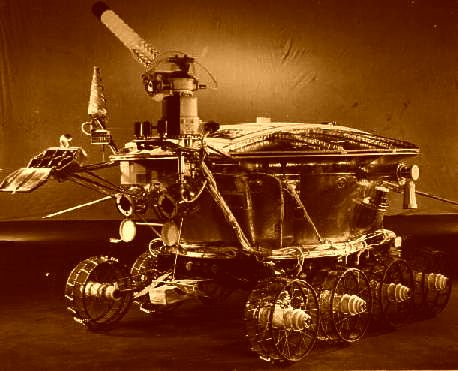
At the first sight the lunokhod
looked like a large metal clothes hamper put on eight heavy wheels resembling
those you find on streetcars. Its body featured loads of assorted
protuberances, differently shaped antennae, robotic arms and other stuff – none
of it functional; it was there just for the sake of TV cameras, but made a
profound impression all the same. The roof was sporting diagonal serrated
notches – this wasn't done on purpose, it's just that they used the sheetmetal
for the subway station floor where it meets the escalators, and it's always
like that there. Nevertheless, it made the machine appear even more mysterious.
Strange are the depth of the
human psychology! First thing it needs is detail. I remember when I was young,
I would often draw tanks and airplanes and show them to my friends. They always
liked those pictures where there were lots of superfluous lines, so that I
would even put more of them all over. So was the lunokhod – a convincingly
complex and clever piece of machinery.
The lid swung away – it was
hermetically sealed, with rubber gaskets and several layers of thermal
isolation material. There was some space inside – approximately like in the
turret of a tank, and fastened to the floor was a slightly modified frame from the
"Sport" bicycle, complete with pedals and two gears, one of them welded
carefully to the rearmost axle. The handlebars were your regular semi-racing
"horns"; by means of a special transfer case they could be used to wiggle the
front wheels slightly, but as they told us there should not be any need for
that. The walls were equipped with shelves, but those were empty for now; the
space between handlebars was occupied by a compass, and on the floor there was
a tin box painted green – a transceiver with a phone. In front of the
handlebars in the wall there were two tiny lenses, like the fisheyes they put
into the doors; if one looked through them, he could see the edges of the front
wheels and the pretend manipulator. A radio receiver hung in the back – just a
common mass-market brick of red plastic, with a black volume control handle
(the mission chief explained to us that in order to prevent the psychological
separation from our country every Soviet spacecraft is designed to receive
"Mayak"[51]
programming). The large convex outside lenses were covered on top and sides by
metal shielding, giving the front of the lunokhod an appearance of a face – or
rather a muzzle, quite agreeable in fact, like the ones they draw on watermelons
or appliances in children's comics.
When I installed myself inside
for the first time and the lid clicked shut over me I thought that I would
never be able to endure such cramped and uncomfortable surroundings. I had to
dangle over the frame, distributing my weight between the hands clutching the
bars, feet pushed against the pedals and the saddle which did not so much
accept its share of weight as determine the posture my body was forced to
assume. The cyclist leans in this fashion when developing higher speed – but
then he has an opportunity to flex back which I did not have, since my head was
already pressing against the lid as it was. However, truth be told, a couple of
weeks after the training started I did get used to this and it turned out that
there was quite enough space inside for one to forget for hours on end how
little space there actually was.
The round "eyes" were located
right in front of my face, but the lenses distorted the view to such an extent
that it was utterly impossible to make sense of anything beyond the thin steel
of the machine. On the other hand, the spot just in front of the wheels was
enlarged and in sharp focus, as was the edge of one of the toothed antennae;
everything else disappeared in zigzags and patches, as if you were staring into
a long dark corridor through the glass of a gas mask.
The machine was really heavy,
and it was hard to cause it to move – so that I even started doubting that I
would be able to conquer the entire fifty miles of the lunar surface in it.
After just one spin around the yard I got winded, my back was aching, the
shoulders hurt too.
Now every other day, taking
turns with Mityok, I took the elevator to the surface, stripped down to my
underwear, climbed into the lunokhod and started my regimen of turning circles
in the yard to strengthen my leg muscles, frightening the chickens and even
squashing them from time to time – I was not doing it intentionally, of course,
but I found it absolutely unrealistic to distinguish a wayward chicken from a
piece of an old newspaper or, for example, some laundry stripped from the line
by a wind gust, and in addition I could never put on the brakes in time to
avoid them. At first colonel Urchagin would drive in his wheelchair in front of
me, showing me the way – he looked like a greenish-gray blob through the
lenses – but then I got the knack for it and could go around the entire yard
with my eyes closed – one only had to dial an exact turn into the handlebars
and machine described a sweeping circle all by itself, returning to the
starting point of the journey. I didn't even have to peer through the "eyes"
most of the time; I just worked my muscles and mulled my own thoughts.
Sometimes I would remember my childhood, sometimes – imagine how the rapidly
approaching moment of my departure into eternity was going to feel like. From
time to time I also tried to wrap up some of the older conundrums which started
surfacing again in my consciousness. For example, I would start thinking – who
exactly am I?
It has to be said that this
question bothered me since I was a kid, usually early in the morning when I
woke up and found myself staring at the ceiling. Afterwards, when I grew up a
little, I began asking it at school, but all I got in response was that
consciousness is a property of highly organized matter consistent with Lenin's
theory of reflection. I couldn't quite catch the meaning of those words, so I
kept wondering – how come I could see? And who is that "I" that is seeing? And
what does it actually mean – to see? Am I seeing something on the outside or
just looking within myself? And what is "outside" or "within"? I often felt
right on the threshold of solution, but when I tried to make the last step
towards it I would suddenly lose the "I" which was just now standing on that
threshold.
When my aunt went to work she
often asked our neighbor to look after me, an old woman whom I also pestered
with all those questions, taking delight in seeing her struggle with the
answers.
"You, Ommie boy, have a soul
inside you," she'd say, "it peers out from you through your eyes, and it
lives in your body, like your hamster lives in the pot. This soul is a part of
God, who created us all. So you are this soul."
"Why would God have me sit in
this pot?" I asked.
"I don't know," said the old
woman.
"Where does he sit himself?
"Everywhere," the old woman
answered, showing with her hands.
"So I am also God?"
"No," she'd say. "A man is
not God. But he is divinely inspired."
"Is the Soviet Man also
divinely inspired?" I asked, having trouble with the unfamiliar words.
"Of course," said the old
woman.
"Are there many gods?" I
asked.
"No. He is one."
"Then why does the dictionary
say there are many?" I asked pointing at the Atheist's Encyclopedia on the
aunt's bookshelf.
"I don't know."
"Which one is better?"
But the woman answered again:
"I don't know."
And then I asked:
"Can I choose for myself?"
"Go ahead, Ommie boy," the
old woman laughed, and so I buried myself in the dictionary, where they had
stacks of different gods. I particularly liked Ra, the god in whom ancient
Egyptians put their trust many millennia ago – I liked him because he had a
hawk's head, and pilots, cosmonauts and other heroes in general were often
called "Motherland's hawks" on the radio. So I decided that if I am indeed
inspired by a god, let this be the one. I remember I took a large notebook and
scribbled this note in it, taken from the dictionary:
"During the day Ra traverses the
Celestial Nile in the Manjet-boat, the Barque of Millions of Years, shining
light on the world, in the evening he transfers to the Mesektet-boat, the
Barque of Night, and descends to the underworld where he travels the Nether
Nile fighting off forces of darkness, and in the morning he appears on the
horizon again."
The ancient people couldn't
have known that the Earth was in fact rotating around the Sun, it said in the
dictionary, and this is why they created this romantic myth.
Right under the article's text
in the dictionary there was an ancient Egyptian picture showing Ra's transfer
from one barque to the other; it depicted two identical boats side-by-side in
which two girls were standing, one of them passing to the other a hoop with a
hawk sitting inside – that was Ra. Most of all I liked that the boats, in
addition to a lot of other stuff in them, contained what unmistakably was four
Khrushchev-era six-story housing projects.
Since then, even though I
continued to respond to the name "Omon", I would always call myself "Ra", and
that was the name of the main character in my private adventures that I
experienced before falling asleep, with my face turned to the wall and eyes
closed – until the time, that is, when my dreams have undergone the usual
age-related transformation.
I wonder if anyone seeing the
photo of the lunokhod in the paper would be visited by a thought that inside
the steel box, whose existence is justified by its task to crawl fifty miles on
the Moon and fall forever motionless, there is actually a person peering out
through its two glass lenses? On the other hand, what's the difference. Even if
someone does get an inkling, they still would never guess that this person was
in fact I, Omon Ra, the true hawk of our Motherland, as the mission chief said
once embracing me by the shoulders at the window and pointing with his finger
to the glowing thundercloud in the sky.
10.
Another subject that appeared
in our curriculum – "General Theory of the Moon" – was considered optional for
everyone except Mityok and me. The lectures were conducted by the doctor of philosophy
(Ret.) Ivan Evseyevich Kondratiev. For some reason I did not hit it off with
him, even though there was no clear rationale for my dislike; his lectures
were, as a matter of fact, quite interesting. I remember that the first meeting
with us he started in a very unusual fashion – he read poems about the Moon to
us from scraps of paper for at least half an hour, becoming so touched himself
at the end that he had to wipe his glasses. I was still keeping notes at the
time, and this lecture left behind a nonsensical pile of quotational debris:
"And like a golden drop of honey The Moon is twinkling sweet and high... Not
long did moon's vain hopes delude us, Its dreams of love and prideful fame...
The Moon! how full of sense and beauty Is that one sound for Russian heart!..
But in this world the other regions, By moon tormentedly beset... And in the
sky, resigned to everything,The
disk of moon in shallow grin... The flow of thought he was directing, and
subjugated thus the Moon... This uneasy and watery moonness..."[52].
And two more pages in the same vein. Then he became solemn and started speaking
in authoritative voice, almost chanting:
"My friends! Let us remember
now the historic words of Vladimir Ilyich Lenin, related by him in the year
nineteen hundred eighteen in his letter to Inessa Armand: "Of all the planets
and celestial bodies," he wrote, "Moon remains the principal one for us."[53]
Years have passed since then, many things have changed in the world. But
Lenin's judgment had lost neither its incisiveness nor importance, the time
having reaffirmed its validity. The radiant fire of Lenin's words casts a
special glow on the today's date in the calendar. Indeed, the Moon plays an
enormous role in the evolution of the humankind. A prominent Russian scientist
Georgy Ivanovich Gurdzhiev, while still in the underground period of his
activity, had developed the true Marxist theory of the Moon. In accordance with
it, Earth had five different moons – and this is the reason that the star, the
symbol of our great state, has five ends. The fall of each of the previous
moons was accompanied by social upheavals and catastrophes – thus, for example,
the fourth moon which crashed onto our planet in 1904, becoming known by the
name of the Tunguska meteorite, caused the first Russian revolution, which was
followed closely by the second. The moons that fell before it led to other
changes in the socioeconomic formation – though of course the cosmic
catastrophes were not affecting the level of development of the productive forces,
which formed independently of the will and conscience of the people as well as
influence of planets, but instead contributed to crystallization of the
subjective precursors of the revolution[54].
The fall of the contemporary Moon – moon number five, the last one
remaining – shall usher in the full and absolute victory of communism
within the boundaries
of the Solar system. While studying this particular subject we will pay
close
attention to the two major works by Lenin regarding the Moon: 'Moon And
The Uprising'
and 'Advice From A Stranger'[55].
We will start today's lesson by addressing the bourgeois falsifications of the
topic – the views according to which all organic life on Earth is nothing but
food for the Moon, a source of the emanations consumed by it[56].
This can be proven wrong simply by pointing out that the goal of existence of
organic life on Earth is not the nourishment of the Moon but instead, as
Vladimir Ilyich Lenin amply demonstrated, the construction of a new society,
free from exploitation of man number one, two and three by man number four,
five, six and seven..."
And so forth. He spoke
effusively and intricately, but what I remembered best was an example that
stunned me with its poetic quality: the weight on the end of a string makes the
clock go, the Moon is such a weight, Earth is the clock, and life is the movement
of gears and singing of the mechanical cuckoo.
Quite often we would have some
kind of medical evaluation – naturally, we all have been studied from head to
toe and crosswise. This is why upon hearing that Mityok and I had to pass
something that sounded like "reincarnational evaluation", I just wrote it off
as another reflex check or blood pressure monitoring – the first word did not
convey anything in particular to me. But when I was called downstairs and saw
the specialist that was supposed to conduct the evaluation I was overcome with
childish fear, very out of place considering what I was destined for in the
very near future but insurmountable nonetheless.
It was not a doctor before me
in white scrubs with stethoscope sticking out of his pocket but an officer, a
colonel, but not in uniform – he was wearing some kind of strange black cassock
with shoulder patches. He was big and fleshy, his face red, as if burned by hot
soup. Around his neck I noticed a nickel-plated whistle and a chronometer, and
but for his eyes, which resembled the visor hole of a heavy tank, he would look
like a soccer official. He conducted himself very amiably, though, laughing
often, and by the end of our talk I did feel more at ease. He talked to me in a
small office where there were only a desk, two chairs, an examination table
wrapped in plastic and a door into the next room. After filling out several
yellowish forms he gave me a measure of some bitter liquid to drink, put a
small hourglass on the desk in front of me and exited through the second door,
instructing me to follow him there when all the sand has fallen to the bottom.
I remember myself looking at
the hourglass, amazed at how slowly the grains of sand roll down
through the
glass neck, until I realized that this was happening because each grain
possessed free will and did not want to fall down, for this was
tantamount to
death for them. And at the same time their eventual fall was
inescapable, and
both our and "other" world, I thought, were very similar to this
hourglass – when all who lived die in one direction, the reality turns
upside down and they
become alive again, that is, begin to die in the other direction.
I was really sad about this for
some time but then noticed that the sand was not falling anymore, and
remembered that I'd better go and show myself to the colonel. I felt
trepidation and at the same time an unusual lightness; I recall trying for
quite a while to reach the door behind which they were waiting for me, which was
odd considering it was two or three steps away. When I finally laid my hands on
the door handle I pushed it, but the door did not open. Then I pulled it
towards me and discovered that I was pulling on a blanket instead. I was on my
cot, Mityok was sitting at its edge. My head was spinning slightly.
"So? How was it?" asked
Mityok. He was strangely agitated.
"How was what?" I asked,
pushing up on my elbows and attempting to ascertain what had happened.
"The reincarnational
evaluation," said Mityok.
"Wait," I said, recalling how
I was pulling the door handle, "wait... No. Can't remember a thing."
For some reason I was feeling
empty and alone, like I had just traveled across a barren autumn field, and the
sensation was so peculiar that I forgot about everything else, including the
feeling of impending death, ceaseless in the last months, though it had lost
its edge by now, becoming just a background for all other thoughts.
"I see. You signed it for
them, didn't you?[57] – asked Mityok with a hint of loathing in his voice.
"Get lost," I said turning
towards the wall.
"These two burly corporals in
black frocks haul you in," Mityok continued, "and tell me: "Here, take back
your Egyptian." And your shirt is all covered with puke. Is it really true you
don't remember a single thing?"
"True," I answered.
"Well then, wish me luck," he
said. "It's my turn to go now."
"Break a leg," I said. More
than anything else in the world I wanted to sleep, because I had a feeling that
if I fall asleep fast enough, I would wake up being myself again.
I heard the door squeak behind
Mityok, and next it was already morning.
"Krivomazov! To the mission
chief, on the double!" one of our guys shouted in my ear. I started to wake
up, but managed to come to completely only when I was already dressed. Mityok's
cot was empty and undisturbed, all the other guys were in their places, still
in underwear. I was feeling a certain tension in the air, everybody was
stealing awkward glances at each other, even Ivan was not shooting off his
usual morning jokes, very funny even though totally stupid. I realized
something must have happened, and on my way up to the third above-ground floor
was trying to figure out what. Walking down the corridor and squinting at the
sun which tried to force its way in through the drawn blinds I caught my
reflection in an enormous dusty mirror, marveled at the ghostly paleness of my
face and realized that my heroic feat had, for all intents and purposes,
already begun.
The mission chief rose to greet
me and shook my hand.
"How is your training?" he
asked
"Progressing, comrade mission
chief," I said.
He stared probingly into my
eyes.
"Good," he said after a
while, "I see. Here's what I called you here for, Omon. You are going to help
me. Take this tape recorder," he waved at a small Japanese Walkman on the desk
in front of him, "take the forms, a pen, and go to room three twenty nine, it
should be empty now. Have you ever transcribed recordings?"
"No," I answered.
"It's simple. You cue the tape
forward a little, write what you heard and then cue it further. If you didn't
catch something the first time, you rewind and listen again, several times if
you need to."
"Understood. Am I dismissed?"
"Yes. Wait. I think you should
understand why I asked you to do this and not someone else. You will soon face
questions, the kind that nobody down there," the mission chief pointed to the
floor, "will be able to answer for you. I would be within my rights not to
answer you either, but I think it's better for you to be in the loop. But keep
in mind, neither the morale officers nor the crew have to ever find out what
you are about to learn. What is happening now is a breach of protocol on my
part. As you can see, even generals commit those."
I silently took from the desk
the recorder and several yellow forms like those I saw yesterday, and went to
three twenty nine. The shades were drawn shut, the familiar metal chair with
leather straps on the armrests and legs was still standing in the center, but
now some wires were going from it to the wall. I sat behind the small desk in
the corner, placed the ruled pad in front of me and turned on the tape.
"Thank you, comrade colonel...
Very comfortable, it's a recliner, not a chair, ha-ha-ha... Of course I am
nervous. This is kind of like a test, right?... I see. Yes. With two 'i's – Sviridenko..."
I switched the recorder off.
This was unmistakably Mityok's voice, but it was strange, like someone have
attached bellows instead of lungs to his vocal cords – he spoke sonorously and
effortlessly, on a continuous exhale. I rewound the tape a little, pushed
"Play" again and did not stop the tape anymore[58].
"...test, right?... I see.
Yes. With two 'i's – Sviridenko... Thank you, but I don't smoke. Nobody in our
group does – they'd throw you right out... Yes, for more than a year now. I
can't quite believe it myself. Since I was a boy I always dreamed of going to
the Moon... Of course, of course. Precisely, only those with the soul that is
crystal clear. To think – with the entire Earth below... About who on the Moon?
No, never heard about it... Ha-ha-ha, so that was a joke, you're funny... This
place look weird, though. Well, unusual. Is it like that everywhere or only in
the Special Department? All those skulls on the shelves, oh my God, standing
like books. And labeled, just look at that... No, no, not in that sense at all.
If they're here, it means they need to be here. Research, databases and stuff.
I understand. I understand. You don't say... So well preserved... And this one,
above the eye – from a pickaxe[59]?..
That's mine. They had two other forms there as well. The last check – before
Baikonur[60]. Yes. Ready. Comrade colonel, I have
already described in detail... Just talk about myself, starting from the
childhood? No, thank you, I am comfortable... Well, if that's a general order,
sure. Why don't you install headrests, like in cars. Otherwise the pillow is
going to fall down if it shifts... Aha, and I was just thinking – why do you
have this mirror on the wall. And you're going to put another one on the table.
Wow, that's a thick candle... From whose fat? Ha-ha-ha, that's a joke again,
right, comrade colonel... Amazing. First time I see something like that,
honest. I only read in books that you could do that, but never seen it for
myself. Mind-boggling. Like a corridor. Where? Into this one? Jesus Christ, how
many of those mirrors you have here – a regular barbershop. No, of course not,
comrade colonel... Never had. It's just a saying, I picked it up from my
grandma. I am a devoted atheist, or I wouldn't have gone to the flight
academy... I remember, but very roughly. I was already eleven by the time we
moved to Moscow; I was born in that small town – you know, it just sits there
by the rail line, a train comes by every couple of days and that's all. It's
quiet. The streets are dirty, geese walk around. Many drunks. And everything is
just so gray – doesn't matter if it's summer or winter. Two factories, a movie
theater. Well, there's also the park – but you understand, no one in his right
mind would show his face there. And then, you know, something rumbles above, so
you just look to the sky. Well, what's there to explain... And I also read
books all the time, I owe to them everything that is good in me[61].
My most favorite was, of course, 'The Andromeda Nebula'[62].
Very big influence on me, that book had. Imagine, this Iron Star... And on that
very black planet there's our cheerful Soviet starship with a swimming pool, a
spot of blue light around it, and where the light ends – adversary life forms,
they are afraid of light and can live only in darkness. Some kind of jellyfish,
I didn't quite understand that part, and also the Black Cross – I guess he was
making a dig at the clergy there. This Black Cross was there, he was stalking
in the darkness, and where the blue light is the people are working, mining for
anameson. And then this Black Cross like shoots something mysterious at them!
It was aiming for Erg Noor himself, but brave Nisa Krit shielded him with her
body. And then our guys really got back at them, like revenge – a nuclear blast
from there to the horizon, they saved Nisa Krit, and they caught the principal
jellyfish, and back to Moscow. I was reading it and thinking – how do people
work in our embassies abroad! A very good book. And there's another one I
remember. They had some kind of black cave there or something..."
"..."
"No, the cave was afterwards,
and it was not a cave, more like corridors. Very low corridors, and ceiling all
covered with soot from torches. The warriors always walked with torches at
night, protecting his highness the prince. From Accadians, they said. But
really they were protecting him from his brother, of course... You, sir Master
of the Northern Tower, please forgive me if I said something wrong, but
everybody thinks that – warriors and serfs, both. You may order my tongue cut
out, but still everyone would tell you the same. The Queen Shubad herself
posted this squadron there, against Meskalamdug. Every time he rides by on his
way to the hunt, he always passes the Southern Wall, and those two hundred
warriors with him in copper helmets – what's that for, fighting lions?
Everybody's talking about it... What do you mean? What's with you, sir Master
of the Northern Tower, were you chewing too much five-leaf again? I am
Ninhursag, Arrata's priest and carver of seals. I mean, I'm going to be carver
of seals when I grow up, I am still little... come on, why are you writing, you
must know who I am. You gave me that bridle with copper figuring. You don't
remember? Why... Wait... So we're sitting with Namtura – you know, the one with
his ears lopped off, he was teaching me to carve triangles. This is the hardest
one for me. You have to make two deep cuts, and then from the third side you
just dig with a broad chisel, and... Right, so then somebody from the outside
tears away the curtain, and so brazenly – so we look up, and those two warriors
are standing there. Rejoice, they say, with the great joy! Our prince is prince
no more, but King Abarraggi! Just embarked on his way to the Goddess Nanna, so
naturally, we have to be going too. Namtura is crying – from happiness, I
guess, singing something in Accadian, and starts gathering his rags in a big
bundle. And I went out into the yard right away, only told Namtura to pick up
the chisels. And in the yard – Urshu Victorious! - all those warriors, and with
torches, like broad daylight... No, not at all, sir Master of the Northern
Tower! Of course not. It's what Namtura is mumbling all the time... Never had,
and I never brought sacrifices either. Don't. I am the nunn of the great King
Abarraggi now, you can't just cut my ears off all of a sudden, you need a royal
decree for that... Apology accepted. Right, so the chariots with bulls were ready.
Here's when sir Master of the Locks came to me – here, Ninhursag, he said, take
this dagger made from the government bronze, you are an adult now. And also he
gave me a small sack of barley meal – you cook that along the way, he said. So
I look around and I see those, in the copper helmets, walking around. So I
think: Urshu the Great! I mean, Anu the Great! This must mean that Meskalamdug
finally buried the hatchet with Abarraggi... Wise decision, I thought, you
don't quarrel with the King – not when his every word is Anu. And then they
showed me to my chariot, so I climb into it. There was also this boy standing
there – he was directing the bulls. I never saw him before. I only remember
that he had the turquoise necklace, very expensive. And the dagger tucked under
his belt – must have just gotten it too. So, I looked back at the fortress, and
I got a little sad and stuff. But then the clouds parted, and in the clearing
the Moon just burst out... I felt so happy and light right away... So then they
push away this stone slab near the stables – and there's the entrance into the
caves. I never knew there was a cave there. Really I didn't... Why, may I never
distinguish myself in battle! That was you, wasn't it? Now I remember. So right
there you, sir Master of the Northern Tower, approached us with two goblets of
beer, and you said – here, from Meskalamdug, the king's brother. And the same
skirt you were wearing as now, only you had the copper helmet on your head. So,
we drank. I never drank beer before that, ever. Then the second boy shouted
something, and we drove ahead – right into a crack in the cliff. I remember the
road was descending, and around me – I didn't see a thing, it was so dark...
Afterwards? Afterwards I found myself here in the tower. That's from beer,
isn't it?.. Are they going to punish me now? Put in a word for me, sir Master
of the Northern Tower. Tell them how it was. Or just pass them the tablets, now
that you wrote everything down. Of course I have it with me... No, I'm not
going to give it to you. I'll affix it myself. Nobody better lay a hand on my
seal, by U... Anu the Great. Here. You like it, don't you? I made it myself.
Third time a charm. This is god Marduk. What do you mean – 'fence', those are
the Elder Gods standing. Please help me, sir Master of the Northern Tower! I
will carve three seals for you, I will. No, I'm not crying... There, I won't
anymore. Thank you. You are truly wise and mighty man, I say this with all my
heart. Please don't tell anyone I cried... They'd say: what kind of Arrata's
priest is he – let him drink a little beer and he's ready to cry... Of course I
want to. Where? From the South or North? ‘Cause you have this wall all covered
in mirrors here. I see... Sure I know that. That was when Ninlil went to the
clear stream to bathe herself, and then she stepped out to the shore. Her
mother would tell her again and again, but she went just the same, so she's
stepping onto the shore, see, and that's when Enlil knocked her up. So then he
comes to the city of Kiur, but the Council of Gods says to him – Enlil, you
rapist, away from the city with you! But Ninlil, she went after him, sure
thing... No, not blinding at all. The other two? That was after, once when
Enlil turned into watchman near the crossing, and then when Nanna was already
in Ninlil's womb..."
"..."
"And then, those two are just
different manifestations of the same. You can say thus: Hecate is the dark and
mysterious side, while Selena – light and wondrous. I must admit I am off my
horse here – just heard a couple of things here and there in Athens... Sure,
sure I've been to Athens. Under Domician that was. I was hiding there. Or we
wouldn't be talking right now, Abbas Senator, we wouldn't be riding in this
palanquin of yours... Impugning the royal name, what else. Presumably I said
that the master has a statue of the princeps in his yard, and that they went
and buried two slaves nearby. But he never had any statue in the first place.
Even under Nerva we were still apprehensive about returning. But with our current
princeps there's nothing to worry about. He sent to us Plinius Secundus himself
to be the Legate – these are the times that we live in, glory be to Isis and
Serapis! Not for... No, not at all, Abbas Senator, by Hercules! This I picked
up in Athens, they have Egyptians there now like you won't believe... What
interesting tablets you have, one almost can't see the wax. And these lions'
muzzles – are they made of electron? Corinthian bronze, you don't say... First
time I see that... Sextius Rufinus. No, of freed slaves. Here's the nice thing
about palanquins – when the slaves are skilled, of course – you can ride and
write. And the light is shining just like in a room, the pines passing by...
It's like you look inside my soul, Abbas Senator. Constantly within myself I
compose them. Not in the Marcial's order, I am afraid – just
dulling the stylos... Songs I sing
with brief verse, like Catullus was singing, and before him Calbus and
ancients. What do I care! I have left the Forum in favor of verses...
Of course
I am exaggerating, Abbas Senator. These are verses, after all. As a
matter of
fact, that's why I was brought along with the Christians' case –
because of
literature. Just wanted to look at our Legate. A great man, he is...
Well, not
exactly as a witness. No, I wrote it like it was – that Maximus, he
really was
from Galilee. They'd assemble at his place at night, inhale some kind
of smoke.
And then he clambers up to the roof wearing only his caligae, and cries
like a
cockerel – one look at that, and I knew right away they must have been
Christians... Well, about the bats I embellished a little, I admit. So
what?
The gladiator school was already crying for them anyway. And that
Legate I
liked very much. Right... He invited me to the table, listened to my
poems.
Praised me lavishly. And then he says – why don't you, Sextius, come to
dinner.
When the Moon is full. I will send for you, he says... And he did send,
he
really did. I gathered all the cartouches with the poems – what if, I
thought,
he'd send me to Rome? I put on my best cloak... How could I wear a toga
– I
don't have the citizenship. So then we're riding, and out of the city
for some
reason. For a long time we were riding, I even dozed off in the
chariot. I wake
up, look around – a villa, or a temple, or something like that, and
people with
torches. So, you see, we go inside – through the house and into the
garden. And
they already have tables set there, right under the skies, and the Moon
is
shining. Such a large Moon it was that night. And the slaves say to me
– sir
Legate will be right out, why don't you lie beside the table, drink
some wine.
This is your place, under that marble lamb. Well, I lie down, and I
drink- and then I notice everyone around is looking at me funny... And
not a word.
What was it, I'm thinking, that the Legate must have told them about my
poems...I got chills even,
honest. But then two harps started playing behind the screen, and I
became so
cheerful all of a sudden – simply amazing. I
don't even remember how I ended up dancing around... And
then they brought out the flaming tripods, and then those people in
yellow
chitons... They weren't quite themselves, if you know what I mean –
they sit,
and sit some more, and then extend their hands toward the Moon and
start
chanting something in Greek... No, I couldn't make it out – I was
dancing,
making merry. And then sir Legate shows up – he had the Phrygian helmet
on for
some reason, with a silver disk, and a flute in his hand. Eyes
gleaming. He
poured me more wine. Those are some good poems that you're writing,
Sextius, he
says to me. Then he started talking about the Moon – exactly like you
just did,
Abbas Senator. Now wait a minute, you have been there too, haven't you?
Right.
Ha-ha, and all this time I'm thinking – why is it we're traveling in
your
palanquin. But how... You have your toga on now, sure, but then you
were
dressed in a chiton, and Thracian helmet, just like the Legate. Yeah,
and that
red spear you were holding, with the horsetail. I was really
uncomfortable turning
my back to you. But Legate kept saying – here, Sextius, why don't you
look at
Hecate, he says, and I will play the flute for you. And he started
playing – really softly. So I looked up, and I was looking – and then
you are asking me
about Hecate and Selena. When did I manage to climb into your
palanquin? Is
everything all right? Well, glory be to I... Hercules. Apollo and
Hercules.
That's fine, I brought them with me, for Legate to read. And you, Abbas
Senator, dabbling in literature also? That's why you have been writing
and
writing all this time. A-a. As a keepsake. So you liked the poems too.
This
hour is for you – it walks like Leah, and rose is reigning over hair so
fragrant. Of course. I can even affix my gemma. That's all right, the
cutting
is not that deep, it does not require a lot of wax. It'll print
through. Are we
almost there? Why thank you, Abbas Senator, my hair does seem to be a
little
messed up. And how much does a mirror like that cost in the Metropolia?
You
don't say, this kind of money would buy you a house around our place in
Viphinia. Is this Corinthian bronze as well? Silver? And some kind of
inscription..."
"..."
"I can make it out. There... To
Lieutenant Wolf, for the Western Prussia. General Lüdendorf. Begging
your
pardon, brigadenfuehrer, it just opened by itself. An amazing cigarette
box,
shining like a mirror. So you were already lieutenant in '15? Air
Force, too?
Please don't, brigadenfuehrer, you are making me uneasy. Because of
those three
crosses I'm not even allowed to fly sorties anymore. There are lots of
Yak's
and MiG's in this world, they say, but only one Vogel Von Richthofen.
If not
for that special mission, I'd probably be covered in mold now, alone in
the
empty barracks... Yes, like "bird". My mother was upset at first when
she found
out how my father was planning to name me. But Baldur Von Schirach –
they were
friends with my father – even dedicated an entire poem to me. They
study it in
schools now... Careful – they're shooting from that window... No, the
wall is
thick enough... I can only imagine what he'd write if he knew about the
special
mission. This was something else entirely. I really bought into that
transfer
to the Western front business, only found out in Berlin what it was.
First off,
I got upset, naturally. I thought: don't they have anything better to
do in
"Ahnenerbe" – recalling combat pilots from the front... But when I saw
that
plane – Holy Virgin Mary! Right away... No, not at all,
brigadenfuehrer, I just
lived in Italy when I was a kid. Right. Never in all my years of flying
I've
seen such beauty. It was only later that I figured out it was actually
Me-109,
only different engine and wings a little longer... Damn, the ammo belt
jammed... No, it's all right, I'll manage... So, I walked into the
hangar and
just stood there breathless. So white, so light – like it was glowing
in the
dark. But what was most amazing – the preparation. I thought I'd be
studying
hardware, and instead they took me to you guys in "Ahnenerbe", measured
the
skull, Wagner playing all along, and don't bother asking questions –
everyone's
silent. In short, when that night they woke me up I thought it was
skull
measuring time again. Then I look out – no, these two Mercedes are
standing
behind the window, engines working... Great shot, brigadenfuehrer!
Right under
the turret. How come you're so good with this thing... So we get in, we
ride.
Then... Yes, it was cordoned off, SS guys with torches. We pass them,
then we
get out of the forest, then some kind of building with columns and an
airport.
Not a soul in sight, gentle breeze – and the Moon in the sky. I thought
I knew
all air fields around Berlin, but I never saw that one. And there's my
plane,
right on the runway, something attached under the fuselage, also white,
kind of
like a bomb. But they didn't even let me stand near it, whisked into
that
building right away... No, I don't recall really. Only remember that
Wagner was
playing. They ordered me to disrobe, then bathed me like I was a
baby... No,
no, save the grenades for later... Rubbed my skin with oil – you know,
smells
of something ancient, very pleasant. And they gave me the flight
uniform,
except it was all white. And all my awards right there on the breast.
Well,
Vogel, I thought, this is it... I was dreaming all my life about
something like
that. Then those, from "Ahnenerbe", say to me: go on, captain, go to
your
plane. They will tell you everything there. Took turns shaking my hand.
So I
went. Even the boots were white, I was afraid to step in the dust...
just a
moment. So I go up to the plane, and there... Wait a minute, if it
wasn't you,
brigadenfuehrer, only not in this steel helmet but in some kind of
black cap...
So you begin to explain it to me – climb to eleven thousand, bearing on
the
Moon, the button is on the left panel... Damn. Just missed it... And
that white
pad you gave me, and then coffee with cognac from the thermos. I am
saying – no, I never drink before the flight, and you looked at me
sternly – do you have
any idea, Vogel, who this coffee is from? So then I turn around and see
– I'd
never believe that... Right. Just like in newsreels, and the suit is
the same,
double-breasted. Only with a cap on his head, and binoculars around his
neck.
And mustache a little wider than they draw on the portraits. Or it only
seemed
that way because of moonlight. He waved at me, like at a stadium or
something... Anyway, so I drank the coffee, got into the plane, put my
oxygen
mask on right away and took off. And it became so easy all of a sudden
– like I
was breathing with two breasts instead of one. I climbed to eleven,
bearing on
the Moon – it was huge that night, half the sky, and then I looked
down. It was
all greenish down there, some river glistening... That's where I
pressed the
button. The plane started veering to the right, how I got down – I
don't even
know... Sign it? You also scribble something for me – just to remember
you by.
Thank you... Did many of them manage to get through to Berlin? Sure,
that I
understand... Nothing major, just the brick fragments, I guess. The
bridge of
the nose is intact... Right, I told you nothing major, I can see it
now. This
cigarette box – you can shave looking into that thing, no mirror
needed..."
"..."
"No, I don't need it anymore;
I didn't even ask for it in the first place. You put it here yourself, comrade
colonel, just after you lit that candle... What was later – I read the books,
then I made a telescope for myself, a small one. I mostly studied the Moon. I
even remember I went as lunokhod to the school matinee party once... I remember
that evening like it was yesterday... No, evening, all matinees were in the
evening then, and Saturday was exchanged with Monday that time[63]...
All our guys assembled in the hall – they all had those simple costumes, you
know, so they could dance. And I had this thing on – get down on all fours and
it really looked like lunokhod. Music is blaring, everybody's so flushed... I
stood there by the door for a while, and then just went walking around the
empty school building. The corridors are all dark, nobody's there... So I crawl
towards a window, on all fours, and right behind it in the sky – this Moon, it
was not even yellow, rather green somehow, like on that picture, you know? I
have a poster over my cot, from the "Working Woman". This is where I gave myself
a word that I was going to get to the Moon... Ha-ha-ha... Well, if you, comrade
colonel, are going to do your best, that means I will get there for sure...
Afterwards? Zaraisk Academy, right after high school, and then here right
away... You received it? Yes, comrade colonel, I know, it's always better when
it's informal like that, on a human level. Right here? Is it all right that the
ink is blue? Exactly. The simpler the soul, the shorter the protocol... Thank
you. Raspberry, if I could. Where do you get these carbonation charges, for the
siphon? On the other hand... Comrade colonel, may I ask you one question? Is it
true that all the lunar soil ends up here with you? I don't remember really,
one of our guys, I guess... Of course I'd like to, I only saw it on TV...
Wow... How much does this jar hold? Ten ounces or so? Could I really? Thank
you... Thank you so much... Just give me another tissue, to make sure... Thank
you. Sure I remember. To the right, through the corridor, to the elevators, and
then down. I won't make it by myself? Still under the influence? So you just
see me along, then... Woo... No, never. The new uniform? No, I like it, why? We
already had caps in the army once – the Budyonny hats[64].
Looks good, but a little unusual – no bill, and the badge is round... No, I
didn't forget... What do you mean – to the left? Why the torch? Couldn't the
electrician... oh yeah, the secret access. A little light here, the stairs are
really steep... Almost like our lunar landing module. Comrade colonel, that's a
dead en..."
There was a loud click and two
voices, one male and one female, belted out in unison:
"...on their lips. The song to
this day can be heard in the depths..."
A short pause followed.
"Of grasslands so fresh," the
woman sang half-inquisitively.
"Malachite of the steppes[65]," reaffirmed the rich baritone.
I switched the recorder off. I
was very scared. I recalled the colonel in the black cassock with the whistle
and chronometer around his neck. Nobody was asking Mityok any questions; that
to which he was giving answers was just soft whistling noise interrupting his
soliloquy from time to time.
11.
Nobody asked me about Mityok.
Truth be told, he wasn't friends with anyone except myself, only played
homemade cards with Otto from time to time. His cot was already taken out from
our dorm, and now only the posters from "Working Woman" with pictures of
"Moonlit Night over Dnepr" and "Khan Baikonur" were left as a reminder that
there was once someone named Mityok living in our world. At the lessons everyone
was trying to look like nothing happened, colonel Urchagin being especially
perky and friendly.
In the meantime our small
squadron, not noticing the loss of the soldier as it were, was about to sing
its "Little Apple" to the end. No one was talking about it directly, but it was
clear – the flight is around the corner. The mission chief met with us a couple
of times, telling us how he was fighting in Kovpak's battalion[66]
during the war, we all had our pictures taken – one by one at first, and then
all together, and then with the teaching staff in front of the banner. Then we
started to meet more new cadets, they were training separately from us, I
didn't know exactly what for – there was some talk about an automated probe to
Alpha Microcephalos right after our mission but I wasn't completely sure that
the new guys were in fact the crew of that probe.
One evening in early September
I was suddenly called before the mission chief. He wasn't in his office and the
adjutant in the waiting room, idly flipping through pages of an old issue of
Newsweek, told me he was in three twenty nine.
From behind the door with the
number "329" I could hear voices and something that sounded like laughter. I
knocked, but no one answered. I knocked one more time and turned the handle.
A wide strip of tobacco smoke
was hanging under the ceiling, reminding me for some reason of the jet trail in
the summer sky over Zaraisk Academy. Strapped with his hands and legs to the
metal chair in the middle of the room was a small Japanese man – that he was
Japanese I figured from the little red circle inside a white rectangle on the
sleeve of his flight suit. His lips were swollen and blue in color, one eye
turned into a narrow slit in the middle of massive purple haematoma, the flight
suit was splattered with blood – some fresh, some brown and caked over. In
front of the Japanese I saw Landratov in shiny high boots and dress uniform of
an Air Force Lieutenant. By the window, leaning against the wall with his arms
crossed, a short young man in civilian clothes was standing. The mission chief
was sitting in the corner behind the desk – he was looking at the Japanese
absentmindedly, tapping against the desk with the end of his pencil.
"Comrade mission chief," I
started, but he waved his hand at me and began collecting the papers strewn
across the desk into a folder. I transferred my gaze to Landratov.
"Hi," he said, offering me
his wide palm, and then all of a sudden, absolutely unexpectedly for me, kicked
the Japanese as hard as he could in the stomach with his boot. The Japanese
gasped.
"This bastard here doesn't
want to be on the joint crew!" said Landratov, his eyes wide with amazement,
throwing his arms up, and rattled out on the floor a short tap sequence with
double slap on the boots, his feet turning unnaturally outward.
"As you were, Landratov!" the
mission chief burbled getting out from behind the desk.
From the corner of the room I
heard a soft whine filled with definite hatred; I looked there and saw a dog,
sitting on its hind legs before a navy blue plate with a rocket printed on it.
It was a very old husky, her eyes were completely red, but what startled me was
not her eyes but the small light green uniform top covering her upper body,
with the shoulder patches of major-general and two Orders of Lenin on the
breast.
"Meet Comrade Laika[67]," said the mission chief catching my stare. "She's the first Soviet cosmonaut.
By the way, her parents are our colleagues. Worked in the Organs[68],
in the North."
Mission chief produced a small
flask of cognac, which he proceeded to pour onto the plate. Laika made a feeble
attempt to nip him in the hand, missed it and started whining again.
"She's quite vigorous, isn't
she?" the mission chief said with a smile. "But what she shouldn't have done
is pee all over the place. Landratov, why don't you go bring a rag."
Landratov went out.
"Yoi o-tenki ni narimashita
ne," said the Japanese, unsticking his lips. "Hana wa sakuragi, hito wa
fujiwara."
The mission chief turned
quizzically to the young man at the window.
"He's just delirious, comrade
lieutenant-general," the young man replied.
The mission chief picked the
folder off the desk.
"Let's go, Omon."
We ventured out into the
corridor, and he put his hand over my shoulders. Landratov, rag in hand, passed
us by and winked at me, closing the door into the three twenty nine behind him.
"That Landratov, he's still
green,"said the mission chief
contemplatively," hadn't settled yet. But an outstanding pilot. A born pilot."
We walked several yards in
silence.
"So, Omon," said the mission
chief, "Baikonur the day after tomorrow. This is it."
I have been waiting for these
words for some months now, but still the sensation was of a heavy snowball,
with a steel nut inside, jamming into my solar plexus.
"Your call letters are going
to be 'Ra', as you requested. It was hard," the mission chief jabbed his
finger up into the air, "but we pushed it through. Only not a word about it
there," he pointed down, "not yet."
I didn't remember ever having
requested anything of the sort.
At the final testing on the
rocket mock-up I was just an observer – other guys were passing the exams, and
I was sitting on the bench by the wall watching. I've passed my test a week
before, making the fully loaded lunokhod turn a hundred yard long figure eight
inside six minutes. The guys made their time precisely, and then they had us
all standing in formation in front of the mock-up for the farewell photo shoot.
I never saw the actual picture, but I can imagine perfectly how it turned out:
Syoma Anikin in front, his face and hands still bearing the traces of motor
oil, behind him – Ivan Grechka, leaning onto an aluminium walker (his stumps
ached from time to time because of all the underground dampness), in a long
mutton overcoat, an undone oxygen mask hanging low around his neck, then – Otto
Pluzis, in the silver spacesuit padded for warmth with a woolen blanket with a
merry yellow duckling print, his helmet was drawn back resembling a hood
stiffened by interstellar frost. Then Dima Matyushevich in a similar spacesuit,
only the patches of blanket were simply green-striped, not with ducklings, and
then I, the last of the crew, in the cadet uniform. Behind me, in the electric
wheelchair of his – colonel Urchagin, and mission chief to the left of him.
"And now, according to
tradition which had turned into a good custom," the mission chief said when
the photographer was done, "we are going to come up for a few minutes to the
Red Square[69]."
We walked across the large hall
and paused by the small steel door – to cast the last look on the rocket,
exactly like the one on which we were destined to soar into the sky soon. Then
the mission chief opened that little hole in the wall with a key from his ring
and we started along the corridor I've never ventured to before.
We were weaving for a long time
between stone walls with thick multicolored cables snaking their way along
them, several times the corridor turned sharply, the ceiling coming down so low
now and again that we had to bend under. Once I spotted a shallow niche in the
wall with wilted flowers in it, a small memorial plaque was hanging nearby,
"Here in 1923 comrade Serob Nalbandyan was viciously murdered with a shovel"
inscribed on it. Then a red carpeted strip appeared under our feet, the corridor
widened and then ended witha
stairwell[70].
The stairwell was very long, by
its side there was an incline with narrow flights of steps in the middle – just
like for strollers in the underground passages. I figured why they made it like
that when I saw the mission chief rolling the wheelchair with colonel Urchagin
up the incline. When he got winded Urchagin would pull the hand brake and they
froze in place, so the others didn't need to climb too fast, especially
considering that Ivan always had problems with long stairs. Finally we ascended
to the massive oak doors with state seals carved into them, the mission chief
unlocked them with his key, but the door halves saturated with dampness only
gave way when I pushed against them with my shoulder.
We were blinded by sunlight,
someone shielded his eyes with a hand, others turned away – only Urchagin was
sitting calmly, with the routine half-smile on his face. Once we got accustomed
to the light it turned out we were facing the gray crypts of the Kremlin wall[71]
and I realized we must have gone through the back door of the Mausoleum[72].
I haven't seen the open sky for such a long time that my head was spinning.
"All cosmonauts," the mission
chief spoke softly, "all of them, no matter how many there were, came before
the flight here, to the stones and stands that are sacred to every Soviet
person, to take a fragment of this place in their hearts with them to space.
Immensely long and arduous was the journey that our country went through – we
started with machine guns mounted on horse-drawn carriages, and now you guys
are working with the most sophisticated automatic technology," he paused and
looked us over with a cold unblinking stare, "that our Motherland had
entrusted into your hands, which Bamlag Ivanovich and I explained to you in our
lectures. I am confident that in this, your last walk on the surface of our
Motherland, you will carry away some remembrance of the Red Square with you,
even though I cannot know what it will turn out to be for each of you..."
We were standing silently on
the surface of our dear old planet. It was late in the day, the sky was getting
slightly overcast, the bluish firs were waving their branches in the wind. We
smelled some kind of flowers. The clock tower started chiming five, mission
chief adjusted the hands on his watch and told us we still had a couple of
minutes.
We went out onto the steps in
front of the Mausoleum. There wasn't anyone on the entire square if you didn't
count two just changed honor guards, who never acknowledged they have seen us
at all, and three mysterious long coats walking away in the direction of the
clock tower. I looked around, trying to soak in everything I was seeing and
feeling at this moment – the graying walls of the State Department Store, the
empty "fruit market" of the St. Basil's, Lenin's Mausoleum, the red-bannered
green copper dome barely discernible over the wall, the fronton of the Museum
of History[73] and
the leaden sky, hanging low and looking away from the Earth, quite probably
unaware of the steel penis of the Soviet rocket about to penetrate it.
"It's time," said the mission
chief.
Our guys filed slowly back
behind the Mausoleum. A minute later only colonel Urchagin and I were left
under the "LENIN" inscription. The mission chief looked at his watch and
coughed, but Urchagin said:
"One moment, comrade
lieutenant-general. I'd like to have a word with Omon."
The mission chief nodded and
disappeared behind the polished granite corner.
"Come here, my boy," said the
colonel.
I came there. The first drops
of rain, heavy and sparse, fell onto the stones of the Red Square. Urchagin
grasped for something in the air, I stretched out my hand. He took it, pressed
it slightly and jerked me towards him. I bent over and he started whispering in
my ear. I was listening to him and looking at the way the steps were darkening
in front of his wheelchair.
Comrade Urchagin must have been
talking for two minutes, making long pauses. After falling silent he pressed my
palm once more and took his hand away.
"Now go, join the others," he
said.
I made a movement in the
direction of the hatch but stopped.
"And you, sir?"
The raindrops were quickening
all around us.
"That's all right," he said,
producing an umbrella from a sheath resembling a holster, attached to the side
of his chair. "I'll go for a little spin here."
This is what I brought with me
from the Red Square falling slowly into the night – the darkened stone pavement
and the slim figure in the old uniform top, sitting in the wheelchair trying to
open the stubborn black umbrella.
The dinner was not particularly
tasty – soup with small star-shaped noodles, boiled chicken with rice and
stewed dried fruits for desert; usually after drinking the liquid I would eat
up all the squishy fruit morsels, but this time I only ate the wrinkled bitter
pear, then felt sick all of a sudden and pushed the plate away.
.
12.
I was floating on one of those
water bicycles though thick reeds, with enormous telegraph poles sticking out
of them, the bicycle was unusual – not the one with the pedals in front of the
seat; it seemed to have been converted from the real ground bicycle, between
the two long fat floats they installed the frame with the word "Sport" written
on it. It was absolutely unclear where all those reeds came from, and the water
bicycle, and even I myself. But I didn't care about that. It was so beautiful
around me that all I wanted to do was float farther and farther, and look
about, and I guess I wouldn't have even thought of wanting anything else for a
long time. The most beautiful thing was the sky – slender long purple clouds
hung over the horizon, resembling a wing of strategic bombers in formation. It
was warm, and the water splashed a little against the paddles, and an echo of a
distant thunder rumbled in the west.
Then I figured it was not
thunder after all. At regular intervals something within of me, or maybe
outside of me, started to shake so hard my ears were ringing. After every blow
the surroundings – the river, the reeds, the sky above – looked more and more
worn out. The world was becoming familiar down to the smallest detail, like
that bathroom wall you have been staring at while sitting on the toilet, and it
was happening fast, until I suddenly realized that my bicycle and I were not
among reeds, or on the water, or even under the sky, but instead inside a
translucent sphere which separated me from everything else. Each blow made the
walls of the sphere harder and thicker, less and less light penetrated through
them, finally it got very dark. When the sky over my head was replaced by a
ceiling, a dim electric bulb turned itself on, walls began mutating, changing
shape, drawing closer, twisting and forming some kind of shelves, crowded with
glasses, tin cans and who knows what else. This is where the rhythmic
convulsions of the world became that which it was from the very beginning – a
ringing telephone.
I was inside the lunokhod,
sitting in the saddle, clutching at the handlebars and bent down to the frame.
I was wearing the flight coat, fur hat with earflaps and fur boots, the oxygen
mask wrapped around my neck like a scarf. The green box of the telephone
screwed onto the floor was ringing off the hook. I lifted the receiver.
"Fuck you, you shit-faced fag!" the monstrous bass in my ear exploded with tortured desperation. "What are
you doing there, jerking off?"
"Who's this?"
"This is Chief of Flight Control
Center colonel Halmuradov. You awake?"
"What?"
"Suck my dick, that's what!
One minute countdown!"
"One minute countdown,
affirmative!" I screamed back, biting my lip in horror, bloodying it, and
grabbed the handlebars again with my free hand.
"As-s-s-hole," the receiver
exhaled, and then I caught indecipherable snippets of conversation – I guess
the person who was just yelling at me was now talking to someone else, holding
the microphone away from his face. Then something beeped in the receiver and I
heard a different voice, talking in a detached and mechanical fashion, but
still with a thick Ukrainian accent:
"Fifty nine... fifty eight...
fifty se-wen..."
I was in that state of profound
guilt and shock when people start moaning loudly, or shout dirty words; the
thought that I almost caused something irreparable to happen obscured
everything else in my mind. Keeping track of the numbers peeling off into my ear
I tried to make sense of what was happening and came to a conclusion that I
hadn't in fact done anything horrible yet. I recalled only how I put down the
bowl with the stewed fruit and pushed myself away from the table, having lost
the appetite. The next thing I remembered was the ringing radio, demanding that
I pick up the receiver.
"Thirty three..."
I noticed that lunokhod had
been fully stocked. The shelves that have always been barren were now
tightly
packed – oily cans with the Chinese luncheon meat "Great Wall" were
glistening
on the bottom, while the top shelf contained a pad, a tin mug, can
opener and a
holster with the handgun, all that drawn together with thick wire. My
left
thigh was pressing against the large oxygen tank marked "FLAMMABLE"; my
right – against the aluminium water canister, its sides reflecting the
tiny lamp on the
wall. A map of the Moon was hanging under the lamp, sporting two large
black
dots, of which the bottom one was marked "Landing Site".
"Sixteen..."
I pushed my eyes against the
lenses on the wall. Outside was complete darkness – as could be expected, since
the lunokhod was covered with the nose cone deflector.
"Eight... Se-wen..."
"The fleeting seconds of the
countdown," I recalled comrade Urchagin's words, "what are they but the voice
of history multiplied by millions of televisions?"
"Three... Two... Wun...
Ignition."
Somewhere deep below I heard
roaring and thunder – it was becoming louder by the second and soon exceeded any
imaginable limit. Hundreds of hammers were striking into the steel body of the
rocket. Then everything started to shake, I bumped my head several times on the
wall – if not for the fur hat, I swear my brain would have been splattered all
over. Several cans of luncheon meat fell onto the floor, then came a blow so
hard I immediately thought of a catastrophe – and the next moment in the
receiver I still continued to hold to my ear I heard a distant voice:
"Omon! You're off!"
"Poyehali![74]" I shouted. The thunder turned into a steady and mighty rumble, shaking – into
vibrations like those you experience in a fast-moving train. I put the receiver
back, and it rang again.
"Omon, are you all right?"
It was the voice of Syoma,
superimposed onto the monotonous drone of flight information being read out
loud.
"Sure I'm all right," I said, "but why are we... On the other hand..."
"We thought they were going to
scrub the liftoff, you were sleeping so soundly. The moment is calculated very
precisely, you know. The entire trajectory depends on it. They even sent a
soldier up the rocket, he was banging with his boots on the cone, to wake you
up. And they were raising you on the intercom all the time."
"Aha."
We were silent for several
second.
"Listen," Syoma started
again, "I only have four minutes left, even less now. Then I am disconnecting
the first stage. We all already said our good-byes to each other, but you...
You know, we won't be talking anymore."
I couldn't find any words that
would be appropriate in this situation, the only thing I was feeling was
extreme embarrassment.
"Omon," called Syoma again.
"Yes, Syoma," I said, "I can
hear you. So we're flying, I guess."
"Yes," he said.
"How are you doing?" I asked,
fully recognizing the futility and even insult contained in my question.
"I'm all right. And you?"
"Fine. What do you see?"
"Nothing. It's all closed in
here. The noise is horrible. And shaking."
"Me too," I said.
"Well," said Syoma, "I
should be going now. You know what? When you get to the Moon, you remember me,
OK?"
"Of course," I said.
"You just think about me.
Think that I was there. Syoma. The first stage. Promise?"
"I promise."
"You must complete the
mission, and do everything you need to do, you hear?"
"Yes."
"It's time. Farewell."